


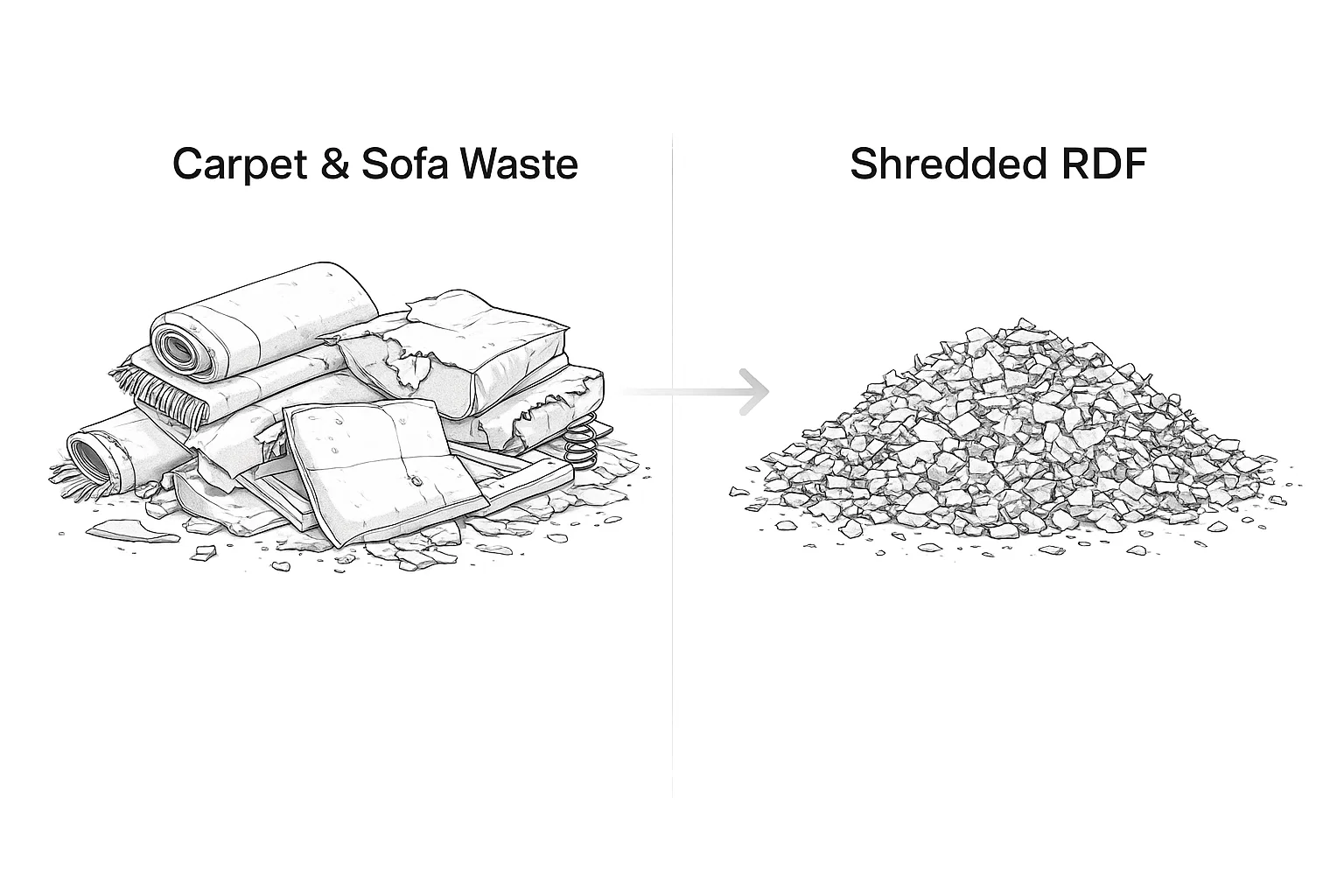
In the waste recycling industry, carpets and upholstery are notoriously difficult to process. They are the materials that test the limits of machinery.
If you manage a recycling facility, you have likely faced this scenario: a general-purpose shredder is running at full speed, only to come to a grinding halt because a roll of old carpet has wrapped itself tightly around the main shaft. Your team then has to spend hours manually cutting the material free. This downtime isn’t just a financial loss; it is a major safety hazard.
올바른 것을 선택하다 Industrial Textile Shredders for Carpet and Upholstery Waste isn’t just about raw horsepower. It is about selecting blade geometry and rotor designs engineered to handle materials that are “soft” yet incredibly strong. At Energycle, we understand that processing these complex composites requires a specific engineering approach.
Why Are Carpets and Upholstery So Hard to Shred?
To solve the problem, you first need to understand the material behavior. Carpets and soft furniture aren’t single materials; they are complex hybrids that create a “perfect storm” for standard machinery:
- Extreme Tensile Strength: Carpets are often woven from nylon or polypropylene fibers designed specifically to resist tearing. If the cutting gap on a shredder is too wide, these fibers will simply slip through and wrap around the rotor.
- Abrasive Backing: Carpet tiles and broadloom often feature heavy latex, PVC, or bitumen backings. These contain calcium carbonate fillers that act like sandpaper, wearing down standard steel blades rapidly.
- Heat Sensitivity: Many synthetic textiles have low melting points. When a dull blade rubs against the fabric instead of cutting it, friction generates heat. This causes the plastic to melt and fuse to the machine, leading to a complete blockage.
The Solution: Why Single-Shaft Technology Wins
For these materials, a standard twin-shaft shear shredder often struggles to control output size and is prone to wrapping. Based on field experience, a high-torque 단일 샤프트 분쇄기 equipped with a hydraulic pusher is the superior choice.
We specifically recommend utilizing a dedicated textile waste single-shaft shredder. Unlike gravity-fed systems, this equipment uses a hydraulic ram to force the fluffy carpet or bulky sofa foam against the spinning rotor, ensuring that every rotation results in a cut, not a slip.
Key Engineering Features That Matter
- Zero-Gap Cutting: For textiles, the gap between the rotating knife and the stationary counter-knife must be precise (often around 0.5mm). This creates a “scissor-like” action that shears the fiber cleanly rather than tearing it.
- Anti-Tangle Rotor Design: Our rotors are designed with specific knife arrangements and protective cover plates at the shaft ends. This prevents fibers from migrating into the bearings—a common killer of recycling equipment.
- Screen-Controlled Output: Unlike twin-shaft machines, a single-shaft shredder holds the material inside the chamber until it is small enough to pass through a screen (e.g., 40mm). This guarantees a uniform size suitable for downstream processing.
From Waste to Energy: Unlocking Hidden Value
Investing in high-performance Industrial Textile Shredders for Carpet and Upholstery Waste is about more than just volume reduction; it is about creating a sellable product.
Processed carpet and textile scraps possess a very high calorific value, making them an ideal feedstock for Refuse Derived Fuel (RDF) or Solid Recovered Fuel (SRF). According to data from the Confederation of European Waste-to-Energy Plants (CEWEP), properly treated textile waste can offer energy yields comparable to brown coal.
By converting bulky, dirty carpets into uniform, high-density RDF fluff, you transform a material that costs money to landfill into a fuel product sought after by cement kilns and power plants. This shift can fundamentally change the economics of your operation.
Maintenance: Keeping Your Shredder Running
Owning a great machine is step one; maintaining it ensures your ROI.
- Monitor the Amperage: Modern control systems watch the motor load. If the shredder hits an unbreakable object (like a hidden metal bracket in a sofa), the system should auto-reverse to protect the drive train.
- Rotate, Don’t Just Replace: Because carpet backing is abrasive, knife edges wear down. Our designs use square, rotatable knives. When one edge dulls, you simply turn it 90 degrees to use a fresh edge, effectively quadrupling the life of your consumables.
At Energycle, we don’t just supply iron; we help you engineer a workflow that handles your specific waste stream. Don’t let tough textile waste bottle-neck your production line. Choose the right tool for the job, and turn that pile of carpet into a valuable energy resource.
