


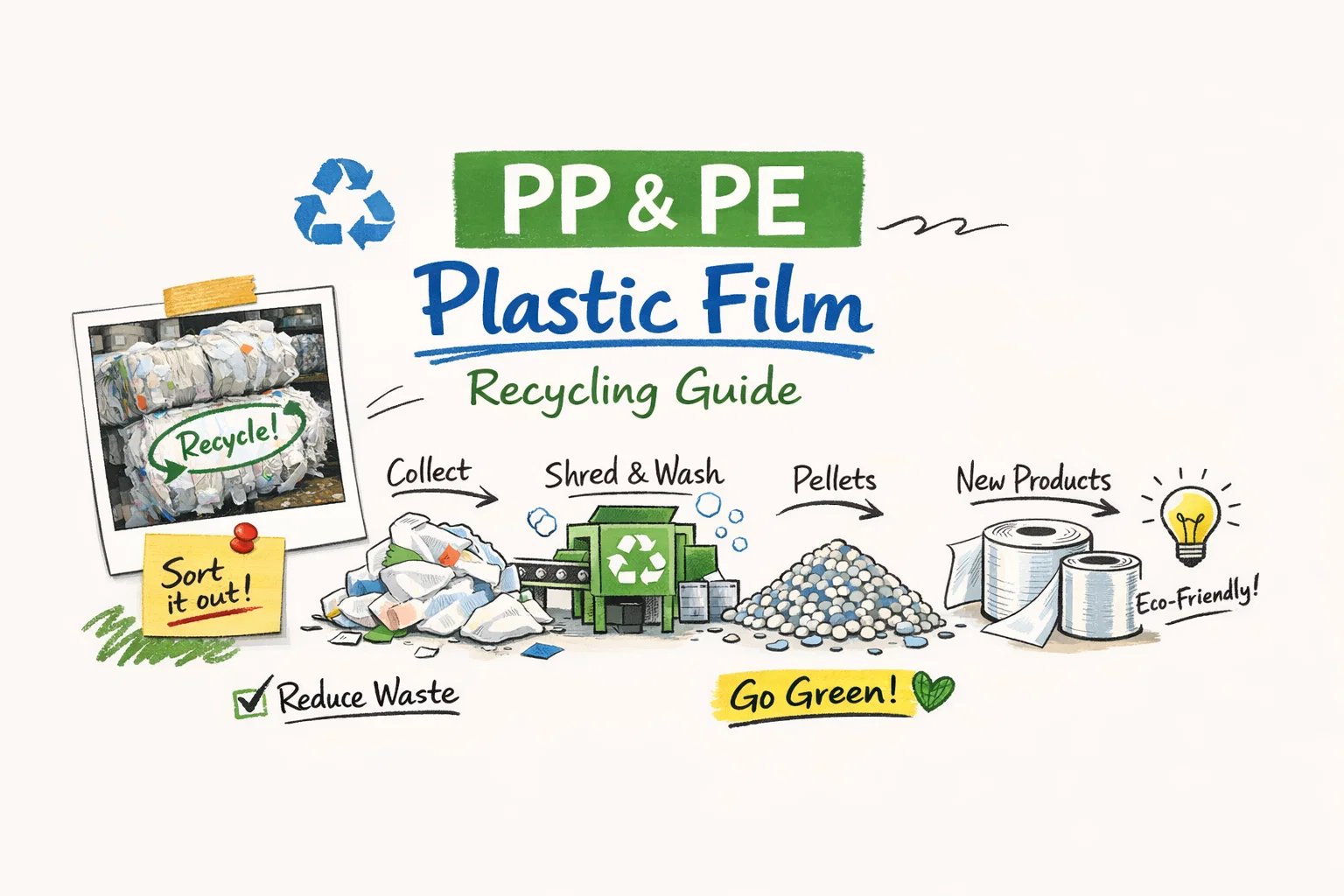
Plastic film made from PP (polypropylene) i PE (polyethylene) is one of the most difficult plastic waste streams to recycle efficiently. Although widely used in packaging, agriculture, and industrial applications, plastic film presents unique processing challenges that require a well-designed recycling approach.
Ovaj vodič objašnjava how PP/PE plastic film recycling works, the most common technical challenges, i how shredding and densifying fit into a modern recycling process, helping recycling operators, engineers, and investors make informed decisions before selecting equipment.
Why Is PP & PE Plastic Film Recycling So Challenging?
Compared with rigid plastics, plastic film behaves very differently during processing. The main difficulties include:
- Low bulk density
Film occupies large volumes, making storage and feeding inefficient. - Severe tangling and wrapping
Film easily wraps around shafts, rotors, and conveyors, causing blockages and downtime. - High moisture retention
After washing, thin film holds water on its surface, increasing drying difficulty. - Unstable feeding to downstream machines
Loose film cannot be fed consistently into extruders or pelletizers.
Because of these characteristics, plastic film recycling requires more than just basic shredding—it needs a process-oriented system design.
Standard PP & PE Plastic Film Recycling Process
Most industrial recycling plants follow a structured process to handle plastic film efficiently:
Sorting → Shredding → Washing → Dewatering → Densifying → Reprocessing
Each stage plays a specific role in stabilizing material flow and improving output quality.
The Role of Shredding in Plastic Film Recycling
Shredding is the first critical step in film size reduction. Unlike rigid plastics, film cannot be processed efficiently with standard crushers.
A properly designed plastic film shredder helps to:
- Reduce film into manageable pieces
- Prevent wrapping and bridging
- Enable uniform washing and dewatering
- Stabilize material flow between process stages
However, shredding alone does not solve the core problems of low density and unstable feeding.
Why Densifying Is Essential for Plastic Film
Densifying is the step that transforms loose, fluffy film into compact, high-density material.
A densifier typically uses controlled heat and mechanical force to:
- Increase bulk density dramatically
- Remove residual moisture
- Convert film flakes into agglomerated material
- Ensure consistent feeding into extruders or pelletizers
Without densifying, many recycling lines struggle with feeding instability, poor pellet quality, and reduced throughput.
Shredding vs. Densifying: Different Functions, One Workflow
| Proces | Primarna funkcija | Problem Solved |
|---|---|---|
| Usitnjavanje | Smanjenje veličine | Tangling, blockages |
| Densifying | Density increase | Feeding instability, moisture |
In practical recycling operations, shredding and densifying are complementary, not interchangeable. Together, they create a stable and efficient workflow for plastic film recycling.
For facilities that require continuous processing and stable output, an PP/PE plastic film shredding and densifying line can significantly improve operational efficiency.
You can see a typical system configuration here:
When Do You Need a Shredding and Densifying Line?
Not every recycling operation requires a full integrated line. The decision depends on material conditions and production goals.
You likely need shredding + densifying if:
- You process post-consumer PP/PE film with high moisture
- Your output feeds directly into pelletizing or extrusion
- You require continuous, automated operation
- You want to reduce storage volume and improve logistics
You may not need it if:
- Processing volumes are very small
- Film is pre-compacted or pre-agglomerated
- Material is used for low-demand applications
Common Mistakes in Plastic Film Recycling System Selection
Many recycling plants experience performance issues due to incorrect assumptions during equipment selection:
- Choosing rigid plastic crushers for film materials
- Focusing only on throughput, not moisture control
- Ignoring the role of densifying before pelletizing
- Underestimating film wrapping and feeding challenges
Avoiding these mistakes at the planning stage can save significant cost and downtime later.
From Process Understanding to Equipment Selection
Successful plastic film recycling starts with understanding the material, not buying machines first.
Before selecting equipment, clearly define:
- Film type (PP, LDPE, HDPE, mixed film)
- Contamination level and moisture content
- Target throughput and final application
- Degree of automation required
Once these factors are clear, selecting a suitable shredding and densifying solution becomes a logical next step rather than a guess.
Zaključak
PP and PE plastic film recycling is technically demanding, but highly achievable with the right process design.
Kombiniranjem effective shredding, proper washing, i controlled densifying, recyclers can transform problematic film waste into valuable raw material for reuse.
This guide provides the technical foundation needed to evaluate recycling solutions objectively—before moving on to detailed equipment specifications and system configurations.
