

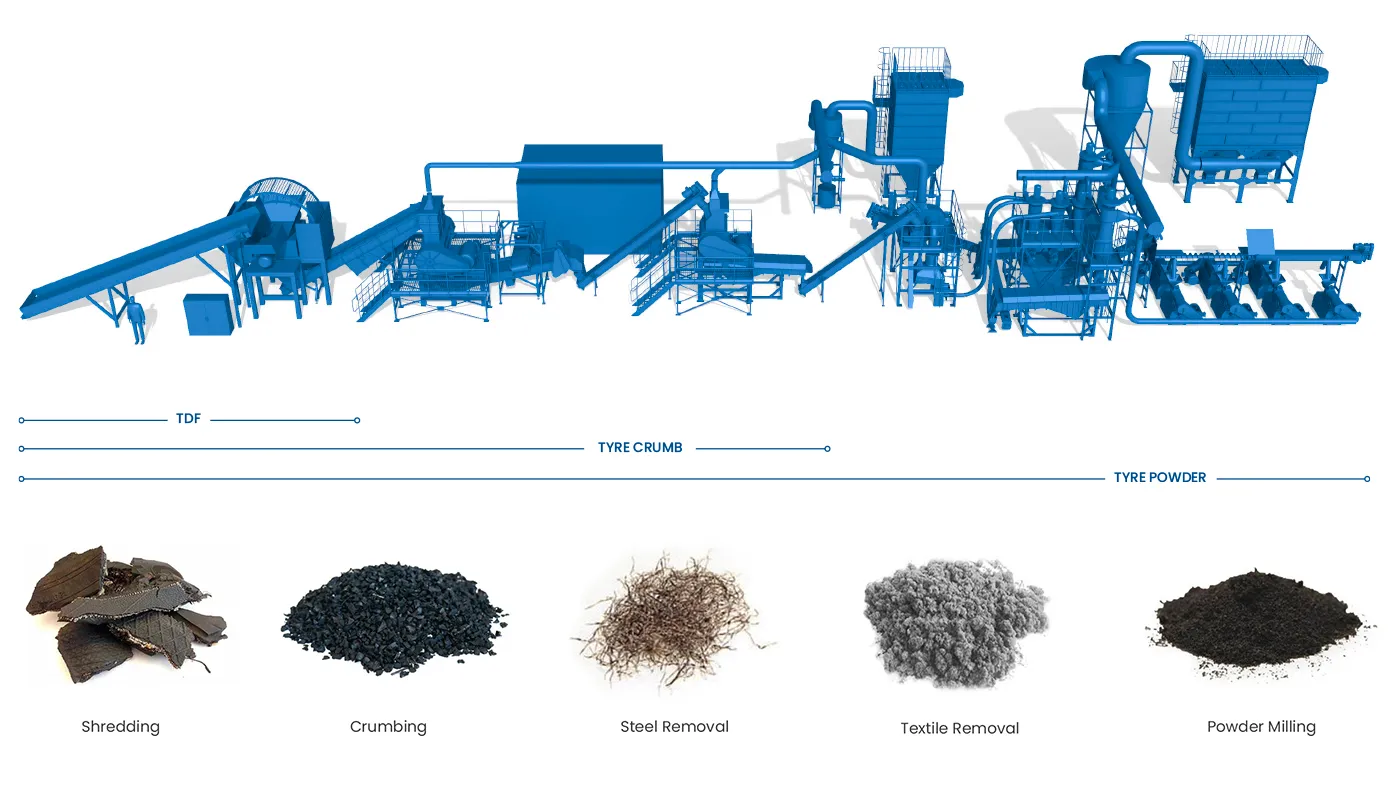
A stroj za recikliranje guma transforms end-of-life tires — passenger car, truck, OTR (off-the-road), and industrial — into reusable materials: crumb rubber, rubber powder, steel wire, and fiber. With an estimated 1.5 billion waste tires generated globally each year and landfill bans tightening across North America, Europe, and Asia, tire recycling is both an environmental necessity and a profitable business. This guide covers every machine type in the tire recycling process, real specifications, output products and their markets, and a step-by-step framework for building or upgrading a tire recycling line.
What Is a Tire Recycling Machine?
A tire recycling machine is any equipment used to break down waste tires into reusable raw materials. No single machine processes a whole tire into finished product — tire recycling requires a sequence of specialized machines, each handling a specific stage: debeading (removing steel bead wire), shredding (primary size reduction), granulating (secondary size reduction), steel separation, fiber separation, and grinding (fine powder production). The term “tire recycling machine” typically refers to the complete line or to the primary shredder that anchors the system.
The Tire Recycling Process: Step by Step
Understanding the complete process helps you specify the right equipment for each stage. Here is the standard mechanical tire recycling process used in ambient-temperature processing:
Stage 1: Collection and Inspection
Waste tires arrive from tire dealers, auto shops, fleet operators, and municipal collection points. Inspect for contamination (rims still mounted, excessive mud, chemical contamination) and sort by type: passenger car tires (PCT), truck and bus tires (TBT), and OTR tires each require different processing parameters due to size and steel content differences.
Stage 2: Debeading
A tire debeading machine extracts the steel bead wire from each tire sidewall. This step is critical: bead wire left in the tire damages shredder blades and contaminates the rubber output. A single-hook debeader processes 60–120 passenger tires per hour. Removing the bead wire also makes subsequent shredding 30–40% more energy-efficient because the shredder doesn’t need to cut through hardened steel cable.
Stage 3: Sidewall Cutting (Optional)
For large truck and OTR tires, a tire cutting machine separates sidewalls from the tread. This reduces the size of material entering the primary shredder and allows sidewalls and treads to be processed separately or sold as-is for specific applications (e.g., sidewall rubber for conveyor belt liners). Learn more about why sidewall cutting matters in tire recycling.
Stage 4: Primary Shredding
The sjeckalica guma is the core machine in any tire recycling line. A low-speed, high-torque drobilica s dvostrukom osovinom tears whole tires (or pre-cut sections) into rough chips of 50–100 mm. Primary shredders for tire recycling typically use 30–110 kW motors and process 500–3,000 kg/h depending on tire type and machine size. The output — called tire-derived fuel (TDF) chips at this stage — already has commercial value as an alternative fuel.
Stage 5: Secondary Shredding / Granulation
A granulator guma reduces the 50–100 mm chips to 5–20 mm granules. At this stage, steel wire liberates from the rubber matrix and can be removed by magnetic separators. Textile fiber also separates and is removed by air classifiers or vibrating screens. The output is a mix of rubber granules, loose steel wire, and fiber. See our detailed guide on waste tire granulators and output specifications.
Stage 6: Steel and Fiber Separation
Overband magnetic separators and magnetic drums remove steel wire fragments from the rubber granules — typically achieving 99%+ steel removal. Air classifiers and vibrating screens remove textile fiber (nylon, polyester cord). The separated steel sells as scrap metal ($100–$200/ton); fiber can be used as insulation or fuel supplement.
Stage 7: Fine Grinding (Optional)
For higher-value applications, a gumena mljevenica/mlinar dalje smanjuje granule na finu gumušku prahu (40–80 mreža / 0.2–0.4 mm). Fina gumuška prahu nudi visoke cijene ($300–$600/ton) za upotrebu u izrađivanju gumenih proizvoda, modifikaciji asfaltu i sportskim površinama. Kriojeničko mljevenje (hladnjenje gume s tekućim azotom prije mljevenja) proizvodi još finiju prahu, ali povećava trošak obrade za $50–$100/ton.
Tipovi strojeva za recikliranje guma
Here is every machine type used in a tire recycling line, with specifications from Energycle’s manufacturing range:
| Stroj | Funkcija | Propusnost | Snaga motora | Izlazna veličina |
|---|---|---|---|---|
| Uređaj za uklanjanje guma | Izvadi žicu iz bočne strane guma | 60–120 guma/s | 7.5–15 kW | Cijela guma (žica izvađena) |
| Gumena rezica | Rezaj bočne strane srednjeg dijela | 40–80 guma/s | 5.5–11 kW | Bočne trake + trake |
| Primarni mljevenik (Dvojsjemeni) | Mljevi cijelu/rezanu gumu na čipove | 500–3,000 kg/s | 30–110 kW | 50–100 mm čipovi |
| Granulator guma | Smanji čipove na granule, oslobodi žicu | 300–2.000 kg/h | 22–75 kW | 5–20 mm granule |
| Magnetski separator | Ukloni željeznu žicu iz granula | Podnosi brzinu linije | 1.5–4 kW | Čiste granule + željeznu žicu |
| Zračni klasifikator / Fibrski separator | Ukloni tekstilnu fibru iz granula | Podnosi brzinu linije | 3–7.5 kW | Čiste granule + fibru |
| Gumeni pulverizator | Mljevi granule na finu prahu | 200–800 kg/h | 37–75 kW | 40–80 mreža prашaka |
Izvođeni proizvodi i vrijednost tržišta
Linija za recikliranje guma proizvodi više prihoda. Razumijevanje izvođenih proizvoda i njihovih tržišta pomaže vam odlučiti koliko daleko trebate procesirati i u koje faze opreme trebate uložiti:
| Izlazni proizvod | Veličina | Tržišna cijena | Prijave |
|---|---|---|---|
| Čipovi TDF | 50–100 mm | $30–$80/ton | Gipsana pećina gorivo, električna stanica gorivo (zamjenjuje ugljen) |
| Kvrgasta guma (gruba) | 5–20 mm | $120–$250/ton | Površine igrališta, sportski stazi, terenski mulč |
| Kvrgasta guma (finija) | 1–5 mm | $200–$400/tona | Asfalt guma (cestovno asfaltiranje), oblikovani proizvodi, sportska igrališta |
| Ruberinska prah | 40–80 mreža | $300–$600/ton | Dodatak gume, vodootpornost, automobilske dijelove |
| Željezni vod | — | $100–$200/ton | Recikliranje staličnog otpada (grobne pećine, mini-mjeline) |
| Tekstilna vlakna | — | $20–$50/ton | Izolacija, gorivo dodatak, geotekstilni punač |
Uobičajena putnička guma teži 8–10 kg i sadrži oko 70% gume, 15% stala i 15% tekstilne vlakne po težini. Procesiranje 1.000 guma proizvodi oko 7 tona gume, 1,5 tona stala i 1,5 tona vlakana.
TDF vs. TDA vs. Kvrgasta guma: usporedba krajnjeg proizvoda
Tri glavna kategorija proizvoda iz recikliranja guma službe jako različitim tržištima. Dubina procesiranja određuje koje proizvode možete prodati:
| Proizvod | Potrebno procesiranje | Inversión Inicial | Prihod/ton | Tržišna potražnja |
|---|---|---|---|---|
| TDF (Gorivo iz gume) | Samo rezanje (1 faza) | Nizak ($80K–$200K) | $30–$80 | Stabilan — cementne pećnice, elektrane |
| TDA (agregat iz odreznih guma) | Rezanje + filtriranje | Nizak-Srednji ($100K–$250K) | $50–$120 | Rastući — civilno inžinjerstvo, ispuštanje, odvodnja |
| %% | Rezanje + granulacija + odvoj | Srednji-Vисок ($200K–$600K) | $120–$600 | Snažan — sportske površine, asfalt, oblikovane proizvode |
Naša preporuka za nove operacije: Počnite s proizvodnjom TDF (najniža uložena kapitala, trenutni prihod), zatim dodajte opremu za granulaciju i odvoj po prilikvom dozvoljenom korištenju novca. Režnik kupljen za proizvodnju TDF postaje prvi stupanj crumb gume — nema izgubljenog ulaganja. Za detaljnu analizu tržišta pogledajte naš vodič o tržištu recikliranja guma: TDF vs. TDA vs. CRM.
Automobilski auto vs. kamion vs. OTR gume
Različite vrste guma zahtijevaju različite veličine opreme i pristupe procesiranja:
| Parametar | Automobilski gume | Kamionske/autobusne gume | OTR gume |
|---|---|---|---|
| Težina | 8–10 kg | 40–70 kg | 200–4,000 kg |
| Dijametar | 550–700 mm | 900–1,200 mm | 1,800–4,000 mm |
| Sadržaj čelika | 10–15% | 15–25% | 10–20% |
| 胎圈拆除工艺 | Standardni jednostavni hak | Teški debeader | Hidraulični OTR debeader |
| Preseka | Izborno | Preporučeno | Zahtjevani |
| Veličina granulatora | 30–55 kW | 55–90 kW | 90–200+ kW |
| Proizvodnja (granulator) | 500–2,000 kg/h | 800–2,500 kg/h | Prilagođeno po projektu |
Kompletne postavke cijeline za recikliranje guma
Osnovna cijelina TDF (Najniža ulaganje)
Debeader → primarni granulator → magnetski separator → presjek. Izlaz: 50–100 mm TDF čipovi + željezni vod. Proizvodnja: 500–2,000 kg/h. Ulaganje: $80,000–$200,000. Vraćanje ulaganja: 12–24 mjeseci pri 8 sati dnevno operacije.
Cijelina za pravljenje crumb guma (Srednje ulaganje)
Debeader → primarni granulator → granulator → magnetski separator → zračni klasifikator → vibracijski ekran. Izlaz: 1–5 mm čista crumb guma + željezo + vlakno. Proizvodnja: 300–1,500 kg/h završenog crumb guma. Ulaganje: $200,000–$600,000. Vraćanje ulaganja: 8–18 mjeseci. Gledajte naš isprobni pokret cijeline za recikliranje guma.
Cijelina za pravljenje finog gume (Najviše vrijednosti)
Cijelina za pravljenje crumb gume + guma mljevenica + fini presjek + pakiranje. Izlaz: 40–80 mreža gume mljevenica. Proizvodnja: 200–800 kg/h gume mljevenica. Ulaganje: $400,000–$1,000,000+. Vraćanje ulaganja: 12–24 mjeseci. Najviše prihoda po tuni ali zahtjeva veći kapital i više stručnih operatera.
5-stupanjski izboriški okvir
Korak 1: Definirajte Vašu početnu robu
Automobilske gume, kamionske gume ili OTR gume? Mješovite ili jednostavne vrste? Očekivana dnevna/mjesečna količina u tona? Tip gume određuje svaku specifikaciju stroja u cijelini — 500 kg/h linija za automobilske gume je potpuno drugačija postavka od 500 kg/h kamionske gume linije.
Korak 2: Izaberite Vašu krajnju proizvod
Čipovi TDF (najjednostavniji), crumb guma (najbolji iznos ulaganja protiv prihoda), ili fini gume mljevenica (najviše vrijednosti, najviše ulaganja)? Istražite lokalnu potražnju tržišta — crumb guma linija je beskorisna ako ne postoje kupci u ekonomskoj dostupnosti. Identificirajte barem 2–3 potencijalna kupca prije ulaganja.
Korak 3: Uređajte Vašu liniju
Izračunajte potrebnu proizvodnju iz Vaše količine guma. Postrojenje koji procesira 50 tona dnevno automobilskih guma treba oko 3,000–4,000 kg/h kapaciteta primarnog graniranja (računajući 8 sati smjene i 80% dostupnosti). Uvijek uređajte opremu za vrhunsku kapacitet plus 20% marže.
Korak 4: Planirajte Vašu postavku
Cijelina za pravljenje crumb gume zahtjeva 500–2,000 m² pokrivenog prostora plus vanjski prostor za pohranu guma. Planirajte tok materijala: primanje guma → debodiranje → graniranje → odvajanje → presjek → pohranja proizvoda. Uključite prostor za pristup održavanju, rezervne dijelove i buduću ekspanziju.
Korak 5: Izračunajte ROI
Prihod = (tonnage gume × cijena gume) + (tonnage željeza × cijena željeza) + naknada za otpuštanje (ako se naplaćuje za prihvat gume). Troškovi = deprecijacija opreme + struja + rad + održavanje + najam. Većina operacija za recikliranje guma naplaćuje $1–$3 po gumi kao naknadu za otpuštanje/prihvat — to sam po sebi može pokriti 30–50% troškova operacije. 1,000 kg/h crumb guma linija tipično generira $300,000–$600,000 godišnji bruto prihod s 40–60% maržom.
Osnovne manteniranske radnje
Oprema za recikliranje guma radi u teškim uvjetima — abrazivna guma, ugrađeni željezni vod i visoki moment opterećenja. Diskiplinirani program održavanja je neosporno:
- Dnevno: Inspect shredder blades for chipping, clear jammed material, check oil levels on hydraulic systems
- Tjedni: Verify magnetic separator strength, check conveyor belt tension and alignment, inspect granulator screens for wear holes
- Mjesečno: Lubricate all bearings, inspect electrical connections and motor temperatures, check shredder shaft seals
- Every 500–1,000 hours: Rotate or replace shredder blades (tire processing wears blades 2–3× faster than standard plastic shredding due to steel wire contact)
- Godišnje: Full machine inspection, replace worn screens and liners, check gearbox oil, verify safety systems
Blade costs are the largest maintenance expense — budget $5,000–$15,000 annually for a mid-size line. Using wear-resistant blade materials (D2, DC53, or hardfacing) extends blade life 40–80%. See our shredder blade metallurgy guide.
Početak s Energycle
Energycle manufactures complete stroj za recikliranje guma lines — from debeading through shredding, granulation, separation, and grinding. With installations across Africa, Southeast Asia, the Middle East, and South America, we provide:
- Free project consultation — tell us your tire supply, target product, and budget; we design the optimal line configuration
- Turnkey line supply — all machines, conveyors, electrical panels, and controls from a single source
- Instalacija i puštanje u rad — our engineers install on-site and train your operators
- Spare parts and blade supply — fast delivery of wear parts to minimize downtime
Kontaktirajte našu inžinjerijsku tim with your tire type, daily volume, and target end product — we will design a line and provide a complete quotation within one week.
Često postavljana pitanja
Koliko košta stroj za recikliranje guma?
A basic TDF shredding line (debeader + shredder + magnetic separator) costs $80,000–$200,000. A complete crumb rubber line costs $200,000–$600,000. A fine rubber powder line with pulverizer costs $400,000–$1,000,000+. Individual machines: tire shredders $30,000–$150,000, debeaders $8,000–$25,000, granulators $20,000–$80,000. Payback periods range from 8–24 months depending on configuration and local market prices.
What is the tire recycling process?
The standard mechanical tire recycling process has 6–7 stages: (1) collection and sorting, (2) debeading (steel bead wire removal), (3) optional sidewall cutting, (4) primary shredding to 50–100 mm chips, (5) granulation to 5–20 mm, (6) magnetic and air separation to remove steel wire and fiber, and (7) optional fine grinding to 40–80 mesh powder. Each stage adds value to the output product.
Is tire recycling profitable?
Yes — tire recycling generates revenue from multiple streams: crumb rubber ($120–$600/ton depending on fineness), steel wire ($100–$200/ton), tipping fees ($1–$3 per tire accepted), and fiber ($20–$50/ton). A mid-size crumb rubber operation processing 1,000 kg/h typically generates $300,000–$600,000 annual gross revenue with 40–60% profit margins after operating costs.
What size shredder do I need for tire recycling?
For passenger car tires: a 30–55 kW double-shaft shredder handles 500–2,000 kg/h. For truck tires: 55–90 kW for 800–2,500 kg/h. For OTR tires: 90–200+ kW, custom-engineered. Always size for peak volume plus 20% margin, and account for 80% uptime (maintenance, shift changes, feeding gaps).
What is the difference between TDF, TDA, and crumb rubber?
TDF (tire-derived fuel) is coarsely shredded tire chips (50–100 mm) burned as alternative fuel in cement kilns. TDA (tire-derived aggregate) is shredded tire pieces used as lightweight fill in civil engineering projects. Crumb rubber is finely granulated rubber (1–5 mm) used in sports surfaces, asphalt modification, and molded products. Each requires progressively more processing equipment but commands higher prices.
Can I recycle truck tires and car tires on the same line?
Yes, but the line must be sized for the larger tire. A shredder designed for truck tires easily handles passenger car tires, but not vice versa. The main difference is debeading — truck tires need a heavy-duty debeader. Feed rate drops when processing larger tires because each tire takes longer to shred. Many operators process car tires and truck tires in separate batches.
How long do tire shredder blades last?
Tire shredder blades last 500–1,000 operating hours before needing rotation or replacement — roughly 2–4 months at 8 hours/day. Steel bead wire in tires causes 2–3× faster blade wear compared to standard plastic shredding. D2 and DC53 tool steel blades offer the best cost-to-life ratio; tungsten carbide-tipped blades last longer but cost 4–6× more upfront.
What permits do I need for tire recycling?
Requirements vary by jurisdiction but typically include: waste processing/recycling license, environmental permit (air emissions, noise, water discharge), fire safety clearance (tire storage is a significant fire risk), and business operating permits. Some regions also require tire storage limits (maximum number of tires on-site). Consult your local environmental agency before investing in equipment.
Povezane resurse
- Guma za recikliranje — Nabava proizvoda
- Uništavač guma
- Tržišta recikliranja guma: TDF vs TDA vs CRM specifikacije
- Gomilice za otpadne gume: Kako djeluju
- Tire Granulators: Steel Wire Separation & Crumb Rubber Specs
- Stroj za skidanje rubova gume s jednom kukom
- Stroj za rezanje otpadnih guma
- Mlin za usitnjavanje gume za recikliranje
- Zašto se izreže bočni zid tijela gume tijekom recikliranja?
- Probni rad linije za recikliranje otpadnih guma
- Double Shaft Shredder for Plastic, Metal & Tire
- Vodič za metalurgiju noža mljevača
- Plastična reciklačka mašina: Kompletni vodič
