

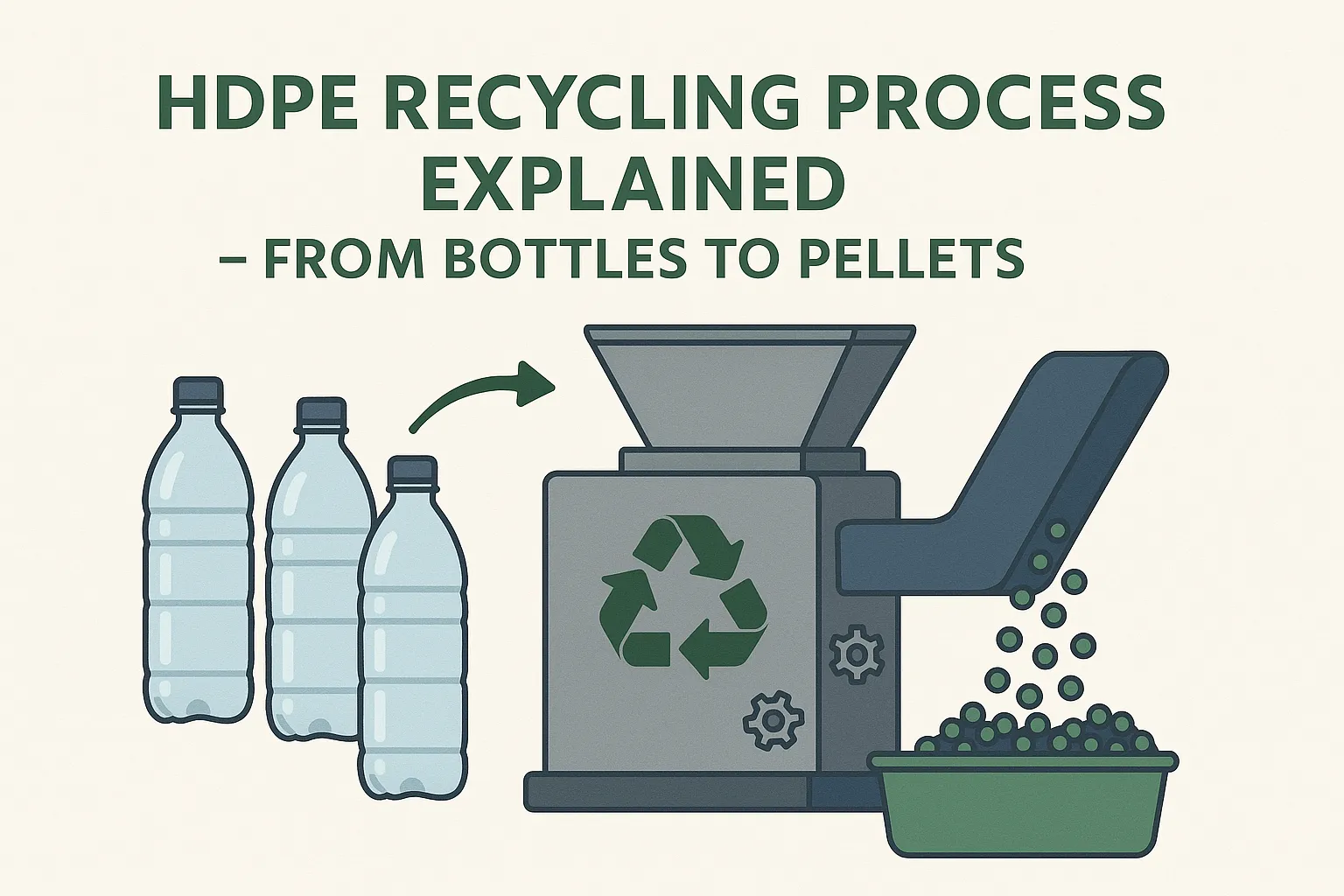
High-Density Polyethylene (HDPE, resin code #2) is one of the most recycled plastics worldwide. Found in milk jugs, detergent bottles, pipes, and crates, HDPE’s high melt strength and low moisture absorption make it ideal for closed-loop recycling back into pellets. This guide walks through each step of the HDPE recycling process with the equipment specifications that matter at production scale.
HDPE Recycling Process: 8 Steps from Bale to Pellet
1. Sběr a třídění
Post-consumer HDPE (bottles, containers, rigid packaging) is collected from curbside bins, MRFs, and commercial sites. Automated sorting uses near-infrared (NIR) sensors to separate HDPE (RIC #2) from other resins. Pre-sorted HDPE bales typically trade at $200–$400/ton depending on color and contamination level.
2. Odstranění koulí a počáteční kontrola
Compressed bales are opened by a debalovací stroj that cuts strapping wire and loosens material for conveyor feeding. Operators perform visual QC to remove non-HDPE contaminants (metals, paper, film bags). A bubnové síto can remove dirt, sand, and small debris at this stage.
3. Size Reduction (Shredding)
HDPE bottles and rigid items are reduced to 10–20 mm flakes by a jednohřídelový drtič with screen. For thick-wall HDPE (pipes, crates), a drtič plastů may be used first for primary size reduction. Consistent flake size is critical for uniform washing and extrusion downstream.
4. Washing and Cleaning
This is the most critical step for pellet quality. The washing sequence typically includes:
- Pre-wash: A třecí šroubová podložka removes loose dirt and labels at the feed stage.
- Hot wash (optional): A nepřetržitá horká pračka at 60–85°C dissolves adhesives, oils, and residual product (critical for food-grade applications).
- High-speed friction wash: A vysokorychlostní třecí podložka spinning at 1,000+ RPM scrubs contaminants off flake surfaces.
- Oddělení dřezu a plováku: HDPE (density ~0.95 g/cm³) floats while heavier contaminants like PVC, PET, and dirt sink. A separační nádrž s plovákem achieves 99%+ purity when properly configured.
- Final rinse: Clean water rinse removes any remaining detergent or fine particles.
5. Dewatering and Drying
Washed HDPE flakes must reach <1% moisture before pelletizing. A two-stage drying process is standard:
- Mechanické odvodňování: A odstředivá sušička spins flakes at high speed to remove surface water (reduces moisture from ~30% to ~5%).
- Tepelné sušení: A termální sušička nebo pipeline hot air system brings moisture below 1% for optimal extrusion.
6. Extrusion and Pelletizing
Dried HDPE flakes are fed into an extruder that melts, degasses, and homogenizes the material. A měnič obrazovky filters out remaining micro-contaminants. The molten HDPE is then pelletized using one of two methods:
- Strand pelletizing: Molten strands are cooled in a water bath and cut into cylindrical pellets. Simple and cost-effective for most HDPE applications.
- Water ring pelletizing: Die-face cutting produces uniform round pellets. Preferred for high-throughput lines.
7. Kontrola a testování kvality
Every batch of HDPE pellets must pass quality checks before shipment:
- Melt Flow Index (MFI): Determines processability; typical rHDPE ranges 0.3–8 g/10min depending on application.
- Density test: Confirms material grade (0.941–0.965 g/cm³ for HDPE).
- Moisture content: Must be <0.1% for injection molding applications.
- Color and contamination: Visual inspection + ash content testing for filler levels.
- Tensile strength: Verifies mechanical properties meet end-use specifications.
8. Balení a distribuce
Qualified HDPE pellets are packaged in 25 kg bags or 1-ton bulk bags (FIBCs). Recycled HDPE pellets are used in packaging, pipe manufacturing, automotive parts, construction materials, and consumer goods. Current market price for clean, natural-color rHDPE pellets ranges $600–$1,000/ton.
HDPE Recycling Line Configuration
A typical HDPE bottle-to-pellet recycling line includes the following equipment in sequence:
Debaler → Trommel → Shredder → Friction Washer → Hot Washer → Friction Washer → Sink-Float Tank → Centrifugal Dryer → Thermal Dryer → Extruder + Pelletizer
Line capacity ranges from 500 kg/h to 3,000 kg/h depending on configuration. For a complete system with pricing, see our HDPE bottle recycling line page or request a quote through our Ceník strojů pro rok 2026.
HDPE vs Other Plastics: Why HDPE Is Easier to Recycle
HDPE has several properties that make it one of the most recycling-friendly plastics:
- Low moisture absorption: Unlike nylon or PET, HDPE doesn’t require extensive pre-drying before extrusion.
- Wide processing window: Melts at 130–135°C with degradation above 300°C — a large safety margin.
- Density separation: At 0.95 g/cm³, HDPE floats in water, making sink-float separation from PET (1.38) and PVC (1.40) highly effective.
- Minimal quality loss: HDPE can be recycled 10+ times with only gradual property degradation, making it suitable for closed-loop applications.
- Strong end-market demand: rHDPE is accepted in pipe, film, and blow molding applications with growing regulatory mandates for recycled content.
Investment and ROI
A complete HDPE recycling line (500 kg/h) typically costs $80,000–$150,000 for the washing line and $30,000–$60,000 for the pelletizing line. Key factors for ROI:
- Feedstock cost: $200–$400/ton for baled HDPE bottles
- Output value: $600–$1,000/ton for clean rHDPE pellets
- Gross margin: $200–$600/ton before operating costs
- Payback period: Typically 12–24 months at 500+ kg/h utilization
For a detailed cost-benefit analysis, see our Průvodce náklady na zahájení výroby recyklace plastů.
Často kladené otázky
What is the HDPE recycling process?
The HDPE recycling process converts used HDPE plastic (#2) back into reusable pellets through 8 steps: collection, debaling, shredding, washing, sink-float separation, drying, extrusion/pelletizing, and quality testing. The entire process takes HDPE from post-consumer waste to production-ready raw material.
Can HDPE be recycled into food-grade material?
Yes, but it requires an FDA-compliant or EFSA-compliant process with hot washing (85°C+), super-clean decontamination, and documented challenge testing. Standard mechanical recycling produces industrial-grade rHDPE suitable for pipes, containers, and non-food packaging.
What equipment do I need to recycle HDPE?
A complete HDPE recycling line needs: a debaler, drtič, třecí podložka, plovoucí nádrž s ponorem, odstředivá sušička, thermal dryer, and peletizér. Optional: hot washer for food-contact applications, DAF system for water treatment.
How much does it cost to start an HDPE recycling business?
A 500 kg/h HDPE recycling line (washing + pelletizing) costs approximately $110,000–$210,000 for equipment. Total startup costs including facility, utilities, and working capital typically range $200,000–$500,000. Payback is usually 12–24 months at steady utilization.
What is the difference between HDPE and LDPE recycling?
HDPE (rigid bottles, pipes) and LDPE (films, bags) use different shredding and washing equipment. HDPE is processed as rigid flakes with sink-float separation. LDPE requires specialized film washing lines with squeeze drying and film squeezers because film material behaves differently in water and tends to wrap around rotating equipment.
