

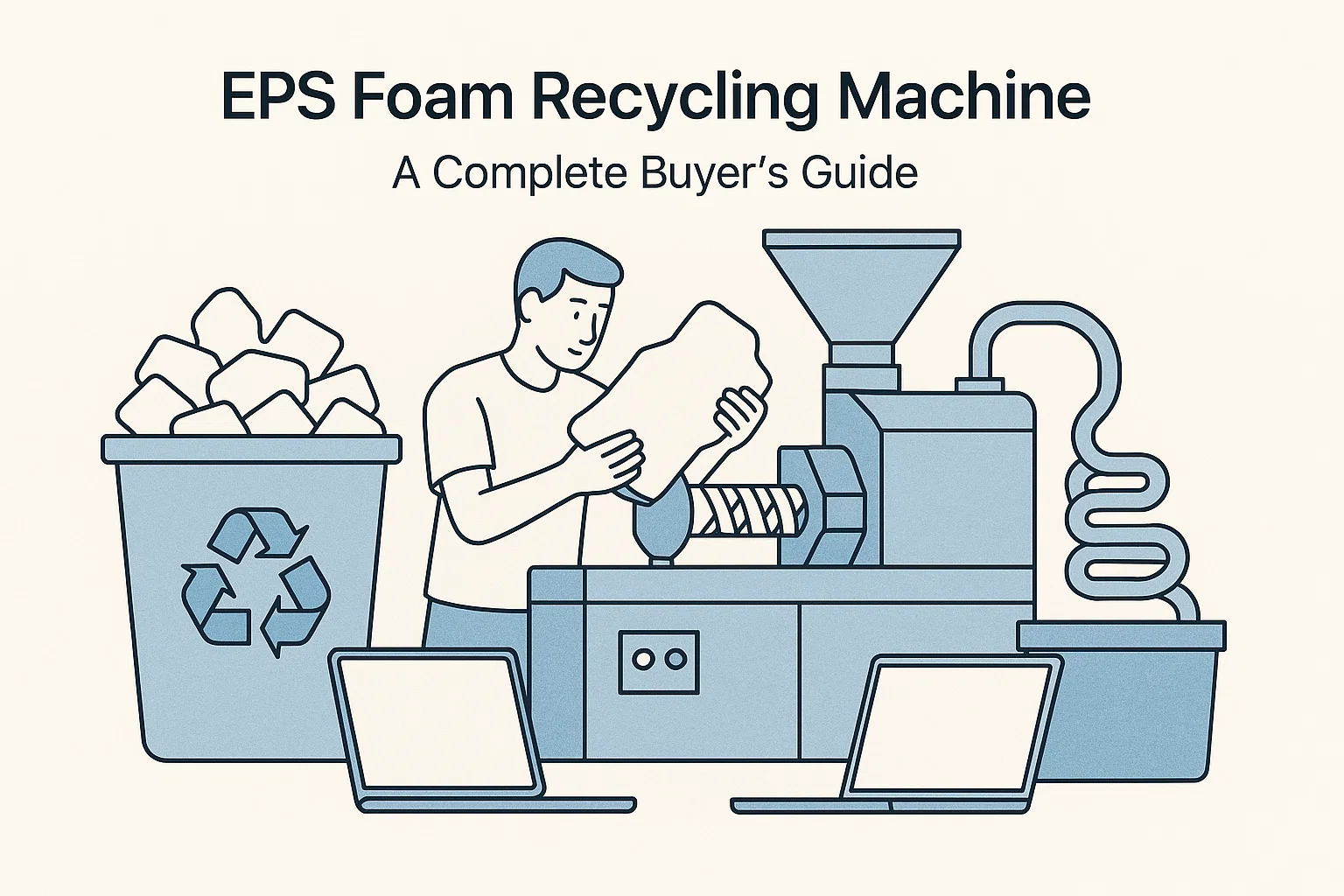
An transformuje 50 kubických metrů volné pěny na jeden kubický metr hustých bloků nebo ingotů, okamžitě získává cenný prostor. compresses or melts expanded polystyrene (EPS) foam — commonly known as Styrofoam — reducing its volume by up to 90:1 and converting waste foam into dense blocks, ingots, or pellets that can be sold as recycled polystyrene feedstock. EPS is 98% air by volume, making it one of the most expensive materials to transport and landfill per unit of actual plastic content. The right recycling machine solves this problem by densifying the foam on-site, turning a disposal cost into a revenue stream. This guide covers every EPS recycling machine type, compares their specifications, and walks you through the selection process.
Autor: Tým inženýrů Energycle | Over 15 years manufacturing EPS recycling equipment, with machines operating at fish markets, packaging plants, retail distribution centers, and municipal recycling facilities across 60+ countries.
What Is an EPS Recycling Machine and Why Do You Need One?
An EPS recycling machine is specialized industrial equipment that reduces the volume of expanded polystyrene foam waste through compression, melting, or pelletizing. EPS foam has an extremely low density — typically 15–30 kg/m³ — meaning a full truckload of loose EPS weighs only 300–600 kg but takes up the entire trailer. Without densification, hauling EPS waste costs $150–400 per tonne in disposal and transport fees.
By compressing EPS on-site, recyclers achieve two economic benefits simultaneously: they eliminate disposal costs and generate revenue from selling the densified material. Compressed EPS blocks sell for $200–400 per tonne, and recycled PS pellets command $500–900 per tonne depending on quality and market conditions. Japan achieves a 94.2% EPS utilization rate, proving that the material is highly recyclable when the right equipment is in place.
Types of EPS Recycling Machines: Complete Comparison
Three distinct machine types handle EPS foam recycling. Each serves a different scale, budget, and end-market requirement.
1. EPS Cold Press Compactor (Hydraulic Compactor)
A chlazený lisovací kompresor uses hydraulic force to compress loose EPS foam at room temperature. No heat is applied — the machine simply squeezes the air out of the foam cells, producing dense blocks at a 50:1 volume reduction ratio.
%% EPS waste is fed into a hopper, a crusher breaks it into smaller pieces, and a hydraulic ram compresses the material into a rectangular block (density 300–400 kg/m³). The block is ejected, strapped, and stacked on a pallet for shipping.
| Specifikace | Typický rozsah |
|---|---|
| Volume reduction ratio | 30:1 to 50:1 |
| Output density | 300–400 kg/m³ |
| Propustnost | 100–300 kg/hr (by input volume) |
| Výkon motoru | 7,5–22 kW |
| Spotřeba energie | 5–15 kWh per tonne |
| Výstupní formulář | Stlačené bloky |
Nejlepší pro: Retail distribution centers, fish markets, packaging factories, municipal collection points, and any operation that wants low-cost, low-maintenance EPS volume reduction. Cold press machines require minimal operator training and can run in unheated outdoor facilities.
2. EPS Hot Melt Densifier
An EPS hot melt densifier uses controlled heat (200–230°C) to melt the polystyrene, completely collapsing the foam cell structure. The molten PS is extruded into dense ingots or blocks at a 90:1 volume reduction ratio — nearly twice the density of cold press output.
%% EPS is crushed and fed into a heated screw barrel. The screw conveys the material through heating zones that melt the polystyrene. Molten PS exits through a die and cools into solid ingots (density 600–800 kg/m³).
| Specifikace | Typický rozsah |
|---|---|
| Volume reduction ratio | 50:1 to 90:1 |
| Output density | 600–800 kg/m³ |
| Propustnost | 150–500 kg/hr (by input volume) |
| Výkon motoru | 15–45 kW + heaters |
| Spotřeba energie | 30–60 kWh per tonne |
| Výstupní formulář | Melted ingots/logs |
Nejlepší pro: Large-scale recycling operations processing 500+ kg/day of EPS, facilities that pay shipping by weight (denser = cheaper per kg shipped), and operations serving buyers who prefer melted ingots for easier reprocessing. Hot melt machines have higher energy costs but produce higher-value, denser output. For a detailed comparison, see our guide on EPS cold press vs hot melt machines.
3. EPS Pelletizing Line
An Linka pro pelletizaci EPS překonává densifikaci – vyrábí recyklované polystyrenové (PS) granule připravené pro okamžitou použití v výrobě. Linka zahrnuje drcovač, extruder s degazací, filtrace taveniny a vřetenový granulátor.
| Specifikace | Typický rozsah |
|---|---|
| Volume reduction ratio | 90:1+ |
| Output density | 1,000–1,050 kg/m³ (pevné PS granule) |
| Propustnost | 100–400 kg/hr (výstup granulů) |
| Výkon motoru | 55–150 kW celková linka |
| Výstupní formulář | PS granule (2–4 mm) |
Nejlepší pro: Profesionální recyklační zařízení, která chtějí nejvyšší hodnotový výstup. Recyklované PS granule se prodávají za $500–900/tonu – výrazně více než komprimované bloky ($200–400/tonu). Vyšší investice je odůvodněná, když se objem zpracování pravidelně přesahuje 1,000 kg/den.
Porovnání vedle vedle: Který typ EPS stroje je pro vás ten pravý?
| Faktor | Studený tlačička kompresoru | Hot Melt Densifier | Linka pro granulaci |
|---|---|---|---|
| Snížení objemu | 30–50:1 | 50–90:1 | 90:1+ |
| Hodnota výstupu | $200–400/tonu (bloky) | $300–500/tonu (ingoty) | $500–900/tonu (granule) |
| Investice | $15,000–40,000 | $30,000–80,000 | $80,000–200,000+ |
| Náklady na energii | Nízké (5–15 kWh/t) | Střední (30–60 kWh/t) | Vysoké (50–100 kWh/t) |
| Dovednosti operátora | Minimální | Mírný | Zkušený |
| Údržba | Nízký | Střední | Střední-Vysoký |
| Prostor na podlaze | 3–8 m² | 5–12 m² | 30–80 m² |
| Ideální denní objem | <500 kg | 500–2,000 kg | >1,000 kg |
| Nejlepší aplikace | Sběrné střediska, maloobchod | Recyklační továrny | Profesionální recyklaři |
Jaké materiály mohou zpracovávat stroje pro recyklaci EPS?
Stroje pro recyklaci EPS jsou primárně navrženy pro rozšířený polystyren, ale většina strojů může také zpracovávat související pěnové materiály:
- EPS (expandovaný polystyren) — balicí pěna, rybí krabice, izolační desky, potravinářské nádoby. To je hlavní surovina.
- XPS (extrudovaný polystyren) — izolační desky. Těžší než EPS, dobře zpracovatelné pomocí strojů na horký vosk.
- EPP (expandovaný polypropylen) — automobilové díly, opakovaně použitelné balení. Vyžaduje úpravu teploty (vyšší bod tání než PS).
- EPE (Rozšířený polyetylen) — ochranné balení, bazénové hadice. Mohou být zpracovány pomocí aglomerátorů místo studeného lisování. Viz naši příručku o recyklaci EPE a EPS pěn.
Contaminated EPS: Potravinářsky kontaminovaný EPS (rybí krabice, odvozové nádoby) lze recyklovat, ale vyžaduje předwymytí nebo určený zpracování. Čistý, suchý EPS produkuje nejvyšší hodnotu výstupu. Pro podrobné pokyny o zpracování kontaminace viz obecné problémy a řešení při recyklaci EPS.
Jak vybrat správný stroj pro recyklaci EPS: 5 kroků
Krok 1: Audito váš objem EPS odpadu
Změřte týdenní objem EPS odpadu (v m³) a hmotnost po dobu 4–6 týdnů. Objem EPS kolísá sezónně – balicíintenzivní podniky dosahují vrcholu během dodavatelských období, izolační odpad z výstavby dosahuje vrcholu během stavební sezóny. Velikost stroje přizpůsobte vrcholnému objemu, ne průměru, abyste se vyhnuli zácpám.
- <50 m³/týdně → Malý studený lisovací kompresor (100 kg/hod)
- 50–200 m³/týdně → Standardní studený lis nebo malý horký voskový densifikátor
- 200–500 m³/týdně → Horký voskový densifikátor (200–300 kg/hod)
- >500 m³/týdně → Velký horký voskový densifikátor nebo lisovací linka
Krok 2: Definujte svůj konečný trh
Váš kupující určí, který typ stroje potřebujete:
- Selling compressed blocks to a broker → Cold press compactor (lowest investment, simplest operation)
- Shipping long distances to a recycler → Hot melt densifier (higher density = lower shipping cost per kg)
- Selling directly to PS product manufacturers → Pelletizing line (produces ready-to-use PS pellets at premium price)
Contact potential buyers před purchasing equipment. Verify what form they accept (blocks, ingots, or pellets), minimum quality requirements, and current market prices in your region.
Step 3: Calculate ROI
EPS recycling machine ROI comes from two sources: disposal cost savings and material sales revenue.
Example calculation (cold press compactor):
- EPS waste volume: 100 m³/week (~2,000 kg/week at 20 kg/m³)
- Current disposal cost: $150/tonne × 2 tonnes/week = $300/week saved
- Material sales: $300/tonne × 2 tonnes/week = $600/week revenue
- Total weekly benefit: $900/week = $46,800/year
- Equipment cost: $25,000 cold press compactor
- Operating cost: ~$5,000/year (electricity + maintenance)
- Payback period: ~7 months
For a detailed financial analysis, see our EPS recycling machine ROI guide.
Step 4: Evaluate Space and Utilities
Cold press compactors fit in a 3×3 m area with standard single-phase power. Hot melt densifiers need 5×5 m with three-phase power and ventilation for fumes. Pelletizing lines require 30–80 m² with water cooling, three-phase power (100+ kVA), and proper industrial ventilation.
Step 5: Verify Manufacturer and Support
Before ordering, confirm:
- Request a test run with your actual EPS waste material
- Ask for reference installations processing similar material at similar volumes
- Verify spare parts availability and delivery timeline
- Confirm installation support, operator training, and warranty terms
- Check if the machine handles your specific EPS types (fish box foam, insulation boards, and packaging all have different densities)
The EPS Recycling Process: From Waste to Product
Regardless of which EPS recycling machine you choose, the process follows a consistent flow:
- Collection & sorting — Separate EPS from other waste. Remove tape, labels, and non-foam contaminants. Sort by color (white EPS commands higher prices than colored).
- Zmenšení velikosti — A built-in crusher or pre-shredder breaks large EPS pieces into 20–50 mm fragments for uniform processing.
- Zhušťování — Cold compression (hydraulic) or hot melting (screw extruder) converts loose foam into dense blocks or ingots.
- Cooling & packaging — Compressed blocks are strapped; melted ingots cool naturally. Material is palletized for shipment.
- Sale to recycler — Densified EPS is sold to PS recyclers who re-pelletize it into usable polystyrene resin for manufacturing picture frames, crown molding, insulation, hangers, and other PS products.
For an in-depth workflow analysis, see how EPS recycling machines work.
EPS Recycling Machine Applications by Industry
| Průmysl | Common EPS Waste | Recommended Machine | Typical Volume |
|---|---|---|---|
| Seafood & fish markets | Fish boxes, ice chests | Cold press (handles wet foam) | 200–500 kg/day |
| Electronics packaging | TV/appliance packaging inserts | Cold press or hot melt | 100–300 kg/den |
| Construction & insulation | EPS/XPS insulation board offcuts | Zhušťovadlo tavné fólie | 500–2,000 kg/day |
| Food service & catering | Takeout containers, cups | Cold press (after washing) | 50–200 kg/day |
| Nábytkářská výroba | Balící pěna, štěpiny z forem | Chladicí lis nebo linka na pelletizaci | 200–1 000 kg/den |
| Městské recyklační střediska | Bytové sběrné místa EPS | Chladicí kompresor | 100–500 kg/den |
| Profesionální recyklační továrny | Sběřený EPS z více zdrojů | Linka na pelletizaci | 1 000–5 000 kg/den |
Jaké produkty se vyrábějí z recyklovaného EPS?
Recyklovaný polystyren z EPS recyklačních strojů vstoupí do výroby jako PS resin pro:
- Obrazy a dekorativní profilování — největší jednotlivý trh pro recyklovaný PS
- Korunní profil a architektonické doplňky — recyklovaný PS nahrazuje dřevo v odolných vůči vlhkosti aplikacích
- Háčky na oblečení — mnoho prodejních háčků je vyrobených z 100% recyklovaného PS
- Nové EPS izolační desky — uzavřený cyklus recyklace zpět do izolačního materiálu pro stavebnictví
- Sadbík a zahradní produkty — zemědělské aplikace
- Surfové desky a mořské produkty — recyklované PS foamy prkna
- Pisárny, pravítka a kancelářské potřeby — injekčně tvarované spotřební zboží
Údržba a provozní tipy
Správná údržba prodlužuje životnost EPS recyklačních strojů a udržuje kvalitu výstupu:
- Denní: Clear hopper of non-EPS contaminants (tape, film, metal), check hydraulic fluid level (cold press), inspect crusher blades
- Týdně: Lubricate moving parts, check heating elements and temperature sensors (hot melt), clean barrel and screw of residue buildup
- Měsíční: Inspect hydraulic seals and hoses, sharpen or replace crusher blades, calibrate temperature controllers
- Čtvrtletní: Full hydraulic system service, motor and drive inspection, electrical connection checks
Common operational issues include feed blockages from oversized pieces, temperature fluctuations in hot melt machines, and contamination affecting output quality. For troubleshooting, see our EPS machine maintenance guide a common EPS recycling problems.
Často kladené dotazy
Co je to stroj na recyklaci EPS?
An EPS recycling machine is industrial equipment that compresses or melts expanded polystyrene (Styrofoam) waste, reducing its volume by 50–90× and converting it into dense blocks, ingots, or pellets. The densified material is sold to recyclers as polystyrene feedstock for manufacturing new products.
Kolik stojí stroj na recyklaci EPS?
EPS cold press compactors start at $15,000–40,000. Hot melt densifiers range $30,000–80,000. Complete EPS pelletizing lines cost $80,000–200,000+. Most machines achieve payback within 6–18 months through disposal cost savings and material sales revenue combined.
Jaký je rozdíl mezi stroji na studený tisk EPS a stroji na horkou lepidlu?
A cold press uses hydraulic force to compress EPS at room temperature (50:1 reduction, output: blocks at 300–400 kg/m³). A hot melt densifier heats EPS to 200–230°C to melt it (90:1 reduction, output: ingots at 600–800 kg/m³). Cold press costs less and uses less energy; hot melt produces denser, higher-value output.
Můžou stroje na recyklaci EPS zpracovávat kontaminovanou pěnu?
Lightly contaminated EPS (dust, minor food residue) can be processed directly. Heavily contaminated foam (fish boxes, food containers) may need pre-washing. Some cold press machines can handle wet EPS from fish markets. Hot melt machines generally require drier, cleaner feedstock for consistent output.
Jaké další pěny kromě EPS lze recyklovat?
Most EPS recycling machines also process XPS (extruded polystyrene insulation). With temperature adjustments, some can handle EPP (expanded polypropylene) and EPE (expanded polyethylene). However, EPE and EPP are different polymers and their recycled output must be kept separate from PS material.
Jak profitabilní je recyklace EPS?
EPS recycling is highly profitable relative to investment. A $25,000 cold press processing 2 tonnes/week generates approximately $46,800/year in combined disposal savings and material sales, achieving payback in about 7 months. Pelletizing operations earn more per tonne ($500–900/t for pellets vs $200–400/t for blocks) but require higher capital investment.
Kolik místa potřebuje stroj na recyklaci EPS?
A cold press compactor needs just 3×3 m (9 m²) plus staging area for incoming foam. A hot melt densifier requires 5×5 m (25 m²) with ventilation. A pelletizing line needs 30–80 m² of covered floor space. All machines also need adjacent space for EPS waste storage (loose foam takes up significant volume before processing).
Explore Our EPS Recycling Equipment
Energycle manufactures a complete range of Recyklační stroje EPS for operations of every scale — from compact cold press compactors for fish markets and retail centers to high-capacity pelletizing lines for professional recycling facilities. Every machine is built for continuous industrial operation with CE certification and comprehensive after-sales support.
Contact our EPS recycling team with your foam waste type, daily volume, and facility details. We will recommend the right machine, provide ROI calculations for your specific situation, and arrange a test run with your actual material before you commit.
Související zdroje
- EPS Recycling Machine (Product Page)
- Stroj na lisování za studena z EPS pěny
- Stroj na tavení pěny EPS
- EPS Styrofoam Pelletizing Line
- EPS Cold Press vs Hot Melt: Which Is Right?
- How EPS Recycling Machines Work: Workflow Analysis
- EPS Recycling Machine ROI Analysis
- Common EPS Recycling Problems & Solutions
- 5 Things to Know Before Buying an EPS Compactor
- Can Foam Be Recycled? EPS, EPE & EPP Guide
- Recycling EPE and EPS Foams
- EPS Equipment Maintenance Tips
- Foam Shredder vs Compactor Comparison
- Stroj na recyklaci plastů: kompletní průvodce
