

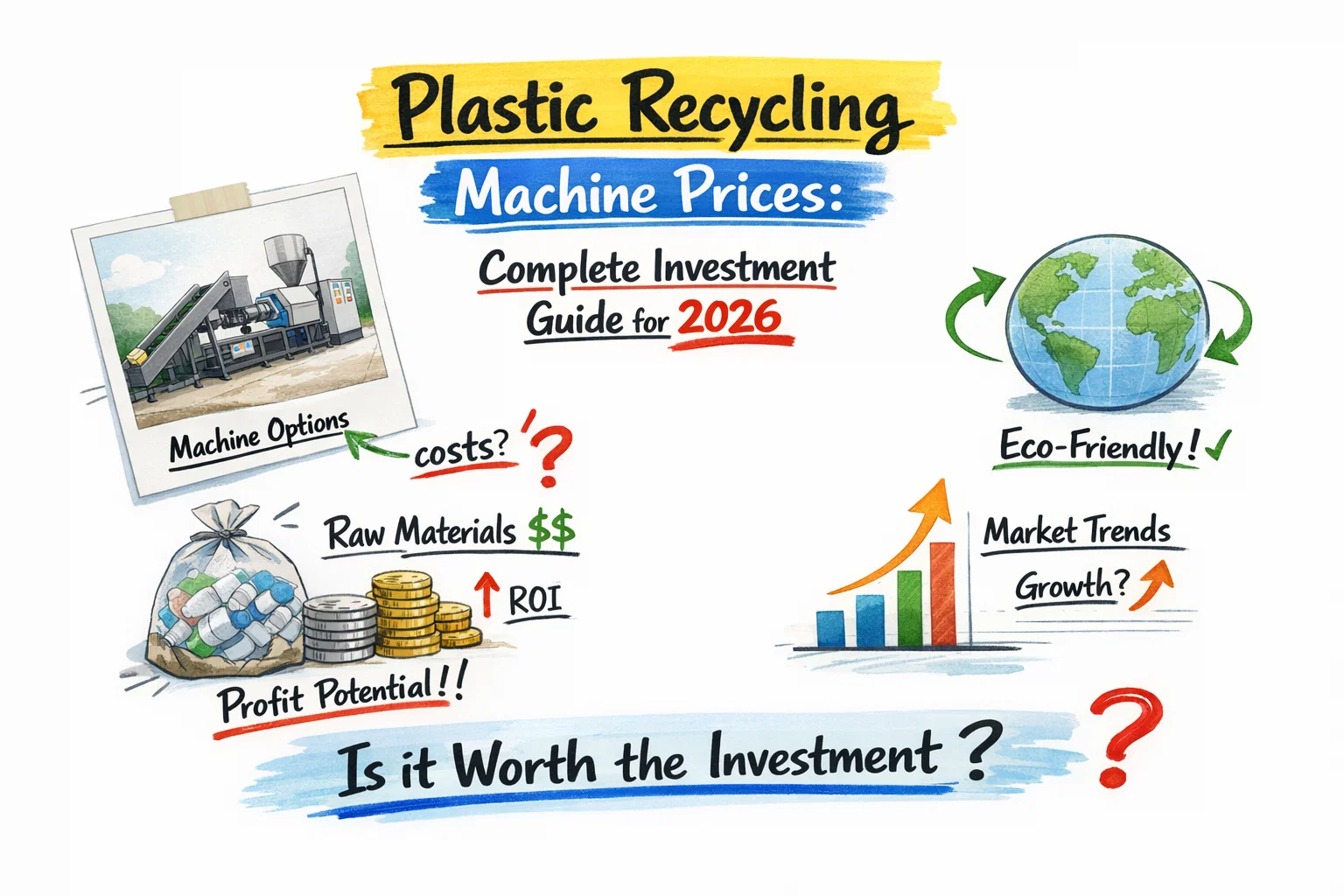
Preços de máquinas de reciclagem de plástico: Guia completo de investimento para 2026
Edição de 2026: Use este guia para estimar faixas de orçamento, comparar configurações e, em seguida, clicar para acessar as páginas de equipamentos correspondentes e obter especificações detalhadas.
Panorama dos preços das máquinas de reciclagem de plástico (2026)
Configuração inicial
Típico: $15k–$60k
Melhor para: Redução de tamanho básica + coleta local
Triturador/Bittor + transporte básico (sem lavagem/granulação)
Varal
Típico: $80k–$250k
Melhor para: PET / PP / PEAD com contaminação
As etapas dependem dos rótulos, da cola, do óleo/areia e das necessidades de lavagem a quente.
Linha completa (para pellets)
Típico: $150k–$300k
Melhor para: venda de pellets de qualidade estável
O nível de filtragem + desgaseificação + acionamento de automação representam o custo mais elevado.
Insights de Investimento Chave
Compreender os preços das máquinas de reciclagem de plástico é crucial para empresas que entram no setor de reciclagem. Em vez de comparar os "preços anunciados", concentre-se em (1) condição do material, (2) capacidade e (3) qualidade de saída desejada. Esses três fatores determinam as etapas necessárias do processo — e o orçamento real.
Compreendendo o Mercado de Máquinas de Reciclagem de Plástico
A demanda por equipamentos de reciclagem continua a crescer à medida que as regulamentações se tornam mais rigorosas e as marcas aumentam suas metas de conteúdo reciclado. Para os compradores, isso significa mais opções — além de uma maior variação de preços, impulsionada pelo nível de automação, pelos requisitos de separação e pelo grau de qualidade necessário para a venda.
Com a seleção correta de equipamentos e um fornecimento estável de matéria-prima, muitas operações de reciclagem podem ser lucrativas. As que apresentam melhor desempenho são aquelas que adaptam o processo ao nível de contaminação e controlam os custos operacionais (energia, água, peças de desgaste e tempo de inatividade).
Tipos de Máquinas de Reciclagem de Plástico e Seus Intervalos de Preços
Equipamentos de Britagem
Triturador de eixo único para filmes e sacos (especificações e opções)
Preço: $3.000 – $15.000
Capacidade: 50-500 kg/hora
Melhor para: Plásticos macios como filmes e sacos
Trituradores de eixo único são uma opção comum para materiais flexíveis. O desempenho final depende do projeto do rotor, do tamanho da tela e das medidas anti-enrolamento — portanto, a configuração importa mais do que o preço base.“
Triturador industrial de eixo duplo para plásticos rígidos e resíduos volumosos.
Preço: $20.000 – $100.000
Capacidade: 500-5,000 kg/hora
Melhor para: Plásticos rígidos e fluxos de resíduos mistos
Os sistemas de eixo duplo oferecem alto torque para peças de paredes espessas e fluxos mistos. O preço é determinado pelo tamanho da fresa, caixa de engrenagens, resistência da estrutura e pacote de automação/segurança.
Sistemas de Lavagem e Separação
| Tipo de Sistema | Preço (USD) | Capacidade de Processamento | Principais características |
|---|---|---|---|
| Unidades de Lavagem Compactas | $15.000 – $50.000 | 200-1,000 kg/hora | Limpeza básica, classificação manual |
| Linhas de Lavagem Automatizadas | $50.000 – $200.000 | 1,000-3,000 kg/hora | Limpeza de estágio múltiplo, separação por densidade |
| Sistemas de Lavagem Industriais | $200.000 – $1.000.000 | 3,000-15,000 kg/hora | Separação avançada, reciclagem de água |
Próximo passo recomendado: Compare soluções completas de reciclagem por material. .
Equipamentos de Pelotização e Extrusão
Máquina de granulação de parafuso único para flocos padrão
Preço: $10.000 – $80.000
Melhor para: Matéria-prima relativamente limpa e estável
Os sistemas de parafuso único são amplamente utilizados para a produção de pellets com boa relação custo-benefício. O orçamento depende do diâmetro do parafuso, da relação comprimento/diâmetro (L/D), das zonas de aquecimento, da filtração e do método de granulação.
Extrusora de dupla rosca para materiais contaminados ou misturados
Preço: $80.000 – $250.000
Melhor para: Necessidades maiores de mistura/desgaseificação
As extrusoras de dupla rosca processam materiais mais difíceis, proporcionando melhor mistura e desvolatilização. O nível de filtração/desgaseificação desejado é o principal fator que influencia o custo total da linha de produção.
Custo por Material: Etapas Necessárias e o que Altera o Preço
| Material | Fluxo de trabalho típico | Módulos Essenciais | Principais fatores de custo | Melhor “Próximo Clique” |
|---|---|---|---|---|
| Garrafas PET | Triagem → Remoção de etiquetas → Lavagem (a quente) → Enxágue → Secagem | Removedor de etiquetas, lavagem a quente, separação por densidade, secadora | Cola/etiquetas, requisito de lavagem a quente, reciclagem de água, umidade final | Soluções para lavagem e reciclagem de PET |
| HDPE/PP rígido | Triturar → Lavar → Flutuar-afundar → Secar → (Opcional: granulação) | Triturador, lavagem por fricção, tanque de flutuação-afundamento, secador | Nível de contaminação, necessidades de separação, nível de automação | Linha de reciclagem de plásticos rígidos |
| Filme de LDPE | Triturar → Pré-lavar → Espremer/Desidratar → Secar → (Opcional: granulação) | Triturador de eixo único, espremedor de filme, sistema de secagem | Alvo de umidade, areia/solo, compressão versus secagem térmica, anti-enrolamento | configurações de trituradores de filme |
| Sacos de tecido PP | Triturar → Lavar → Secar → Granular | Triturador, etapas de lavagem, granulação com filtração | Requisitos de tinta/contaminação, nível de filtragem da tinta fundida e qualidade de saída. | opções de máquinas de granulação |
Dica prática: A maneira mais rápida de controlar o CAPEX é adequar o fluxo de trabalho ao seu nível real de contaminação e à sua necessidade de produção — evite pagar por etapas desnecessárias.
O que esses preços geralmente incluem (e excluem)
Incluído (típico)
- Máquina principal + motor e caixa de engrenagens padrão
- Painel elétrico básico / controles padrão
- Peças de desgaste padrão (varia conforme o modelo)
Frequentemente excluído (confirmar nas citações)
- Sistema de transporte / silos / plataformas e estrutura de aço
- Instalação e comissionamento / treinamento de operadores no local.
- Reciclagem de água, tratamento de águas residuais, coleta de poeira
- Tensão/padrões personalizados, certificações, pacotes de peças de reposição
- Envio, impostos locais, desembaraço aduaneiro de importação
A comparação de preços só se torna precisa após a confirmação do escopo de entrega (EXW/FOB/CIF), nível de automação e qualidade de produção exigida.
Análise de Investimento em Planta de Reciclagem Completa
Operações Pequenas (500-2,000 toneladas/ano)
Despesa de Investimento
- Custo de Equipamentos: $50.000 – $200.000
- Requisitos de Instalação: 500 – 2,000 pés quadrados
- Potencial de Receita Anual: Depende da matéria-prima local e da qualidade do produto.
- Período típico de retorno do investimento: geralmente modelado entre 18 e 36 meses (caso a caso)
As instalações de pequena escala são um ponto de partida prático quando se tem um fornecimento local estável e um comprador garantido para flocos/pellets. As melhores configurações mantêm o processo simples e focam no tempo de atividade e na produção consistente.
Operações de Médio Porte (5,000-15,000 toneladas/ano)
Vantagens
- Melhor eficiência de processamento
- Melhores economias de escala
- Mais opções de automação
- Múltiplos fluxos de produtos
- Controle de custos mais rigoroso por tonelada
Considerações
- Requisitos de capital mais altos ($300,000-$800,000)
- Necessidades de instalação maiores (5,000-20,000 pés quadrados)
- Operações mais complexas
- Maior conformidade regulatória
- Maior exposição ao risco de mercado
Operações de Escala Industrial (20,000+ toneladas/ano)
Instalações de reciclagem em grande escala podem exigir investimentos de 1 a 10 milhões de libras, dependendo da complexidade do material e do nível de automação. Essas operações podem incluir:
- Classificação avançada para melhorar a separação e a pureza
- Controle de qualidade integrado para atender aos requisitos dos compradores premium
- Otimização de água/energia para reduzir os custos operacionais
- Seções modulares escaláveis para expansão de capacidade
Fatores Críticos que Afetam os Preços de Equipamentos
Requisitos de Capacidade e Capacidade de Tráfego
A capacidade de processamento está fortemente correlacionada com o custo do equipamento, pois uma maior produtividade exige rotores mais robustos, acionamentos de maior potência, estruturas mais pesadas e sistemas de segurança/controle mais resistentes.
Nível de Automatização e Integração de Tecnologia
Funcionalidades de automação que podem melhorar a eficiência e reduzir os custos de mão de obra incluem:
- Classificação óptica/avançada: custo adicional, produção de maior pureza
- Sistemas de controle PLC: Custo inicial mais elevado, operação mais fácil e estabilidade.
- Planejamento de monitoramento e manutenção: Reduz o tempo de inatividade por meio de manutenção programada.
Reputação da Marca e Origem da Fabricação
| Origem do Equipamento | Posição típica de preço | Principais vantagens | Melhor ajuste |
|---|---|---|---|
| Fabricantes Europeus | Premium | Tecnologia avançada, construção robusta | Alto nível de automação e requisitos de produção rigorosos |
| Fabricantes Chineses | Valor | Custo-benefício, personalização rápida | O melhor retorno sobre o investimento (ROI) é obtido quando as especificações são bem definidas. |
| Fabricantes Norte-Americanos | Valor premium | Suporte local, familiaridade com as normas. | Projetos que necessitam de presença de serviços locais |
Desempenho Financeiro: Custo Total de Propriedade (TCO) e Retorno sobre o Investimento (ROI) (O que importa nas operações reais)
Lista de verificação do Custo Total de Propriedade (TCO)
- Peças de desgaste: lâminas, telas, parafusos, aquecedores, rolamentos
- Energia por tonelada: Depende da potência do motor, do método de secagem e dos estágios de separação.
- Gestão da água: consumo, filtração, reciclagem, tratamento de águas residuais
- Tempo de inatividade: Intervalos de manutenção e disponibilidade de peças de reposição
- Mão de Obra: intensidade de triagem + nível de automação
Modelos de Geração de Receita
As operações de reciclagem normalmente geram receita por meio de uma ou mais fontes:
- Venda de flocos/pellets: O preço depende muito da pureza e da consistência.
- Taxas de processamento de resíduos: depende da economia de cobrança local
- Fluxos de subprodutos: Separe as frações valiosas sempre que possível.
Prazo de Recuperação do Investimento
O retorno sobre o investimento (ROI) varia bastante de acordo com o custo da matéria-prima, o nível de contaminação, o preço da energia local, o rendimento e a qualidade do produto. A maioria dos projetos modela o retorno do investimento usando premissas conservadoras e prioriza o tempo de operação estável em detrimento da produção máxima.
Quadro de Decisão de Seleção de Equipamentos
Processo de Seleção Passo a Passo
- Definir Requisitos de Processamento: tipos de plástico, volume, contaminação, meta de produção
- Confirme o fluxo de trabalho: Adicione apenas etapas que resolvam problemas reais.
- Modelo TCO: energia + peças de desgaste + água + tempo de inatividade
- Avaliar a capacidade do fornecedor: Suporte, treinamento, peças de reposição, prazo de entrega
- Planejar para Escalabilidade: caminho de expansão e atualização modular
Qualidade vs. Custos Considerações
O preço inicial é importante, mas o Custo Total de Propriedade (TCO) determina a rentabilidade. Equipamentos mais adequados geralmente proporcionam os seguintes resultados:
- Reduzir o tempo de inatividade: Saída estável e manutenção previsível
- Melhor qualidade de saída: melhor aceitação por parte dos compradores e preços mais competitivos
- Custo unitário mais baixo: otimização de energia/água por tonelada
Obtenha um orçamento preciso (rapidamente)
Envie 5 informações — Obtenha uma configuração precisa e um orçamento.
- Fotos de materiais + contaminação (rótulos, areia, óleo)
- Capacidade alvo (kg/h)
- Formato de saída (flocos ou grânulos) + especificações desejadas (umidade/MFI)
- Fonte de alimentação (tensão/Hz)
- Escopo de entrega (apenas equipamento / chave na mão / instalação)
Responderemos com um fluxograma de processo recomendado e um orçamento detalhado.
Conclusão
Em 2026, o preço dos equipamentos de reciclagem de plástico deve ser compreendido com base na configuração do equipamento, e não em um valor único. A melhor abordagem é adequar o fluxo de trabalho às suas necessidades de material e produção, verificar o que está incluído e avaliar o Custo Total de Propriedade (peças de desgaste, energia, água, tempo de inatividade) antes de tomar uma decisão final de investimento.
Se você compartilhar fotos dos materiais, informações sobre a capacidade e a qualidade de saída desejada, podemos recomendar o processo correto e fornecer um orçamento preciso e comparável.
