

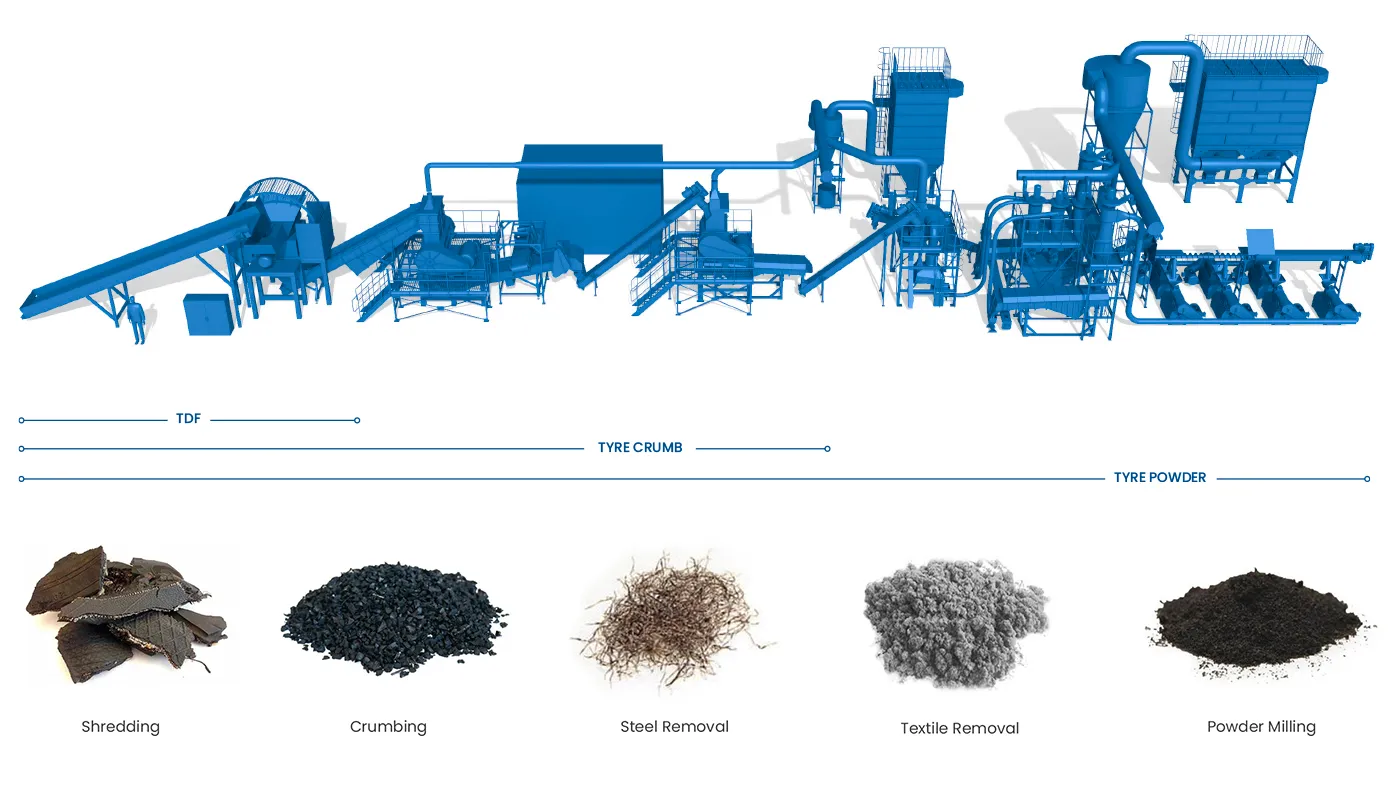
UM máquina de reciclagem de pneus transforms end-of-life tires — passenger car, truck, OTR (off-the-road), and industrial — into reusable materials: crumb rubber, rubber powder, steel wire, and fiber. With an estimated 1.5 billion waste tires generated globally each year and landfill bans tightening across North America, Europe, and Asia, tire recycling is both an environmental necessity and a profitable business. This guide covers every machine type in the tire recycling process, real specifications, output products and their markets, and a step-by-step framework for building or upgrading a tire recycling line.
What Is a Tire Recycling Machine?
A tire recycling machine is any equipment used to break down waste tires into reusable raw materials. No single machine processes a whole tire into finished product — tire recycling requires a sequence of specialized machines, each handling a specific stage: debeading (removing steel bead wire), shredding (primary size reduction), granulating (secondary size reduction), steel separation, fiber separation, and grinding (fine powder production). The term “tire recycling machine” typically refers to the complete line or to the primary shredder that anchors the system.
The Tire Recycling Process: Step by Step
Understanding the complete process helps you specify the right equipment for each stage. Here is the standard mechanical tire recycling process used in ambient-temperature processing:
Stage 1: Collection and Inspection
Waste tires arrive from tire dealers, auto shops, fleet operators, and municipal collection points. Inspect for contamination (rims still mounted, excessive mud, chemical contamination) and sort by type: passenger car tires (PCT), truck and bus tires (TBT), and OTR tires each require different processing parameters due to size and steel content differences.
Stage 2: Debeading
UM tire debeading machine extracts the steel bead wire from each tire sidewall. This step is critical: bead wire left in the tire damages shredder blades and contaminates the rubber output. A single-hook debeader processes 60–120 passenger tires per hour. Removing the bead wire also makes subsequent shredding 30–40% more energy-efficient because the shredder doesn’t need to cut through hardened steel cable.
Stage 3: Sidewall Cutting (Optional)
For large truck and OTR tires, a tire cutting machine separates sidewalls from the tread. This reduces the size of material entering the primary shredder and allows sidewalls and treads to be processed separately or sold as-is for specific applications (e.g., sidewall rubber for conveyor belt liners). Learn more about why sidewall cutting matters in tire recycling.
Stage 4: Primary Shredding
O triturador de pneus is the core machine in any tire recycling line. A low-speed, high-torque triturador de eixo duplo tears whole tires (or pre-cut sections) into rough chips of 50–100 mm. Primary shredders for tire recycling typically use 30–110 kW motors and process 500–3,000 kg/h depending on tire type and machine size. The output — called tire-derived fuel (TDF) chips at this stage — already has commercial value as an alternative fuel.
Stage 5: Secondary Shredding / Granulation
UM granulador de pneus reduces the 50–100 mm chips to 5–20 mm granules. At this stage, steel wire liberates from the rubber matrix and can be removed by magnetic separators. Textile fiber also separates and is removed by air classifiers or vibrating screens. The output is a mix of rubber granules, loose steel wire, and fiber. See our detailed guide on waste tire granulators and output specifications.
Stage 6: Steel and Fiber Separation
Overband magnetic separators and magnetic drums remove steel wire fragments from the rubber granules — typically achieving 99%+ steel removal. Air classifiers and vibrating screens remove textile fiber (nylon, polyester cord). The separated steel sells as scrap metal ($100–$200/ton); fiber can be used as insulation or fuel supplement.
Stage 7: Fine Grinding (Optional)
For higher-value applications, a rubber pulverizer/grinder further reduces granules to fine rubber powder (40–80 mesh / 0.2–0.4 mm). Fine rubber powder commands premium prices ($300–$600/ton) for use in molded rubber products, asphalt modification, and sports surfacing. Cryogenic grinding (freezing rubber with liquid nitrogen before milling) produces even finer powder but adds $50–$100/ton in processing cost.
Tire Recycling Machine Types
Here is every machine type used in a tire recycling line, with specifications from Energycle’s manufacturing range:
| Máquina | Função | Taxa de transferência | Potência do motor | Tamanho da saída |
|---|---|---|---|---|
| Desempenadeira de pneus | Extract bead wire from tire sidewall | 60–120 tires/h | 7.5–15 kW | Whole tire (wire removed) |
| Tire Cutter | Cut sidewalls from tread | 40–80 tires/h | 5.5–11 kW | Sidewall strips + tread rings |
| Primary Shredder (Double-Shaft) | Shred whole/cut tires to chips | 500–3.000 kg/h | 30–110 kW | 50–100 mm chips |
| Granulador de Pneus | Reduce chips to granules, liberate wire | 300–2,000 kg/h | 22–75 kW | 5–20 mm granules |
| Separador Magnético | Remove steel wire from granules | Matches line speed | 1.5–4 kW | Clean granules + steel wire |
| Air Classifier / Fiber Separator | Remove textile fiber from granules | Matches line speed | 3–7.5 kW | Clean granules + fiber |
| Pulverizador de borracha | Grind granules to fine powder | 200–800 kg/h | 37–75 kW | 40–80 mesh powder |
Output Products and Market Value
A tire recycling line produces multiple revenue streams. Understanding output products and their markets helps you decide how far to process and which equipment stages to invest in:
| Produto de saída | Tamanho | Preço de mercado | Aplicações |
|---|---|---|---|
| Chips de TDF | 50–100 mm | $30–$80/ton | Cement kiln fuel, power plant fuel (replaces coal) |
| Crumb Rubber (coarse) | 5–20 mm | $120–$250/ton | Playground surfaces, sports tracks, landscaping mulch |
| Crumb Rubber (fine) | 1–5 mm | $200–$400/tonelada | Asphalt rubber (road paving), molded products, athletic fields |
| Pó de borracha | 40–80 mesh | $300–$600/ton | Rubber compound additive, waterproofing, automotive parts |
| Fio de aço | — | $100–$200/ton | Steel scrap recycling (foundries, mini-mills) |
| Fibra textil | — | $20–$50/ton | Insulation, fuel supplement, geotextile filler |
A typical passenger car tire weighs 8–10 kg and contains approximately 70% rubber, 15% steel, and 15% textile fiber by weight. Processing 1,000 tires produces roughly 7 tons of rubber, 1.5 tons of steel, and 1.5 tons of fiber.
TDF vs. TDA vs. Crumb Rubber: End-Product Comparison
The three main product categories from tire recycling serve very different markets. Your processing depth determines which products you can sell:
| Produto | Processing Required | Investimento em Capital | Revenue/ton | Demanda de mercado |
|---|---|---|---|---|
| TDF (Tire-Derived Fuel) | Shredding only (1 stage) | Low ($80K–$200K) | $30–$80 | Stable — cement kilns, power plants |
| TDA (Tire-Derived Aggregate) | Shredding + screening | Low-Medium ($100K–$250K) | $50–$120 | Growing — civil engineering fills, drainage |
| %% | Shredding + granulation + separation | Medium-High ($200K–$600K) | $120–$600 | Strong — sports surfaces, asphalt, molded goods |
Our recommendation for new operations: Start with TDF production (lowest capital, immediate revenue), then add granulation and separation equipment as cash flow permits. The shredder purchased for TDF production becomes stage 1 of the crumb rubber line — zero wasted investment. For detailed market analysis, see our guide on tire recycling markets: TDF vs. TDA vs. CRM.
Passenger Car vs. Truck vs. OTR Tire Processing
Different tire types require different equipment sizing and processing approaches:
| Parâmetro | Passenger Car Tire | Truck/Bus Tire | OTR Tire |
|---|---|---|---|
| Peso | 8–10 kg | 40–70 kg | 200–4,000 kg |
| Diameter | 550–700 mm | 900–1,200 mm | 1,800–4,000 mm |
| Steel Content | 10–15% | 15–25% | 10–20% |
| O debeading | Standard single-hook | Heavy-duty debeader | Hydraulic OTR debeader |
| Pre-Cutting | Opcional | Recomendado | Required |
| Shredder Size | 30–55 kW | 55–90 kW | 90–200+ kW |
| Throughput (shredder) | 500–2,000 kg/h | 800–2,500 kg/h | Custom per project |
Complete Tire Recycling Line Configurations
Basic TDF Line (Lowest Investment)
Debeader → primary shredder → magnetic separator → screening. Output: 50–100 mm TDF chips + steel wire. Throughput: 500–2,000 kg/h. Investment: $80,000–$200,000. Payback: 12–24 months at 8 hours/day operation.
Crumb Rubber Line (Medium Investment)
Debeader → primary shredder → granulator → magnetic separator → air classifier → vibrating screen. Output: 1–5 mm clean crumb rubber + steel + fiber. Throughput: 300–1,500 kg/h of finished crumb. Investment: $200,000–$600,000. Payback: 8–18 months. Watch our tire recycling line trial run.
Fine Rubber Powder Line (Highest Value)
Full crumb rubber line + rubber pulverizer + fine screening + packaging. Output: 40–80 mesh rubber powder. Throughput: 200–800 kg/h of powder. Investment: $400,000–$1,000,000+. Payback: 12–24 months. Highest revenue per ton but requires larger capital and more skilled operators.
Quadro de Escolha de 5 Passos
Step 1: Define Your Feedstock
Passenger car tires, truck tires, or OTR tires? Mixed or single type? Expected daily/monthly volume in tons? Tire type determines every machine specification in the line — a 500 kg/h passenger car line is a completely different setup from a 500 kg/h truck tire line.
Step 2: Choose Your End Product
TDF chips (simplest), crumb rubber (best balance of investment vs. revenue), or fine rubber powder (highest value, highest investment)? Research local market demand — a crumb rubber line is pointless if no buyers exist within economical shipping distance. Identify at least 2–3 potential buyers before investing.
Step 3: Size Your Line
Calculate required throughput from your tire supply volume. A facility processing 50 tons/day of passenger car tires needs approximately 3,000–4,000 kg/h primary shredding capacity (accounting for 8-hour shifts and 80% uptime). Always size equipment for peak capacity plus 20% margin.
Step 4: Plan Your Layout
A complete crumb rubber line requires 500–2,000 m² of covered space plus outdoor tire storage area. Plan material flow: tire receiving → debeading → shredding → granulation → separation → screening → product storage. Include space for maintenance access, spare parts, and future expansion.
Passo 5: Calcular o Retorno sobre Investimento
Revenue = (rubber tonnage × rubber price) + (steel tonnage × steel price) + tipping fees (if charged for tire acceptance). Costs = equipment depreciation + electricity + labor + maintenance + rent. Most tire recycling operations charge $1–$3 per tire as a tipping/acceptance fee — this alone can cover 30–50% of operating costs. A 1,000 kg/h crumb rubber line typically generates $300,000–$600,000 annual gross revenue with 40–60% margins.
Maintenance Essentials
Tire recycling equipment operates in harsh conditions — abrasive rubber, embedded steel wire, and high torque loads. A disciplined maintenance program is non-negotiable:
- Diário: Inspect shredder blades for chipping, clear jammed material, check oil levels on hydraulic systems
- Semanalmente: Verify magnetic separator strength, check conveyor belt tension and alignment, inspect granulator screens for wear holes
- Mensal: Lubricate all bearings, inspect electrical connections and motor temperatures, check shredder shaft seals
- Every 500–1,000 hours: Rotate or replace shredder blades (tire processing wears blades 2–3× faster than standard plastic shredding due to steel wire contact)
- Anualmente: Full machine inspection, replace worn screens and liners, check gearbox oil, verify safety systems
Blade costs are the largest maintenance expense — budget $5,000–$15,000 annually for a mid-size line. Using wear-resistant blade materials (D2, DC53, or hardfacing) extends blade life 40–80%. See our shredder blade metallurgy guide.
Comece com Energycle
Energycle manufactures complete máquina de reciclagem de pneus lines — from debeading through shredding, granulation, separation, and grinding. With installations across Africa, Southeast Asia, the Middle East, and South America, we provide:
- Free project consultation — tell us your tire supply, target product, and budget; we design the optimal line configuration
- Turnkey line supply — all machines, conveyors, electrical panels, and controls from a single source
- Instalação e comissionamento — our engineers install on-site and train your operators
- Spare parts and blade supply — fast delivery of wear parts to minimize downtime
Entre em contato com nossa equipe de engenharia with your tire type, daily volume, and target end product — we will design a line and provide a complete quotation within one week.
Perguntas frequentes
Quanto custa uma máquina de reciclagem de pneus?
A basic TDF shredding line (debeader + shredder + magnetic separator) costs $80,000–$200,000. A complete crumb rubber line costs $200,000–$600,000. A fine rubber powder line with pulverizer costs $400,000–$1,000,000+. Individual machines: tire shredders $30,000–$150,000, debeaders $8,000–$25,000, granulators $20,000–$80,000. Payback periods range from 8–24 months depending on configuration and local market prices.
What is the tire recycling process?
The standard mechanical tire recycling process has 6–7 stages: (1) collection and sorting, (2) debeading (steel bead wire removal), (3) optional sidewall cutting, (4) primary shredding to 50–100 mm chips, (5) granulation to 5–20 mm, (6) magnetic and air separation to remove steel wire and fiber, and (7) optional fine grinding to 40–80 mesh powder. Each stage adds value to the output product.
Is tire recycling profitable?
Yes — tire recycling generates revenue from multiple streams: crumb rubber ($120–$600/ton depending on fineness), steel wire ($100–$200/ton), tipping fees ($1–$3 per tire accepted), and fiber ($20–$50/ton). A mid-size crumb rubber operation processing 1,000 kg/h typically generates $300,000–$600,000 annual gross revenue with 40–60% profit margins after operating costs.
What size shredder do I need for tire recycling?
For passenger car tires: a 30–55 kW double-shaft shredder handles 500–2,000 kg/h. For truck tires: 55–90 kW for 800–2,500 kg/h. For OTR tires: 90–200+ kW, custom-engineered. Always size for peak volume plus 20% margin, and account for 80% uptime (maintenance, shift changes, feeding gaps).
What is the difference between TDF, TDA, and crumb rubber?
TDF (tire-derived fuel) is coarsely shredded tire chips (50–100 mm) burned as alternative fuel in cement kilns. TDA (tire-derived aggregate) is shredded tire pieces used as lightweight fill in civil engineering projects. Crumb rubber is finely granulated rubber (1–5 mm) used in sports surfaces, asphalt modification, and molded products. Each requires progressively more processing equipment but commands higher prices.
Can I recycle truck tires and car tires on the same line?
Yes, but the line must be sized for the larger tire. A shredder designed for truck tires easily handles passenger car tires, but not vice versa. The main difference is debeading — truck tires need a heavy-duty debeader. Feed rate drops when processing larger tires because each tire takes longer to shred. Many operators process car tires and truck tires in separate batches.
How long do tire shredder blades last?
Tire shredder blades last 500–1,000 operating hours before needing rotation or replacement — roughly 2–4 months at 8 hours/day. Steel bead wire in tires causes 2–3× faster blade wear compared to standard plastic shredding. D2 and DC53 tool steel blades offer the best cost-to-life ratio; tungsten carbide-tipped blades last longer but cost 4–6× more upfront.
What permits do I need for tire recycling?
Requirements vary by jurisdiction but typically include: waste processing/recycling license, environmental permit (air emissions, noise, water discharge), fire safety clearance (tire storage is a significant fire risk), and business operating permits. Some regions also require tire storage limits (maximum number of tires on-site). Consult your local environmental agency before investing in equipment.
Recursos Relacionados
- Tire Recycling Machine — Product Range
- Triturador de pneus
- Mercados de reciclagem de pneus: especificações TDF vs TDA vs CRM
- Granuladores de pneus usados: Como Funcionam
- Tire Granulators: Steel Wire Separation & Crumb Rubber Specs
- Máquina de remoção de fios de pneu de gancho único
- Máquina de corte de pneus usados
- Moedor de pulverização de reciclagem de borracha de pneu
- Why Is the Sidewall Cut During Tire Recycling?
- Teste de linha de reciclagem de pneus usados
- Double Shaft Shredder for Plastic, Metal & Tire
- Shredder Blade Metallurgy Guide
- Máquina de Reciclagem de Plástico: Guia Completo
