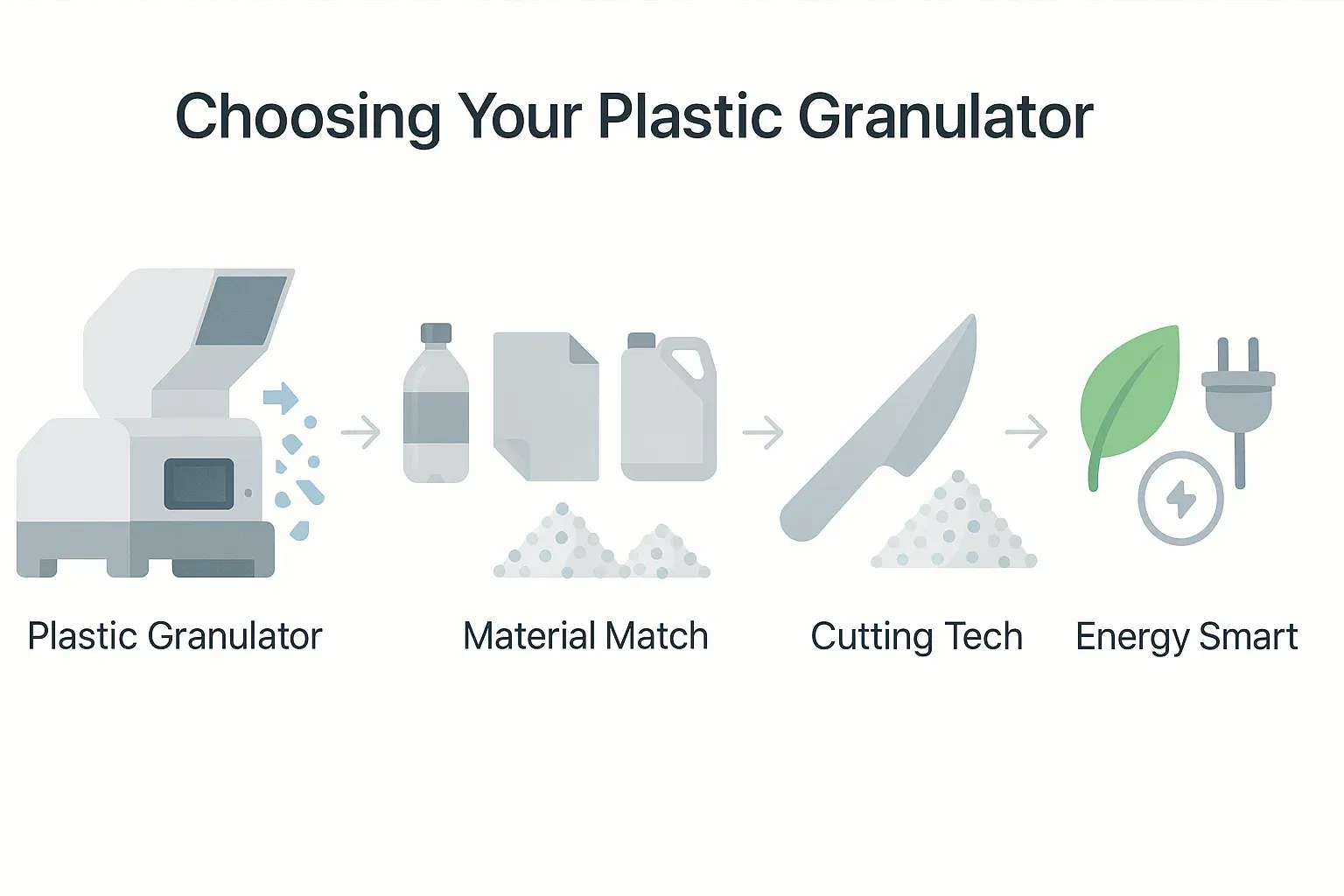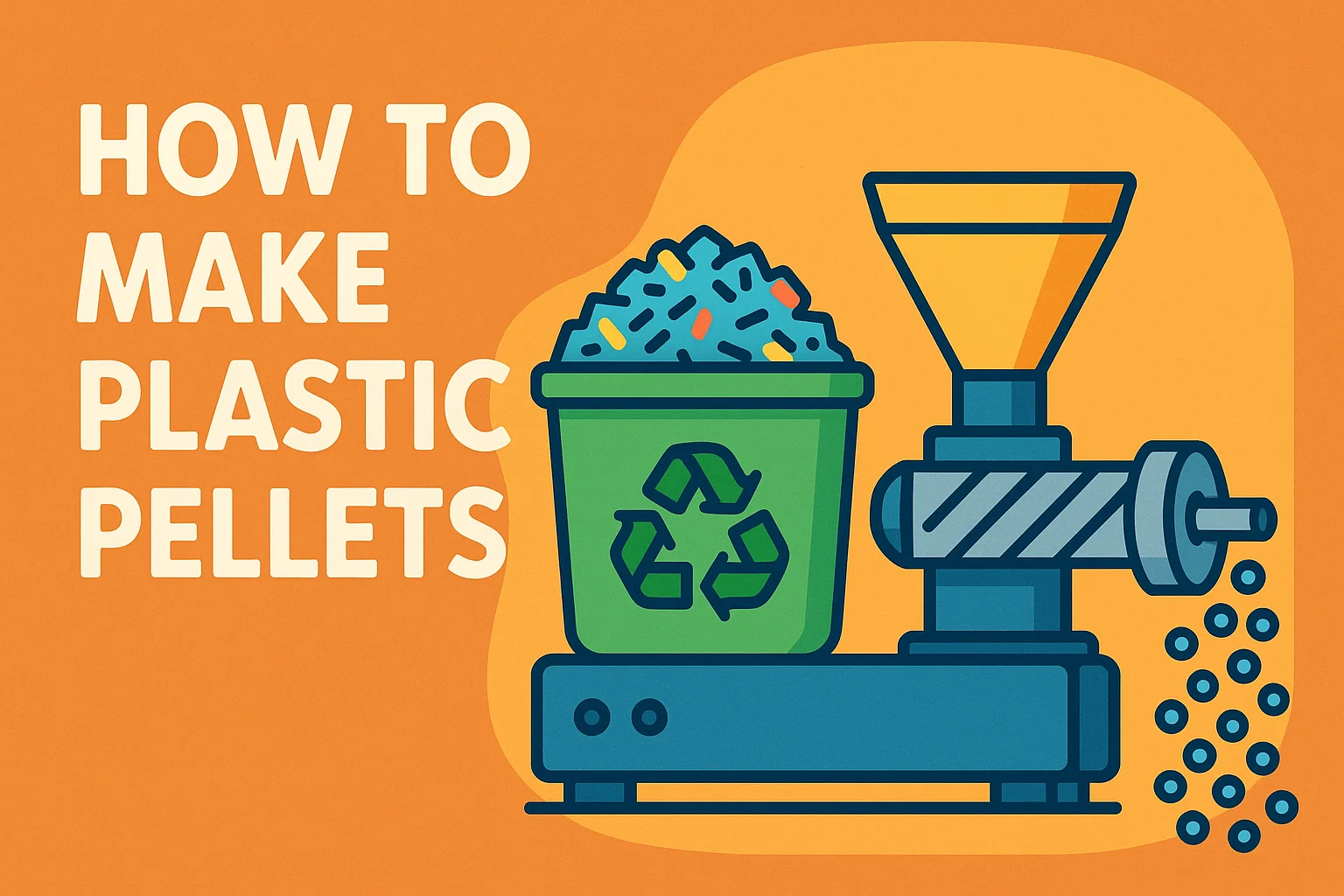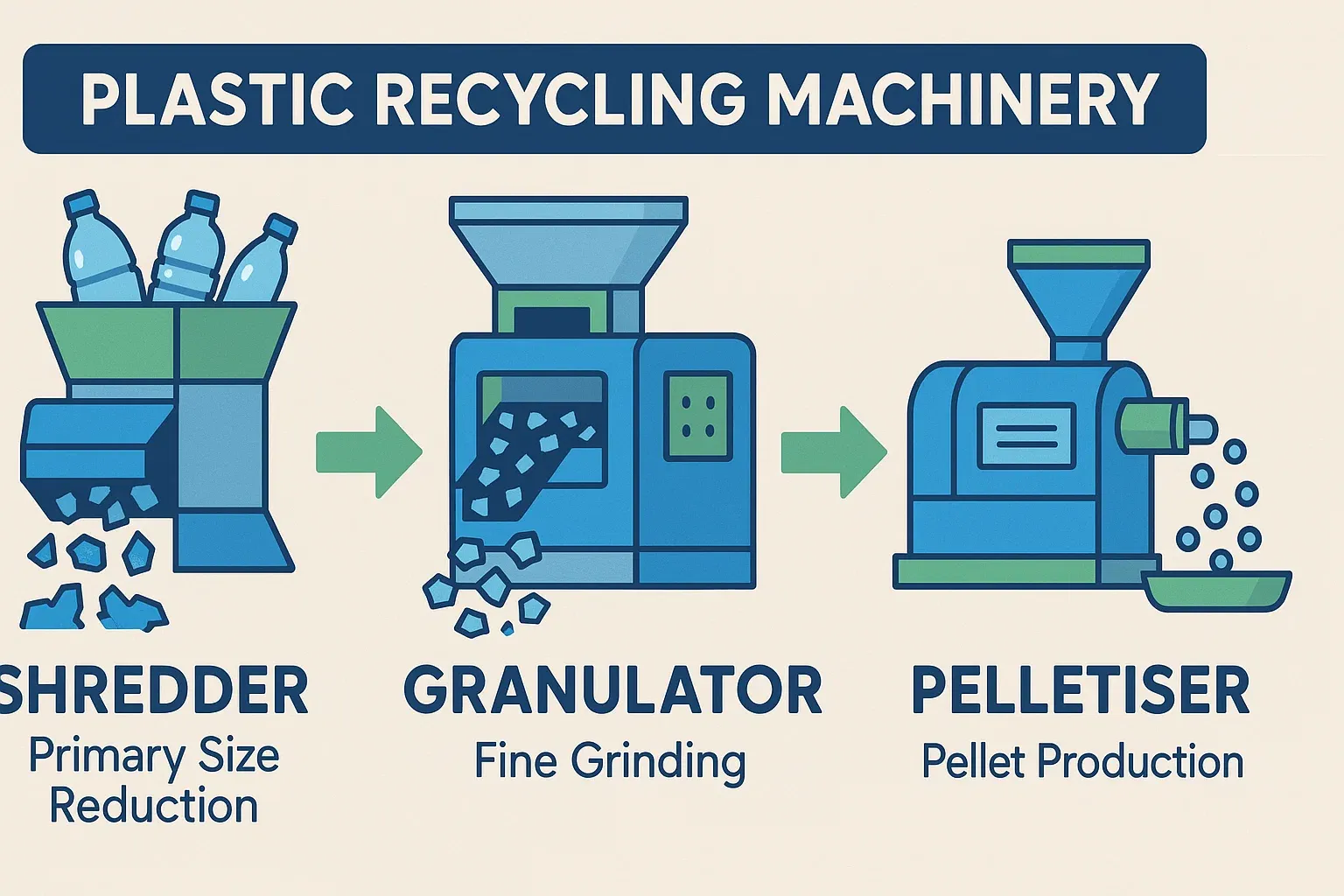

A plastic pelletizing machine melts shredded, washed, or densified plastic waste and reshapes it into uniform pellets — the standard raw material form that injection molders, extruders, and film blowers purchase and process. Pelletizing is the final value-adding step in plastic recycling: it converts low-value flakes or regrind into market-ready pellets worth $400–$1,200/ton depending on polymer type and quality. This guide covers every pelletizer type, real specifications, material-to-machine matching, cutting system selection, and a framework for specifying the right pelletizing line for your operation.
What Is a Plastic Pelletizing Machine?
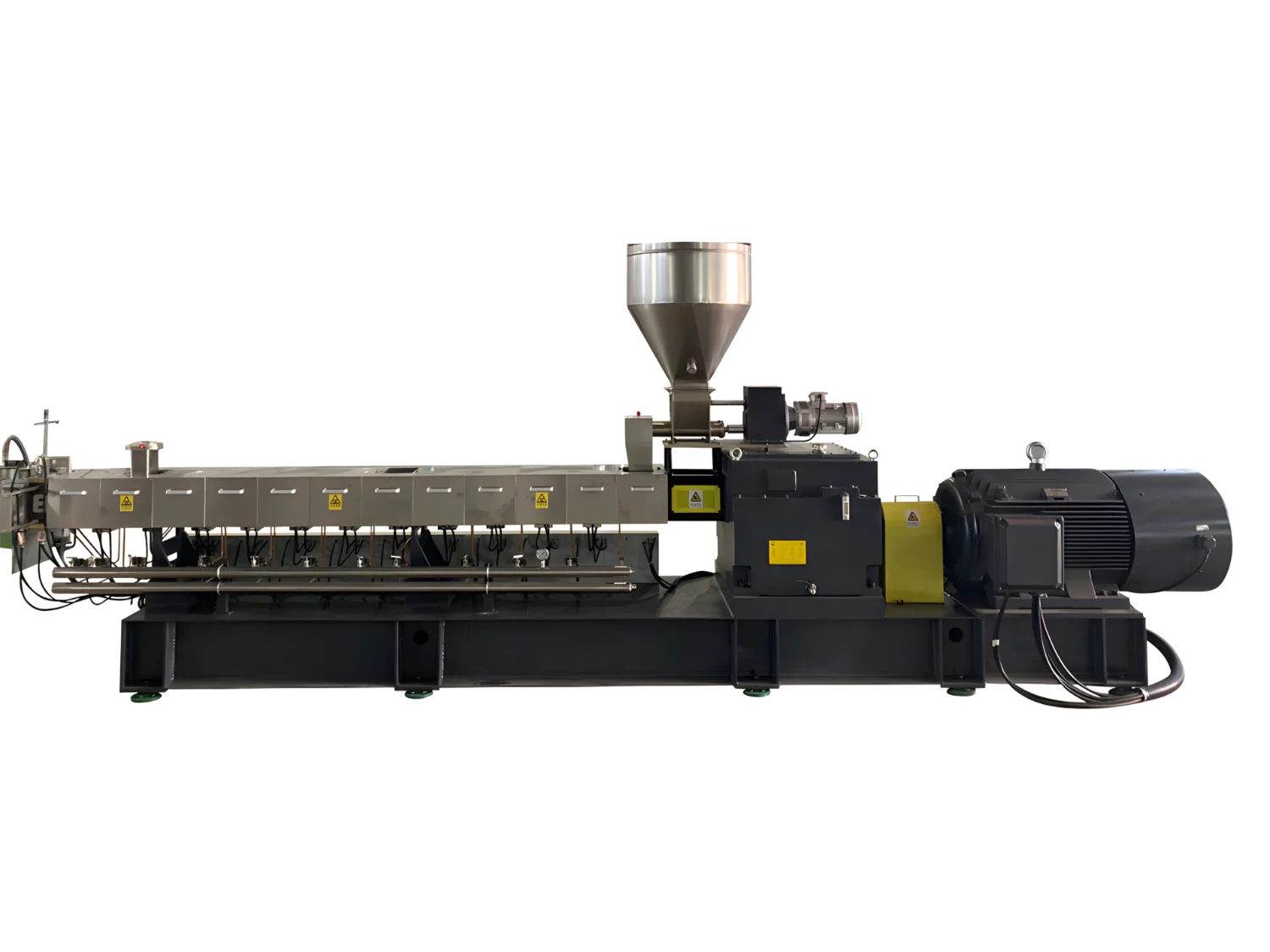
A plastic pelletizing machine (also called a pelletizer or granulating extruder) melts plastic input material through a heated screw-and-barrel system, filters out contaminants via a screen changer, then pushes the melt through a die plate where a cutting system chops it into cylindrical or spherical pellets of 2–5 mm diameter. The pellets are cooled (by water or air), dried, and collected in bags or silos. Learn the fundamentals in our guide: What Is a Plastic Pelletizer and How Does It Work?
Key components of every pelletizing line:
- Feeding system — force feeder, crammer, or cutter compactor that densifies and feeds material into the extruder
- Extruder — single-screw or twin-screw barrel that melts, homogenizes, and pressurizes the plastic
- Screen changer — hydraulic or manual filter that removes contaminants (paper, metal, dirt) from the melt
- Die plate — perforated plate that shapes the melt into strands or directly into pellets
- Cutting system — strand cutter, water ring cutter, or underwater pelletizer that forms final pellet shape
- Cooling and drying — water bath, air cooling, or centrifugal dryer that solidifies and dries pellets
Types of Plastic Pelletizing Machines
Single-Screw Pelletizer
The most common type for recycling applications. A single rotating screw inside a heated barrel melts and conveys plastic forward. Simple, reliable, and lower cost than twin-screw systems. Best for clean, pre-sorted feedstock (PE, PP, PET flakes, PS). Throughput: 100–1,500 kg/h. See our single-screw pelletizing machine range.
Twin-Screw Pelletizer
Two co-rotating or counter-rotating screws provide superior mixing, venting, and degassing. Required for materials that need intensive compounding (color concentrates, filled plastics, engineering plastics) or that contain high moisture or volatile content. Higher cost (1.5–2.5× single-screw) but produces better pellet quality for demanding applications. Throughput: 200–3,000 kg/h.
Cutter Compactor Pelletizer
Integrates a high-speed cutter compactor (agglomerator) directly before the extruder. The cutter compactor shreds, densifies, and pre-heats film, fiber, and lightweight materials through friction — then feeds directly into the extruder barrel. This eliminates the need for a separate agglomerator or densifier, saving floor space and energy. Ideal for PE/PP film, woven bags, nonwoven fabric, and raffia. See our cutter compactor pelletizing line.
Two-Stage Pelletizer
Uses two extruders in series: the first melts and filters, the second homogenizes and builds pressure for pelletizing. The two-stage design provides extra melt filtration, better degassing (two venting zones), and more consistent melt quality. Best for heavily printed film, post-consumer mixed plastics, and materials with high contamination. Higher investment but produces premium-quality pellets.
Pelletizer Type Comparison
| Type | Throughput | Motor Power | Best For | Relative Cost |
|---|---|---|---|---|
| Single-Screw | 100–1,500 kg/h | 22–250 kW | Clean PE/PP/PET flakes, regrind | 1× (baseline) |
| Twin-Screw | 200–3,000 kg/h | 37–400 kW | Compounding, engineering plastics, high-moisture | 1.5–2.5× |
| Cutter Compactor | 200–1,500 kg/h | 55–300 kW | PE/PP film, woven bags, nonwoven, raffia | 1.2–1.8× |
| Two-Stage | 300–2,000 kg/h | 75–400 kW | Printed film, post-consumer mix, high contamination | 1.5–2.0× |
Cutting Systems: Strand vs. Water Ring vs. Underwater
The cutting system determines pellet shape, quality, and throughput. Choosing the right one depends on your polymer type, required pellet geometry, and production speed. For an in-depth comparison, see strand vs. underwater pelletizing for rPET.
| Cutting System | Pellet Shape | Best For | Throughput Range | Pros | Cons |
|---|---|---|---|---|---|
| Strand Cutting | Cylindrical | PE, PP, PET, PS — most recycling | 100–1,500 kg/h | Simple, low cost, easy maintenance | Strand breakage with low-melt-strength materials |
| Water Ring Cutting | Semi-spherical | PE, PP — especially film recycling | 200–1,500 kg/h | Compact, no strand handling, consistent pellets | Not ideal for high-melt-flow materials |
| Underwater (UWP) | Spherical | PET, PA, TPE, engineering plastics | 500–5,000+ kg/h | Perfect pellet shape, high-speed, dust-free | Expensive, complex, higher maintenance |
See our water ring pelletizing system for PP/PE woven bag applications.
Material-to-Pelletizer Matching
Different plastics require different extruder configurations, temperatures, and cutting systems. Here is our recommendation based on 500+ installations:
| Material | Recommended Pelletizer | Cutting System | Key Notes |
|---|---|---|---|
| PE Film (LDPE/LLDPE) | Cutter Compactor + Single-Screw | Water ring or strand | Film needs densifying; cutter compactor is ideal. See PE/PP film pelletizer |
| PP Woven Bags / Raffia | Cutter Compactor + Single-Screw | Water ring | High bulk — compaction essential before extrusion |
| PET Bottle Flakes | Single-Screw (with crystallizer/dryer) | Strand or underwater | Must dry to <50 ppm moisture; IV loss control critical. See PET pelletizer |
| Rigid HDPE/PP (crates, drums) | Single-Screw | Strand | Easy to pelletize; force-feeder sufficient. See rigid PP/HDPE pelletizer |
| Nonwoven / Meltblown | Cutter Compactor + Single-Screw | Water ring | Ultra-light material requires aggressive densification. See nonwoven pelletizing line |
| PA / Nylon | Twin-Screw (with vacuum venting) | Underwater or strand | Hygroscopic — needs drying + vacuum degassing |
| Mixed Post-Consumer | Two-Stage | Strand or water ring | High contamination requires double filtration + degassing |
For detailed material compatibility, read what types of plastics can be processed with a pelletizer.
Pelletizer Specifications Reference
Representative specifications from Energycle's single-screw pelletizer range:
| Model | Screw Diameter | L/D Ratio | Throughput | Motor Power | Typical Application |
|---|---|---|---|---|---|
| SJ-65 | Ø65 mm | 28:1–33:1 | 80–150 kg/h | 22–37 kW | Small-batch, rigid regrind |
| SJ-85 | Ø85 mm | 28:1–33:1 | 150–300 kg/h | 37–55 kW | PE/PP film, woven bags |
| SJ-100 | Ø100 mm | 28:1–33:1 | 250–500 kg/h | 55–90 kW | Medium recycling lines |
| SJ-120 | Ø120 mm | 28:1–33:1 | 400–800 kg/h | 90–132 kW | High-volume recycling |
| SJ-150 | Ø150 mm | 28:1–33:1 | 600–1,200 kg/h | 132–200 kW | Large industrial lines |
| SJ-180 | Ø180 mm | 28:1–33:1 | 800–1,500 kg/h | 200–250 kW | Maximum throughput |
Visit our plastic pelletizer product page for complete specifications and configuration options. For pricing guidance, see plastic pelletizer machine cost factors and budget vs. high-end pelletizer comparison.
5-Step Selection Framework
Step 1: Define Input Material
Identify polymer type (PE, PP, PET, PS, PA, etc.), form (film, flake, regrind, fiber), contamination level (clean in-house vs. dirty post-consumer), and moisture content. This determines extruder type, number of stages, and whether you need a cutter compactor or pre-dryer.
Step 2: Set Throughput Target
Calculate required pellet output in kg/h. Match upstream washing/drying line output to pelletizer capacity. Always size the pelletizer 20–30% above your current throughput for surge capacity and future growth. Running a pelletizer at 80% of rated capacity extends screw and barrel life significantly.
Step 3: Choose Cutting System
Strand cutting for simplicity and most recycling applications. Water ring for film recyclers wanting compact, consistent pellets. Underwater for PET, engineering plastics, and high-speed production where pellet shape matters for end customers.
Step 4: Specify Pellet Quality
Define target pellet size (typically 3–4 mm), acceptable moisture content (<0.5% for most applications, <50 ppm for PET), color consistency requirements, and maximum contamination levels. These specifications determine screen changer mesh size, number of filtration stages, and cooling/drying system design.
Step 5: Calculate ROI
Pellets sell for $400–$1,200/ton depending on polymer and quality — 2–5× the value of washed flakes. A 500 kg/h pelletizer running 8 hours/day, 300 days/year produces 1,200 tons annually. At $200/ton margin over flake value, that is $240,000/year gross margin from a machine investment of $80,000–$200,000 — payback in 6–12 months.
Maintenance Essentials
- Daily: Inspect die plate for blocked holes; clean screen changer; check water temperature in cooling system
- Weekly: Verify screw torque and motor amperage (rising amps indicates barrel wear); inspect pellet cutter blades
- Monthly: Lubricate gearbox; check heater band function on each zone; inspect screen changer seals
- Every 2,000–4,000 hours: Measure screw and barrel wear (replace when clearance exceeds 0.5 mm per side)
- Annually: Full inspection of screw, barrel, die plate, gearbox, and electrical systems
For complete maintenance programs, see our pelletizer maintenance checklist and pelletizing methods guide.
Getting Started with Energycle
Energycle manufactures plastic pelletizing machines from 80 kg/h laboratory units to 1,500 kg/h production lines, plus complete turnkey recycling systems from washing through pelletizing. We provide:
- Free material testing — send us your plastic samples and we test pellet quality on our machines
- Custom line design — extruder, cutting system, and feeding system configured for your specific material and throughput
- Installation and training — on-site commissioning and operator training included
- After-sales support — spare screws, barrels, die plates, and cutter blades with fast delivery
Contact our engineering team with your material type, throughput requirement, and desired pellet specifications — we will recommend the right configuration and provide a quotation within 48 hours.
Frequently Asked Questions
How much does a plastic pelletizing machine cost?
Small single-screw pelletizers (100–200 kg/h) cost $25,000–$60,000. Mid-range systems (300–800 kg/h) cost $60,000–$150,000. Large production lines (800–1,500 kg/h) range from $150,000–$350,000. Complete turnkey lines including washing, drying, and pelletizing cost $200,000–$800,000. Cutter compactor systems add 20–50% over basic single-screw models.
What is the difference between a pelletizer and a granulator?
A pelletizer melts plastic and extrudes it through a die to form uniform pellets — it changes the physical form of the material through heating. A granulator mechanically cuts solid plastic into small pieces (regrind) without melting. Pellets are market-ready raw material; regrind is an intermediate product. See our detailed comparison: pelletizer vs. granulator.
Which pelletizer type is best for PE film recycling?
A cutter compactor pelletizer is the best choice for PE/PP film. The integrated cutter compactor densifies lightweight film through friction heating before feeding it into the extruder — solving the biggest challenge in film recycling (low bulk density). A water ring cutting system produces consistent, dust-free pellets. Expect 200–1,500 kg/h throughput depending on model size.
What throughput can I expect from a plastic pelletizer?
Throughput depends on screw diameter, motor power, and material type. A Ø65 mm single-screw handles 80–150 kg/h; a Ø120 mm handles 400–800 kg/h; a Ø180 mm reaches 800–1,500 kg/h. Film materials pelletize faster than rigid flakes due to easier melting. Actual throughput is typically 75–85% of rated maximum during sustained production.
How do I choose between strand cutting and water ring cutting?
Strand cutting is simpler and cheaper — melt exits the die as strands, passes through a water bath, and is cut by a rotary blade. Best for rigid plastics with good melt strength. Water ring cutting cuts melt directly at the die face in a water chamber — produces rounder pellets with no strand-handling issues. Best for film-grade PE/PP where strand breakage would be a problem.
Can I pelletize PET bottle flakes?
Yes, but PET requires special handling: flakes must be crystallized and dried to below 50 ppm moisture before extrusion (PET degrades rapidly with moisture at melt temperatures). Use a single-screw or twin-screw pelletizer with vacuum venting. Strand cutting or underwater pelletizing works best. IV (intrinsic viscosity) loss should be monitored — target less than 0.02 dL/g drop through the extruder. See our PET flake pelletizer sizing guide.
What maintenance does a pelletizer require?
Daily: clean screen changer and inspect die plate. Weekly: check motor amperage and cutter blade sharpness. Monthly: lubricate gearbox and inspect heater bands. Every 2,000–4,000 hours: measure screw and barrel wear. The screw and barrel are the highest-cost wear items — budget $3,000–$15,000 for replacement depending on size. Running clean material and maintaining proper temperatures extends wear life 2–3×.
Is plastic pelletizing profitable?
Yes — pelletizing adds $200–$600/ton in value over washed flakes. A 500 kg/h line running one shift (8h/day, 300 days/year) produces 1,200 tons of pellets annually. At a conservative $200/ton value-add, gross margin is $240,000/year from a $100,000–$200,000 equipment investment. Most operations achieve payback within 6–12 months. Post-consumer recycled pellets with food-grade certification command even higher premiums.
Related Resources
- Plastic Pelletizers — Product Range
- Single-Screw Plastic Pelletizing Machine
- PP/PE Film Pelletizing Machine
- Rigid PP/HDPE Pelletizing Machine
- Water Ring Pelletizing System
- PET Flake Single-Screw Pelletizer
- Single-Screw Pelletizer for PET: Sizing Guide
- Cutter Compactor Pelletizing Line
- PP Meltblown Nonwoven Pelletizing Line
- Strand vs. Underwater Pelletizing for rPET
- Pelletizer Machine Cost Factors
- Budget vs. High-End Pelletizer Comparison
- Pelletizer Maintenance Checklist
- Pelletizer vs. Granulator Differences
- What Plastics Can Be Pelletized?
- Plastic Recycling Machine: Complete Guide
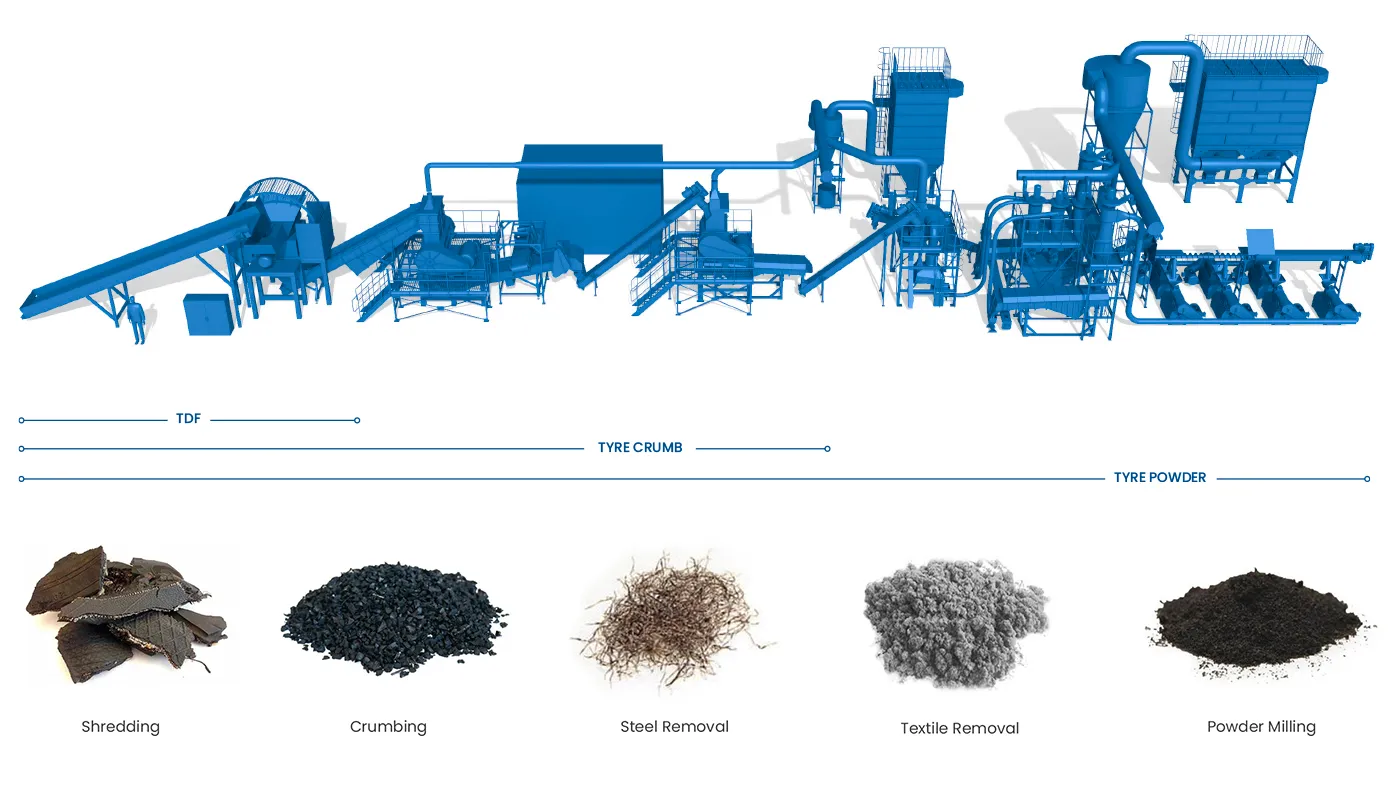
A tire recycling machine transforms end-of-life tires — passenger car, truck, OTR (off-the-road), and industrial — into reusable materials: crumb rubber, rubber powder, steel wire, and fiber. With an estimated 1.5 billion waste tires generated globally each year and landfill bans tightening across North America, Europe, and Asia, tire recycling is both an environmental necessity and a profitable business. This guide covers every machine type in the tire recycling process, real specifications, output products and their markets, and a step-by-step framework for building or upgrading a tire recycling line.
What Is a Tire Recycling Machine?
A tire recycling machine is any equipment used to break down waste tires into reusable raw materials. No single machine processes a whole tire into finished product — tire recycling requires a sequence of specialized machines, each handling a specific stage: debeading (removing steel bead wire), shredding (primary size reduction), granulating (secondary size reduction), steel separation, fiber separation, and grinding (fine powder production). The term "tire recycling machine" typically refers to the complete line or to the primary shredder that anchors the system.
The Tire Recycling Process: Step by Step
Understanding the complete process helps you specify the right equipment for each stage. Here is the standard mechanical tire recycling process used in ambient-temperature processing:
Stage 1: Collection and Inspection
Waste tires arrive from tire dealers, auto shops, fleet operators, and municipal collection points. Inspect for contamination (rims still mounted, excessive mud, chemical contamination) and sort by type: passenger car tires (PCT), truck and bus tires (TBT), and OTR tires each require different processing parameters due to size and steel content differences.
Stage 2: Debeading
A tire debeading machine extracts the steel bead wire from each tire sidewall. This step is critical: bead wire left in the tire damages shredder blades and contaminates the rubber output. A single-hook debeader processes 60–120 passenger tires per hour. Removing the bead wire also makes subsequent shredding 30–40% more energy-efficient because the shredder doesn't need to cut through hardened steel cable.
Stage 3: Sidewall Cutting (Optional)
For large truck and OTR tires, a tire cutting machine separates sidewalls from the tread. This reduces the size of material entering the primary shredder and allows sidewalls and treads to be processed separately or sold as-is for specific applications (e.g., sidewall rubber for conveyor belt liners). Learn more about why sidewall cutting matters in tire recycling.
Stage 4: Primary Shredding
The tire shredder is the core machine in any tire recycling line. A low-speed, high-torque double-shaft shredder tears whole tires (or pre-cut sections) into rough chips of 50–100 mm. Primary shredders for tire recycling typically use 30–110 kW motors and process 500–3,000 kg/h depending on tire type and machine size. The output — called tire-derived fuel (TDF) chips at this stage — already has commercial value as an alternative fuel.
Stage 5: Secondary Shredding / Granulation
A tire granulator reduces the 50–100 mm chips to 5–20 mm granules. At this stage, steel wire liberates from the rubber matrix and can be removed by magnetic separators. Textile fiber also separates and is removed by air classifiers or vibrating screens. The output is a mix of rubber granules, loose steel wire, and fiber. See our detailed guide on waste tire granulators and output specifications.
Stage 6: Steel and Fiber Separation
Overband magnetic separators and magnetic drums remove steel wire fragments from the rubber granules — typically achieving 99%+ steel removal. Air classifiers and vibrating screens remove textile fiber (nylon, polyester cord). The separated steel sells as scrap metal ($100–$200/ton); fiber can be used as insulation or fuel supplement.
Stage 7: Fine Grinding (Optional)
For higher-value applications, a rubber pulverizer/grinder further reduces granules to fine rubber powder (40–80 mesh / 0.2–0.4 mm). Fine rubber powder commands premium prices ($300–$600/ton) for use in molded rubber products, asphalt modification, and sports surfacing. Cryogenic grinding (freezing rubber with liquid nitrogen before milling) produces even finer powder but adds $50–$100/ton in processing cost.
Tire Recycling Machine Types
Here is every machine type used in a tire recycling line, with specifications from Energycle's manufacturing range:
| Machine | Function | Throughput | Motor Power | Output Size |
|---|---|---|---|---|
| Tire Debeader | Extract bead wire from tire sidewall | 60–120 tires/h | 7.5–15 kW | Whole tire (wire removed) |
| Tire Cutter | Cut sidewalls from tread | 40–80 tires/h | 5.5–11 kW | Sidewall strips + tread rings |
| Primary Shredder (Double-Shaft) | Shred whole/cut tires to chips | 500–3,000 kg/h | 30–110 kW | 50–100 mm chips |
| Tire Granulator | Reduce chips to granules, liberate wire | 300–2,000 kg/h | 22–75 kW | 5–20 mm granules |
| Magnetic Separator | Remove steel wire from granules | Matches line speed | 1.5–4 kW | Clean granules + steel wire |
| Air Classifier / Fiber Separator | Remove textile fiber from granules | Matches line speed | 3–7.5 kW | Clean granules + fiber |
| Rubber Pulverizer | Grind granules to fine powder | 200–800 kg/h | 37–75 kW | 40–80 mesh powder |
Output Products and Market Value
A tire recycling line produces multiple revenue streams. Understanding output products and their markets helps you decide how far to process and which equipment stages to invest in:
| Output Product | Size | Market Price | Applications |
|---|---|---|---|
| TDF Chips | 50–100 mm | $30–$80/ton | Cement kiln fuel, power plant fuel (replaces coal) |
| Crumb Rubber (coarse) | 5–20 mm | $120–$250/ton | Playground surfaces, sports tracks, landscaping mulch |
| Crumb Rubber (fine) | 1–5 mm | $200–$400/ton | Asphalt rubber (road paving), molded products, athletic fields |
| Rubber Powder | 40–80 mesh | $300–$600/ton | Rubber compound additive, waterproofing, automotive parts |
| Steel Wire | — | $100–$200/ton | Steel scrap recycling (foundries, mini-mills) |
| Textile Fiber | — | $20–$50/ton | Insulation, fuel supplement, geotextile filler |
A typical passenger car tire weighs 8–10 kg and contains approximately 70% rubber, 15% steel, and 15% textile fiber by weight. Processing 1,000 tires produces roughly 7 tons of rubber, 1.5 tons of steel, and 1.5 tons of fiber.
TDF vs. TDA vs. Crumb Rubber: End-Product Comparison
The three main product categories from tire recycling serve very different markets. Your processing depth determines which products you can sell:
| Product | Processing Required | Capital Investment | Revenue/ton | Market Demand |
|---|---|---|---|---|
| TDF (Tire-Derived Fuel) | Shredding only (1 stage) | Low ($80K–$200K) | $30–$80 | Stable — cement kilns, power plants |
| TDA (Tire-Derived Aggregate) | Shredding + screening | Low-Medium ($100K–$250K) | $50–$120 | Growing — civil engineering fills, drainage |
| Crumb Rubber | Shredding + granulation + separation | Medium-High ($200K–$600K) | $120–$600 | Strong — sports surfaces, asphalt, molded goods |
Our recommendation for new operations: Start with TDF production (lowest capital, immediate revenue), then add granulation and separation equipment as cash flow permits. The shredder purchased for TDF production becomes stage 1 of the crumb rubber line — zero wasted investment. For detailed market analysis, see our guide on tire recycling markets: TDF vs. TDA vs. CRM.
Passenger Car vs. Truck vs. OTR Tire Processing
Different tire types require different equipment sizing and processing approaches:
| Parameter | Passenger Car Tire | Truck/Bus Tire | OTR Tire |
|---|---|---|---|
| Weight | 8–10 kg | 40–70 kg | 200–4,000 kg |
| Diameter | 550–700 mm | 900–1,200 mm | 1,800–4,000 mm |
| Steel Content | 10–15% | 15–25% | 10–20% |
| Debeading | Standard single-hook | Heavy-duty debeader | Hydraulic OTR debeader |
| Pre-Cutting | Optional | Recommended | Required |
| Shredder Size | 30–55 kW | 55–90 kW | 90–200+ kW |
| Throughput (shredder) | 500–2,000 kg/h | 800–2,500 kg/h | Custom per project |
Complete Tire Recycling Line Configurations
Basic TDF Line (Lowest Investment)
Debeader → primary shredder → magnetic separator → screening. Output: 50–100 mm TDF chips + steel wire. Throughput: 500–2,000 kg/h. Investment: $80,000–$200,000. Payback: 12–24 months at 8 hours/day operation.
Crumb Rubber Line (Medium Investment)
Debeader → primary shredder → granulator → magnetic separator → air classifier → vibrating screen. Output: 1–5 mm clean crumb rubber + steel + fiber. Throughput: 300–1,500 kg/h of finished crumb. Investment: $200,000–$600,000. Payback: 8–18 months. Watch our tire recycling line trial run.
Fine Rubber Powder Line (Highest Value)
Full crumb rubber line + rubber pulverizer + fine screening + packaging. Output: 40–80 mesh rubber powder. Throughput: 200–800 kg/h of powder. Investment: $400,000–$1,000,000+. Payback: 12–24 months. Highest revenue per ton but requires larger capital and more skilled operators.
5-Step Selection Framework
Step 1: Define Your Feedstock
Passenger car tires, truck tires, or OTR tires? Mixed or single type? Expected daily/monthly volume in tons? Tire type determines every machine specification in the line — a 500 kg/h passenger car line is a completely different setup from a 500 kg/h truck tire line.
Step 2: Choose Your End Product
TDF chips (simplest), crumb rubber (best balance of investment vs. revenue), or fine rubber powder (highest value, highest investment)? Research local market demand — a crumb rubber line is pointless if no buyers exist within economical shipping distance. Identify at least 2–3 potential buyers before investing.
Step 3: Size Your Line
Calculate required throughput from your tire supply volume. A facility processing 50 tons/day of passenger car tires needs approximately 3,000–4,000 kg/h primary shredding capacity (accounting for 8-hour shifts and 80% uptime). Always size equipment for peak capacity plus 20% margin.
Step 4: Plan Your Layout
A complete crumb rubber line requires 500–2,000 m² of covered space plus outdoor tire storage area. Plan material flow: tire receiving → debeading → shredding → granulation → separation → screening → product storage. Include space for maintenance access, spare parts, and future expansion.
Step 5: Calculate ROI
Revenue = (rubber tonnage × rubber price) + (steel tonnage × steel price) + tipping fees (if charged for tire acceptance). Costs = equipment depreciation + electricity + labor + maintenance + rent. Most tire recycling operations charge $1–$3 per tire as a tipping/acceptance fee — this alone can cover 30–50% of operating costs. A 1,000 kg/h crumb rubber line typically generates $300,000–$600,000 annual gross revenue with 40–60% margins.
Maintenance Essentials
Tire recycling equipment operates in harsh conditions — abrasive rubber, embedded steel wire, and high torque loads. A disciplined maintenance program is non-negotiable:
- Daily: Inspect shredder blades for chipping, clear jammed material, check oil levels on hydraulic systems
- Weekly: Verify magnetic separator strength, check conveyor belt tension and alignment, inspect granulator screens for wear holes
- Monthly: Lubricate all bearings, inspect electrical connections and motor temperatures, check shredder shaft seals
- Every 500–1,000 hours: Rotate or replace shredder blades (tire processing wears blades 2–3× faster than standard plastic shredding due to steel wire contact)
- Annually: Full machine inspection, replace worn screens and liners, check gearbox oil, verify safety systems
Blade costs are the largest maintenance expense — budget $5,000–$15,000 annually for a mid-size line. Using wear-resistant blade materials (D2, DC53, or hardfacing) extends blade life 40–80%. See our shredder blade metallurgy guide.
Getting Started with Energycle
Energycle manufactures complete tire recycling machine lines — from debeading through shredding, granulation, separation, and grinding. With installations across Africa, Southeast Asia, the Middle East, and South America, we provide:
- Free project consultation — tell us your tire supply, target product, and budget; we design the optimal line configuration
- Turnkey line supply — all machines, conveyors, electrical panels, and controls from a single source
- Installation and commissioning — our engineers install on-site and train your operators
- Spare parts and blade supply — fast delivery of wear parts to minimize downtime
Contact our engineering team with your tire type, daily volume, and target end product — we will design a line and provide a complete quotation within one week.
Frequently Asked Questions
How much does a tire recycling machine cost?
A basic TDF shredding line (debeader + shredder + magnetic separator) costs $80,000–$200,000. A complete crumb rubber line costs $200,000–$600,000. A fine rubber powder line with pulverizer costs $400,000–$1,000,000+. Individual machines: tire shredders $30,000–$150,000, debeaders $8,000–$25,000, granulators $20,000–$80,000. Payback periods range from 8–24 months depending on configuration and local market prices.
What is the tire recycling process?
The standard mechanical tire recycling process has 6–7 stages: (1) collection and sorting, (2) debeading (steel bead wire removal), (3) optional sidewall cutting, (4) primary shredding to 50–100 mm chips, (5) granulation to 5–20 mm, (6) magnetic and air separation to remove steel wire and fiber, and (7) optional fine grinding to 40–80 mesh powder. Each stage adds value to the output product.
Is tire recycling profitable?
Yes — tire recycling generates revenue from multiple streams: crumb rubber ($120–$600/ton depending on fineness), steel wire ($100–$200/ton), tipping fees ($1–$3 per tire accepted), and fiber ($20–$50/ton). A mid-size crumb rubber operation processing 1,000 kg/h typically generates $300,000–$600,000 annual gross revenue with 40–60% profit margins after operating costs.
What size shredder do I need for tire recycling?
For passenger car tires: a 30–55 kW double-shaft shredder handles 500–2,000 kg/h. For truck tires: 55–90 kW for 800–2,500 kg/h. For OTR tires: 90–200+ kW, custom-engineered. Always size for peak volume plus 20% margin, and account for 80% uptime (maintenance, shift changes, feeding gaps).
What is the difference between TDF, TDA, and crumb rubber?
TDF (tire-derived fuel) is coarsely shredded tire chips (50–100 mm) burned as alternative fuel in cement kilns. TDA (tire-derived aggregate) is shredded tire pieces used as lightweight fill in civil engineering projects. Crumb rubber is finely granulated rubber (1–5 mm) used in sports surfaces, asphalt modification, and molded products. Each requires progressively more processing equipment but commands higher prices.
Can I recycle truck tires and car tires on the same line?
Yes, but the line must be sized for the larger tire. A shredder designed for truck tires easily handles passenger car tires, but not vice versa. The main difference is debeading — truck tires need a heavy-duty debeader. Feed rate drops when processing larger tires because each tire takes longer to shred. Many operators process car tires and truck tires in separate batches.
How long do tire shredder blades last?
Tire shredder blades last 500–1,000 operating hours before needing rotation or replacement — roughly 2–4 months at 8 hours/day. Steel bead wire in tires causes 2–3× faster blade wear compared to standard plastic shredding. D2 and DC53 tool steel blades offer the best cost-to-life ratio; tungsten carbide-tipped blades last longer but cost 4–6× more upfront.
What permits do I need for tire recycling?
Requirements vary by jurisdiction but typically include: waste processing/recycling license, environmental permit (air emissions, noise, water discharge), fire safety clearance (tire storage is a significant fire risk), and business operating permits. Some regions also require tire storage limits (maximum number of tires on-site). Consult your local environmental agency before investing in equipment.
Related Resources
- Tire Recycling Machine — Product Range
- Tire Shredder
- Tire Recycling Markets: TDF vs TDA vs CRM Specs
- Waste Tire Granulators: How They Work
- Tire Granulators: Steel Wire Separation & Crumb Rubber Specs
- Single Hook Tire Wire Debeading Machine
- Waste Tire Cutting Machine
- Tire Rubber Recycling Pulverizing Grinder
- Why Is the Sidewall Cut During Tire Recycling?
- Waste Tire Recycling Line Trial Run
- Double Shaft Shredder for Plastic, Metal & Tire
- Shredder Blade Metallurgy Guide
- Plastic Recycling Machine: Complete Guide
An eddy current separator (ECS) recovers non-ferrous metals — aluminum cans, copper wire, brass fittings, zinc die-castings — from mixed waste streams by exploiting electromagnetic repulsion. If your recycling line processes municipal solid waste (MSW), auto shredder residue (ASR), electronic scrap, incineration bottom ash (IBA), or PET bottle flakes contaminated with aluminum closures, an eddy current separator is how you pull the non-ferrous value out. This guide covers the physics behind the technology, every ECS type Energycle offers, real operating parameters, and a step-by-step framework for specifying the right separator for your application.
What Is an Eddy Current Separator?
An eddy current separator is an electromagnetic sorting machine that separates non-ferrous metals from non-metallic materials on a conveyor belt. The core mechanism: a high-speed magnetic rotor spinning inside a non-metallic shell drum generates rapidly alternating magnetic fields. When conductive metals pass through these fields, electric currents (eddy currents) are induced inside the metal pieces, creating their own magnetic fields that oppose the rotor's field. The resulting repulsive force launches non-ferrous metals forward off the belt, while non-conductive materials (plastic, glass, wood, paper) simply fall off the belt end by gravity.
The separation force depends on a material's conductivity-to-density ratio. Aluminum (high conductivity, low density) separates most easily. Copper and brass (high conductivity but higher density) require stronger fields or slower belt speeds. Stainless steel and lead respond poorly to eddy current separation due to low conductivity or very high density.
How Does an Eddy Current Separator Work?
The working principle follows Faraday's Law of electromagnetic induction and Lenz's Law. Here is the step-by-step process:
Step 1: Material Feeding
Pre-sorted material (ferrous metals already removed by magnetic drum or overband separator) feeds onto the ECS conveyor belt as a thin, uniform layer. A vibratory feeder upstream ensures monolayer distribution — stacked particles reduce separation efficiency by 30–50%.
Step 2: Magnetic Field Exposure
As material reaches the head pulley, it passes over the magnetic rotor spinning at 2,000–5,000 RPM inside a stationary shell. The rotor contains alternating N-S-N-S permanent magnets (typically NdFeB rare-earth) arranged around its circumference. This creates a rapidly changing magnetic field at the belt surface.
Step 3: Eddy Current Induction
When a conductive metal piece enters this alternating field, circulating electric currents (eddy currents) are induced within the metal. Per Lenz's Law, these eddy currents generate their own magnetic field that opposes the external field — creating a repulsive (Lorentz) force that pushes the metal piece away from the rotor.
Step 4: Trajectory Separation
Three forces act on each particle simultaneously: (1) the eddy current repulsive force (forward/upward), (2) belt conveyor momentum (forward), and (3) gravity (downward). Non-ferrous metals, receiving the additional repulsive kick, follow a longer trajectory and land in the "metals" collection bin. Non-conductive materials simply drop off the belt end into a separate "non-metals" bin. An adjustable splitter plate between the two bins lets operators fine-tune the cut point.
Types of Eddy Current Separators
Different applications require different ECS designs. The main distinction is rotor geometry — concentric vs. eccentric — which determines the magnetic field pattern and optimal particle size range.
Concentric Pole Rotor ECS
The magnetic rotor is centered inside the shell drum. This produces a uniform, symmetrical field pattern ideal for standard recycling applications where particle sizes range from 20–150 mm. Concentric ECS units are the industry workhorse — used in MSW recycling, construction & demolition (C&D) waste, auto shredder residue, and general scrap processing. They offer reliable separation at high throughput with lower maintenance costs.
Eccentric Pole Rotor ECS
The magnetic rotor is offset (eccentric) inside the shell, creating an intense but localized field zone. This concentrates maximum magnetic energy at the separation point, making eccentric ECS units effective for fine particles down to 5 mm. Applications include IBA (incinerator bottom ash) processing, zorba/zurik sorting, WEEE (waste electrical and electronic equipment) recovery, and fine aluminum recovery from glass cullet. Our high-recovery ECS for fine aluminum uses this design.
High-Frequency ECS
Uses more magnetic poles (typically 18–30 poles vs. 12–16 on standard units) and higher rotor speeds to create rapid field alternation. This design targets the smallest non-ferrous particles (5–20 mm) where standard concentric units lose effectiveness. High-frequency ECS is essential for fine fraction processing in IBA plants, wire-chopping lines, and small WEEE recycling.
Wet Eddy Current Separator
Processes material in a water slurry rather than on a dry belt. Used where the feed is already wet (e.g., slag quench water, heavy media plant tailings) or where dust control is critical. Less common than dry ECS but necessary in specific metallurgical and mining applications.
Eddy Current Separator Type Comparison
| Type | Particle Size Range | Rotor Speed | Poles | Best Applications | Recovery Rate |
|---|---|---|---|---|---|
| Concentric (Standard) | 20–150 mm | 2,000–3,500 RPM | 12–16 | MSW, C&D, auto shredder, general scrap | 90–95% |
| Eccentric | 5–50 mm | 3,000–5,000 RPM | 14–22 | IBA, WEEE, zorba/zurik, fine aluminum | 85–93% |
| High-Frequency | 5–20 mm | 3,500–5,000 RPM | 18–30 | Fine fraction IBA, wire chopping, small WEEE | 80–90% |
| Wet | 5–80 mm | 1,500–3,000 RPM | 12–18 | Slag processing, wet mining tailings | 75–88% |
Key Operating Parameters
Five parameters determine eddy current separator performance. Optimizing these based on your specific material stream is the difference between 70% and 95% recovery rates.
1. Rotor Speed (RPM)
Higher rotor speed increases field alternation frequency and repulsive force — but only up to a point. Beyond the optimal RPM for a given particle size, performance plateaus or drops because particles receive too-brief field exposure. Typical operating range: 2,000–5,000 RPM. Start at 3,000 RPM and adjust based on recovery results. Fine particles need higher RPM; large aluminum cans separate well at lower speeds.
2. Belt Speed
Belt speed controls three factors: material burden depth (faster = thinner layer), dwell time in the magnetic field (faster = less exposure), and particle trajectory after separation. Optimal belt speed creates a single-particle-thick layer without stacking. Typical range: 1.5–3.0 m/s. Increase belt speed for high-throughput applications; decrease for fine-fraction recovery.
3. Splitter Position
The adjustable divider between metal and non-metal collection bins. Moving the splitter closer to the belt increases metal purity but reduces recovery; moving it further away increases recovery but allows more non-metal contamination. Set the splitter position based on whether your priority is maximum recovery (recycling revenue) or maximum purity (downstream process requirement).
4. Feed Layer Uniformity
The single most overlooked parameter. Stacked material blocks magnetic field access to lower layers, cutting recovery by 30–50%. Use a vibratory feeder to spread material into a uniform monolayer before it reaches the ECS head pulley. For wet or sticky material, install a pre-screening stage to remove fines that cause bridging.
5. Ferrous Pre-Removal
Ferrous metals (steel, iron) must be removed before the ECS. Steel pieces attract to the magnetic rotor shell, wrapping around it and damaging the belt, reducing non-ferrous separation effectiveness, and causing costly downtime. Always install a magnetic separator upstream — overband magnets, magnetic drums, or pulley magnets remove 99%+ of ferrous contamination.
Material Separation Performance
Not all non-ferrous metals separate equally. The governing factor is the conductivity-to-density ratio (σ/ρ) — higher ratios produce stronger separation forces. Here is how common materials rank:
| Material | Conductivity (MS/m) | Density (kg/m³) | σ/ρ Ratio | ECS Separation |
|---|---|---|---|---|
| Aluminum | 37.7 | 2,700 | 14.0 | Excellent — primary target metal |
| Magnesium | 22.6 | 1,740 | 13.0 | Excellent |
| Copper | 59.6 | 8,960 | 6.7 | Good — needs slower belt or higher RPM |
| Brass | 15.9 | 8,500 | 1.9 | Moderate — larger pieces only |
| Zinc | 16.6 | 7,130 | 2.3 | Moderate |
| Lead | 4.8 | 11,340 | 0.4 | Poor — density too high |
| Stainless Steel | 1.4 | 7,900 | 0.2 | Very poor — use sensor-based sorting |
This table explains why aluminum cans are the easiest material to recover with an ECS (highest σ/ρ ratio), while stainless steel requires sensor-based sorting technologies instead.
Specifications Reference
Energycle manufactures eddy current separators in working widths from 600 mm to 2,000 mm. Here are representative specifications across our range:
| Model | Belt Width | Throughput | Motor Power | Rotor Diameter | Rotor Speed |
|---|---|---|---|---|---|
| ECS-600 | 600 mm | 1–3 t/h | 4 kW | Ø300 mm | Up to 4,000 RPM |
| ECS-800 | 800 mm | 2–5 t/h | 5.5 kW | Ø300 mm | Up to 4,000 RPM |
| ECS-1000 | 1,000 mm | 3–8 t/h | 7.5 kW | Ø350 mm | Up to 3,800 RPM |
| ECS-1200 | 1,200 mm | 5–12 t/h | 11 kW | Ø350 mm | Up to 3,800 RPM |
| ECS-1500 | 1,500 mm | 8–18 t/h | 15 kW | Ø400 mm | Up to 3,500 RPM |
| ECS-2000 | 2,000 mm | 12–25 t/h | 22 kW | Ø400 mm | Up to 3,500 RPM |
All models feature VFD (variable frequency drive) for rotor speed adjustment, NdFeB rare-earth magnets, replaceable non-magnetic shell, and adjustable splitter plate. Visit our eddy current separator product page for full specifications and configuration options.
Industry Applications
Eddy current separators serve every industry that needs to recover non-ferrous metals from mixed material streams:
Municipal Solid Waste (MSW) Recycling
In materials recovery facilities (MRFs), ECS recovers aluminum cans and other non-ferrous metals after magnetic separation removes steel. A typical MRF processes 20–50 t/h and recovers 95%+ of aluminum cans with a single ECS pass. The recovered aluminum generates $800–$1,500/ton revenue — often the highest-value stream in MSW recycling. See our complete MSW sorting machine lineup.
Auto Shredder Residue (ASR)
After end-of-life vehicles are shredded, the mixed output contains aluminum engine parts, copper wiring, brass fittings, and zinc die-castings among plastic and glass. Multi-stage ECS processing (coarse fraction + fine fraction) recovers 85–92% of non-ferrous metals from ASR, adding $50–$120 per vehicle in recovered metal value.
Incineration Bottom Ash (IBA)
Waste-to-energy plant bottom ash contains 5–12% non-ferrous metals by weight — primarily aluminum and copper. Processing IBA through screening, magnetic separation, and eccentric/high-frequency ECS recovers metals worth €40–€80 per ton of ash processed. This application requires fine-particle ECS capability (down to 5 mm) due to the granular nature of IBA.
Electronic Waste (WEEE)
After shredding, e-waste contains copper, aluminum, brass, and precious metals mixed with plastic and circuit board fragments. ECS recovers the bulk non-ferrous metals; downstream sensor-based sorting or density separation further purifies the output. Typical recovery: 80–90% of aluminum and copper from shredded WEEE.
PET Bottle Recycling
Aluminum closures and rings must be removed from PET flake streams to achieve food-grade purity. An ECS positioned after crushing and washing removes 98%+ of aluminum contamination, bringing metal content below the 50 ppm threshold required for bottle-to-bottle recycling. Learn more about achieving ≤50 ppm metal in recycled pellets.
Construction & Demolition (C&D) Waste
Demolition debris contains aluminum window frames, copper pipe and wire, brass fixtures, and other non-ferrous metals. After primary crushing and ferrous removal, ECS recovers these high-value metals from the mixed aggregate, wood, and concrete stream.
Where ECS Fits in a Recycling Line
An eddy current separator never operates alone. Here is the typical position in a recycling line and the equipment it works alongside:
Typical processing sequence:
- Size reduction — shredder or crusher breaks material to processable size
- Screening — trommel or vibrating screen separates material into size fractions
- Ferrous removal — magnetic separator (overband, drum, or pulley) removes steel and iron
- Eddy current separation — ECS recovers non-ferrous metals from remaining stream
- Further sorting — sensor-based sorting, density separation, or manual QC for final purity
For maximum recovery, many facilities use two ECS units in series: a concentric unit for the coarse fraction (>20 mm) and an eccentric or high-frequency unit for the fine fraction (5–20 mm). This dual-stage approach recovers 15–25% more non-ferrous metal than a single-pass system.
5-Step Selection Framework
Use this framework when specifying an eddy current separator for your operation:
Step 1: Characterize Your Feed Material
Identify the non-ferrous metals present (aluminum, copper, brass, zinc), their particle size distribution, percentage by weight in the feed, and moisture level. This determines whether you need a concentric, eccentric, or high-frequency ECS design and what recovery rate to expect.
Step 2: Determine Required Throughput
Measure your feed rate in tons per hour. The ECS belt width must handle this volume while maintaining monolayer feed distribution. A 1,000 mm belt handles 3–8 t/h depending on material bulk density; wider belts for higher throughput. Always size for peak capacity plus 20% margin.
Step 3: Choose Rotor Configuration
Concentric rotor for particles >20 mm (standard applications). Eccentric rotor for particles 5–50 mm (fine fraction, IBA, WEEE). High-frequency rotor for particles 5–20 mm (maximum fine-particle recovery). If your feed contains both coarse and fine fractions, plan for two ECS units in series.
Step 4: Verify Upstream Equipment
Confirm ferrous pre-removal is adequate (≤0.5% ferrous in ECS feed). Verify screening/sizing produces the correct size fraction for your ECS type. Ensure vibratory feeder or spreading conveyor is included for uniform monolayer distribution. Missing any upstream step significantly reduces ECS performance.
Step 5: Calculate ROI
Estimate annual non-ferrous recovery tonnage × metal value per ton = gross revenue. Subtract ECS operating costs (electricity, belt replacement every 12–18 months, rotor shell replacement every 3–5 years, maintenance labor). Most ECS installations achieve payback within 6–18 months based on recovered metal value alone — aluminum recovery at 95% rates generates $800–$1,500/ton revenue.
Maintenance and Troubleshooting
Eddy current separators are relatively low-maintenance compared to other recycling equipment, but regular checks prevent costly downtime:
| Interval | Task | Details |
|---|---|---|
| Daily | Visual inspection | Check belt tracking, splitter position, and discharge areas for material buildup |
| Weekly | Belt tension check | Verify belt tension and alignment; misalignment causes uneven wear and reduced separation |
| Monthly | Bearing lubrication | Grease rotor and drive bearings per manufacturer schedule |
| Monthly | Shell inspection | Check non-magnetic shell for wear marks from ferrous contamination; replace if worn through |
| Quarterly | Magnetic field check | Verify rotor magnetic field strength with a gaussmeter — NdFeB magnets degrade <1% per year |
| Annually | Belt replacement | Replace conveyor belt; inspect drive components, rollers, and bearings |
| 3–5 years | Shell replacement | Replace non-magnetic rotor shell (carbon fiber or stainless steel) when worn below minimum thickness |
Common issues and solutions:
- Low recovery rate → Check feed layer uniformity (most common cause), verify rotor speed matches particle size, inspect splitter position
- Metal in non-metal bin → Increase rotor speed, reduce belt speed, or move splitter further from belt
- Non-metal in metal bin → Decrease rotor speed, increase belt speed, or move splitter closer to belt
- Belt damage → Ferrous contamination reaching rotor; improve upstream magnetic separation
- Excessive vibration → Check rotor balance, bearing condition, and belt tracking alignment
Getting Started with Energycle
Energycle manufactures eddy current separators in concentric and eccentric configurations with belt widths from 600 mm to 2,000 mm. We also provide complete sorting and recycling line integration including:
- Free material testing — send us a sample of your waste stream and we test separation performance on our ECS units
- Custom rotor configurations — pole count, magnet grade, and rotor speed optimized for your specific material
- Complete line design — from shredding through screening, magnetic separation, eddy current separation, and sensor sorting
- After-sales support — spare belts, replacement shells, remote troubleshooting, and on-site commissioning
Contact our engineering team with your material type, throughput, and target metal recovery — we will recommend the right ECS configuration and provide a detailed quotation within 48 hours.
Frequently Asked Questions
How does an eddy current separator work?
An eddy current separator works by spinning a magnetic rotor at 2,000–5,000 RPM inside a non-magnetic shell drum. When non-ferrous metals pass over the rotor on a conveyor belt, the rapidly changing magnetic field induces eddy currents inside the metals. These eddy currents create opposing magnetic fields (per Lenz's Law), generating a repulsive force that launches metals off the belt into a separate collection bin, while non-conductive materials simply fall off the end.
What metals can an eddy current separator recover?
Eddy current separators recover non-ferrous metals including aluminum (cans, extrusions, castings), copper (wire, pipe, fittings), brass, zinc die-castings, magnesium, and other conductive non-magnetic metals. Aluminum has the highest recovery rate (95%+) due to its high conductivity-to-density ratio. Copper and brass recovery is also good (85–92%) with proper rotor speed and belt speed optimization.
What is the difference between concentric and eccentric eddy current separators?
A concentric ECS has the rotor centered inside the shell, creating a uniform field ideal for particles 20–150 mm — the standard choice for most recycling applications. An eccentric ECS offsets the rotor to concentrate maximum field intensity at the separation point, enabling effective recovery of fine particles down to 5 mm. Choose concentric for general recycling; eccentric for IBA, WEEE, and fine-fraction applications.
What particle size can an eddy current separator process?
Standard concentric ECS units effectively separate particles from 20 mm to 150 mm. Eccentric and high-frequency models extend the lower range to 5 mm. Particles below 5 mm generally cannot be separated by ECS and require alternative technologies like electrostatic separation or wet gravity concentration. For best results, screen your material into size fractions and use the appropriate ECS type for each fraction.
How much does an eddy current separator cost?
Small ECS units (600 mm belt width, 1–3 t/h) start around $15,000–$25,000. Mid-range models (1,000–1,200 mm, 5–12 t/h) cost $30,000–$65,000. Large industrial units (1,500–2,000 mm, 12–25 t/h) range from $70,000–$150,000. Most installations achieve payback within 6–18 months from recovered metal value — a facility recovering 100 kg/h of aluminum generates $80,000–$150,000 annual revenue at current market prices.
Why is ferrous removal needed before an eddy current separator?
Ferrous metals (steel, iron) are attracted to the ECS magnetic rotor rather than repelled. They wrap around the shell, damaging the belt, blocking non-ferrous metal separation, and requiring costly emergency shutdowns for removal. Always install magnetic drums, overband magnets, or pulley magnets upstream to remove 99%+ of ferrous metals before the ECS.
Can an eddy current separator recover copper?
Yes, but copper is harder to separate than aluminum due to its higher density (8,960 kg/m³ vs. 2,700 kg/m³ for aluminum). Despite copper's excellent conductivity, its lower conductivity-to-density ratio means the repulsive force relative to gravity is weaker. Optimize copper recovery by using slower belt speeds, higher rotor RPM, and an eccentric rotor design. Expect 85–92% copper recovery with proper optimization.
What maintenance does an eddy current separator require?
Daily: visual inspection of belt tracking and discharge. Weekly: belt tension check. Monthly: bearing lubrication and shell wear inspection. Annually: belt replacement. Every 3–5 years: rotor shell replacement. NdFeB magnets degrade less than 1% per year and typically last 15–20+ years. Total annual maintenance cost is typically 3–5% of equipment purchase price — far lower than most recycling machines.
Related Resources
- Eddy Current Magnetic Separator — Product Page
- Advanced Eddy Current Separator for Recycling
- High-Recovery ECS for Fine Aluminum
- Suspended Self-Discharging Magnetic Separator
- Sorting Machinery for Plastic Recycling
- MSW Sorting Machines
- Bag Breaker for MSW Sorting
- E-Scrap Shredder for WEEE
- How to Achieve ≤50 ppm Metal in Recycled Pellets
- Plastic Recycling Machine: Complete Guide