

Industrial Baler Solutions for Recycling Plants
Industrial Balers for Paper, Plastic, PET Bottles, and Mixed Recyclables
Explore Energycle industrial balers for continuous and batch compaction. This parent page helps you compare automation level, material fit, bale density, and throughput range before choosing the right model for your recycling line.
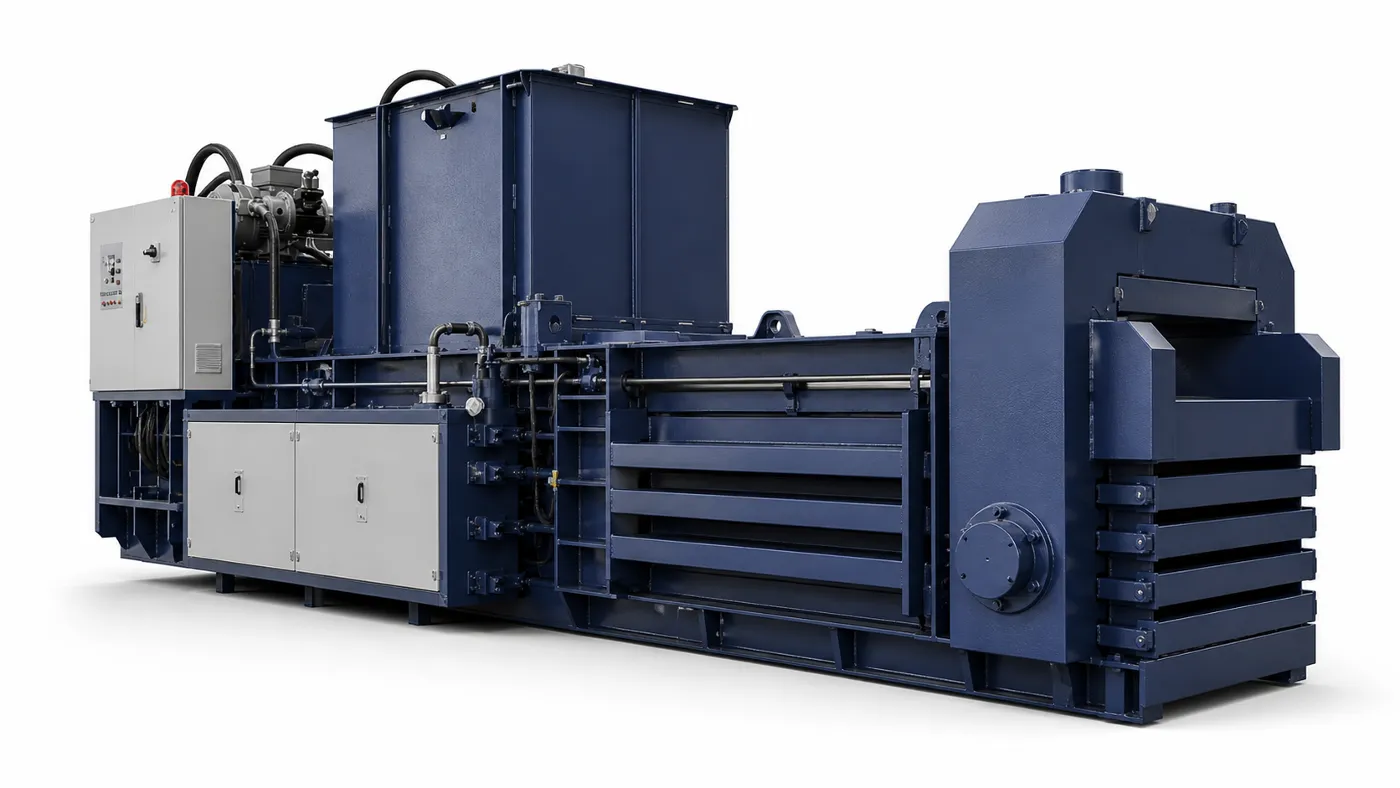
Why Recycling Facilities Use Industrial Balers
A properly selected baler does more than reduce volume. It stabilizes outbound logistics, lowers handling cost, and improves bale consistency for sale or downstream recycling.
Higher Bale Density for Better Freight Efficiency
Dense and stable bales reduce transport frequency, improve truck utilization, and make warehouse stacking more predictable.
Logistics ROIReduced Handling Volume
Compaction simplifies storage and transfer of loose paper, film, and containers in high-traffic recycling operations.
Automation Options by Throughput
From manual tying to fully automatic tying and conveyor feeding, different baler routes can match different plant scales.
More Uniform Bale Quality
Stable bale shape and weight improve internal handling, loading safety, and buyer confidence for recycled material transactions.
Lower Total Baling Cost per Ton
With the right model and automation level, facilities can reduce labor, handling, and outbound logistics cost across long-term operations.
Configurable for Different Material Streams
Industrial balers can be configured for OCC, waste paper, PET bottles, plastic film, textile scraps, and mixed packaging waste with suitable infeed and tying logic.
Typical Industrial Baler Applications
Use this page to match your dominant material stream and daily tonnage with the right baler class before requesting a final proposal.
OCC and Waste Paper
For cardboard distribution centers, printing waste, and paper recovery facilities needing dense, transport-ready bales.
Plastic Film and Packaging
For LDPE film, stretch wrap, woven bag scraps, and post-commercial packaging requiring volume reduction.
PET Bottles and Cans
For beverage container recovery lines where bale consistency supports downstream sorting and resale.
Textile and Fiber Waste
For garment and textile industries compacting cotton fiber, cloth offcuts, and nonwoven scraps.
MRF and Municipal Stations
For mixed recyclable consolidation where volume, labor, and outbound logistics must be controlled continuously.
Logistics and Transfer Hubs
For sites that need fast compaction before cross-docking, export packing, or inter-plant transport.
How to Select the Right Industrial Baler
A quick planning workflow to avoid under-sizing or over-investing in your baling project.
Define Material Mix
Confirm main feedstock, contamination level, moisture, and required bale density by material type.
Estimate Throughput
Use hourly and daily volume targets to decide between vertical, semi-automatic, and fully automatic routes.
Set Automation Level
Choose feeding and tying logic based on labor availability, shift pattern, and expected continuity.
Confirm Bale Spec
Set bale size, weight range, and wire standard according to logistics and buyer requirements.
Finalize Proposal
Review footprint, power, and infeed integration before finalizing machine model and delivery plan.
Define Material Mix
Confirm main feedstock, contamination level, moisture, and required bale density by material type.
Estimate Throughput
Use hourly and daily volume targets to decide between vertical, semi-automatic, and fully automatic routes.
Set Automation Level
Choose feeding and tying logic based on labor availability, shift pattern, and expected continuity.
Confirm Bale Spec
Set bale size, weight range, and wire standard according to logistics and buyer requirements.
Finalize Proposal
Review footprint, power, and infeed integration before finalizing machine model and delivery plan.
Industrial Baler Type Comparison
Use this matrix to quickly narrow your route before jumping into model-level discussions.
| Decision Factor | Vertical Baler | Semi-Automatic Horizontal Baler | Fully Automatic Horizontal Baler |
|---|---|---|---|
| Best Project Scale | Small to medium | Medium to large | Large and continuous |
| Feeding Method | Manual batch loading | Organized infeed with operators | Conveyor-fed continuous flow |
| Tying Method | Manual tying | Semi-automatic/manual-assisted | Automatic tying |
| Labor Dependence | Higher | Medium | Lower at high throughput |
| Typical Use Case | Batch compaction at limited throughput | Growing facilities balancing budget and capacity | High-volume recycling lines prioritizing consistency and automation |
Industrial Baler Selection Guide
Reference matrix for early-stage model screening. Final sizing should be confirmed with your real feedstock and operating target.
| Selection Item | Vertical Baler Route | Semi-Automatic Horizontal Route | Fully Automatic Horizontal Route |
|---|---|---|---|
| Daily Material Volume | Lower to medium | Medium | Medium-high to high |
| Main Materials | PET bottles, textile, paper batches | Paper, film, mixed packaging | OCC, film, PET, mixed recyclables at scale |
| Automation Preference | Manual-heavy | Partial automation | High automation |
| Labor Availability | Requires more operator handling | Moderate staffing | Optimized for reduced manual intervention |
| Infeed Integration | Standalone/manual feed | Can integrate with basic infeed | Best for conveyor and continuous line integration |
| Investment Logic | Lower entry budget | Balanced capex and capacity | Best ROI when throughput is consistently high |
Swipe horizontally to view the full table on mobile.
Industrial Baler Models and Related Systems
Access the main baler routes and related upstream equipment from this category hub.
Fully Automatic Horizontal Hydraulic Baler
Continuous conveyor-fed baling with automatic tying for high-volume recycling operations.
Semi-Automatic Horizontal Balers
A practical route for medium-throughput sites balancing labor and automation investment.
PET Bottle and Cans Balers
Compaction solution for beverage container recovery and transport-efficient bale output.
Hydraulic Industrial Baler
Heavy-duty baling route for mixed industrial recyclables and flexible compaction scenarios.
Vertical Fiber & Textile Baler
Space-saving batch compaction for textiles, fabrics, and variable materials at lower throughputs.
Industrial Cardboard & Paper Baler
Dedicated compaction for OCC and paper waste, generating dense bales for efficient transport.
Semi-Auto Waste Paper Baling Machine
Specialized semi-automatic system designed to handle large volumes of loose waste paper efficiently.
Frequently Asked Questions About Industrial Balers
Key buyer questions before selecting baler type and model range.
Selection depends on daily throughput, labor plan, feeding method, and bale consistency target. In general, continuous high tonnage favors fully automatic horizontal systems, while lower batch volume often fits vertical balers.
Typical materials include OCC, mixed paper, PET bottles, cans, plastic film, textile waste, and other recyclable packaging streams. Actual suitability depends on moisture and contamination level.
Please provide material type, bulk density, contamination status, expected kg/h or tons/day, bale size requirement, and site power or layout constraints.
Yes. Semi-automatic and fully automatic horizontal balers are commonly integrated with conveyor infeed, sorting platforms, and bale transfer logistics.
This is the category hub. Use it to compare baler routes and then enter each model page for machine-level specifications and configuration details.
Need Help Selecting an Industrial Baler for Your Plant?
Tell us your material type, daily volume, preferred automation level, and bale target. We will recommend the right baler route and suitable model range.