

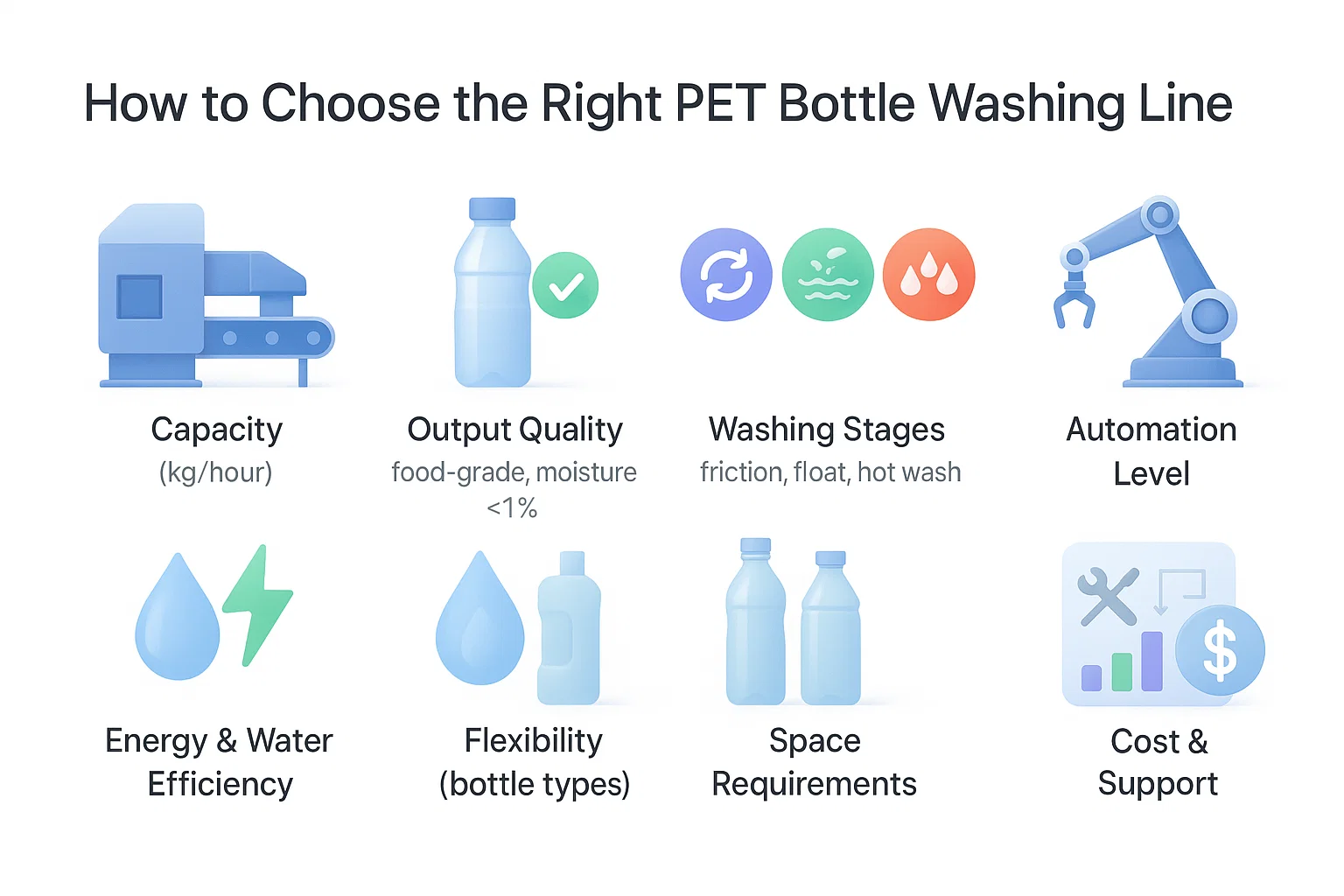
Choosing PET bottle washing line capacity begins with the required saleable flake output, not a supplier’s largest nameplate number. Feedstock composition, reject rate, planned operating time, sorting performance and the slowest process stage determine the useful capacity. A line sized from clean-bottle assumptions can miss its output target when it receives wet bales containing caps, labels, liquid, dirt and non-PET items.
Define which capacity you are comparing
Suppliers may describe capacity as contaminated bottle input, wet flake at an intermediate stage, dry flake output or the mechanical rating of one machine. Those figures are not interchangeable. State both the design feed rate and the guaranteed saleable output, together with the assumed feedstock and output specification.
| Capacity term | What it should mean | Question for the quotation |
|---|---|---|
| Input capacity | Mass of received PET-bottle feed entering the defined process boundary | Does this mass include moisture, liquid, caps, labels and dirt? |
| Intermediate capacity | Mass passing a named machine or stage | Is the material wet or dry, and what contaminants remain? |
| Saleable output | Dry PET flake that meets the written buyer specification | Which sampling and test methods determine acceptance? |
| Nameplate rate | Manufacturer rating for one machine under stated conditions | What test material and duty were used, and can adjacent stages support it? |
| Scheduled output | Saleable production over the planned shift, day or year | Which availability, cleaning and changeover assumptions are included? |
Measure feedstock before sizing equipment
Collect representative samples across suppliers, seasons and collection systems. Measure PET bottle content, caps and rings, labels, non-PET containers, metals, fines, dirt, retained liquid and moisture. Record colour and opaque PET separately when the buyer requires a specific flake stream.
Bale composition affects both mass balance and equipment load. Two tonnes of incoming bales do not necessarily produce two tonnes of PET flake. The Association of Plastic Recyclers’ PET rigid design guidance also shows why labels, adhesives, closures, colour and barrier components must be considered in the process.
Calculate required input rate from saleable output
Use the measured saleable yield and planned operating availability to estimate the feed rate required for a production target.
Required design input = target saleable output ÷ saleable yield ÷ planned availability
For an illustrative calculation only, suppose the target is 800 kg of specification flake per scheduled hour, trial data shows a saleable yield of 0.75, and planned availability over the schedule is 0.85. The calculated design input is 800 ÷ 0.75 ÷ 0.85, or about 1,255 kg/h. Replace these assumptions with your own trial and operating data; they are not an Energycle performance guarantee.
Keep water removed from wet material and contaminants rejected from the line separate in the mass balance. A lower output mass can reflect correct removal of dirt and non-PET material rather than poor recovery.
Size every stage to the same design basis
A line cannot maintain the target if its sorting station, label remover, granulator, hot washer, separation tank, dryer or bagging system becomes a continuous bottleneck. Ask each supplier to state the rate, material condition and buffer allowance at every stage.
| Stage | Capacity driver | Common sizing risk |
|---|---|---|
| Bale opening and feeding | Bale form, density and delivery pattern | Surges that overload sorting and size reduction |
| Sorting | Contaminant rate, item presentation and required purity | Using conveyor speed without checking sorter workload |
| Size reduction | Bottle geometry, blade condition, screen and feed rate | Rating the granulator on clean material only |
| Washing | Residue, adhesive, chemistry, temperature and residence time | Reducing residence time to chase throughput |
| Separation | Tank loading, flake form, skimming and reject discharge | Carrying contamination forward at peak rate |
| Drying | Incoming water, flake size and required final condition | Quoting moisture without a sampling method |
| Storage and packing | Bulk density, silo volume and bagging cycle | Allowing a full silo or slow bagging station to stop the line |
Match washing stages to the output specification
Cold washing may suit relatively clean material for a defined industrial outlet. Feedstock with difficult adhesive, oil or product residue may need controlled hot washing, chemical dosing and additional rinsing. These choices affect residence time, heating duty, water treatment and the practical line capacity.
Food-contact suitability cannot be established by hot washing alone. It requires source control, a validated recycling process, testing and jurisdiction-specific regulatory assessment. Define the intended market before requesting a line configuration rather than adding a “food-grade” label to a generic output target.
Check utility capacity at peak operating conditions
Electrical supply, process water, heat, compressed air, drainage and wastewater treatment must support simultaneous demand. A correctly sized machine can still lose production when water pressure falls, a heater cannot maintain the process condition or sludge handling interrupts circulation.
Request connected load and estimated operating demand separately. Confirm water quality, recirculation stages, heating source, discharge limits and ambient design conditions. The PET bottle recycling system overview shows the modules that should be included in this utility balance.
Drying capacity needs a defined moisture test
Mechanical dewatering removes free surface water and reduces the duty of downstream air or thermal drying. The result changes with flake size, feed rate, dryer condition and incoming water. Define where the sample is taken, how it is handled and which moisture test is used.
Our guide to centrifugal dryers for PET washing lines explains the variables that affect this stage. Do not select a dryer only from motor power or an unconditional moisture percentage.
Allow for operation, cleaning and maintenance
Scheduled production should account for startup, shutdown, product changes, cleaning, inspection, knife service, screen cleaning and planned maintenance. Use operating records from a comparable process where available. Our PET bottle washing line maintenance guide lists the checks that influence availability.
Buffers help absorb short interruptions, but oversized buffers cannot correct a stage that is continuously too small. Confirm how the line responds when sorting pauses, a wash tank needs cleaning or bagging stops.
Performance acceptance checklist
- Representative test material and documented composition.
- Input rate and saleable dry-flake output stated separately.
- Output limits for polymer contamination, colour, moisture, fines and residues.
- Test duration long enough to include stable operation and normal material variation.
- Sampling locations, frequency, laboratory methods and responsible parties.
- Utilities and operator staffing available during the test.
- Defined treatment of startup material, rejects, water and off-specification output.
After the design rate is fixed, the separate guide to PET bottle washing line price factors can be used to compare quotation scope without mixing capacity and price intent.
Frequently asked questions
Should PET washing line capacity be measured at input or output?
Both should be stated. Input capacity defines the feed basis, while dry saleable output shows what the plant can sell under the agreed feedstock and quality conditions.
How much spare capacity should a PET line have?
There is no universal percentage. Allowance should reflect feed variation, the slowest stage, cleaning, planned availability and future production plans rather than an arbitrary margin.
Can one capacity test represent every bottle stream?
No. Bale composition, contamination, moisture, labels and colour can change yield and stage loading. Use representative material and state the accepted feedstock range.
Request a capacity-based process review
Send Energycle representative bale data, target saleable flake output, quality limits, operating schedule, utilities and site constraints. We can build a mass balance and stage-by-stage capacity basis before preparing a process proposal.
