

Textile and Fiber Compaction
Vertical Fiber & Textile Baler
A heavy-duty vertical baler designed for cotton, polyester fiber, non-wovens, yarn scraps, rags, and textile offcuts. It helps textile recyclers, mills, and packing stations reduce storage volume, improve bale handling, and move low-density fiber material into a denser logistics format with safer daily operation.
Why This Vertical Textile Baler Fits Fiber and Nonwoven Scrap
Textile and fiber waste is bulky, light, and difficult to stack efficiently before shipment. The machine is built to create denser bales while keeping operation practical and safer for daily loading and discharge.
Front and Rear Doors Simplify Strapping
The door layout makes it easier to strap and secure the bale, which is especially useful when handling bulky, low-density textile and fiber material.
Automatic Bale Ejection
The chain bale eject system helps reduce manual unloading effort and shortens the gap between finished bales and the next cycle.
Safety-Focused Ram Interlock
The ram stops when the feed gate is open, helping reduce accidental compression risk during loading and material adjustment.
Anti-Rebound Gate and Emergency Stop Protection
The gate structure helps control material spring-back, while the dedicated emergency stop provides direct operator control in unexpected situations.
Stable Ram Guide for More Uniform Bale Density
The guide structure helps prevent platen tilt and supports more consistent compression even when soft textile material loads unevenly in the chamber.
Durable Hydraulic Components
NOK seals, quality joints, and the direct motor-pump layout help improve durability and reduce maintenance risk over time.
Typical Materials and Application Scope
This baler is best suited to low-density textile and fiber streams where compaction mainly improves storage, internal handling, and freight efficiency.
Cotton and Textile Scrap
Compacts cotton waste, textile offcuts, and rag material into denser bales for transport and storage.
Polyester and Synthetic Fibers
Suitable for polyester, PP, PE, and similar synthetic fiber streams generated in textile and nonwoven production.
Nonwovens and Padding
Works on nonwoven rolls, trims, filling material, and lightweight padding that otherwise occupy excessive warehouse volume.
Yarn and Production Offcuts
Handles yarn scraps and loom or cutting-room offcuts that need cleaner packing before resale, reuse, or disposal handling.
Textile Mills and Warehouses
A strong fit for mills, rag graders, and warehouses reducing storage volume and improving bale transport logistics.
Fiber Recycling and Consolidation
Useful where textile recyclers need cleaner bale presentation and less wasted space across the fiber-handling workflow.
How the Vertical Textile Baling Process Works
The machine turns bulky loose textile and fiber material into strapped bales that are easier to stack, move, and ship.
Load the Chamber
Cotton, nonwovens, textile trims, and fiber waste are loaded into the chamber for batch compression.
Hydraulic Compaction
The vertical ram compresses the material to the target density while the guide structure helps keep the platen stable.
Strap the Bale
Front and rear doors give access for strapping so the compressed bale can be secured before discharge.
Eject the Bale
The automatic chain ejector helps discharge the finished bale with less manual lifting and faster cycle turnaround.
Store or Ship the Bale
The compacted bale is ready for stacking, warehouse storage, internal transfer, or outbound transport.
Load the Chamber
Cotton, nonwovens, textile trims, and fiber waste are loaded into the chamber for batch compression.
Hydraulic Compaction
The vertical ram compresses the material to the target density while the guide structure helps keep the platen stable.
Strap the Bale
Front and rear doors give access for strapping so the compressed bale can be secured before discharge.
Eject the Bale
The automatic chain ejector helps discharge the finished bale with less manual lifting and faster cycle turnaround.
Store or Ship the Bale
The compacted bale is ready for stacking, warehouse storage, internal transfer, or outbound transport.
Vertical Textile Baler vs Horizontal Baling Options
The right choice depends mostly on material type, daily volume, and whether the plant needs compact fiber baling or larger continuous horizontal throughput.
| Decision Factor | Vertical Fiber Textile Baler | Semi-Automatic Horizontal Baler | Fully Automatic Horizontal Baler |
|---|---|---|---|
| Best Material Fit | Cotton, textile offcuts, fiber, nonwovens, and soft low-density material | Paper, cardboard, film, bottles, and broader recyclable streams | Large continuous recyclable streams with high daily tonnage |
| Operating Style | Batch vertical compaction | Horizontal baling with moderate automation | Continuous conveyor-fed baling |
| Footprint | More compact footprint | Larger than vertical baling | Largest footprint and system complexity |
| Typical Use Case | Textile mills, fiber consolidators, rag and nonwoven handling | Growing recycling operations with mixed recyclable material | Large-scale MRFs and industrial waste operations |
| When to Choose | When textile or fiber compaction is the real priority | When you need horizontal output without full automation | When the site justifies full automation and continuous feed |
Technical Specifications
These are two common configurations. Chamber size, motor power, and control layout can be matched to your textile type, bale target, and handling requirement.
| Parameter | RTM-1500LF11042 | RTM-1500LF12080 |
|---|---|---|
| Pressure | 150 tons | 150 tons |
| Feed Opening | 1100 x 1400 mm | 1200 x 500 mm |
| Baling Chamber Height | 2400 mm | 1500 mm |
| Bale Size | 1100 x 400 x 400-1000 mm | 1200 x 800 x 400-1000 mm |
| Bale Weight | 70 – 180 kg | 100 – 250 kg |
| Power | 18.5 / 22 kW | 18.5 / 22 kW |
| Machine Weight | 4500 kg | 5000 kg |
| Overall Dimension | 1800 x 1450 x 1300 mm | 3500 x 1300 x 3500 mm |
Machine Gallery
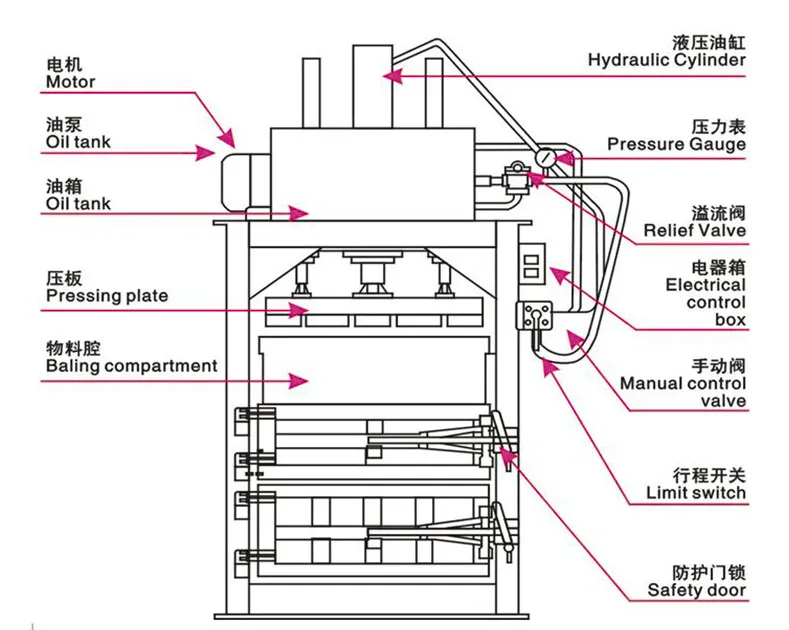
Reference view of the vertical textile and fiber baler used for cotton and nonwoven compaction.
Frequently Asked Questions
Common questions from textile plants and fiber recyclers evaluating vertical baling options.
Typical materials include cotton, polyester, PP and PE fiber, nonwovens, yarn scraps, rags, and other low-density textile materials.
An automatic chain ejector helps push out the strapped bale safely and quickly, reducing manual handling effort during unloading.
The machine includes a gate interlock that halts ram movement, an emergency stop, and an anti-rebound gate structure to improve operator safety.
Yes. Chamber size, motor power, control logic, and bale range can be adjusted around your material type, bale size, and throughput target.
If the site is processing much larger daily volume or a broader mix of recyclable materials with continuous flow, a horizontal baler may be the better choice.
Need a Baler for Textile and Fiber Scrap?
Send us your material type, target bale weight, chamber preference, and daily output. We will help match the right vertical textile baler configuration to your operation.
📖 Related Guide: Industrial Baler Machine: Types, Sizing, Energy Efficiency & Selection Guide