

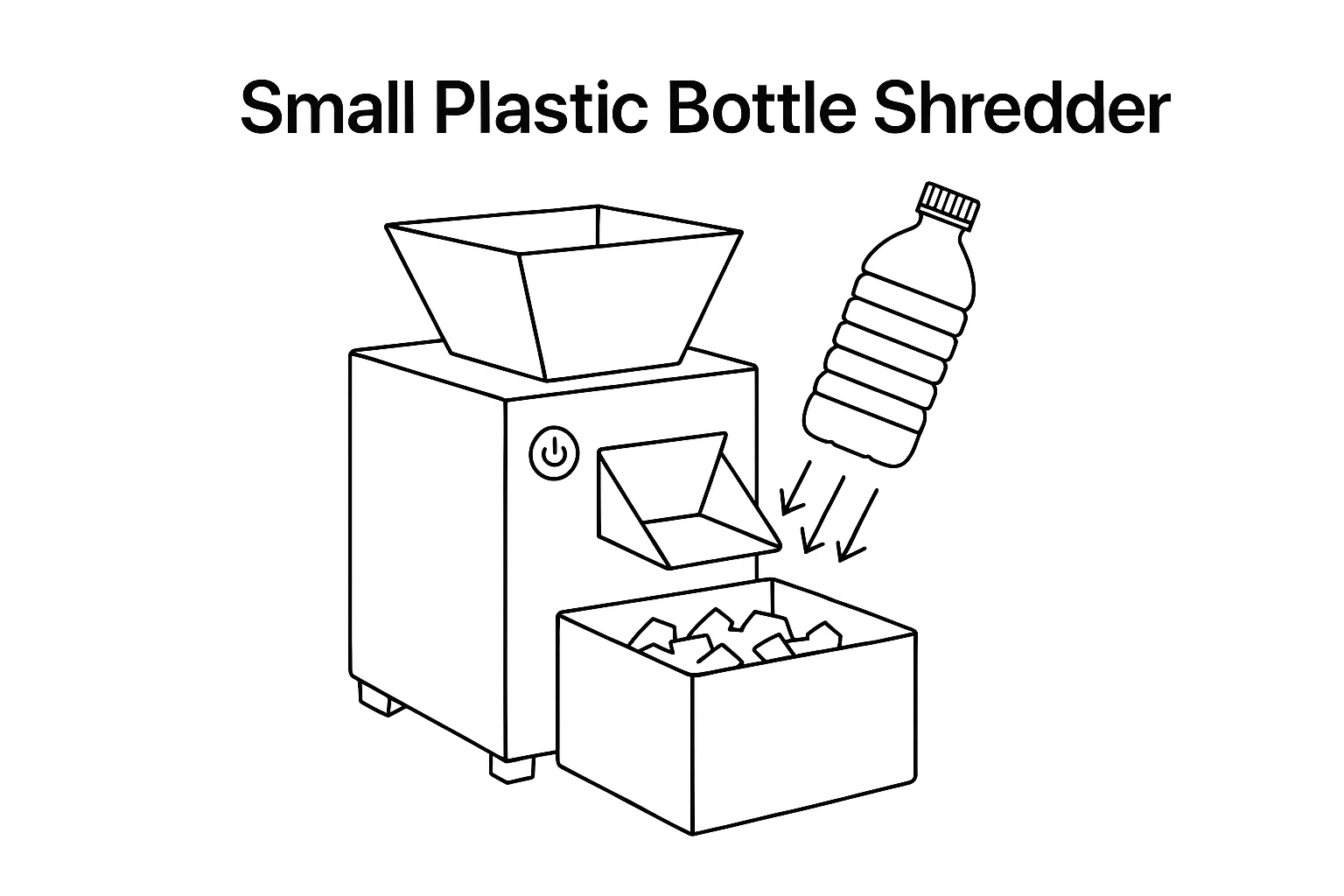
Best small plastic bottle shredder machines optimize space constraints without compromising throughput efficiency in recycling lines. For localized recycling centers, injection molding facilities, and laboratory test lines, selecting the right shredder involves evaluating motor torque, screen geometry, and blade composition rather than just footprint. This guide analyzes the technical requirements for compact PET processing equipment.
For small-footprint setups, see our mini desktop small shredder page.
Small Industrial Shredder Mechanics
Small-scale plastic bottle shredders typically utilize one of two primary cutting mechanisms, depending on the required output material quality and throughput density.
Single-Shaft Shredders
These units operate with a high-speed rotor (typically 80–120 RPM) against a stationary bed knife. High-speed operation allows for precise particle sizing via a screen, making them ideal for producing uniform flakes (10–15mm) suitable for immediate washing or extrusion. However, they require consistent feed rates to prevent motor amperage spikes.
Double-Shaft Shredders
Characterized by low speed and high torque, double-shaft machines use two counter-rotating shafts to shear and tear material. They handle higher contamination levels and are less prone to jamming on bulk-fed bottles. The output is generally coarser strips rather than defined flakes, often requiring a secondary granulator for final sizing.
Key Technical Specifications for Selection
When procuring a small plastic bottle shredder, engineers typically define the operating window based on the following parameters.
1. Drive System and Torque constraints
Small units (throughput <200 kg/hr) typically require motors between 3 kW and 7.5 kW. For processing PET bottles, high torque is critical to pierce the preforms or neck sections without stalling. Electric drives with gear reducers are standard; hydraulic drives are reserved for larger plants due to cost.
2. Cutting Chamber Geometry
The chamber size dictates the maximum bottle dimension accepted without bridging. A minimum cutting chamber width of 300mm–500mm is recommended for standard 2L bottles to ensure gravity feeding is efficient.
3. Screen Size and Flux Rate
The discharge screen determines final particle size and throughput. Smaller holes (e.g., 10mm) produce cleaner flake but increase back-pressure and heat generation, which can melt PET fines. A 12–15mm screen offers a balance between flake quality and throughput for small-scale operations.
| Feature | Single-Shaft Shredder | Double-Shaft Shredder (Shear) |
|---|---|---|
| Primary Action | Cutting / Granulating | Shearing / Crushing |
| Output Shape | Uniform Flake (10-20mm) | Irregular Strips (20-50mm) |
| Motor Power (Small Scale) | 4 kW – 11 kW | 3 kW – 7.5 kW |
| Noise Level | Higher (75-85 dB) | Lower (65-75 dB) |
| Maintenance Focus | Blade Gap Adjustment, Screen Cleaning | Hardfacing Shafts, Gearbox Oil |
| Ideal Application | Final sizing for washing line | Volume reduction for transport |
Recommended Equipment Configurations
Based on processing requirements for PET, HDPE, and PP bottles, specific configurations yield optimal results.
Compact Single-Shaft Systems (Energycle Desktop Series)
Designed for laboratories or micro-recycling setups (<50 kg/hr), these units prioritize precision.
* Motor: 1.5 kW
* Chamber: 300mm x 300mm
* Blade Material: D2 High-Carbon Steel (Hardness 58-60 HRC)
* Application: Producing test-grade flake for R&D extrusion.
Intermediate Industrial Shredders (Energycle Compact Pro)
Suitable for pilot plants or end-of-line scrap recovery (80–120 kg/hr).
* Drive: 4 kW with VFD (Variable Frequency Drive) for load sensing.
* Rotor Type: V-Rotor design to center bottles and reduce wear on side walls.
* Safety: Zero-speed sensor interlocks to prevent hopper opening during operation.
* Discharge: Pneumatic extraction coupling to prevent dust accumulation.
Maintenance and Contamination Control
Reliability in small shredders depends on strict maintenance protocols, particularly given the abrasive nature of glass-filled plastics or paper labels.
- Blade Sharpening: Dull blades increase power consumption by up to 30% and generate fines (dust). Rotatable knives (square inserts) allow operators to index blades 4 times before replacement.
- Bearing Protection: PET fines are abrasive. Selecting machines with outboard bearings separates the bearing housing from the cutting chamber, preventing seal failure and grease contamination.
- Clearance Adjustment: The gap between rotating and stationary knives should be maintained at 0.2–0.3mm for effective cutting of thin-walled bottles.
FAQ
What is the power requirement for a 100 kg/hr shredder?
A throughput of 100 kg/hr for loose plastic bottles typically requires a motor power of 5.5 kW to 7.5 kW (7.5–10 HP) to handle peak loads without jamming, especially if processing baled or dense material.
Can a small shredder handle caps and rings?
Yes. Industrial-grade single-shaft shredders with D2 or SKD11 steel blades can process PP/PE caps and rings attached to PET bottles. However, separation (sink-float tank) is required downstream to isolate the different polymers.
How often do shredder blades need replacement?
For clean PET bottles, D2 steel blades typically last 300–500 operational hours before sharpening is required. Carbide-tipped blades can extend this interval to 1,000+ hours but incur higher replacement costs.
References
[1] Plastics Recycling Terminology and Standards — ISO 15270. Plastics Recycling Terminology and Standards — ISO 15270
[2] “Size Reduction of Plastics,” Handbook of Industrial Polymer Engineering. Size Reduction of Plastics
