

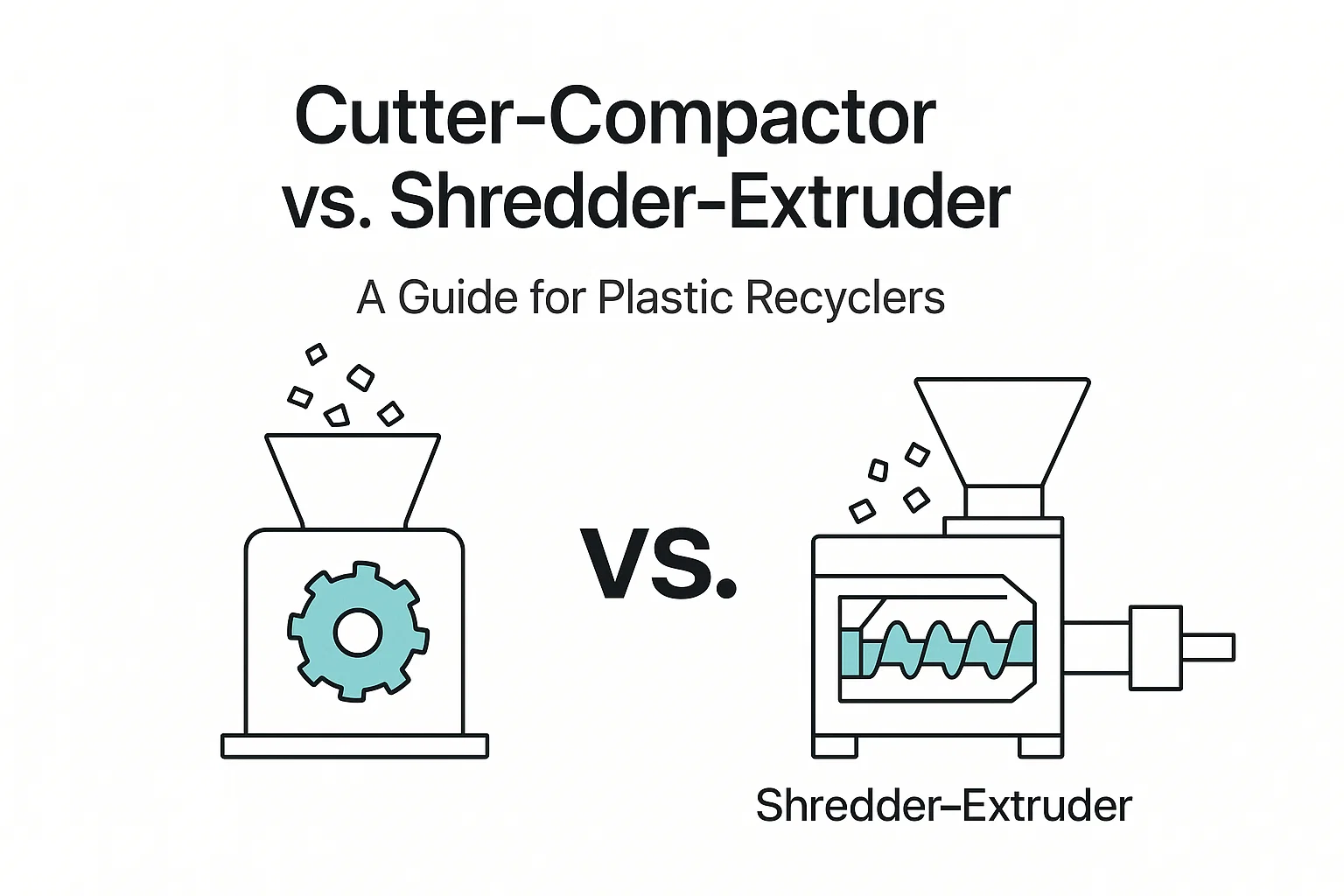
How Each System Works — Technical Principles
The two architectures solve the same problem — getting plastic into an extruder at a consistent rate — through fundamentally different physics. Understanding the mechanism matters because it determines material compatibility, energy profile, and pellet quality.
The Cutter-Compactor: Integrated Densification
A cutter-compactor combines size reduction, drying, densification, and feeding in a single unit. The core is a large vertical pot (the compactor drum) mounted directly beneath or beside the extruder barrel.
The process sequence:
- Direct feeding. Light, bulky scrap — film rolls, woven bags, stretch wrap — is conveyed or dumped directly into the compactor pot. No pre-shredding is required.
- Cutting and friction heating. High-speed rotating blades (typically 300–600 RPM) cut the material against stationary counter-knives. The mechanical friction generates heat — raising the material temperature to 80–110°C, near the Vicat softening point of most polyolefins.
- Densification. Centrifugal force presses the heated material against the pot wall, compressing bulk density from approximately 30–80 kg/m³ (loose film) to 250–350 kg/m³ (dense crumb).
- Moisture flash-off. The friction heat evaporates surface moisture — up to 5–7% — acting as an efficient pre-dryer without a dedicated thermal drying step.
- Tangential dosing. The densified, semi-softened material is centrifugally force-fed into the extruder screw at a constant, self-regulating rate. Because the material enters warm and pre-compacted, the extruder applies minimal additional shear, preserving polymer chain length (intrinsic viscosity).
The result: a single machine replaces what would otherwise be a separate shredder, conveyor, buffer silo, dryer, and force feeder.
The Shredder-Extruder: Modular Cold Feed
A shredder-extruder line couples a heavy-duty single-shaft shredder with a separate extruder, connected by conveyors and buffer storage.
The process sequence:
- Size reduction. Material — rigid parts, purging lumps, thick film bales — is pushed by a hydraulic ram against a slow-rotating rotor (typically 60–100 RPM). The rotor’s cutting teeth shear material against a fixed bed knife.
- Screening. A perforated screen (commonly 30–50 mm holes) retains oversize material in the cutting chamber until it passes through. The resulting chips are uniform enough for extruder feeding.
- Buffer storage. Chips are conveyed to a silo or buffer hopper that provides a consistent reserve, decoupling the shredder’s batch-style operation from the extruder’s continuous demand.
- Force feeding. A crammer feeder or side-feeder pushes the cold chips into the extruder throat at a controlled rate.
- Shear melting. Because the material enters cold and at relatively low bulk density, the extruder screw supplies most of the melting energy. This typically requires a longer barrel (L/D ratio of 32:1 or higher) and more installed power than in a compactor-fed setup.
The result: a modular system with individually replaceable components and high tolerance for hard, dense, or contaminated inputs.
Key Takeaway: The cutter-compactor uses friction heat to densify and pre-condition light materials in one step. The shredder-extruder uses mechanical torque to reduce hard materials at ambient temperature, then relies on the extruder for all thermal processing.
Material Compatibility — Which Feedstock Fits Which System
The feedstock determines the system, not the other way around. Forcing the wrong material through the wrong architecture causes accelerated wear, unstable output, and poor pellet quality.
| Feedstock Type | Cutter-Compactor | Shredder-Extruder |
|---|---|---|
| LDPE / LLDPE film (agricultural, stretch wrap) | Excellent — designed for this | Possible but inefficient; film wraps around rotor |
| PP woven bags / raffia | Excellent — densifies bulky fiber | Possible with large screen; bridging risk in hopper |
| BOPP / CPP film | Good — watch for ink degassing | Good — less thermal stress on printed material |
| HDPE rigid (bottles, pipes, crates) | Poor — hard parts damage high-speed blades | Excellent — high-torque rotor handles rigids easily |
| PP rigid (bumpers, pallets, caps) | Poor — noisy, rapid blade wear | Excellent — standard application |
| Purging lumps / thick offcuts | Not suitable — exceeds blade capacity | Excellent — primary use case |
| Washed post-consumer film (wet, 3–7% moisture) | Excellent — friction dries material in-pot | Requires separate pre-drying step |
| Mixed rigid + film | Limited — cannot optimize for both | Good — shredder accepts mixed streams |
| Heavily contaminated (sand, paper, metal) | Poor — contaminants destroy compactor blades | Good — low-speed rotor is more forgiving |
The 80% rule: If 80% or more of your feedstock is film, fiber, or lightweight flexible material, a cutter-compactor is the natural fit. If 80% or more is rigid, thick-walled, or heavily contaminated, a shredder-extruder is the correct architecture. Mixed streams at roughly equal proportions often favor the shredder-extruder for its versatility, or require two separate lines.
Key Takeaway: Match the system to your dominant feedstock. A cutter-compactor forced to process rigids will eat through blades weekly. A shredder-extruder processing clean film will waste energy on cold-melting material that should have been pre-heated.
Head-to-Head Comparison Table
| Parameter | Cutter-Compactor Line | Shredder-Extruder Line |
|---|---|---|
| Working principle | Friction cutting + thermal densification | High-torque cold shredding |
| Ideal input bulk density | Low (< 150 kg/m³) — film, foam, fiber | High (> 200 kg/m³) — rigid parts, regrind |
| Moisture tolerance | High (5–7%) — friction drying built in | Low (< 2%) — requires external pre-drying |
| Pre-heating effect | Yes — material enters extruder at 80–110°C | No — material enters cold |
| Typical energy consumption | ~0.28–0.35 kWh/kg (varies by material and moisture) | ~0.35–0.45 kWh/kg (higher extruder load for cold feed) |
| Start-up time | 15–30 minutes (pot heat-up phase) | Near-instant (cold feed, no warm-up) |
| Footprint | Compact (~40 m²) — integrated, often skid-mounted | Larger (~80–100 m²) — modular components spread out |
| Operator requirement | 1 operator (dump-and-run design) | 1–2 operators (shredder + extruder monitoring) |
| Blade/knife maintenance | High frequency — sharpening every 40–80 hours for film | Lower frequency — knife rotation every 500–1,000 hours per edge |
| Contamination tolerance | Low — sand, metal, paper destroy high-speed blades | High — slow-speed rotor absorbs abuse better |
| Pellet quality (film applications) | Premium — gentle melt preserves IV, effective degassing | Standard — longer residence time may cause yellowing |
| Printed/inked material | Effective degassing in hot pot (volatile removal) | Less volatile removal at entry; requires extruder degassing |
| Flexibility (material switching) | Limited — optimized for one feedstock class | High — can switch between rigid types and film with screen changes |
Key Takeaway: The cutter-compactor wins on energy, footprint, labor, and pellet quality for film. The shredder-extruder wins on contamination tolerance, material flexibility, and suitability for rigid inputs.
Decision Framework — A Step-by-Step Selection Path
Use this structured flow to narrow your choice before engaging suppliers.
Step 1: Classify your dominant feedstock. Is it primarily flexible (film, fiber, woven bags) or rigid (bottles, pipes, crates, lumps)?
- If 80%+ flexible → proceed to Step 2 with cutter-compactor as the leading option.
- If 80%+ rigid → proceed to Step 2 with shredder-extruder as the leading option.
- If mixed → default to shredder-extruder for versatility, or evaluate two separate lines.
Step 2: Assess moisture content. What is the typical moisture level of your feedstock after washing or as-received?
- If > 3% moisture and flexible feedstock → cutter-compactor (friction drying eliminates the need for a separate thermal dryer, saving $30,000–$80,000 in equipment and floor space).
- If < 2% moisture and rigid feedstock → shredder-extruder (no drying advantage to capture).
Step 3: Evaluate contamination level. Does your feedstock contain sand, paper, metal fragments, or heavy organic residue?
- If heavy contamination → shredder-extruder (low-speed rotor survives what would destroy compactor blades in hours).
- If clean or lightly contaminated → either system works; proceed to Step 4.
Step 4: Check pellet quality requirements. Does your buyer pay a premium for low-gas, high-clarity pellets (e.g., blown film applications)?
- If premium pellet market → cutter-compactor (degassing in the compactor pot produces cleaner pellets with fewer gas bubbles).
- If standard pellet market → either system meets requirements.
Step 5: Evaluate facility constraints. Do you have space limitations or single-operator staffing?
- If limited floor space or labor → cutter-compactor (~40 m² footprint, 1 operator).
- If space and labor are available → either system works.
Step 6: Consider future feedstock changes. Will your feedstock composition shift significantly within 5 years?
- If feedstock is stable and consistent → optimize with a cutter-compactor (if film) or shredder-extruder (if rigid).
- If feedstock will diversify → shredder-extruder provides more flexibility for future material changes.
Key Takeaway: Walk through feedstock → moisture → contamination → pellet quality → facility → future plan. In most cases, the first two steps already determine the answer.
CapEx, OpEx, and Total Cost of Ownership
The purchase price is the beginning of the cost conversation, not the end. Energy, maintenance, labor, and pellet quality premiums compound over the equipment’s 10–15 year service life.
Capital Expenditure Comparison
Cutter-compactor lines have a moderate initial investment. The integrated design eliminates separate shredder, conveyor, buffer silo, and crammer feeder purchases. Installation is simpler — many units ship skid-mounted and require only utility connections and a flat concrete pad of approximately 40 m².
Shredder-extruder lines carry a higher initial investment. The bill of materials includes: shredder, conveyor belt, buffer silo, crammer feeder, and extruder — each with its own motor, controls, and foundation requirements. The modular footprint (approximately 80–100 m²) also requires more civil works.
The CapEx gap narrows when you factor in scope. If your process requires pre-drying (shredder-extruder with wet feedstock), melt filtration, pelletizing, water treatment, and automation, those costs apply equally to both architectures. The feeding module difference is meaningful but is not the majority of total installed cost.
Energy Cost (kWh/kg)
Energy is the largest recurring cost in any pelletizing operation and the area where the two architectures differ most.
| Component | Cutter-Compactor | Shredder-Extruder |
|---|---|---|
| Size reduction + densification | Included in compactor motor | Separate shredder motor |
| Pre-heating | Friction heat (included) | None (cold feed) |
| Extruder melting load | Lower — material enters warm | Higher — material enters cold |
| Typical total specific energy | ~0.28–0.35 kWh/kg | ~0.35–0.45 kWh/kg |
At an electricity tariff of $0.12/kWh and a throughput of 500 kg/h running 6,000 hours/year, the difference of approximately 0.07–0.10 kWh/kg translates to roughly $25,000–$36,000 in annual energy savings for the cutter-compactor — at the same material condition and throughput.
Important: these ranges are indicative. Actual kWh/kg depends on polymer type, moisture content, contamination, screw design, and operating conditions. Always validate with a trial run using your feedstock.
Maintenance and Spare Parts Cost
Cutter-compactor blade maintenance is the system’s primary cost disadvantage. High-speed blades cutting film at 300–600 RPM wear rapidly — sharpening is required every 40–80 operating hours for standard film, and more frequently for contaminated or filled materials. Annual blade replacement sets typically cost $2,000–$5,000 depending on the machine size and blade metallurgy.
Shredder knife maintenance is less frequent but not negligible. Single-shaft shredder knives are rotatable — each knife has 4 usable edges, giving an effective service life of 500–1,000 hours per edge for clean plastic. Contaminated post-consumer feedstock reduces this significantly. Knife sets are typically more expensive per replacement but replaced far less often.
| Maintenance Item | Cutter-Compactor | Shredder-Extruder |
|---|---|---|
| Blade/knife sharpening frequency | Every 40–80 hours | Every 500–1,000 hours per edge |
| Annual blade/knife cost (estimate) | $2,000–$5,000 | $1,500–$4,000 |
| Critical failure risk | Blade breakage → pot damage | Rotor jam → hydraulic system strain |
| Downtime per maintenance event | 2–4 hours (blade change) | 4–8 hours (knife rotation + alignment) |
Revenue: Pellet Quality Premium
Pellet quality directly affects selling price. For film recycling applications, the cutter-compactor consistently produces pellets with fewer gas bubbles (voids), better color consistency, and higher melt strength. The friction heat in the compactor pot vaporizes volatiles — moisture, ink solvents, and organic residues — before the material enters the extruder. This “pre-degassing” effect is especially valuable for blown film and cast film applications where gas bubbles cause pin-holes and reduced optical clarity.
Shredder-extruder systems rely entirely on the extruder’s venting zones for degassing. For rigid recycling (where volatile contamination is lower), this is adequate. For film recycling with printed or laminated material, the difference in pellet quality — and the price premium — can be significant.
Key Takeaway: Cutter-compactors save on energy and earn pellet premiums but cost more in blade maintenance. Shredder-extruders cost more to run on electricity but are cheaper on consumables. For facilities processing film at high electricity tariffs ($0.12+/kWh), the cutter-compactor’s energy advantage usually outweighs blade costs over a 5-year horizon.
ROI Scenarios by Feedstock Type
Abstract comparisons only go so far. Here are three concrete scenarios plant operators encounter.
Scenario A: Clean Post-Industrial Film (LDPE/LLDPE)
Recommended system: Cutter-compactor.
Clean post-industrial film is the ideal feedstock for a cutter-compactor. Low contamination means minimal blade wear (sharpening intervals extend toward the 80-hour end). The material enters dry or with minimal surface moisture. Bulk density is very low (30–60 kg/m³), making the compactor’s densification function essential — a shredder would struggle to feed this material to the extruder at a stable rate without an intermediate agglomerator.
ROI profile: Shorter payback when feedstock is consistent and uptime is high. The energy savings and single-operator labor model compound over time.
Scenario B: Washed Post-Consumer Film (Dirty, 3–7% Moisture)
Recommended system: Cutter-compactor (heavy-duty configuration).
Post-consumer washed film arrives wet and partially contaminated. The cutter-compactor’s friction drying handles 5–7% surface moisture without a separate thermal dryer — saving $30,000–$80,000 in capital and ongoing energy cost. However, residual sand and grit from washing accelerates blade wear. Budget for more frequent sharpening (every 40–50 hours) and a higher annual blade cost.
ROI profile: Moderate payback. Energy and drying savings are substantial, but blade consumables partially offset them. The decision turns on feedstock cleanliness — invest in better upstream washing to protect compactor blades.
Scenario C: Mixed Rigid Plastics (HDPE/PP)
Recommended system: Shredder-extruder.
Rigid plastics — bottles, crates, pipes, automotive parts — have high bulk density and wall thickness. A cutter-compactor’s high-speed blades cannot handle these materials without extreme wear and noise. The shredder’s slow-speed, high-torque rotor is engineered for exactly this application. If your rigid stream includes metal inserts or residual fasteners, the shredder’s hydraulic reversing function prevents catastrophic jams.
ROI profile: Longer payback due to higher energy cost and potential need for two operators, but the system’s ability to accept variable, unpredictable feedstock provides revenue stability that a more specialized line cannot.
Workflow Setup and Daily Operations
Cutter-Compactor Daily Workflow
- Pre-start check (5 min): Inspect blade condition, check cooling water flow to the pot, verify extruder heater temperatures have reached setpoint.
- Warm-up (15–30 min): Run the compactor at low speed without material to bring the pot to operating temperature. This prevents “cold-start bridging” where material sticks to cold surfaces.
- Production feeding: Convey or dump material into the pot continuously. The compactor’s PLC-controlled speed adjusts automatically — if extruder back-pressure rises, the compactor slows to prevent overfeeding.
- Shift-end flush: Run the compactor empty to clear residual material. If processing printed film, a brief flush with clean PE film removes ink residues from the pot walls.
Shredder-Extruder Daily Workflow
- Pre-start check (5 min): Inspect shredder knife condition, verify hydraulic fluid level, confirm buffer silo level, check extruder heater temperatures.
- Cold start: The shredder is ready to run immediately — no warm-up required. Begin feeding material via hopper or conveyor.
- Production feeding: The shredder operates in batch-push cycles (hydraulic ram advances, retracts, advances). The buffer silo decouples shredder output from extruder demand, providing continuous feed even during ram retraction.
- Material changeover: To switch between material types, clear the shredder chamber and buffer silo completely. If switching screen sizes, a 15–30 minute changeover is typical.
Troubleshooting Guide
Cutter-Compactor Issues
Material bridging in the pot. If pot temperature exceeds 110°C (for LDPE), the plastic begins to melt prematurely and forms a solid “log” instead of loose crumb. Fix: Increase cooling water flow to the pot jacket. If cooling capacity is already maxed, reduce blade speed by 10–15% to lower friction heat generation.
Unstable extruder output. The extruder motor current fluctuates and pellet weight varies. Cause: Usually inconsistent material feed — either the material is too dry (insufficient friction for densification) or blade wear is reducing cutting efficiency. Fix: Check blade sharpness first. If blades are acceptable, verify that the material has sufficient moisture content for friction engagement.
Excessive vibration. Increasing vibration during operation indicates unbalanced blade wear or a foreign object in the pot. Fix: Stop immediately. Inspect blades for uneven wear or chipping. Check for metal debris using a magnetic separator on the infeed conveyor.
Ink smoke or odor. Processing heavily printed film generates volatile organic compounds. Fix: Ensure the pot’s ventilation hood and extraction fan are operating at full capacity. Consider adding a secondary extruder vent zone if odor complaints persist.
Shredder-Extruder Issues
Crammer feeder jamming. Light film bridges in the crammer feeder funnel and stops flowing. Fix: Install a rotating agitator or paddle in the buffer hopper directly above the feeder. For persistent bridging, increase the shredder screen size to 50 mm+ to produce larger, heavier chips that flow more reliably.
Shredder screen blinding. Wet film or fibrous material clogs screen perforations, reducing throughput and increasing motor current. Fix: Switch to a larger screen aperture (50 mm+) and rely on the extruder for final size homogenization. If blinding is chronic, consider adding a pre-drying step or switching to a cutter-compactor for wet feedstock.
Hydraulic ram stalling. The shredder’s hydraulic ram cannot push material through the rotor — usually caused by oversized or exceptionally hard input (e.g., a large metal-contaminated lump). Fix: Modern shredders have automatic reversing. If the ram stalls repeatedly, remove the oversized piece manually and consider adding a pre-sorting step upstream.
Extruder output drops despite stable feed. The crammer feeder is running but extruder throughput has declined. Cause: Usually a partially plugged screen changer or worn screw/barrel. Fix: Inspect the melt filter pressure differential. If within normal range, measure screw flight depth — worn screws reduce conveying capacity progressively.
Key Takeaway: Most cutter-compactor problems trace back to temperature control in the pot or blade condition. Most shredder-extruder problems trace back to material flow (bridging, screen blinding) or the extruder handling cold feed. Knowing the root cause pattern saves diagnostic time.
Frequently Asked Questions
Can a cutter-compactor process rigid plastics?
Technically yes, but it is not recommended. Rigid parts generate excessive noise, cause rapid blade wear, and can damage the compactor pot. The cutter-compactor is designed for thin-walled, flexible materials. For rigid streams, use a shredder-extruder.
How often do shredder knives need replacement?
For clean plastic, square shredder knives typically last 500–1,000 operating hours per cutting edge. Each knife has 4 rotatable edges, providing approximately 2,000–4,000 total hours before replacement. Post-consumer waste with contamination reduces these intervals significantly.
Which system produces better pellets for blown film?
The cutter-compactor generally produces superior pellets for blown film applications. The friction heat in the compactor pot vaporizes moisture, ink solvents, and light volatiles before the material reaches the extruder. This pre-degassing step reduces gas bubbles (voids) in the pellet — a critical quality factor for blown film where pin-holes and optical defects reduce sellable output.
What is the typical energy consumption difference?
Cutter-compactors typically consume 0.28–0.35 kWh/kg; shredder-extruders typically consume 0.35–0.45 kWh/kg — at comparable throughput and similar material conditions. The difference comes from the compactor’s friction pre-heating, which reduces the extruder’s melting workload. Actual figures depend on polymer, moisture, contamination, and screw design — always validate with a trial run.
Can I upgrade a shredder system to a cutter-compactor later?
No. The machines are mechanically distinct architectures. However, you can add a densifier (agglomerator) between the shredder and extruder to partially replicate the compactor effect. This adds capital cost and energy consumption, so it is generally better to specify the correct architecture from the start.
Does the cutter-compactor reduce labor costs?
Yes. The integrated “dump-and-run” design allows a single operator to manage feeding, monitoring, filter changes, and pelletizing. Modular shredder-extruder systems often require a second operator to monitor the shredder and buffer system independently — especially during material changeovers or when processing variable feedstock.
What if my feedstock is 50/50 film and rigid?
A 50/50 split is the hardest scenario. Options: (a) two separate lines — a cutter-compactor for film and a shredder-extruder for rigid — if volume justifies the investment; (b) a shredder-extruder as a single-line compromise, accepting the energy penalty on film processing; (c) sort feedstock into two campaigns and run them on a shredder-extruder with screen changes between runs.
Your Next Step
The cutter-compactor vs. shredder-extruder decision comes down to your feedstock profile. Film-dominant operations with moisture benefit from the compactor’s integrated densification, drying, and gentle melting. Rigid-dominant operations with contamination need the shredder’s torque and tolerance. Trying to make one system do both jobs leads to compromised output and inflated operating costs.
Not sure which architecture fits your material? Send us a sample or your feedstock specification — our engineers will recommend the right configuration, provide a site-specific energy model, and arrange a trial run on your material before you commit.
Related equipment: Cutter-compactor recycling pelletizing line | Single shaft shredder | PE/PP film shredder
