

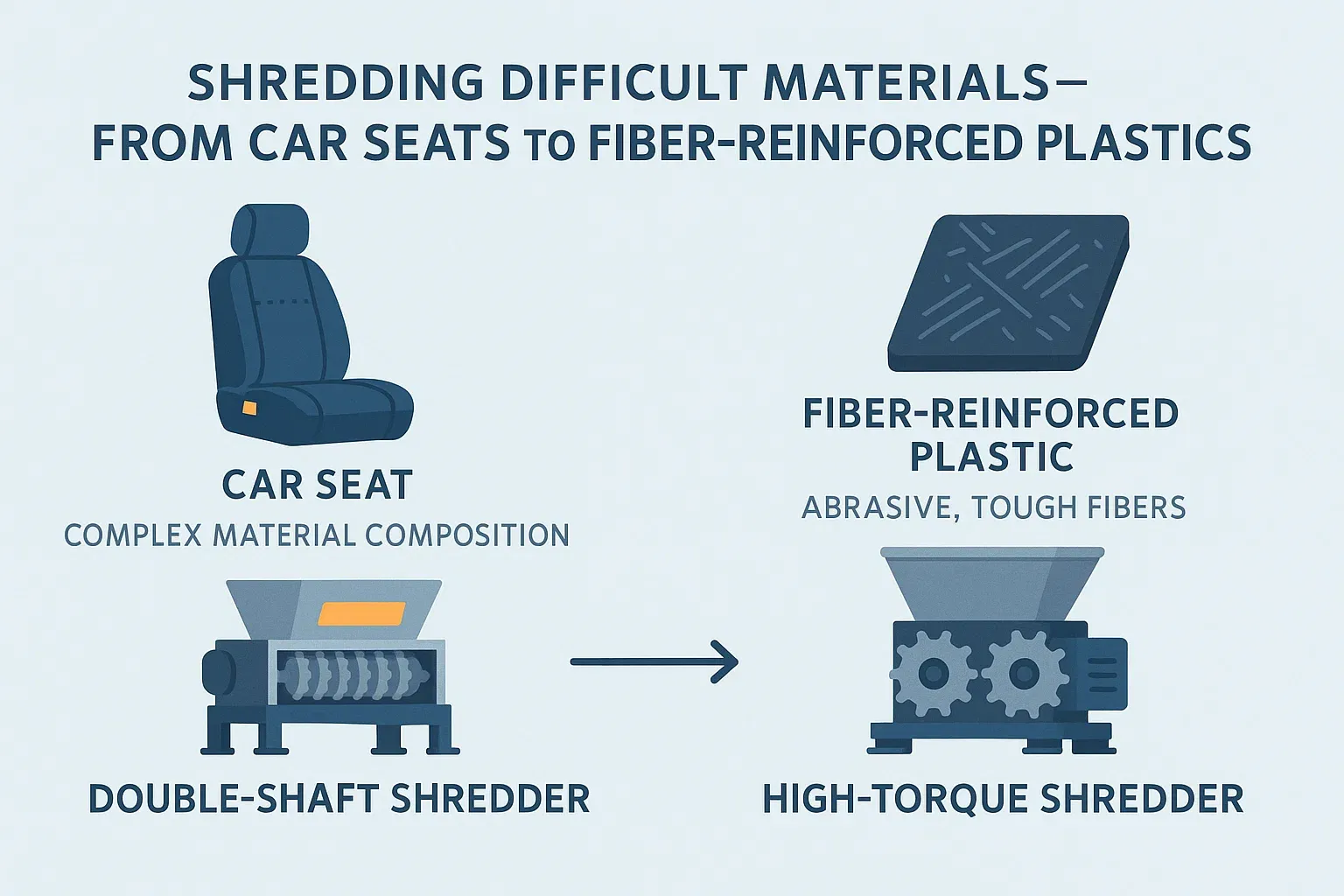
Some materials fight back. Shredding a PET bottle is trivial; shredding a car seat with a steel frame, polyurethane foam, and polyester fabric is an engineering challenge. This guide details the machine configurations required for the toughest materials in the recycling industry.
Related equipment: double shaft shredder (plastic & metal), heavy-duty metal shredder.
1. Car Seats (The “Sandwich” Problem)
Challenge: A mix of ductile fabric, soft foam, and rigid steel.
* Failure Mode: High-speed shredders jam instantly on the steel frame. Single-shaft shredders wrap the fabric around the rotor.
* Solution: Twin-Shaft Shear Shredder (Low Speed, High Torque).
* Configuration: 10-20 RPM. Massive torque (100,000 Nm+).
* Action: The hooked blades pierce the foam and rip the steel frame apart. The slow speed prevents sparking (fire risk).
2. Fiber-Reinforced Plastics (FRP / Wind Turbine Blades)
Challenge: Glass fibers are harder than tool steel.
* Failure Mode: Rapid abrasive wear. A standard D2 rotor will look like a smooth pipe after 100 hours.
* Solution: Hardfaced Rotor + Carbide Knives.
* Metallurgy: The entire rotor body is welded with a Tungsten Carbide matrix (“Waffle Pattern”).
* Knives: Solid Carbide inserts brazed onto steel carriers.
* Dust Control: FRP dust is a carcinogen. Negative pressure air filtration is mandatory.
3. Airbags and Seatbelts
Challenge: Explosive propellants (Airbags) and extreme tensile strength (Seatbelts).
* Failure Mode: Explosions in the chamber; Nylon melting/winding.
* Solution: Underwater Shredding or Nitrogen Inerting.
* Safety: The cutting chamber is flooded or purged with Nitrogen to prevent ignition of undeployed airbag propellant.
* Geometry: Seatbelts require a “Scissor Cut” with zero gap (<0.2mm) to prevent winding.
4. Ghost Gear (Discarded Fishing Nets)
Challenge: Ultra-high MWPE (Dyneema) ropes that float and tangle.
* Failure Mode: Wraps around the rotor bearing housing, destroying seals.
* Solution: Anti-Winding Spline Rotor.
* Design: The rotor shaft has raised “splines” that prevent ropes from tightening.
* Protection: Physical “Labyrinth Rings” bolted to the rotor ends to shield the bearings.
Summary Checklist
| Material | Machine Type | Blade Tech | Critical Feature |
|---|---|---|---|
| Car Seats | Twin-Shaft Shear | Surface Hardened | High Torque / Reverse |
| Wind Blades | Single-Shaft | Carbide Tipped | Hardfaced Rotor |
| Airbags | Shear Shredder | Non-Sparking | Water/Nitrogen Deluge |
| Fishing Nets | Single-Shaft | D2 / H13 | Spline Rotor / Anti-Wind |
References
[1] “Recycling of Wind Turbine Blades,” Composites World. Recycling of Wind Turbine Blades
[2] “Automotive Shredder Residue (ASR) Processing,” Waste Management Journal. Automotive Shredder Residue (ASR) Processing
