

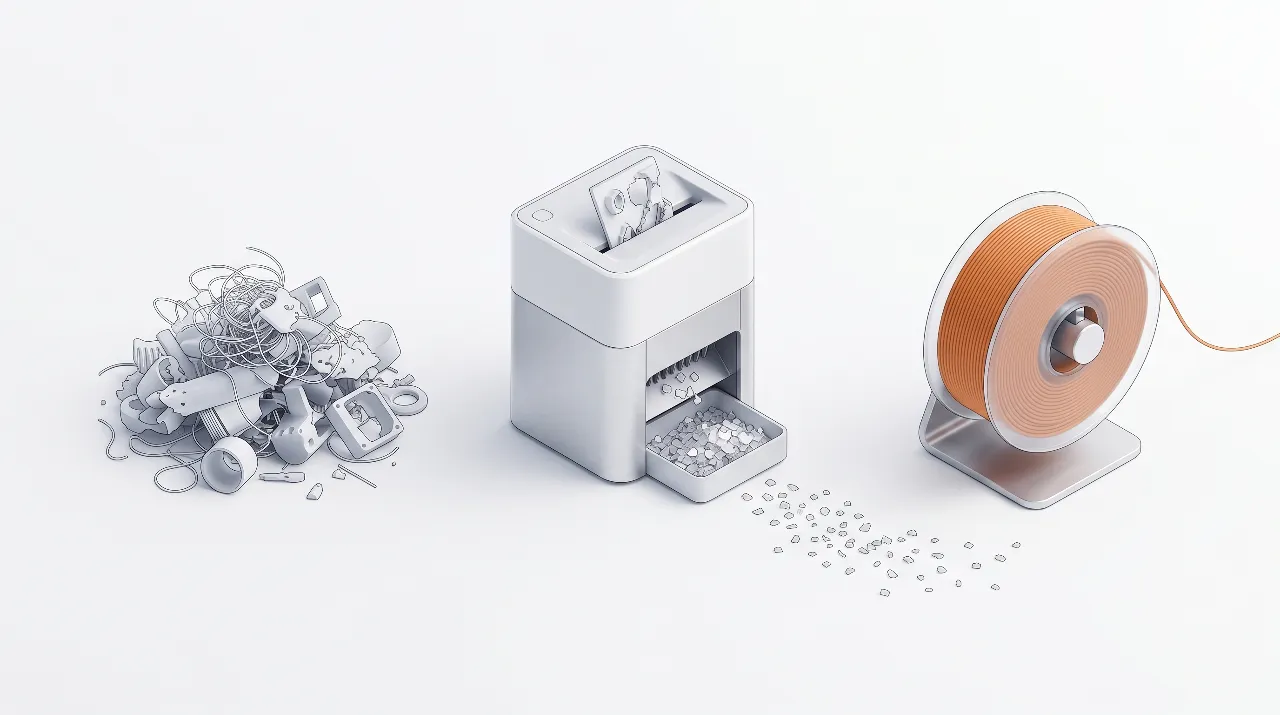
A 3D printer filament shredder gives makers, schools, and small studios a practical way to turn failed prints into new filament instead of waste. By adding a compact shredder and extruder next to your printers, you can build a closed-loop workflow that cuts material cost and reduces the volume of plastic going to landfill. At the desktop scale, most setups aim to shred scrap into 3–6 mm flakes so it can be dried and fed into a small filament extruder.
A practical example is the Energycle mini desktop small shredder, which is designed for makerspaces and small labs that need consistent regrind for extrusion.
Mi az a 3D nyomtatószál-aprító?
A 3D printer filament shredder is a compact plastic shredder designed specifically to chop 3D printing waste and filament into small flakes for recycling. Unlike large industrial granulators, these machines sit on a workbench, plug into standard power, and handle the output volume of hobbyists, classrooms, and small labs. The shredder’s cutting chamber and hopper are sized for failed prints, support structures, purge towers, and leftover spools instead of bulky industrial parts.
A typical 3D printer filament shredder uses counter‑rotating blades to bite through plastic and push it through a fixed screen. The screen defines the flake size, often in the 3–6 mm range for desktop units. This flake size feeds well into small filament extruders and avoids clogging, while still keeping throughput high enough for day‑to‑day use. Many units also accept other rigid plastics such as bottle caps and lab samples, which gives makerspaces more flexibility in what they can recycle.
Why makers and schools need a filament shredder
A filament shredder for 3D printers solves three common problems: growing bins of failed prints, rising filament costs, and pressure to improve sustainability. In a typical classroom or shared makerspace, support material and failed prints can easily add up to multiple kilograms per term, and most municipal recycling streams won’t take mixed, unlabeled 3D printing plastics. A dedicated shredder lets staff convert that pile into a labeled stock of clean flakes ready for experiments, materials lessons, or recycled prototypes.
For makerspaces, the shredder turns messy scrap into a controlled resource. Members can sort waste by polymer, shred it on demand, and use it as feedstock for a shared filament extruder or send it to a local recycler that accepts pre‑processed flakes. This improves space use, reduces trash pickups, and creates a visible sustainability story that is easy to communicate to students, parents, and sponsors.
How a filament shredder fits into a closed-loop workflow
A 3D printer filament shredder is the front end of a closed‑loop 3D printing workflow that goes from waste prints back to usable filament. A practical maker‑scale loop includes collecting, sorting, shredding, drying, extruding, and printing again. When you treat each step as a small, repeatable routine, even beginners can run a basic recycling program alongside normal printing.
If your goal is to start with a compact, bench‑friendly unit, a mini desktop plastic shredder for 3D printing waste is typically the most straightforward first step.
Typical closed-loop steps are:
- Gyűjtsd össze és válogasd szét – Keep separate bins for PLA, ABS, PETG, and other polymers; avoid mixing types because mixed flakes produce inconsistent filament.
- Inspect and clean – Remove metal inserts, screws, magnets, tape, labels, and flexible pads so only clean thermoplastic enters the shredder.
- Foszlány – Use your 3D printer filament shredder to reduce prints to uniform flakes around 3–6 mm, which feed well into desktop extruders.
- Dry and store – Condition the flakes to very low moisture (often under about 0.05% by weight) and store them in sealed containers until extrusion.
- Kilök – Run the dry flakes through a filament extruder such as a desktop Felfil or 3devo system to produce 1.75 mm or 2.85 mm filament.
- Print again – Use recycled filament for prototypes, test pieces, and non‑critical parts, while gradually dialing in print settings for more demanding jobs.
This closed‑loop workflow can be as simple or advanced as your lab equipment allows. A school might stop at step four and send dried flakes to an external recycler, while a makerspace could complete all six steps and share a spreadsheet to track how many kilograms of waste they convert each term.
PLA vs ABS vs PETG: shredding differences
PLA, ABS, and PETG all behave differently in a 3D printer filament shredder, so you need to adjust expectations and settings. PLA is generally brittle and easy to break into clean flakes, which makes it a popular starting point for desktop recycling projects. ABS and PETG are tougher, so they put more load on the motor and blades and may require smaller pieces before shredding.
Mechanically recycled PLA typically follows a sequence of shredding (and optional washing), drying, and extrusion, with careful temperature control to limit polymer degradation. ABS needs higher extrusion temperatures and is more sensitive to fumes and ventilation needs, while PETG is especially sensitive to moisture and can bubble if it is not dried thoroughly. In all three cases, keeping each batch limited to a single polymer type greatly improves extruder stability and filament quality.
Recommended flake size for filament extrusion
The best flake size for filament extrusion is small enough to feed smoothly and melt evenly, but not so tiny that it turns into unmanageable dust. Many desktop systems target particles at or below ~4 mm, while others aim for 3–6 mm regrind to balance throughput and extruder compatibility.
For most desktop filament extruders, flakes in the roughly 3–6 mm range are a good starting point. Larger chunks can bridge in the hopper or cause irregular melt flow, while excessive fines may burn and create fumes or clog the screw. A practical rule for makers and schools is to visually check that each piece is smaller than the extruder intake opening and to screen out powder‑like material where possible. You can use a simple sieve or mesh tray to separate usable flakes from dust and keep the extruder running reliably.
Desktop filament shredder options for makers, schools, and studios
Desktop filament shredders and recyclers vary widely in throughput, footprint, and cost. Energycle’s Mini Desktop Small Shredder is designed as a compact workbench unit that handles 1–5 kg/h of 3D printing waste, bottle caps, and lab samples, producing 3–6 mm regrind suitable for filament extrusion. Systems from Felfil, 3devo, Creality, and Loop combine shredders with filament extruders and spoolers to form a complete recycler for home or lab use.
For specs, footprint, and typical output size, see the Energycle mini desktop shredder for filament recycling.
Key selection filters (especially for schools and makerspaces):
- Safety & access control: interlocks/guards, safe hopper design, emergency stop, and clear SOPs for student use.
- Material discipline: can you realistically keep PLA/ABS/PETG separated and dry?
- Throughput vs noise: a bench-top unit that fits the room and can run without disrupting classes usually wins over raw kg/h.
| System / Shredder option | Best for users | Typical throughput (shredder) | Compatible materials (shred) | Footprint & noise | Approximate system scope | Notes for schools & makerspaces |
|---|---|---|---|---|---|---|
| Energycle Mini Desktop Small Shredder + desktop filament extruder | Schools, makerspaces, small studios | 1–5 kg/h, 3–6 mm flakes | PLA, ABS, PETG, palackkapocs, kis labor minták | Kompakt asztali egység, tervezve közös asztalokra, mérsékelt zajburkolattal | Szalagológép plusz külön extruder (pl. harmadik fél asztali extruder) | Biztonságos adagoló és kezelhető méret osztálytermekhez, egyszerű munkafolyamat diákmunkákhoz; jó kombináció a Energycle asztali műanyag szalagológép útmutatóval. |
| Felfil Rendszer (Felfil Szalagológép + Evo + Spooler) | Haladó hobbiak, tervezési laboratóriumok | Méretarányú kapacitás, finomított nyomtatottak és granulátumokhoz | PLA, ABS, PETG és mások granulátumokból vagy darált hulladékból | Asztali méretű alapterület, fogyasztói szintű megjelenés | Teljes recikláló: szalagológép, extruder, spooler egy koordinált rendszerben | Alkalmazható egyetemi laboratóriumok számára, amelyek “kész használatra” csomagot szeretnének dokumentált extrudálási beállításokkal. |
| 3devo GP20 Szalagológép + Filament Gyártó | Professzionális laboratóriumok, kutatás és fejlesztés, ipari képzés | Nagyobb kapacitás és fejlettebb vezérlés | PLA, ABS, PETG, műszaki műanyagok (a konfigurációtól függően) | Nagyobb alapterület, ipari érzet | Integrált munkafolyamat fejlett hőmérséklet- és szárítási beállításokkal | Jó választás mérnöki iskolák számára, amelyeknek külön anyaglaboratóriuma és személyzete van bonyolultabb ciklusok futtatásához. |
| Creality Szalagológép R1 + Filament Gyártó M1 | Brandingos zárt körű rendszert kereső gyártók | A rendszer filamentszál kimenetének maximálisan körülbelül 1 kg/h-ig terjed | PLA, ABS, PETG, ASA, PA, PC, TPU, PET | Kialakítva a fogyasztói 3D nyomtatók mellé | Két-eszközös zárt körű munkafolyamat népszerűsítve asztali használatra | Kiváló választás a Creality nyomtató tulajdonosok számára, ha széles körben elérhető; az első felhasználók figyelmét érdemes a valós világ véleményeire fordítani. |
| Loop/más összetevős reciklálók | Korai felhasználók, bemutatóterek | Csendes szalagológép integrált extrudálással (specifikációk változnak) | Fókusz a 3D nyomtatási hulladékokra; a rendszer részletei változnak | Beépített, prémium dizájn | Single‑box recycler with guided steps | Good for demonstration and outreach events where aesthetics and simplicity matter more than throughput. |
If you want a dedicated shredder that fits existing benches and works with a variety of filament extruders, the Energycle Mini Desktop Small Shredder is a strong option to anchor your system. You can read more about general desktop plastic shredder types and selection rules in Energycle’s desktop plastic shredder guide.
Cost and payback for a maker-scale recycling setup
A 3D printer filament shredder and extruder add upfront cost, so it helps to estimate payback with a simple model. Recycled filament can lower your effective material cost per kilogram if you generate enough clean, single‑polymer scrap to keep the system running regularly. For schools and makerspaces that already purchase many spools per year, the savings and educational value can justify the equipment.
Here is an example you can adapt with your own numbers (use ranges if you don’t have exact data yet):
- Assume your lab produces about 5–50 kg/year of clean, sortable PLA waste (small makerspace → larger school lab).
- New PLA filament costs around US$15–30/kg delivered (varies by brand and region).
- A desktop shredder + extruder package costs US$2,000–10,000+, with an expected life of 3–5 years.
- Power and maintenance cost about US$0.50–2.00/kg of recycled filament.
If recycled filament replaces a meaningful share of purchased filament, the effective payback period often lands around 1–4 years at maker/school scale (highly dependent on waste volume and equipment uptime).
If you don’t want to publish numbers, you can also rewrite this section as a checklist (what to measure) and remove all dollar figures.
Worked example (simple, conservative):
- Scrap available: 15 kg/year PLA (sorted + kept dry)
- Virgin filament cost: US$22/kg → annual spend replaced ≈ US$330
- Upfront equipment: US$5,000 over 4 years → ≈ US$1,250/year
- Electricity + wear parts: US$1.20/kg → ≈ US$18/year
This rough example shows why utilization matters: payback improves dramatically if the lab can recycle closer to the upper end of the scrap range (or share the recycler across multiple printers/classes).
Practical safety and maintenance tips
Safe operation is essential when adding a filament shredder to a classroom or makerspace. According to Energycle and other desktop shredder suppliers, users should only feed clean, known plastics and never treat the shredder as a general trash bin. Guards, interlocks, and emergency stop switches should stay in place at all times, and operators should receive a short briefing before use.
A few practical tips for smooth operation are:
- Place the shredder on a stable surface, away from student walkways, and secure any loose power cables.
- Use eye and hearing protection as needed, and consider scheduling shredding sessions when the room is less crowded.
- Clean the hopper and cutting chamber regularly to remove dust and stringy residue that can build up around the blades.
- Check blade sharpness and screen condition on a routine schedule and replace worn parts to maintain flake quality and keep power draw under control.
Good maintenance not only protects users but also keeps flake size consistent, which directly affects extrusion stability and filament diameter control. In our experience helping education clients, assigning a small “materials team” of students or staff to manage sorting, shredding, and record‑keeping works much better than sharing responsibility without a clear owner.
How to set up a simple shredder-to-extruder workflow
Setting up a filament recycling loop around a mini desktop shredder is easier if you treat it like a small production line. According to Energycle’s maker‑scale workflow, the key is to keep each step simple and repeatable instead of trying to shred and extrude everything at once. A small laminated checklist near the machine can guide students through the process.
A straightforward sequence for a school or makerspace looks like this:
- Label bins by material and color family (PLA light, PLA dark, ABS, PETG) and post a photo guide above the bins.
- Schedule a weekly shredding session where a trained student or staff member inspects, cleans, and shreds the accumulated prints using the Energycle mini desktop shredder.
- Dry the collected flakes in a low‑temperature oven or dedicated dryer using settings recommended by your extruder manufacturer.
- Store dry flakes in airtight containers with desiccant packs and date labels so you can track batch age.
- Run the filament extruder A laboratóriumi vagy gyártóklub ülés során, minden anyagcsoport esetében a hőmérséklet, a szcrewsebesség és a vonósebesség feljegyzése.
- Nyomtatás teszt coupons minden új újrahasznosított anyagcsoport esetében, és hagyja, hogy a diákok mérjék a mechanikai és dimenziós tulajdonságokat a prémium filamenttel való összehasonlításkor.
Ez a munkafolyamat számos tanulási lehetőséget teremt a anyagtudomány, a fenntarthatóság, a folyamatirányítás és a minőségellenőrzés körül. Az Energycle asztali műanyag szalagvágó útmutatójának és a 3D nyomtató filamentszalag szalagvágó újrahasznosítási útmutatójának az Ön belső forrásaiból való hivatkozása segíthet a diákoknak további olvasmányok megtalálásában az eszköz kiválasztásáról és a bonyolultabb körfolyamatokról.
Gyakran Ismételt Kérdések a 3D nyomtató filamentszalag szalagvágókról
Mi az a 3D nyomtatószál-aprító?
A 3D nyomtató filamentszalag szalagvágó egy kicsi műanyag szalagvágó, amelyet meghiúsult 3D nyomtatások, támogatási szerkezetek és maradék filamentszalag feldolgozására építettek ki, hogy flakokká változzanak, amelyek extrudálásra alkalmasak. A általános célú szalagvágókhoz képest ez a szalagvágó a házi felhasználók, az iskolák és a gyártóhelyek által termelt részletek méretét, anyagát és kapacitását koncentrálja. Sok asztali egység szintén képes szalagvágni kompatibilis merev műanyagokat, mint például palackfedeleket vagy egyszerű laboratóriumi mintákat, ami növeli hasznosságát mint egy bevezető szintű újrahasznosítási eszközként.
Lehet-e megtörni a meghiúsult nyomtatást filamentszalaggá?
Nagyon sok meghiúsult nyomtatást lehet filamentszalaggá alakítani, ha azokat anyag szerint szedik, a megfelelő flake méretre szalagvágják, teljesen megszáradnak, és egy filamentszalag extrudálón keresztül vezetik. Gyakorlatban a újrahasznosított flakok és egy rész prémium granulátum keverése javítja a konzisztenciát és csökkenti a hőhatás idősebbségének hatását. A legtöbb felhasználó a PLA-val kezd, amely könnyebben feldolgozható, és fokozatosan kísérletezik az ABS-vel és a PETG-vel, miután megértette az eszközét.
Milyen flake méret a legjobb a filamentszalag extrudálásához?
A legtöbb asztali extrudálónál egy 3–6 mm-es flake méret ér el egy jó egyensúlyt a folyékonyság és a szalagvágás könnyedsége között. A Creality Shredder R1 például 4 mm-nél kisebb részeket céloz meg, míg az Energycle mini asztali szalagvágó 3–6 mm regrindot készít 3D nyomtató hulladék és palackfedelek számára. A flakok ezen méret alatti tartása csökkenti a hídhatást és segíti a szcrew egyenletes plazmamelegítését, míg a por szűrése segíti az égetést és a zárdák elkerülését.
PLA vs ABS: melyik könnyebben szalagvágható?
A PLA általában könnyebben szalagvágható, mint az ABS, mert rugalmasabb és tisztán vágódik darabokra a vágóélen. Az ABS hajlamos megdugulni és megváltozni, mielőtt megszakadna, így magasabb motoráramot igényelhet, és előnyös lehet, ha nagyobb részeket előre kisebb darabokra vágják. A 3D nyomtató újrahasznosítási útmutatók szerint mindkét műanyag sikeresen újrahasznosítható, de a PLA általában ajánlott az első zárt körű kísérletekhez iskolákban és gyártóhelyeken.
Hívás a cselekvésre: építsen zárt körű filamentszalag munkafolyamatot
A 3D nyomtató filamentszalag szalagvágó a legjobb kiindulópont az iskolák, a gyártók és a kis stúdiók számára, akik szeretnének ellenőrzést gyakorolni a műanyag hulladékuk felett. Egy kis szalagvágó, például az Energycle Mini Desktop Small Shredder hozzáadása és egy megfelelő filamentszalag extrudáló párosítása lehetővé teszi, hogy a meghiúsult nyomtatások törmelékeit megbízható forrássá tegyék a prototípusok és oktatási projektek számára. Részletesebb beállításhoz tekintse meg az Energycle asztali műanyag szalagvágó útmutatóját és a 3D nyomtató filamentszalag szalagvágó újrahasznosítási útmutatóját, majd tervezze ki, mennyi hulladékot termel, és milyen zárt körű munkafolyamat illeszkedik a helyére.
