

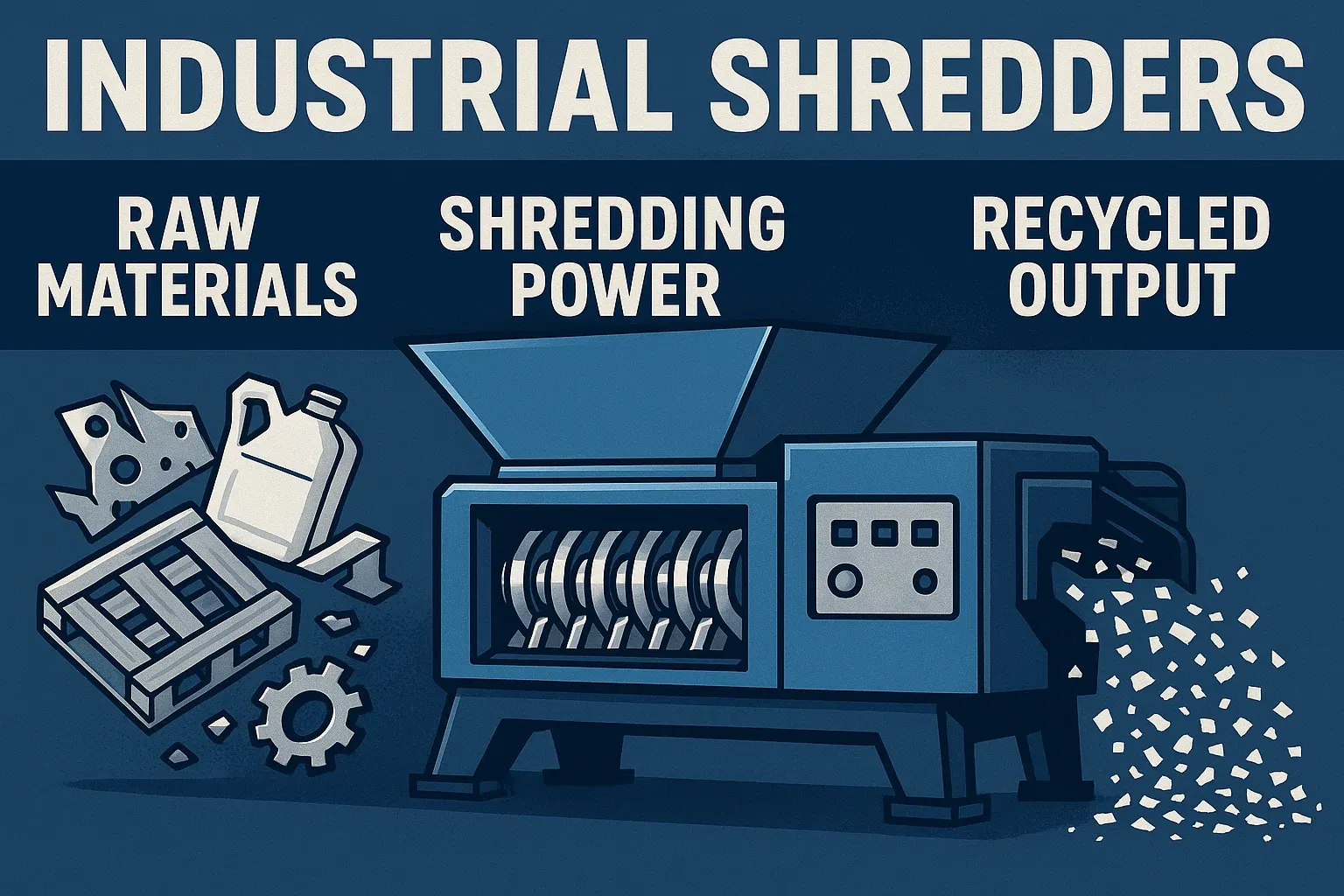
Industrial shredders are not random crushers; they are precision-engineered machines that exploit the mechanical properties of materials to induce failure. Whether processing 100-micron LDPE film or 20mm steel plate, the underlying physics remains the same: Shear Stress exceeded Material Strength. This guide explores the mechanical engineering principles behind size reduction.
Related equipment: single shaft shredder.
1. Mechanics of Material Failure
Shredders primarily utilize Shear forces, although Tensile and Compressive forces play supporting roles.
Shear vs. Tear
- Shear Failure: Occurs when two opposing blades pass each other with zero clearance, similar to scissors.
- Equation: $\tau = F / A$ where $\tau$ is shear stress, $F$ is force, $A$ is cross-sectional area.
- Application: Tires, Metals, Rigid Plastics.
- Tensile Failure (Tearing): Occurs when the hook grabs the material and pulls it against a counter-knife or screen, stretching it until it snaps.
- Application: Textiles, Carpets, Jumbo Bags.
2. Torque and Cutting Force Calculation
The “power” of a shredder is rarely about kW; it is about Torque ($T$).
$$T = (P \times 9550) / n$$
Where:
* $T$ = Torque (Newton-meters)
* $P$ = Power (kW)
* $n$ = Rotational Speed (RPM)
Engineering Insight: A 100kW motor running at 1500 RPM (Granulator) produces ~636 Nm of torque. That same 100kW motor running at 80 RPM (Shredder) through a 20:1 gearbox produces 11,937 Nm of torque. This is why shredders can cut car tires, while granulators would stall instantly.
3. Cutting Geometry: The ‘Bite’
The efficiency of a shredder is dictated by the Rake Angle and Hook Profile.
Positive vs. Negative Rake
- Positive Rake Angle: The blade face leans into the cut.
- Effect: Sharper cut, lower energy consumption.
- Risk: Fragile edge, prone to chipping on metal.
- Negative Rake Angle: The blade face leans away from the cut.
- Effect: High edge strength (blunt force), higher energy use.
- Best for: Scrap metal, electronics.
The “Nibbling” Effect
Rotor knives are arranged in a specific Helix Pattern (Chevrons) along the shaft. This ensures that only 1 or 2 knives are cutting at any millisecond. If all knives hit the material simultaneously, the “impact load” would stall the motor. The helix creates a continuous, smooth cutting action, stabilizing the amperage draw.
4. Screen Dynamics
The screen defines the output size but acts as the primary bottleneck.
- Open Area Ratio (OAR): The percentage of holes vs. solid metal.
- Standard: 35-45% Open Area.
- Throughput Rule: Capacity is directly proportional to OAR. A screen with 50mm holes has significantly higher OAR than one with 20mm holes, often doubling throughput.
- Recirculation: Material that doesn’t pass through the screen is carried back up by the rotor (“Carryover”) for re-cutting. Excessive recirculation generates heat and dust (fines), lowering efficiency.
5. Drive Systems: Hydraulic vs. Electric
- Hydraulic Drive Principles:
- Uses a variable displacement pump.
- Advantage: Can deliver very high torque at low RPM without overheating. Useful for “unshreddable” jams where fast auto-reverse is needed.
- Electric Drive (VFD):
- Uses an inverter to control AC frequency.
- Advantage: Higher wall-plug efficiency (95% vs 75% for hydraulic). Lower maintenance (no oil leaks).
Conclusion
Selecting a shredder requires balancing these physical constraints. A machine designed for high-shear (tires) will fail at processing high-tensile fibers (ropes) due to winding. Understanding the material’s failure mode is the first step in machine design.
References
[1] “Mechanics of Materials,” Hibbeler. Mechanics of Materials
[2] “Design of Shredding Equipment,” Waste Management Journal. Design of Shredding Equipment
