

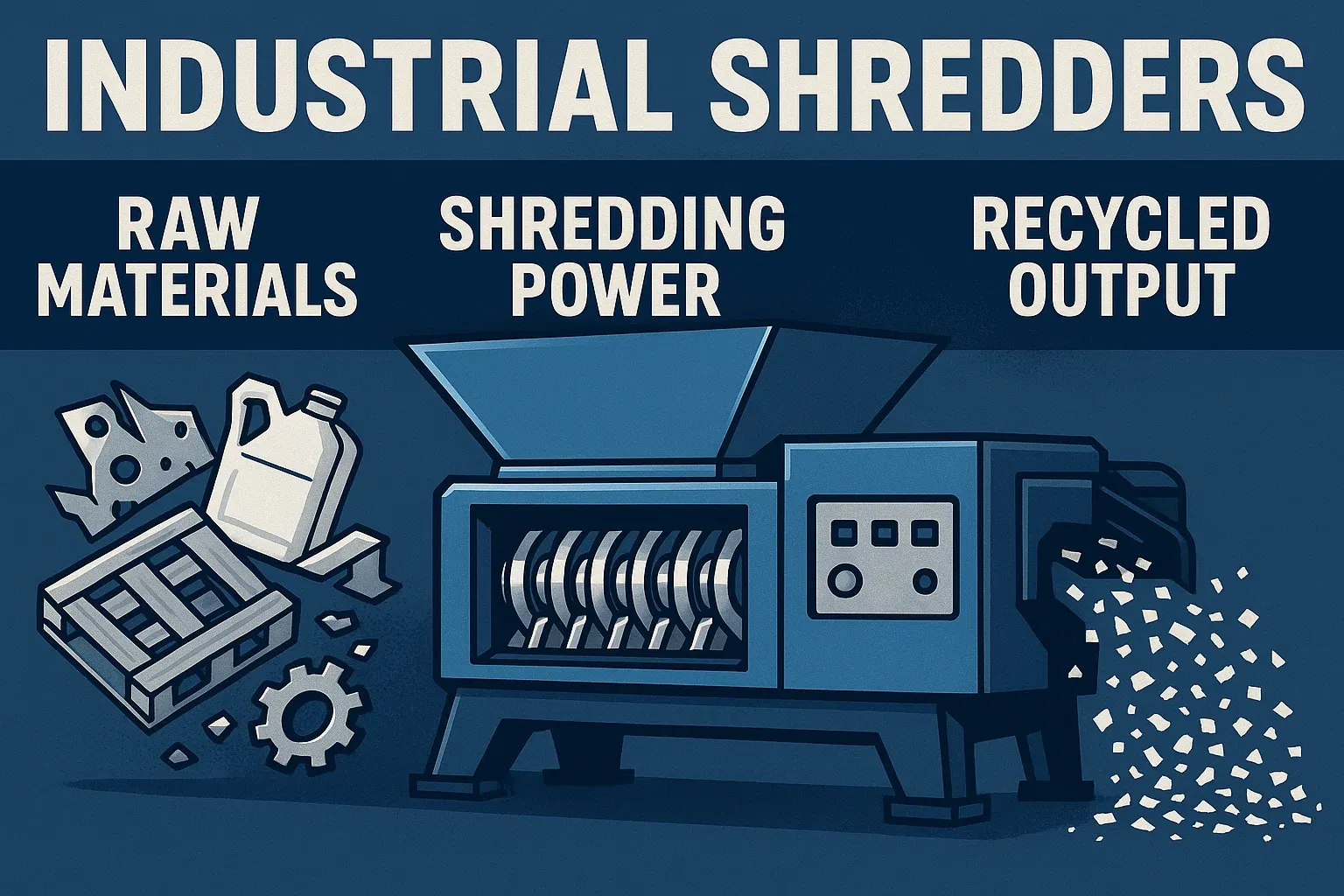
Industrial shredders are not random crushers; they are precision-engineered machines that exploit the mechanical properties of materials to induce failure. Whether processing 100-micron LDPE film or 20mm steel plate, the underlying physics remains the same: Shear Stress exceeded Material Strength. This guide explores the mechanical engineering principles behind size reduction.
Related equipment: single-shaft shredder | dual-shaft shredder | all shredder models.
1. Mechanics of Material Failure
Shredders primarily utilize Shear forces, although Tensile and Compressive forces play supporting roles.
Shear vs. Tear
- Shear Failure: Occurs when two opposing blades pass each other with zero clearance, similar to scissors.
- Equation: $\tau = F / A$ where $\tau$ is shear stress, $F$ is force, $A$ is cross-sectional area.
- Application: Tires, Metals, Rigid Plastics.
- Tensile Failure (Tearing): Occurs when the hook grabs the material and pulls it against a counter-knife or screen, stretching it until it snaps.
- Application: Textiles, Carpets, Jumbo Bags.
2. Torque and Cutting Force Calculation
The “power” of a shredder is rarely about kW; it is about Torque ($T$).
$$T = (P \times 9550) / n$$
Where:
* $T$ = Torque (Newton-meters)
* $P$ = Power (kW)
* $n$ = Rotational Speed (RPM)
Engineering Insight: A 100kW motor running at 1500 RPM (Granulator) produces ~636 Nm of torque. That same 100kW motor running at 80 RPM (Shredder) through a 20:1 gearbox produces 11,937 Nm of torque. This is why shredders can cut car tires, while granulators would stall instantly.
3. Cutting Geometry: The ‘Bite’
The efficiency of a shredder is dictated by the Rake Angle and Hook Profile.
Positive vs. Negative Rake
- Positive Rake Angle: The blade face leans into the cut.
- Effect: Sharper cut, lower energy consumption.
- Risk: Fragile edge, prone to chipping on metal.
- Negative Rake Angle: The blade face leans away from the cut.
- Effect: High edge strength (blunt force), higher energy use.
- Best for: Scrap metal, electronics.
The “Nibbling” Effect
Rotor knives are arranged in a specific Helix Pattern (Chevrons) along the shaft. This ensures that only 1 or 2 knives are cutting at any millisecond. If all knives hit the material simultaneously, the “impact load” would stall the motor. The helix creates a continuous, smooth cutting action, stabilizing the amperage draw.
4. Screen Dynamics
The screen defines the output size but acts as the primary bottleneck.
- Open Area Ratio (OAR): The percentage of holes vs. solid metal.
- Standard: 35-45% Open Area.
- Throughput Rule: Capacity is directly proportional to OAR. A screen with 50mm holes has significantly higher OAR than one with 20mm holes, often doubling throughput.
- Recirculation: Material that doesn’t pass through the screen is carried back up by the rotor (“Carryover”) for re-cutting. Excessive recirculation generates heat and dust (fines), lowering efficiency.
5. Drive Systems: Hydraulic vs. Electric
- Hydraulic Drive Principles:
- Uses a variable displacement pump.
- Advantage: Can deliver very high torque at low RPM without overheating. Useful for “unshreddable” jams where fast auto-reverse is needed.
- Electric Drive (VFD):
- Uses an inverter to control AC frequency.
- Advantage: Higher wall-plug efficiency (95% vs 75% for hydraulic). Lower maintenance (no oil leaks).
Industrial Shredder Types: Single-Shaft vs Dual-Shaft
The two most common industrial shredder configurations use fundamentally different approaches to size reduction. Your choice depends on the material type, target output size, and throughput requirements.
| Factor | Single-Shaft Shredder | Dual-Shaft Shredder |
|---|---|---|
| Cutting action | Rotor knives cut against fixed bed knives + screen controls output size | Two counter-rotating shafts with interlocking cutters shear material between them |
| Output size control | Screen determines final particle size (10–80 mm typical) | No screen — output size set by cutter width (50–200 mm typical) |
| Speed / Torque | Medium speed (60–120 RPM), high torque via gearbox | Low speed (15–40 RPM), very high torque |
| Best materials | Films, bags, fibers, rigid plastics, paper, wood | Bulky waste, tires, metals, e-waste, mixed MSW |
| Throughput range | 200–3,000 kg/h | 500–10,000+ kg/h |
| Price range (USD) | $5,000–$60,000 | $15,000–$150,000+ |
| Maintenance focus | Screen wear + bed knife adjustment | Cutter replacement + shaft seal inspection |
Selection shortcut: If you need a defined output size (for feeding a washing line or granulator), choose a single-shaft shredder with screen. If you need to reduce bulky items to a manageable size as a first stage, choose a dual-shaft shredder. Many recycling plants use both in sequence: dual-shaft for primary size reduction, single-shaft for secondary sizing.
Industrial Shredder Applications by Material
Different materials fail through different mechanisms (see shear vs tensile failure above), so each application requires specific cutter design, speed, and screen configuration.
Plastic Recycling Shredders
- Rigid plastics (HDPE pipes, crates, drums): Single-shaft with V-rotor knives, 20–40 mm screen. See our rigid plastic shredder configurations.
- PE/PP film & woven bags: Single-shaft with anti-winding rotor design, wider clearance to prevent material wrapping. See film & raffia shredder.
- PET bottles: Often processed with a crusher rather than shredder to preserve flake quality.
Metal Scrap Shredders
- Light metals (aluminum cans, copper wire): Dual-shaft at low RPM, hardened tool steel cutters.
- Heavy metals (steel turnings, automotive scrap): Heavy-duty dual-shaft with hydraulic drive for instant reverse on jams. See metal scrap shredder.
Textile & Fiber Shredders
- Textiles require tensile failure (tearing) rather than shear. Hook-style rotors grab and pull fibers against counter-knives.
- Anti-winding features (reverse pulsing, shaft scrapers) prevent fiber buildup on the rotor. See textile waste shredder.
Tire & Rubber Shredders
- Tires need very high torque at low speed. Dual-shaft shredders with 20:1+ gearbox ratios handle steel-belted radials.
- Two-stage process typical: dual-shaft primary (50–100 mm strips) → single-shaft secondary (10–20 mm chips).
- See tire recycling shredder options.
How to Select the Right Industrial Shredder
Before requesting quotes, define these five parameters. They determine 90% of the correct machine configuration:
- Material type & form: What are you shredding? (film rolls, rigid parts, mixed waste, metals)
- Input size: What is the largest piece going in? (affects hopper and rotor diameter)
- Target output size: What size do you need out? (determines screen selection or cutter width)
- Throughput: How many kg/h or tons/day? (sizes the motor, rotor width, and drive)
- Downstream process: What comes after the shredder? (washing line, granulator, pelletizer, landfill)
For a step-by-step RFQ process with TCO analysis and factory acceptance test (FAT) checklist, see our Industrial Shredder Buyer’s Guide. For plastics-specific sizing with cutter geometry details, read the Plastics Shredder Selection Guide.
Frequently Asked Questions
How does an industrial shredder work?
An industrial shredder works by applying shear force through rotating blades that cut material against fixed counter-knives. The motor drives the rotor through a high-ratio gearbox (typically 15:1 to 25:1), converting speed into torque. Material feeds by gravity into the cutting chamber, where it is reduced until small enough to pass through the sizing screen (single-shaft) or fall between the cutter gaps (dual-shaft).
What is the difference between a shredder and a granulator?
A shredder operates at low speed (15–120 RPM) with high torque for primary size reduction of large or tough materials. A granulator operates at high speed (300–600 RPM) with an open rotor and tight-tolerance screen for producing uniform, small particles (3–12 mm). Shredders handle the rough work; granulators refine it. Many recycling lines use both in sequence.
How much does an industrial shredder cost?
A small single-shaft plastic shredder starts at $5,000–$8,000 for 200 kg/h capacity. Medium industrial single-shaft units cost $15,000–$60,000 (500–2,000 kg/h). Heavy-duty dual-shaft shredders for metals and tires range from $30,000 to $150,000+. See our 2026 machine price list for detailed pricing by capacity tier.
What maintenance does an industrial shredder need?
Regular maintenance includes: blade sharpening or rotation every 200–500 operating hours (material-dependent), screen inspection for wear and holes, gearbox oil changes per manufacturer schedule, hydraulic system checks (if equipped), and bearing lubrication. Planned downtime for blade changes typically takes 2–4 hours with a trained crew. Read our full shredder blade guide for details on steel grades and service life.
Single-shaft or dual-shaft shredder – which do I need?
Choose single-shaft if you need defined output size (screen-controlled), process films/plastics/wood, or need the shredder to feed directly into a washing line or granulator. Choose dual-shaft if you process bulky mixed waste, tires, or metals and need high-throughput primary reduction without precise sizing. When in doubt, see our application-specific selection guide.
Conclusion
Selecting an industrial shredder requires matching the machine’s cutting mechanics to your material’s failure mode. A high-shear design (for tires and metals) will fail at processing high-tensile fibers (ropes, textiles) due to winding. Understanding the physics of shear stress, torque delivery, cutting geometry, and screen dynamics — covered in detail above — gives you the engineering foundation to evaluate any supplier’s machine against your actual processing requirements.
Ready to specify your shredder? Start with our RFQ checklist or browse all shredder models.
References
[1] “Mechanics of Materials,” Hibbeler. Mechanics of Materials
[2] “Design of Shredding Equipment,” Waste Management Journal. Design of Shredding Equipment
