

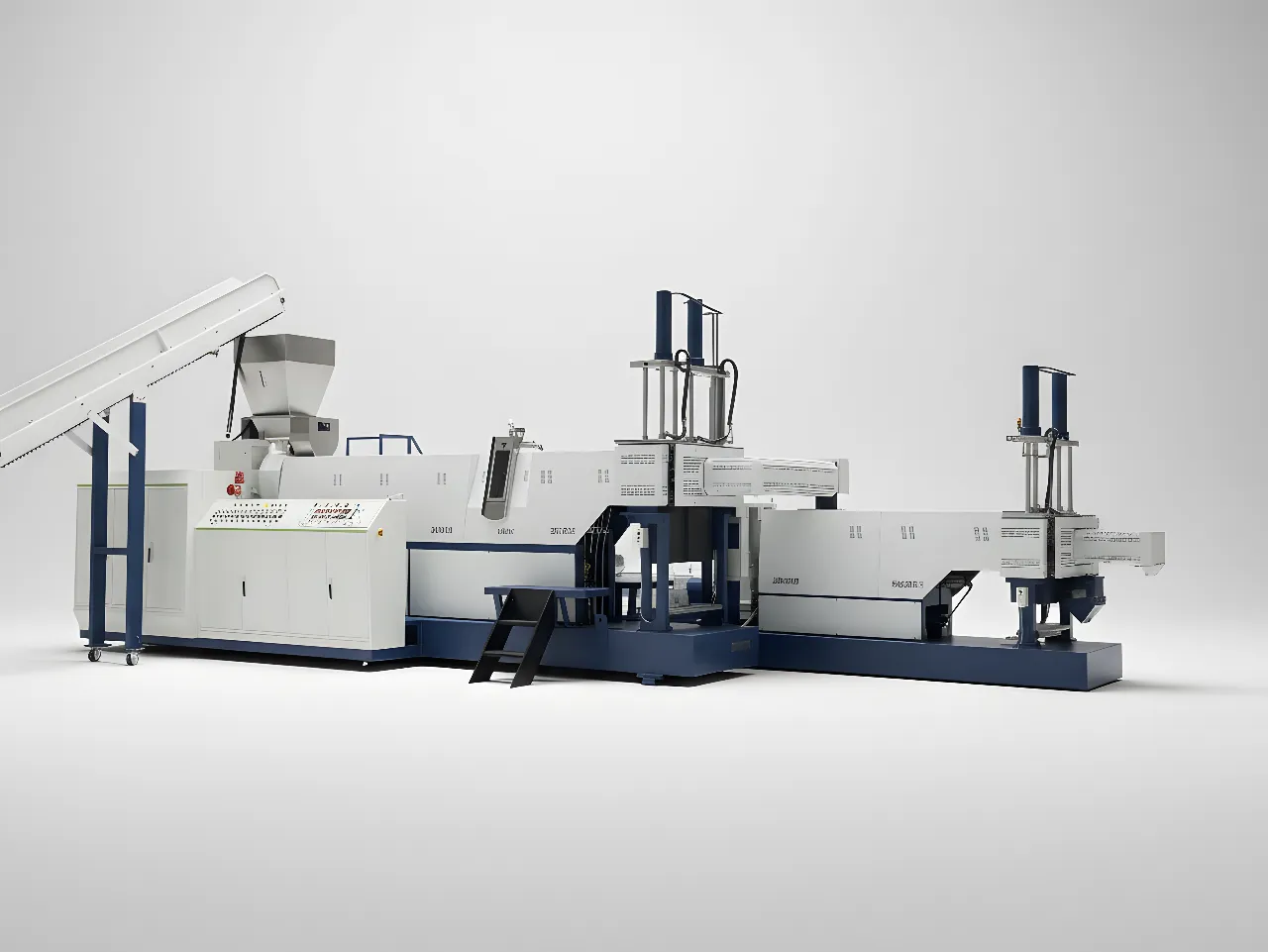
PET Flake to Pellet Conversion
PET Bottle Flake Single Screw Pelletizer
A PET flake pelletizing line designed to convert clean and dry PET bottle flakes into stable pellets through controlled single-screw extrusion, vacuum degassing, fine melt filtration, and underwater pelletizing. It is intended for operations that want higher-value PET output after washing and drying.
Why PET Flake Pelletizing Demands Tight Process Control
PET is less forgiving than many polyolefins. Moisture, IV loss, and filtration quality directly affect whether the final pellets are suitable for higher-value downstream uses.
Built for Stable PET Pellet Quality
The line is designed around PET-specific process control, especially steady feeding, melt stability, moisture management, and precise pellet formation.
Moisture Control Matters
Dry feed is critical for PET. Moisture control helps reduce hydrolysis risk and protects intrinsic viscosity during melt processing.
Vacuum Degassing
Degassing helps remove residual moisture and volatiles so pellet stability and appearance improve during continuous runs.
Fine Filtration Supports Cleaner PET Melt
Advanced screen filtration removes remaining contamination before pelletizing, which is important for recycled PET applications that need more controlled melt quality.
Underwater Pelletizing Delivers Stable Pellet Formation
The underwater pelletizing section supports controlled pellet cutting and cooling for a cleaner and more uniform PET pellet stream.
Higher-Value Output from PET Flakes
Pelletizing lets processors move beyond flake sales and produce a denser, easier-to-handle recycled PET product for broader downstream use.
Best Fit Materials and Use Cases
This line is intended for PET flakes that have already gone through sorting, washing, and drying, and are ready for value-added reprocessing into pellets.
Washed PET Bottle Flakes
The main application is clean and dry PET bottle flakes from bottle recycling systems.
Post-Consumer PET Reprocessing
Suitable for PET recycling plants looking to turn flakes into denser pellet output for easier handling and resale.
Fiber and Sheet Feed Preparation
Useful when recycled PET pellets will feed later polyester, sheet, or other downstream manufacturing processes.
Flake-to-Pellet Upgrading
Ideal for recyclers that want to increase material value compared with selling flakes alone.
Controlled Melt Quality Projects
Useful where melt cleanliness, filtration, and moisture management need tighter control than basic extrusion offers.
Higher Value PET Output
Best suited to projects where pellet density, easier logistics, and more stable downstream dosing are commercial priorities.
PET Flake Pelletizing Workflow
The sequence is designed to protect melt quality while turning dry PET flakes into uniform pellets with tighter process control.
Optimized Feeding
Dry PET flakes are fed in a controlled manner to keep the material flow stable and predictable.
Single-Screw Extrusion
The extruder melts and plasticizes the flakes while maintaining controlled thermal conditions for PET.
Vacuum Degassing
Residual moisture and volatiles are removed to improve pellet stability and reduce melt defects.
Fine Melt Filtration
The molten PET passes through filtration to remove remaining impurities before pellet formation.
Underwater Pelletizing
Pellets are cut and cooled immediately for more uniform pellet formation and easier downstream handling.
PET Flake Pelletizing vs Selling Clean Flakes
Not every PET recycler needs pelletizing, but it becomes attractive when higher-value output and easier downstream handling are worth the extra process control.
| Decision Factor | PET Flake Pelletizer | Clean PET Flake Sales |
|---|---|---|
| Output Format | Dense pellets for easier dosing and storage | Loose flakes |
| Process Complexity | Higher, due to extrusion and pelletizing | Simpler |
| Value Addition | Often higher-value finished output | Lower processing burden but lower upgrade potential |
| Moisture and Melt Control Need | Critical | Less critical if selling flakes directly |
| Best Fit | When pellet resale or downstream PET processing is the goal | When flake output already matches your market |
Machine Specifications
System configuration and output should be matched to flake dryness, intrinsic viscosity target, and filtration requirement.
| Model | Capacity | Extruder Power | Application |
|---|---|---|---|
| SJ-90 | 150 - 250 kg/h | 55 - 75 kW | PET Bottle Flakes |
| SJ-120 | 250 - 400 kg/h | 90 - 132 kW | PET Bottle Flakes |
| SJ-150 | 400 - 600 kg/h | 160 - 220 kW | PET Bottle Flakes |
Equipment Operation Showcase
Reference views of the pelletizing line, extrusion section, and final drying system.


Watch the PET Pelletizing Line in Operation
A quick view of PET flake feeding, extrusion, underwater cutting, and final pellet handling.
Technical Support and FAQ
Key questions buyers usually ask before choosing a PET flake pelletizing line.
By using controlled thermal conditions, strong drying discipline, vacuum degassing, and stable melt flow, the line helps reduce hydrolysis and excessive PET degradation during processing.
PET flakes should be very dry before entering the extruder. Final dryness targets depend on the downstream quality goal, but lower moisture is always better for pellet stability.
Service intervals depend on flake cleanliness, label residue, and dirt load. Better upstream washing usually extends filtration life and improves line stability.
That depends on the full recycling process, flake purity, decontamination logic, and local regulatory requirements. Share your target market and quality standards so the line can be matched correctly.
Please share flake quality, contamination level, moisture condition, expected throughput, and the downstream application required for the final PET pellets.
Project Request and Consultation
Send your PET flake quality, moisture level, target output, and end-use requirement. We will recommend a pelletizing configuration matched to your project.
