

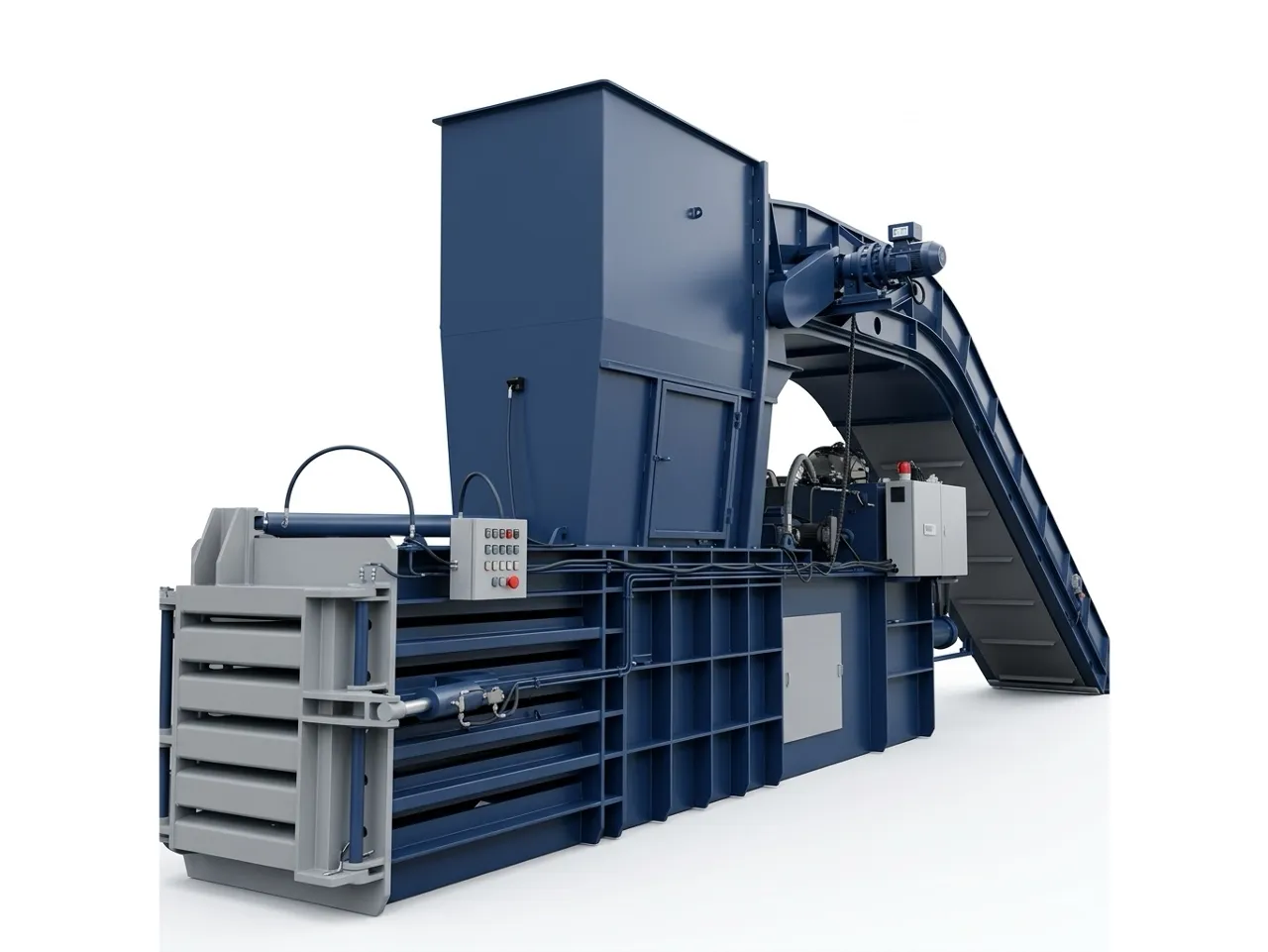
Semi-Automatic Baling for Paper and Lightweight Recyclables
Semi-Auto Waste Paper Baling Machine
A hydraulic semi-auto waste paper baling machine designed for waste paper, OCC, cartons, plastic film, and PET bottle streams. It compresses loose recyclable material into denser bales, reduces transport cost, and gives paper recyclers and collection stations a practical upgrade path between small manual baling and larger continuous full-automatic systems.
Why This Semi-Auto Waste Paper Baler Works for Daily Recycling Operations
Paper recyclers often need more than a small vertical baler, but not every site is ready for a full automatic horizontal line. This machine is designed for that middle ground.
Hydraulic Compression with Practical Semi-Auto Control
The machine uses hydraulic force for stable compaction and can be configured around manual or PLC-assisted operating logic depending on plant needs.
Customizable Chamber and Bale Range
Compression chamber size and bale block dimensions can be matched to different paper grades, workflow constraints, and transport targets.
Precision Press Head
The press head is built for more accurate compression behavior, which supports cleaner bale formation and more predictable daily operation.
Low Investment Relative to Utility
For many paper and packaging waste sites, this machine offers a useful balance between capital cost, throughput, and bale quality without moving directly to a much larger automatic baler.
Lower Freight and Better Yard Handling
By reducing loose-paper volume and creating denser bales, the machine helps lower transport cost and keeps the storage area cleaner and easier to manage.
Supports Recycling Efficiency
Compacting paper and related recyclable streams into a standard bale format makes handling more organized and supports broader recycling and recovery programs.
Material Range and Application Scope
This machine is best suited to facilities handling recurring lightweight recyclable streams that need a practical, denser shipping format.
Waste Paper Factories
A strong fit for mixed waste paper consolidation and bale preparation before transport or downstream recycling.
Cardboard and Carton Waste
Suitable for OCC, packaging board, cartons, and trimming waste from packaging and converting operations.
Recycling Companies
Useful for operators handling multiple light recyclable streams and needing a lower-investment baling route.
Plastic Film and Light Packaging Scrap
Can also process selected film and packaging materials when volume reduction rather than shredding is the main goal.
PET Bottle Collection Streams
Suitable for PET bottle applications where the site needs denser bale output without a fully automatic horizontal baling line.
Warehouse and Factory Waste Handling
A practical solution for facilities cleaning up recurring waste streams and standardizing outbound bale handling.
How the Semi-Auto Waste Paper Baling Process Works
The workflow is designed to turn loose recyclable feed into a denser bale while keeping the machine simple enough for flexible daily operation.
Load the Material
Waste paper, cartons, film, or bottles are loaded into the chamber depending on the site workflow and material mix.
Hydraulic Compression
The hydraulic system compresses the loose material into a denser block, reducing volume and improving handling efficiency.
Form the Bale
The chamber and press head shape the material into a bale size suited to storage, forklift handling, and shipment.
Tie and Secure
Once the target density is reached, the bale is tied for stable storage and transport.
Remove and Dispatch
The finished bale is removed for storage, loading, or transfer to the next recycling and logistics stage.
Semi-Auto Waste Paper Baler vs Other Baling Options
The best fit depends on material mix, volume, and how much automation the site really needs.
| Decision Factor | Semi-Auto Waste Paper Baler | Hydraulic Industrial Baler | Fully Automatic Horizontal Baler |
|---|---|---|---|
| Best Fit | Mid-scale paper and mixed light recyclable handling | Paper-focused sites wanting a stronger dedicated cardboard and paper baler | Large sites with continuous conveyor-fed flow |
| Material Scope | Waste paper plus selected film and PET applications | More tightly centered on OCC, cartons, and waste paper | Broad high-volume recyclable streams |
| Automation Level | Balanced manual and PLC control options | Hydraulic standalone paper baling logic | Highest automation and capital requirement |
| Investment Logic | Lower investment with broad daily utility | Good when paper is the dominant waste stream | Best when tonnage justifies full automation |
| When to Choose | When you need a practical middle-ground baler | When OCC and cardboard are the main commercial waste streams | When labor reduction and continuous output are the core priorities |
Technical Specifications
These reference models show how chamber size, pressure, and throughput scale across the semi-auto waste paper baler range.
| Model | RTM-400WB7280 | RTM-600WB10080 | RTM-1000WB11085 | RTM-1000WB110110 |
|---|---|---|---|---|
| Pressure | 40 tons | 60 tons | 100 tons | 100 tons |
| Main Motor Power | 11 kW | 15 kW | 30 kW | 30 kW |
| Cycle Time | 19 s | 23 s | 36 s | 42 s |
| Oil Reservoir | 240 L | 380 L | 1460 L | 1600 L |
| Number of Belting | 4 lines | 4 lines | 4 lines | 5 lines |
| Feed Opening Size | 1000 x 700 mm | 1200 x 980 mm | 1400 x 1050 mm | 1800 x 1050 mm |
| Chamber Size | 2200 x 700 x 780 mm | 2400 x 980 x 780 mm | 3000 x 1050 x 830 mm | 3700 x 1050 x 1050 mm |
| Bale Size | 1000 x 720 x 800 mm | 1000 x 1000 x 800 mm | 1300 x 1100 x 850 mm | 1600 x 1100 x 1100 mm |
| Throughput | 0.5 - 1 ton/h | 1 - 2 tons/h | 1.5 - 3 tons/h | 2 - 6 tons/h |
| Machine Weight | 4 tons | 5.2 tons | 12 tons | 18 tons |
| Machine Overall Dimension | 5500 x 1100 x 2000 mm | 6100 x 1400 x 2000 mm | 7450 x 1600 x 2300 mm | 8200 x 1600 x 3500 mm |
Frequently Asked Questions
Questions buyers usually ask when comparing semi-auto paper balers with broader baling options.
It is designed for waste paper, cardboard, cartons, and can also handle selected plastic film and PET bottle streams depending on density and bale target.
That flexibility lets operators choose simpler manual control for direct operation or use PLC logic for more streamlined and repeatable production cycles.
Chamber selection depends on feed volume, material bulk density, desired bale size, and how frequently the site wants to cycle and discharge bales.
Yes, especially when the site handles a mix of paper-dominant light recyclable streams and wants a practical, lower-investment baling route.
Please share your material mix, hourly or daily volume, target bale size, power supply conditions, and whether you want manual or PLC-based control.
Need a Semi-Auto Paper Baler Matched to Your Workflow?
Send us your material type, throughput, preferred bale size, and control preference. We will help define the right chamber and hydraulic configuration for your operation.
