

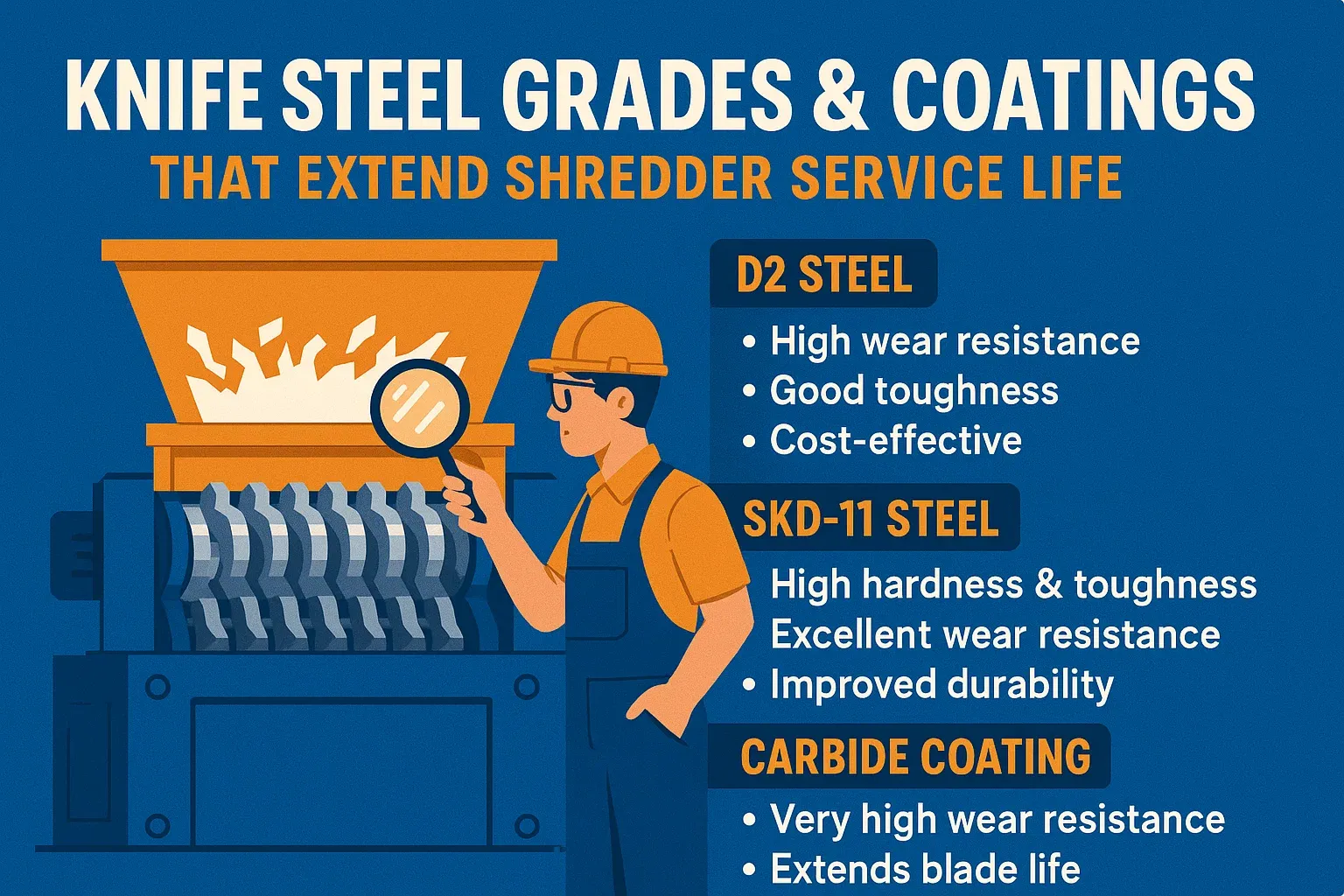
In industrial shredding, Wear Cost Per Ton is a key performance indicator (KPI). A set of D2 blades costing \$2,000 that lasts 500 hours (\$4/hr) is far more expensive than a set of CPM 10V blades costing \$6,000 that lasts 4,000 hours (\$1.50/hr). This guide explores the advanced metallurgy options beyond standard tool steel.
Related equipment: single shaft shredder.
1. The Baseline: D2 / SKD11
- Composition: 1.5% Carbon, 12% Chromium.
- Performance: The industry standard for general plastics.
- Limitation: Large carbide structures in the steel matrix are prone to “pull-out” (micro-chipping) when processing abrasive materials like glass-filled nylon or dirty film.
2. The Upgrade: CPM 10V (Powder Metallurgy)
Crucible Particle Metallurgy (CPM) creates a steel with a uniform distribution of extremely fine Vanadium Carbides.
* Composition: 2.45% Carbon, 9.75% Vanadium.
* Performance: Vanadium Carbides are harder than Chromium Carbides (Rockwell C 82 vs 66 equivalent).
* Wear Life: Typically 5x to 10x that of D2 in abrasive applications.
* Best For: Glass-reinforced plastics, Paper (high silica content), contaminated film.
* Toughness: Surprisingly good due to the fine grain structure, resisting shock better than standard D2.
3. The Extreme: Cemented Carbide Inlays
Tungsten Carbide is not steel; it is a ceramic-metal composite.
* Application: Brazing a solid carbide strip onto a steel carrier body.
* Hardness: 1600 Vickers (~90 HRC).
* Wear Life: Extremely long. Can act as “permanent” blades in some soft applications.
* Fatal Flaw: Brittleness. If a steel bolt or hammer enters the shredder, the carbide can shatter like glass.
* Best For: Tire recycling (wire-free), Carpet recycling (CaCO3 backing).
4. Hardfacing: The “Armored” Rotor
Wear doesn’t just happen to the knives; the rotor body wears too.
* Technique: Welding a matrix of Tungsten Carbide particles onto the rotor surface.
* Pattern: “Waffle” or “Cross-hatch” patterns trap material, allowing plastic-on-plastic wear instead of plastic-on-steel.
* Maintenance: Hardfacing is typically re-applied during scheduled overhauls; the interval depends on abrasion, uptime, and maintenance strategy.
5. The “Free” Upgrade: Cryogenic Treatment
Deep Cryogenic Treatment (DCT) involves cooling the blades to -196°C (-320°F) for 24+ hours after heat treatment.
* Science: Transforms soft “Retained Austenite” into hard “Martensite.”
* Result: Increases abrasive wear resistance by 20-30% and relieves internal stresses (reducing cracking risk).
* Cost: Negligible (<5% of blade cost). Always specify Cryo.
Summary Selection Guide
| Application | Recommended Material | HRC | Relative Cost | Relative Life |
|---|---|---|---|---|
| Clean PE/PP | D2 / SKD11 | 58-60 | 1x | 1x |
| Dirty Film / Paper | CPM 10V | 60-63 | 3x | 8x |
| Tires / Carpet | Carbide Inlay | 88-90 | 4x | 15x |
| Heavy Metal Scrap | Modified H13 | 52-54 | 1.5x | 2x (Impact) |
References
[1] “Tool Steel Selection for Cold Work Applications,” Crucible Industries. Tool Steel Selection for Cold Work Applications
[2] “Wear Mechanisms in Plastic Recycling,” Journal of Tribology. Wear Mechanisms in Plastic Recycling
