

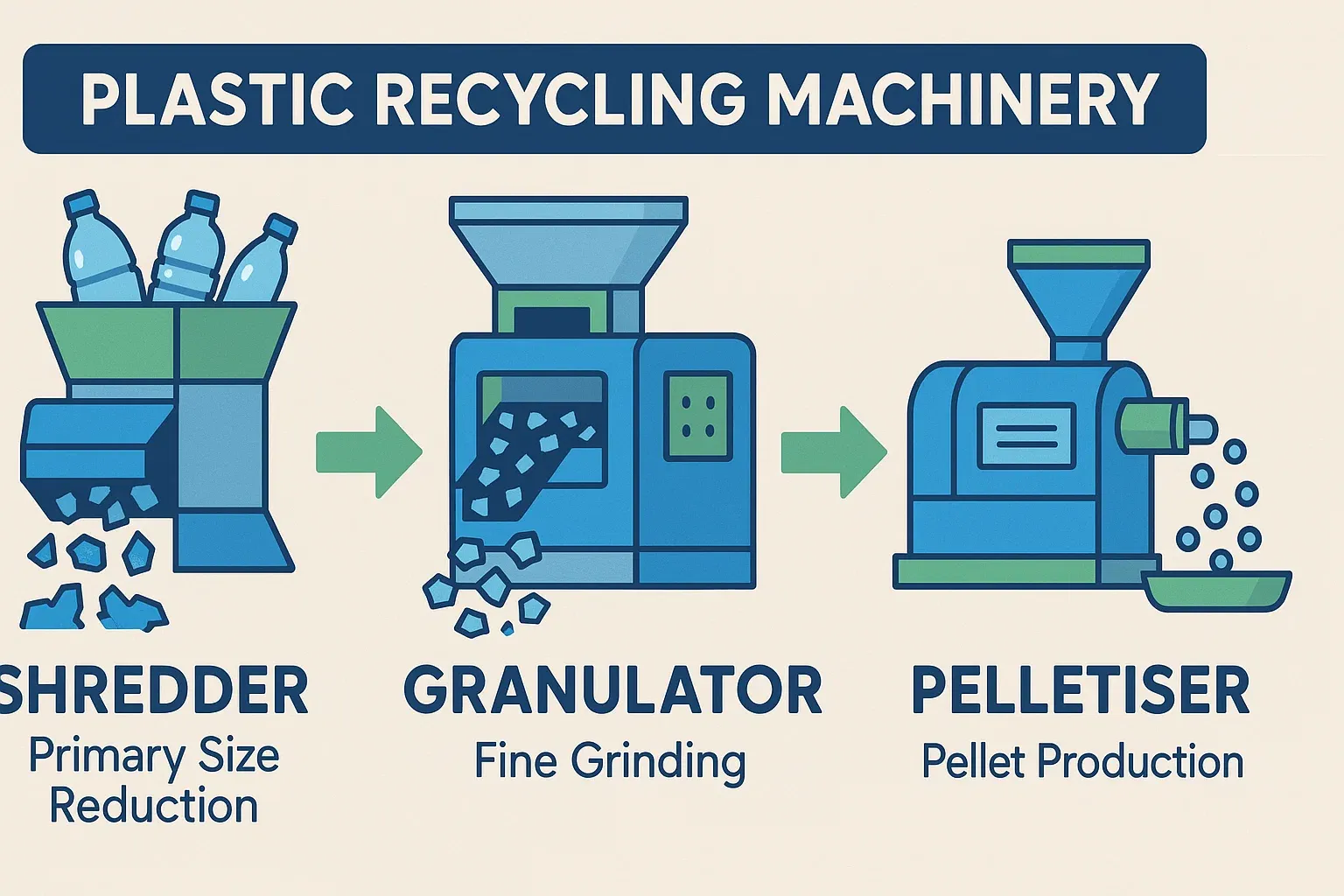
“Shredder,” “granulator,” “crusher,” and “pelletizer” get used interchangeably in plastics recycling conversations — but they solve different mechanical problems at different points in the process. Confusing them leads to undersized equipment, accelerated knife wear, unstable extruder feeding, and off-spec output.
A recycling line is a cascade of size reduction. Each stage takes over where the previous one left off: primary reduction (shredder), secondary sizing (granulator), and tertiary processing (pelletizer/extruder). Attempting to granulate a whole pipe will destroy the machine. Attempting to extrude dirty, unsized flake will block the screen changer within hours. The right machine in the wrong position causes more damage than no machine at all.
This guide covers the physics behind each machine type, where each fits in a recycling line, how to decide what you need, and what to send in an RFQ so suppliers quote the right equipment for your scrap stream. It draws on our experience configuring size-reduction systems across rigid, flexible, and mixed feedstock lines in over 60 countries.
The Physics: Shear vs. Impact vs. Plastification
Before comparing equipment, understand the three failure modes that size-reduction machines exploit. Matching the failure mode to the material is the single most important selection criterion.
Shear Failure — The Shredder
A single-shaft shredder applies opposing cutting edges that pass each other with near-zero clearance — the same principle as scissors. Low-speed rotation (typically 60–100 RPM) delivers massive torque. The machine holds the material with a hydraulic ram and shears it until the material’s shear strength is exceeded.
Why this matters for material selection: Ductile and elastic materials — LDPE film, PP woven bags, rubber, car tires, copper wire — stretch and absorb impact energy without fracturing. You cannot shatter film with a hammer; you have to hold it and cut it. Shear is the only effective failure mode for these materials.
Impact Failure — The Granulator (and Crusher)
A plastic granulator uses a high-speed rotor (typically 400–600 RPM) with cutting knives that strike material against stationary bed knives. The kinetic energy transfer fractures the material when its fracture toughness is exceeded.
Why this matters: Rigid and semi-rigid materials — HDPE crates, PP bumpers, ABS housings, PVC pipes — respond well to high-speed impact cutting because they fracture cleanly along stress lines. The result is a relatively uniform flake. However, if you feed ductile film into a granulator, the material wraps around the rotor instead of fracturing — causing jams, heat buildup, and poor output quality.
Note on terminology: “Crusher” and “granulator” are used interchangeably across regions and manufacturers. What matters is the cutting mechanism (high-speed impact vs. low-speed shear), not the name on the nameplate.
Hammer Mill — The Liberator
A hammer mill uses swinging hammers on a high-speed rotor. Unlike a granulator’s fixed-knife precision cutting, the hammer mill delivers brute-force impact that smashes composite materials apart. Its primary role is liberation — separating bonded materials (copper from steel in motors, aluminum from plastic in e-waste) so that downstream density or magnetic separation can recover individual fractions. Hammer mills are standard in e-waste and scrap metal processing but are rarely the right choice for single-polymer plastics recycling.
Plastification — The Pelletizer (Extruder)
A pelletizer is not a size-reduction machine. It is a thermal processing system: an extruder melts clean, dry flake or regrind, forces the melt through a filtration screen to remove non-melting contaminants (wood, paper, aluminum, sand), and degasses volatiles (ink solvents, residual moisture) under vacuum. The clean melt is then cut into uniform 3–4 mm pellets — the standard feedstock format for injection molding, blow molding, and film extrusion.
Why this matters: Pelletizing is the only step that removes dissolved and embedded contaminants that washing cannot reach. It is also the step that converts irregular regrind into a dense, flowable pellet (bulk density ~500–600 kg/m³) that downstream processors can meter accurately.
Key Takeaway: Shredders cut ductile materials by shear. Granulators fracture rigid materials by impact. Pelletizers melt, filter, and reshape clean flake into a market-ready product. Each machine serves a specific function — substituting one for another creates problems.
The Processing Hierarchy: Primary → Secondary → Tertiary
Every recycling line follows a reduction cascade. Skipping a stage forces the next machine to do work it was not designed for — resulting in excessive wear, unstable throughput, and poor output quality.
Stage 1 — Primary Reduction: The Shredder
| Attribute | Detail |
|---|---|
| Input | Bales, whole parts, purging lumps, pipes, pallets, drums — anything too large or irregular for direct granulation |
| Output | 30–60 mm chips (screen-controlled) |
| Reduction ratio | ~20:1 (from ~1,000 mm input to ~50 mm output) |
| Speed | 60–100 RPM |
| Torque | Very high — hydraulic pusher forces material into the rotor |
| Noise | 80–85 dB (relatively quiet due to low speed) |
The shredder’s job is to create a “flowable” chip that can be conveyed, stored in a buffer silo, and fed consistently into the next stage. It does not produce a final product — it stabilizes the line by converting random 3D shapes into manageable pieces.
Stage 2 — Secondary Sizing: The Granulator
| Attribute | Detail |
|---|---|
| Input | Shredded chips (30–60 mm), bottles, crates, injection parts, pre-sorted rigid scrap |
| Output | 8–12 mm uniform flake (screen-controlled) |
| Reduction ratio | ~5:1 |
| Speed | 400–600 RPM |
| Torque | Moderate — relies on speed, not force |
| Noise | 95–100 dB (high-speed impact is loud) |
Uniform flake is essential for everything downstream: float-sink separation works because all pieces have similar hydrodynamic behavior; friction washers clean effectively because surface area is consistent; centrifugal dryers remove moisture predictably; and extruder screws melt evenly because bulk density is stable.
Stage 3 — Tertiary Processing: The Pelletizer
| Attribute | Detail |
|---|---|
| Input | Clean, dry regrind or flake (8–12 mm, moisture < 1–2%) |
| Output | 3–4 mm uniform pellets |
| Process | Melt extrusion → filtration → degassing → pellet cutting |
| Speed | Variable (screw RPM depends on throughput and polymer) |
| Noise | ~80 dB |
Pelletizing adds the most value per kilogram of any stage in the line. The price difference between washed flake and pelletized compound can be $100–$300/ton depending on polymer, color, and quality certification.
The Bulk Density Progression
Each stage increases bulk density, which reduces storage volume, transport cost, and downstream feeding instability:
| Stage | Material Form | Typical Bulk Density |
|---|---|---|
| Raw input (baled film) | Compressed bales | ~200 kg/m³ |
| After shredding | Irregular chips | ~250–350 kg/m³ |
| After granulating | Uniform flake | ~350–450 kg/m³ |
| After pelletizing | Dense pellets | ~500–600 kg/m³ |
Key Takeaway: Primary → Secondary → Tertiary is not optional. Each stage prepares the material for the next. Skipping the shredder and feeding bulky parts directly into a granulator causes shock loads, knife damage, and unstable throughput. Skipping the granulator and feeding oversized chips into an extruder causes bridging, inconsistent melting, and screen blockage.
Head-to-Head Comparison Table
| Parameter | Shredder | Granulator | Pelletizer |
|---|---|---|---|
| Primary function | Volume reduction, feed stabilization | Precision sizing into uniform flake | Melting, filtration, degassing, pellet formation |
| Cutting principle | Low-speed shear (60–100 RPM) | High-speed impact cut (400–600 RPM) | Screw plastification (thermal) |
| Typical output size | 30–60 mm chips | 8–12 mm flake | 3–4 mm pellets |
| Best for | Bulky, irregular, ductile, or mixed inputs | Pre-sized rigid parts needing uniform flake | Clean dry flake requiring melt filtration and quality upgrade |
| Material feeding | Hydraulic ram (forced feed) | Gravity or assisted feed | Crammer feeder or compactor-fed |
| Tramp metal tolerance | Higher (but still needs protection) | Low — metal destroys high-speed knives fast | Very low — metal damages screw, barrel, screen |
| Ductile material handling | Excellent (shear cuts stretchy material) | Poor (film wraps around rotor) | N/A (requires pre-processed input) |
| Rigid material handling | Good (pre-sizes for granulator) | Excellent (designed for rigid fracture) | N/A |
| Noise level | 80–85 dB | 95–100 dB | ~80 dB |
| Knife maintenance | Lower frequency — rotate every 500–1,000 hrs/edge | Higher frequency — sharpen every 40–80 hrs | Screen/die changes (periodic) |
| Knife cost pattern | Fewer knives, heavy-duty, longer life | More knives, sharper edges critical | Filter screens are the primary consumable |
| Energy profile | Moderate (high torque, low speed) | Higher per kg (high speed) | Highest (thermal melting) |
| Value added | Low — prepares material for processing | Medium — creates market-ready flake | High — creates market-ready pellets |
Decision Framework: What Do You Actually Need?
Use these questions in sequence to determine whether you need a shredder, a granulator, a pelletizer, or a combination.
Question 1: What does your feedstock look like at the infeed?
Bulky, thick, hollow, or irregular (crates, drums, bumpers, pipes, purge blocks, mixed rigid): Start with a shredder. These shapes cannot feed evenly into a granulator — they bounce, bridge, and cause shock loads.
Consistent pieces that feed smoothly (pre-cut parts, small injection runners, sorted bottles): A granulator alone may be sufficient. If parts are small enough and uniform enough to gravity-feed without stalling, the shredder stage can sometimes be eliminated.
Film, fiber, woven bags (low bulk density, ductile): A shredder is essential. Granulators cannot effectively cut stretchy, elastic materials. For film recycling lines, see our separate guide on cutter-compactor vs. shredder-extruder configurations.
Question 2: What does your downstream process require?
Washing line + extrusion → pelletizing: You need uniform flake. That means a granulator stage, whether standalone or after a shredder. Target 8–12 mm flake for optimal washing, drying, and melt consistency.
Direct storage or sale as regrind: You may only need a shredder for safe volume reduction and throughput stability. Final flake geometry matters less when you are selling bulk regrind rather than processing it yourself.
Injection molding or film extrusion end use: You need pelletized output. That means the full cascade — shredder (if input is bulky) → granulator → washing/drying → pelletizer.
Question 3: How contaminated is the feed?
Metal contamination is the primary risk factor for equipment damage. Granulators are significantly less forgiving than shredders — a single bolt can crack a high-speed rotor knife and send fragments through the cutting chamber.
If your feed contains metal risk (clips, screws, fasteners, embedded inserts):
- Install magnetic separation (overband magnet) upstream of the shredder
- Consider metal detection or eddy-current separation for non-ferrous metals
- Place protection before the cutter, not after
- Maintain a regular magnet cleaning schedule with documented procedures
If your feed is clean (post-industrial runners, sorted bottles, single-stream regrind): Standard knife maintenance schedules apply.
Question 4: Do you need both a shredder and granulator?
Yes — if:
- Your feedstock varies in size and shape (mixed rigid collection streams)
- You need tight flake geometry for washing and extrusion
- You receive bales, large parts, or irregular shapes that cannot gravity-feed into a granulator
No — if:
- Your input is already consistent and small enough for direct granulation
- You only need volume reduction for storage/transport (shredder alone)
- Your line uses a cutter-compactor for film (which replaces both shredder and granulator)
The “Rule of 40 mm” is a useful guideline: never feed material larger than 40 mm into a standard granulator. Let the shredder handle everything above that threshold. Oversized input accelerates blade wear exponentially and generates excessive fines and heat.
Key Takeaway: Walk through feedstock shape → downstream requirements → contamination → single vs. dual stage. For most rigid recycling operations processing mixed inputs, the answer is shredder + granulator. For consistent, pre-sorted inputs, a single-stage granulator can work.
Typical Line Configurations by Application
Bottle / Crate Regrind → Washing → Pelletizing
- Granulator as the main cutter (input is consistent, feeds smoothly)
- Optional shredder upstream if you receive bales, oversized crates, or mixed rigid
- Washing line → dryer → pelletizer
Bulky Parts (Drums, Bumpers, Thick-Walled Parts, Purge)
- Shredder first — controls cutting and prevents feed stalls
- Granulator second — sizes flake to 8–12 mm for washing/extrusion
- Metal detection between stages
Mixed Rigid Collection (Variable Size + Occasional Contamination)
- Shredder first + magnetic separation upstream
- Granulator second — only after the infeed is stabilized
- Washing → drying → pelletizer with melt filtration
Post-Industrial Runners and Sprues (In-House Recycling)
- Beside-the-press granulator — compact unit mounted next to the injection molding machine
- Direct regrind back into the hopper (if contamination is near zero)
- No shredder or pelletizer needed for clean, single-polymer regrind
Maintenance Patterns and Knife Economics
Knife cost is a recurring operating expense that varies significantly between shredders and granulators. Understanding the maintenance pattern helps you budget accurately.
Shredder Knife Maintenance
Shredder knives are heavy, low-count, and rotatable. A typical single-shaft shredder has 20–40 individual knives, each with 4 usable cutting edges. For clean plastic, each edge lasts approximately 500–1,000 operating hours. Total knife life before replacement: 2,000–4,000 hours.
Knife rotation (flipping to a fresh edge) takes 4–8 hours of downtime, depending on machine size and access design. Contaminated post-consumer feedstock — especially material containing sand, grit, or occasional metal — reduces these intervals significantly.
Granulator Knife Maintenance
Granulator knives are lighter, higher-count, and require more frequent sharpening. A typical granulator has 3–9 rotor knives plus 1–2 bed knives, all running at 400–600 RPM. Knife sharpness directly affects cut quality — dull granulator knives produce more fines, generate more heat, and increase energy consumption.
For clean rigid scrap, sharpening intervals range from 40–100 operating hours. For contaminated or abrasive feedstock, daily sharpening may be required. Annual knife costs typically run $2,000–$6,000 depending on machine size and feedstock cleanliness.
Pelletizer Consumables
The primary consumable in a pelletizer is the melt filter screen (or laser filter disc). Screen change frequency depends on contamination level — for well-washed flake, a continuous screen changer can run for extended periods without manual intervention. For dirtier feedstock, screen changes are more frequent and filter media cost becomes a meaningful line item.
| Machine | Consumable | Frequency (Clean Feed) | Frequency (Contaminated) | Annual Cost (Typical) |
|---|---|---|---|---|
| Shredder | Knife rotation | Every 500–1,000 hrs/edge | Every 200–500 hrs/edge | $1,500–$4,000 |
| Granulator | Knife sharpening | Every 40–100 hrs | Daily | $2,000–$6,000 |
| Pelletizer | Screen/filter change | Varies by screen changer type | More frequent | $1,000–$5,000 |
Safety and Risk Control
Shredders and granulators store significant rotational energy and expose operators to rotating cutters. Build your equipment selection and standard operating procedures around established safety guidance:
Machine guarding. Design access doors, interlocks, and safe distances around cutting chambers and belt conveyors. See OSHA machine guarding guidance for US requirements.
Lockout/tagout. Treat all blade changes, jam clearing, and screen inspections as energy-control tasks. The rotor must be fully stopped and locked before any access. See OSHA lockout/tagout guidance.
Noise protection. Granulators at 95–100 dB require hearing protection for operators and consideration of building acoustic treatment if the machine is in an enclosed space.
Dust control. High-speed granulation of dry rigid plastics generates fine dust. Dust extraction at the cutting chamber and downstream conveyors is essential for operator health and to reduce explosion risk in enclosed environments.
What to Send in an RFQ (So You Get a Useful Quote)
A vague RFQ (“we need a shredder for plastic”) produces a generic quote that does not match your actual scrap stream. Include these specifics:
- Polymer type(s): PP, HDPE, PVC, ABS, PC, etc.
- Part type and dimensions: Photos help enormously. Include wall thickness range.
- Contamination profile: Metal risk (screws, clips, inserts), sand/stone, labels, moisture level.
- Target output size: Maximum piece size after shredding; final flake size after granulation.
- Target throughput: kg/h and operating hours per day.
- Downstream steps: Washing, drying, extrusion, pelletizing — and any melt filtration constraints.
- Site constraints: Available power supply (kW), noise limits, dust control requirements, floor space.
- Worst-case scenario: Share the most difficult part and contamination case, not just the clean sample. Machine sizing should handle the hardest input, not the easiest.
Frequently Asked Questions
Can I skip the shredder and granulate thick rigid parts directly?
Sometimes — but only if the input feeds smoothly by gravity and you accept slower, less stable output. Thick, hollow, or irregular parts tend to roll and bounce in a gravity-fed cutting chamber, raising amp draw, creating more fines, and increasing knife wear. If you receive a wide mix of rigid scrap, a shredder upstream typically pays back by stabilizing infeed and protecting the granulator from shock loads.
What output size should I target for a rigid washing line?
Target a flake size that your washers and dryers can handle without bridging, carryover, or unstable float/sink separation — typically 8–12 mm. Smaller flake increases surface area for washing but can increase fines and yield loss. Match the flake target to your washer design window rather than picking an arbitrary number.
Is “shredder + granulator” always better than a single machine?
No. Two stages add footprint, power demand, and maintenance points. They make sense when incoming scrap varies in shape and size, or when you need tight flake geometry. A single-stage granulator can be the right choice for consistent, relatively clean rigid parts. A shredder alone works when your goal is safe volume reduction rather than final flake sizing.
What is the difference between a crusher and a granulator?
In plastics recycling, the terms are often used interchangeably. What matters is the cutting mechanism: high-speed impact cutting (typical of what is called a “granulator” or “crusher”) versus low-speed shear cutting (the “shredder”). Some industries use “crusher” specifically for machines that use impact/compression to fracture brittle materials like glass or ceramics — a different application entirely.
How do I protect granulator knives from tramp metal?
Install magnetic separation (overband magnets) upstream of the shredder — not between shredder and granulator where it is less effective. For non-ferrous metals (aluminum, copper), consider eddy-current separation or metal detection with auto-reject. Place all protection before the first cutter, maintain it on a documented schedule, and keep spare knife sets or a sharpening rotation ready for contamination events.
Do I always need a pelletizer?
Not always. If your end customer accepts washed flake or regrind (common in fiber spinning, some injection molding applications, and internal regrind loops), you can sell or reuse the material without pelletizing. Pelletizing adds significant value — typically $100–$300/ton premium — but it also adds capital cost, energy, and complexity. The decision depends on your target market and the price differential between flake and pellet in your region.
Your Next Step
The shredder vs. granulator vs. pelletizer decision follows your feedstock profile and your target output. Bulky, variable inputs need shredding first. Uniform flake for washing and extrusion needs granulation. Market-ready pellets need extrusion with filtration and degassing. Most rigid recycling lines use at least two of the three stages — the question is which combination.
Not sure which configuration fits your material? Send us your feedstock details — polymer, part photos, wall thickness, contamination profile, and target throughput — and our engineers will recommend the right size-reduction sequence with a site-specific layout.
Related equipment: Single shaft shredder | Plastic granulators | Integrated shredder-granulator | Rigid plastic recycling line
