

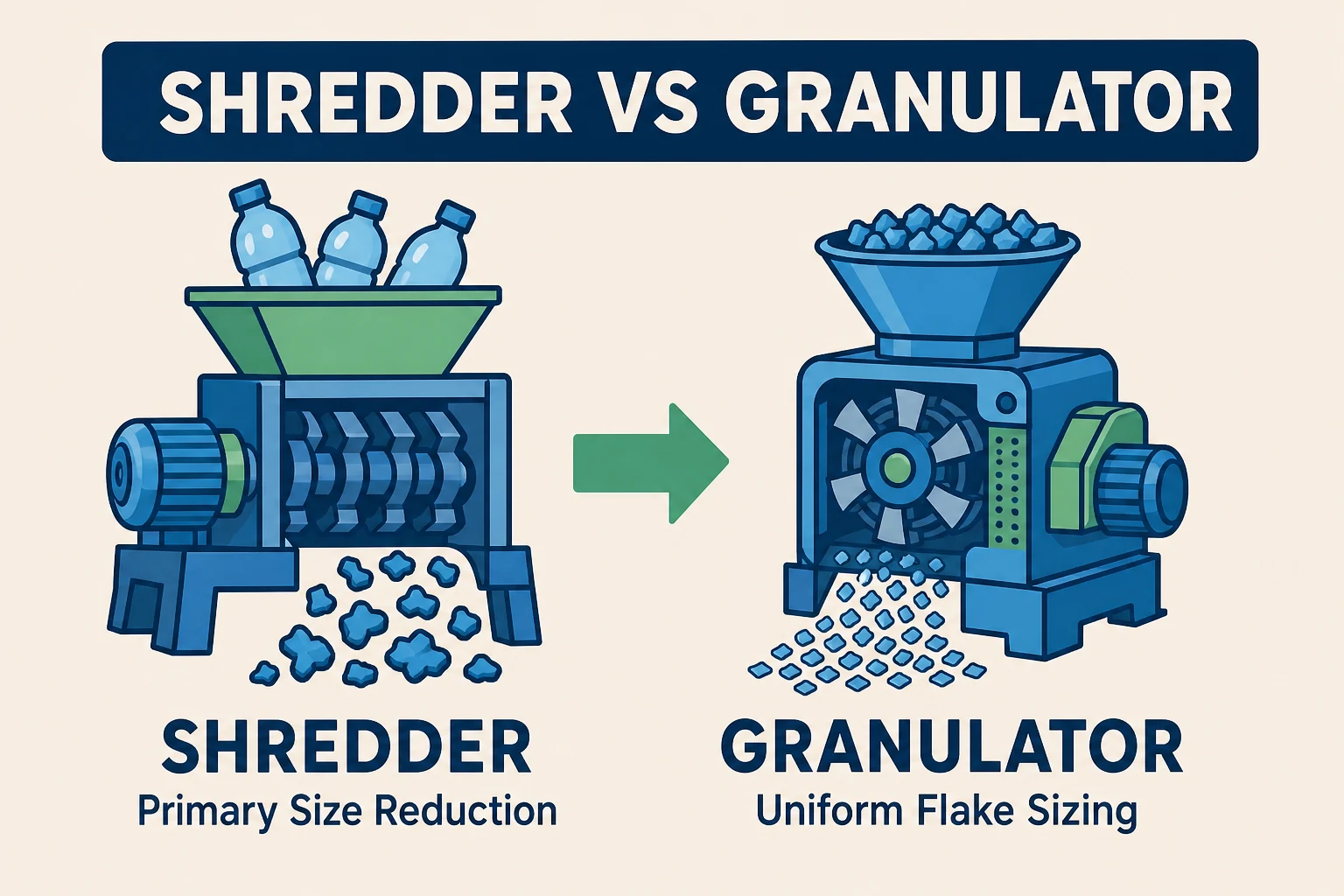
Shredders and granulators are both plastic size-reduction machines, but they are not interchangeable. A shredder is built to accept bulky, irregular, or difficult-to-feed scrap and reduce it into manageable pieces. A granulator uses faster knife action and a sizing screen to produce smaller, more uniform regrind.
The practical shredder vs. granulator decision starts with three questions: What does the material look like at the infeed? What particle size must leave the machine? And what will happen downstream? Choosing by motor power or machine name alone often leads to unstable feeding, excessive knife wear, or an output that does not suit the washing line.
This guide explains the mechanical differences, when one machine is enough, when a two-stage shredder–granulator line is justified, and where pelletizing fits afterward.
Risposta rapida: Choose a shredder for controlled primary reduction of bulky or irregular scrap. Choose a granulator for smaller, feedable material that must become uniform flakes or regrind. Use both when oversized input must be converted into a tightly controlled final particle size.
Shredder vs. Granulator: The Core Mechanical Difference
How a plastic shredder works
UN trituratore di plastica monoalbero normally uses a low-speed, high-torque rotor. A hydraulic pusher or controlled feeding system keeps bulky material in contact with the rotor cutters and counter knife. The machine repeatedly cuts the scrap until pieces are small enough to pass through its screen.
This design is well suited to items that are difficult to gravity-feed into a high-speed cutter, including:
- Plastic drums, pallets, crates, bumpers, and thick purgings
- Long pipes, profiles, sheets, and bulky molded parts
- Film, woven bags, fibers, and other flexible material when the rotor is designed for them
- Mixed shapes or baled scrap that require controlled feeding
Shredder output is usually a coarse, screen-controlled chip. The exact size depends on rotor geometry, screen opening, material behavior, and throughput target; it should not be treated as finished uniform regrind unless the application allows a coarse product.
How a plastic granulator works
UN granulatore di plastica, also called a plastic crusher in many markets, uses a faster rotor fitted with knives. The rotor knives pass stationary bed knives with a controlled clearance, creating a repeated cutting or shearing action. Material remains in the chamber until it passes through the sizing screen.
Granulators are strongest when the feed can enter the cutting chamber consistently and the goal is smaller, more uniform flakes. Typical applications include bottles, small crates, injection-molding runners, pre-cut parts, and shredded rigid-plastic chips.
Terminology note: “Crusher” and “granulator” are often used interchangeably in plastics recycling. Compare the rotor speed, knife layout, feeding method, screen, and intended material—not only the name on the quotation.
Head-to-Head Comparison
| Selection factor | Plastic shredder | Plastic granulator / crusher |
|---|---|---|
| Primary role | Coarse reduction and feed stabilization | Fine sizing into more uniform flakes or regrind |
| Typical operating style | Lower speed, higher torque | Higher speed, precision knife clearance |
| Alimentazione | Often force-fed with a hydraulic pusher | Usually gravity-fed or assisted |
| Best input | Bulky, irregular, long, baled, or difficult-to-feed scrap | Smaller, consistent material that enters the chamber steadily |
| Uscita tipica | Coarser chips, commonly tens of millimeters | Smaller screen-controlled flakes, commonly around 6–20 mm |
| Output uniformity | Moderate; intended mainly for primary reduction | Higher; intended for controlled final sizing |
| Bulky rigid parts | Excellent fit | Possible only when the hopper and rotor are designed for the part size |
| Flexible film | Good with an anti-wrapping film rotor | Requires a granulator specifically configured for film or wet cutting |
| Noise and dust | Generally lower because of slower cutting | Generally higher because of faster cutting and smaller output |
| Main wear concern | Rotor cutters, counter knife, screen, and pusher system | Rotor knives, bed knives, screen, bearings, and knife clearance |
| Typical line position | Riduzione primaria delle dimensioni | Final sizing before washing, separation, reuse, or extrusion |
These values describe common machine behavior, not universal specifications. Final selection must be based on the largest input dimensions, wall thickness, polymer, contamination, target output, and required throughput.
Five Selection Rules That Prevent the Wrong Purchase
Rule 1: Start with feed geometry, not throughput
A quoted capacity is meaningful only when the machine can accept the material consistently. Large hollow parts may bridge above a granulator rotor even when their total weight is low. Long pipes and sheets can require a dedicated horizontal or vertical feeding arrangement. Bulky, irregular feed usually favors a shredder first.
Small bottles, runners, caps, and pre-cut rigid parts may feed directly into a granulator. In that case, adding a shredder can increase cost and maintenance without improving the result.
Rule 2: Define the required output before selecting the machine
If the goal is only volume reduction for storage, transport, or controlled conveying, coarse shredder output may be sufficient. If the material must pass through a washing line, sink-float tank, centrifugal dryer, dosing system, or extruder, tighter flake geometry is normally more important and a granulator may be required.
Rule 3: Do not force a granulator to solve a feeding problem
A granulator performs best when material reaches the rotor steadily. Oversized or unstable feed can bounce, bridge, overload the drive, and damage knives. The shredder’s value is not merely making pieces smaller—it converts random shapes into a flowable feed that the next machine can process predictably.
Rule 4: Match the rotor to the material
Rigid HDPE, PP, ABS, and PVC parts are not cut the same way as LDPE film, PP raffia, textile fibers, or rubber. Flexible materials can wrap around a general-purpose high-speed rotor, but this does not mean every granulator is unsuitable for film. Wet granulators and film-specific knife arrangements can process flexible scrap when correctly configured.
Ask the supplier for a trial using your actual material, including the most difficult pieces—not only a clean, easy sample.
Rule 5: Treat contamination as a protection problem
Metal, stones, sand, and embedded fasteners shorten knife life and can cause severe damage. A shredder is generally more tolerant of difficult feed than a high-speed granulator, but neither machine should be treated as a metal separator.
Use suitable magnets, metal detection, manual sorting, or downstream separation based on where contaminants are exposed. Protection should be engineered around the real contamination pathway and placed before the equipment most vulnerable to damage.
Do You Need a Shredder, a Granulator, or Both?
Choose a granulator alone when:
- The incoming parts are small and consistent enough to feed without bridging
- You need uniform flakes for washing, blending, or direct internal reuse
- The feed is sorted and has a low risk of metal or abrasive contamination
- A beside-the-press unit can return clean runners directly to production
Choose a shredder alone when:
- The main goal is coarse volume reduction or controlled conveying
- The buyer accepts coarse chips rather than tightly sized flakes
- The material is bulky, irregular, long, flexible, or difficult to gravity-feed
- A downstream process can accept the shredder’s screened output
Choose a shredder plus granulator when:
- Input dimensions and shapes vary widely
- Large parts must become consistent flakes for washing or extrusion
- The granulator needs a stable, metered feed to maintain throughput
- You want independent control of primary reduction and final particle size
UN integrated shredder–granulator can combine both stages in a compact footprint. It can be attractive where floor space and internal conveying are limited. Separate machines offer more buffering, easier isolation for maintenance, and greater flexibility when feedstock or capacity changes.
Typical Plastic Recycling Line Configurations
Sorted bottles, small crates, and consistent rigid parts
Granulator → washing and separation → drying → reuse or extrusion
A granulator may be sufficient when parts fit the hopper and feed reliably. Add a shredder only if bales, oversized crates, or irregular items become part of the input stream.
Drums, pallets, bumpers, pipes, and thick purgings
Shredder → controlled transfer → granulator → washing or extrusion preparation
The shredder controls the difficult first cut. The granulator then produces the final flake size required by the next process.
Film, woven bags, raffia, and fibers
Film shredder or cutter-compactor → washing/drying as required → extrusion
Flexible materials need anti-wrapping rotors and stable feeding. A film-specific shredder is commonly used, while a wet or purpose-built granulator can be selected when smaller washed flakes are required. See the Trituratore di film PE/PP for a dedicated flexible-material configuration.
Clean post-industrial runners and sprues
Beside-the-press granulator → direct controlled regrind return
Clean, single-polymer scrap may not require shredding, washing, or pelletizing. The acceptable regrind percentage depends on the product, molding process, contamination control, and quality specification.
Where Pelletizing Fits Downstream
A pelletizer is not an alternative to a shredder or granulator. It is a downstream extrusion system that melts prepared plastic, filters the melt, removes some volatile material through degassing, and cuts the polymer into uniform pellets.
Add pelletizing when the target product requires consistent, flowable pellets or when melt filtration and compounding are part of the quality specification. It may be unnecessary when a customer accepts washed flakes or when clean regrind can return directly to an internal process.
Pelletizing does not replace sorting, washing, or drying. Non-melting solids can be captured by suitable melt filtration, and volatile moisture or gases can be reduced by venting, but incompatible polymers and heavy contamination must still be controlled upstream. For the full downstream process, see the plastic pelletizing guide.
Maintenance and Operating-Cost Differences
| Maintenance area | Trituratore | Granulator |
|---|---|---|
| Knife condition | Inspect cutter edges, counter knife, fasteners, and rotor pockets | Maintain sharp rotor and bed knives with the specified clearance |
| Schermo | Check for wear, cracking, and blocked openings | Check for wear, cracking, heat buildup, and excessive fines |
| Sistema di trasmissione | Monitor gearbox, torque loads, bearings, and hydraulic pusher | Monitor belts or coupling, bearings, vibration, and motor load |
| Effect of dull knives | Lower throughput, higher torque, heat, and irregular output | More fines, heat, noise, power demand, and poor flake quality |
| Contamination sensitivity | Moderate, depending on cutter design | High because fast knife impacts can cause severe damage |
Do not choose sharpening intervals from a generic hour figure. Polymer type, fillers, sand, glass fiber, metal contamination, knife steel, rotor speed, and target particle size can change wear rates dramatically. Track motor load, output quality, knife clearance, and tons processed to build a maintenance interval from actual plant data.
Sicurezza e controllo dei rischi
Both machines contain rotating cutters and stored mechanical energy. Equipment selection should include guarding, interlocked access, safe feeding, emergency stops, dust control, noise control, and documented lockout/tagout procedures.
- Guarding: Prevent access to cutters, drives, conveyors, and discharge points. Review OSHA machine-guarding guidance for US installations.
- Energy isolation: Lock out electrical, hydraulic, pneumatic, and stored rotational energy before clearing jams or servicing knives. See Linee guida OSHA per il blocco/etichettatura.
- Rumore: High-speed granulators commonly require stronger acoustic controls and hearing protection than low-speed shredders.
- Dust and fines: Provide extraction and housekeeping appropriate to the polymer, additives, and particle-size distribution.
What to Include in Your RFQ
A useful quotation needs more than “plastic shredder” or “plastic crusher.” Send the supplier:
- Polymer and product type: PP crates, HDPE drums, PVC pipe, ABS housings, LDPE film, and so on
- Maximum dimensions and wall thickness: Include photographs and the largest difficult item
- Feed condition: Loose, baled, nested, wet, dusty, hot, or cold
- Contaminazione: Metal inserts, sand, stones, labels, moisture, and mixed polymers
- Output target: Maximum chip size or required flake-size range
- Throughput and duty cycle: kg/h, hours per day, and peak loading pattern
- Downstream process: Conveying, washing, separation, drying, direct reuse, or extrusion
- Site limits: Available power, footprint, headroom, dust collection, and noise requirements
Ask for a material trial when feed behavior is uncertain. A short test with representative scrap can reveal bridging, wrapping, fines generation, temperature rise, and realistic throughput before the equipment is ordered.
Domande frequenti
Qual è la differenza principale tra un trituratore e un granulatore?
Un trituratore offre una riduzione primaria a bassa velocità e alta coppia per scarti ingombranti o difficili da alimentare. Un granulatore utilizza tagli precisi con lama e uno schermo di dimensionamento per produrre scaglie più piccole e uniformi.
Posso saltare lo shredder e inserire direttamente parti rigide in un granulatore?
Yes, when the parts fit the hopper, feed consistently, and remain within the granulator’s approved size and wall-thickness range. Large, hollow, thick, or irregular parts usually benefit from shredding first.
Ho sempre bisogno sia di un trituratore che di un granulatore?
No. A granulator alone can suit consistent small parts, while a shredder alone can suit coarse volume reduction. Two stages make sense when bulky input must become tightly sized flakes for washing, separation, or extrusion.
Può un granulatore trattare la pellicola di plastica?
Un granulatore a plastica rigida a uso generale potrebbe avvolgere o bloccarsi con il film. Un granulatore umido o un rotore e un sistema di alimentazione specifici per il film possono trattare materiali flessibili quando configurati correttamente. Si raccomanda di effettuare test sui materiali.
Quale dimensione di uscita devo richiedere?
Specify the size required by the next process. Coarse chips may be sufficient for transport or controlled feeding; washing, separation, drying, and extrusion often require smaller and more consistent flakes. Confirm the acceptable range with the downstream equipment supplier.
How is a pelletizer different from a shredder or granulator?
A pelletizer is a downstream thermal extrusion system, not a size-reduction alternative. It melts prepared plastic, filters and degasses the melt as configured, and cuts it into uniform pellets.
Choose the Machine by Material Flow
The correct shredder vs. granulator decision follows the material through the plant: input geometry determines feeding, the next process determines output size, and contamination determines the protection system. A granulator is not automatically a “smaller shredder,” and a shredder is not automatically required before every granulator.
Need a line recommendation? Send Energycle your polymer, part photographs, maximum dimensions, contamination profile, target output size, and throughput. Our engineers can recommend a shredder, granulator, integrated system, or two-stage layout based on the actual material.
