

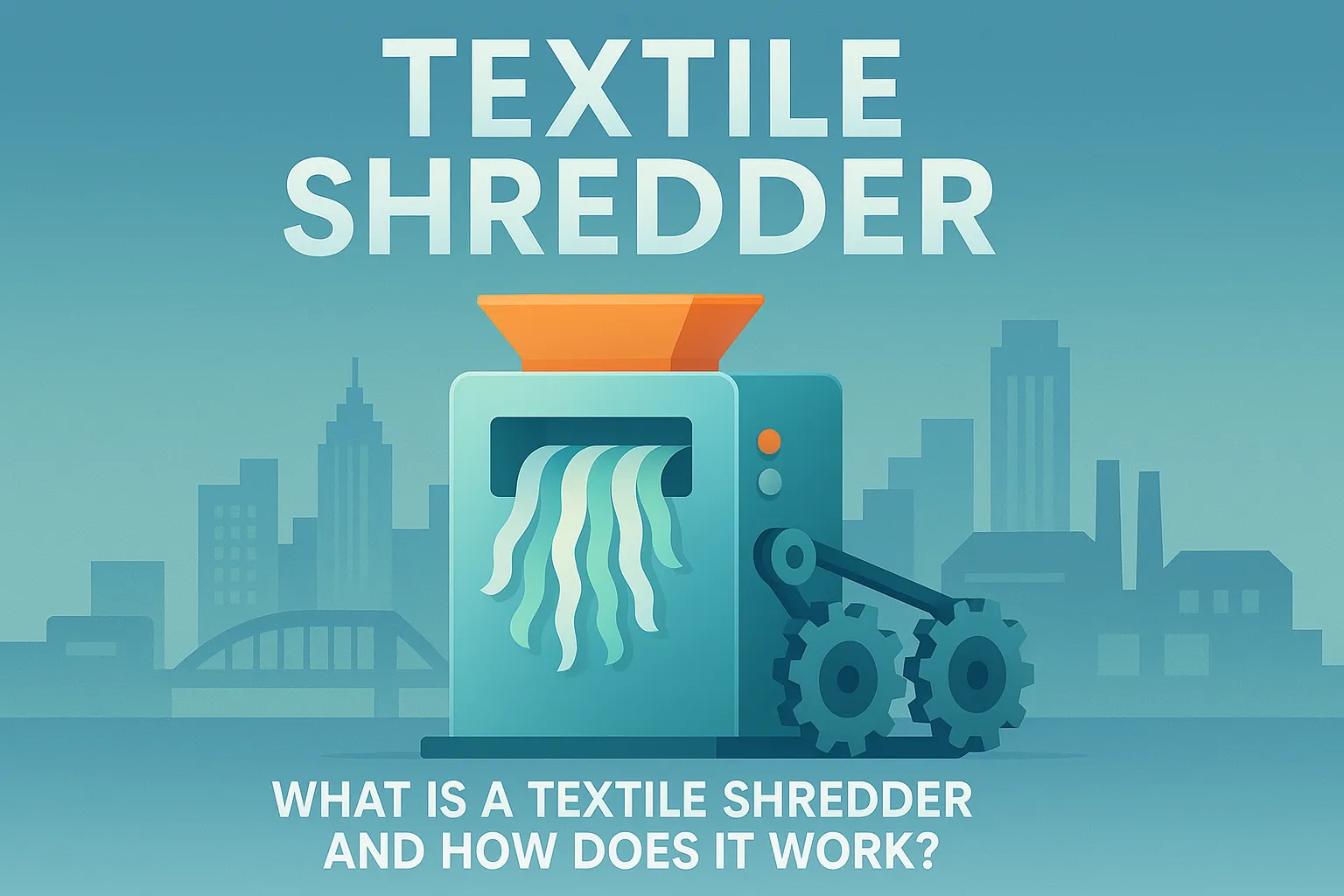
A textile shredder is a low-speed, high-torque machine that cuts used clothing, production offcuts, carpet, upholstery, nonwoven, and industrial textiles into controlled strips or opened fiber. The same equipment may be called a fabric shredder, cloth shredder, or garment shredder depending on the buyer and application. The correct machine depends on fiber composition, feed form, throughput, contamination, target output size, and the next recycling step. This guide compares single-shaft, double-shaft, four-shaft, and fiber-opening systems; explains anti-winding design; and provides a practical selection framework for textile recycling lines.
What Is a Textile Shredder?
A textile shredder is a low-speed, high-torque size-reduction machine purpose-built for fibrous materials. The same equipment is sold under several names: textile shredder is the standard term in the recycling industry, fabric shredder is more common in textile manufacturing and converters, cloth shredder dominates retail and commercial searches, and garment shredder is used specifically for used-clothing and apparel destruction services. They all describe the same machine class. Unlike standard plastic or wood shredders, textile shredders must overcome the unique challenge of fiber winding — long, flexible fibers wrap around shafts and rotors of conventional machines, causing jams, downtime, and motor overloads. Purpose-built textile shredders solve this with specialized rotor geometries, anti-winding knife designs, and fiber-stripping mechanisms that prevent material from accumulating on the cutting elements.
Output ranges from coarse strips (50–100 mm) for RDF (refuse-derived fuel) applications to fine opened fiber (10–30 mm) for nonwoven manufacturing and insulation. The key to effective textile shredding is matching the shredder type and configuration to both the input material composition and the intended end use of the output fiber.
Textile Shredder vs. Fabric Shredder vs. Cloth Shredder: Same Machine, Different Names
Buyers searching for a fabric shredder, cloth shredder, garment shredder, or industrial fabric shredder are all looking at the same equipment category. The difference is purely terminology — driven by industry, region, and end use. Here is how the names map to real applications:
| Term | Most Common User | Typical Application | Machine Type |
|---|---|---|---|
| Textile shredder | Recycling plants, MRF operators | Post-consumer textile recycling, fiber recovery | Single-shaft or double-shaft |
| Fabric shredder | Textile mills, fabric converters, manufacturers | Fabric offcuts, mill ends, defective rolls | Single-shaft with screen control |
| Cloth shredder | Garment factories, laundry services, retail | Used uniforms, branded apparel destruction, hospitality linen | Single-shaft, often with shred-to-destroy verification |
| Garment shredder | Brand protection, used-clothing processors | Apparel destruction, charity sorting residue, returns processing | Single or double-shaft depending on volume |
| Industrial fabric shredder | Large recycling operations | Heavy-duty processing of mixed textile waste, carpet, industrial fabric | Heavy-duty single-shaft (90+ kW) or double-shaft |
| Small / home fabric shredder | Small workshops, R&D, makers | Low-volume scraps, prototyping, sample preparation | Compact single-shaft, 7.5–22 kW |
If you are sourcing equipment, the right question is not “do I need a fabric shredder or a textile shredder” — it is “what fiber type, throughput, and output size do I require.” All four terms point to the same answer: a low-speed, high-torque shredder with anti-winding rotor design. The rest of this guide uses textile shredder as the umbrella term, but the technology and selection criteria apply identically whether your project is labeled fabric, cloth, or garment shredding.
Types of Textile Shredders
Single-Shaft Textile Shredder
Uses one rotating shaft with cutting knives shearing against a fixed bed knife, with a sizing screen controlling output particle size. Single-shaft machines produce the most uniform output — ideal when downstream processes (nonwoven lines, fiber blending) require consistent fiber length. Output size: 10–80 mm depending on screen selection. Throughput: 200–2,000 kg/h. Our textile fibre & carpet waste single shaft shredder features an anti-winding V-rotor design specifically engineered for fibrous materials.
Double-Shaft Textile Shredder
Two counter-rotating shafts with interlocking blades grip and tear fabric into strips. Double-shaft machines excel at high-volume primary shredding of bulky textile bales, carpets, and mixed clothing. They are self-feeding — the counter-rotating shafts pull material in — and handle contaminated or mixed inputs with minimal pre-sorting. Output: 30–150 mm strips. Throughput: 1,000–3,000 kg/h. Best for first-stage reduction where uniformity is less critical than volume.
Four-Shaft Textile Shredder
Four interlocking shafts provide two-stage shredding in a single machine: the outer shafts perform primary reduction, and the inner shafts refine the output. This produces finer, more uniform output than a double-shaft unit without needing a second machine. Higher capital cost but saves floor space and eliminates inter-machine conveying. Output: 20–80 mm. Throughput: 500–5,000 kg/h.
Fiber Opener / Fine Shredder
A secondary machine that takes coarsely shredded textile strips and opens them into individual fibers suitable for nonwoven production, insulation batting, or fiber blending. Fiber openers use high-speed drums with fine pins or teeth (800–1,500 RPM) rather than cutting knives. Output: 5–30 mm opened fiber. These machines typically follow a primary shredder in a two-stage textile recycling line. See our fiber shredder selection specs guide.
Textile Shredder Type Comparison
| Type | Throughput | Motor Power | Output Size | Best For |
|---|---|---|---|---|
| Single-Shaft | 200–2,000 kg/h | 22–132 kW | 10–80 mm (screen-controlled) | Uniform fiber for nonwoven, insulation |
| Double-Shaft | 1,000–3,000 kg/h | 30–200 kW | 30–150 mm strips | High-volume primary reduction, baled clothing |
| Four-Shaft | 500–5,000 kg/h | 45–250 kW | 20–80 mm | Combined primary + secondary in one unit |
| Fiber Opener | 100–1,500 kg/h | 15–75 kW | 5–30 mm opened fiber | Fine fiber for nonwoven lines, insulation |
The Anti-Winding Challenge
Textile shredding is fundamentally different from plastic or metal shredding because of fiber winding. Long, flexible fibers wrap around rotating shafts, build up between blades, and eventually stall the machine. Standard industrial shredders fail on textiles within minutes to hours. Purpose-built textile shredders solve this with multiple design features:
- V-rotor geometry — angled blades create a scissors-cut action that severs fibers rather than pulling them, preventing wrap accumulation
- Anti-winding knife profiles — hook-shaped or serrated blade edges grip and cut fibers instead of allowing them to slide and wrap
- Fiber stripping combs — stationary comb-like elements between rotating blades continuously strip wound fibers off the shaft
- Wide blade spacing — larger gaps between cutting elements reduce the surface area where fibers can accumulate
- Automatic reverse function — controller detects motor overload from fiber buildup and briefly reverses the rotor to clear jams
When evaluating textile shredders, always request a test run with your actual material. A machine that works well on cotton may jam on synthetic fabrics (nylon, polyester) which are stronger and more prone to winding.
Materials You Can Process
| Material | Examples | Shredding Challenge | Recommended Type |
|---|---|---|---|
| Used Garments / Apparel | Mixed clothing bales, sorted reject, branded apparel destruction | Mixed fibers + zippers, buttons, snaps | Garment shredder with metal detection upstream |
| Cotton / Natural Fiber | T-shirts, denim, towels | Moderate — fibers break relatively easily | Single-shaft or double-shaft |
| Polyester / Synthetic | Activewear, lining, fleece | High — strong fibers wind aggressively | Single-shaft with V-rotor + strippers |
| Blended Fabrics | 65/35 poly-cotton, workwear | High — synthetic component causes winding | Single-shaft with anti-winding design |
| Carpet | Nylon, PP, polyester carpet | Very high — backing + fiber + adhesive layers | Heavy-duty double-shaft + secondary opener |
| Nonwoven | Masks, wipes, geotextile | Low — tears easily, minimal winding | Any type |
| Leather / Faux Leather | Shoes, bags, upholstery | Moderate — tough but cuts cleanly | Double-shaft with high torque |
| Industrial Textiles | Conveyor belt, filter fabric, rope | Very high — extremely strong fibers | Heavy-duty single-shaft, slow speed |
For detailed material-specific guidance, see our carpet recycling shredder specs and textile waste shredder.
Output Products and Applications
| Output | Fiber Size | End Application | Value |
|---|---|---|---|
| Coarse strips | 50–150 mm | RDF (refuse-derived fuel), cement kiln fuel | $20–$60/ton |
| Pyrolysis feedstock | 20–30 mm | Textile-to-char and energy via pyrolysis | process-dependent |
| Shredded fabric | 20–50 mm | Wiping cloths, industrial rags, shoddy | $80–$200/ton |
| Opened fiber | 10–30 mm | Nonwoven batting, insulation, automotive felt | $150–$400/ton |
| Fine fiber | 5–15 mm | Fiber-reinforced composites, premium insulation | $250–$600/ton |
| Fluff / dust | <5 mm | Filler material, acoustic panels | $50–$150/ton |
The value chain is clear: finer fiber = higher value, but requires more processing stages and equipment investment. Most operations start with coarse shredding (lowest capital) and add fiber opening equipment as market demand justifies the investment. If your output feeds a pyrolysis reactor, sizing is stricter than for RDF or wiping cloths — see our guide to shredding waste textiles for pyrolysis (particle size, wrapping risk and screw-auger feeding).
Complete Textile Recycling Line Configurations
Basic RDF / Fuel Line
Bale breaker → double-shaft shredder → magnetic separator → screening. Output: 50–100 mm strips for cement kiln fuel. Investment: $150,000–$350,000. Throughput: 1,000–5,000 kg/h.
Investment figures below are market reference ranges for the complete installation. Energycle supplies the size-reduction machines at the core of each configuration — single-shaft shredders, double-shaft shredders and secondary crushers.
Wiping Cloth / Industrial Rag Line
Sorting (manual or automated) → single-shaft shredder → metal detection → baling. Output: sized fabric pieces for industrial wiping. Investment: $120,000–$300,000. Throughput: 500–2,000 kg/h.
Fiber Recovery Line (Nonwoven / Insulation)
Bale breaker → primary shredder (double-shaft) → secondary shredder (single-shaft) → fiber opener → air classifier → fiber blending → nonwoven card or insulation line. Output: 10–30 mm opened fiber. Investment: $300,000–$1,000,000. Throughput: 300–2,000 kg/h of finished fiber.
Safety: Fire and Dust Explosion Prevention
Textile shredding generates combustible dust and static electricity — two conditions that create serious fire and explosion risks. NFPA 652 (Standard on Fundamentals of Combustible Dust) applies to all textile recycling operations. Key safety measures:
- Spark detection and suppression — install inline spark detectors on ducting between shredder and dust collection; automatic water mist suppression activates in milliseconds
- Dust collection — capture airborne fiber and dust at source with enclosed hoods and dedicated extraction; maintain dust collector per NFPA 652
- Static grounding — ground all metal equipment, conveyor frames, and ducting; use anti-static belts
- Metal detection — remove zippers, buttons, rivets, and wire before shredding; metal sparks are the #1 ignition source
- Housekeeping — prevent dust accumulation on surfaces; clean regularly; never allow dust layers to exceed 1/32 inch (0.8 mm)
For comprehensive safety guidance, see our textile shredder safety guide (NFPA 652).
5-Step Selection Framework
Step 1: Define Input Material
Identify fiber composition (cotton, polyester, nylon, blends, carpet), form (loose garments, bales, rolls, carpet tiles), contamination (zippers, buttons, rubber backing), and daily volume in tons. Synthetic content above 30% mandates anti-winding rotor design — standard shredders will fail.
Step 2: Choose Output Specification
RDF requires only coarse strips (one shredder stage). Wiping cloth needs sized pieces (one shredder + screening). Nonwoven fiber needs fine, opened fiber (two shredder stages + fiber opener). Your end product determines the number of processing stages and total investment.
Step 3: Size for Throughput
Textile bale density is 300–500 kg/m³. A facility receiving 20 tons/day needs approximately 3,125 kg/h shredding capacity (8-hour shift, 80% uptime). Size the primary shredder for peak intake plus 20% margin; secondary stages can be smaller because material volume reduces after first shredding.
Step 4: Verify Anti-Winding Features
Request a test run with your actual material — this is non-negotiable for textile applications. Verify: V-rotor or anti-winding knife geometry, fiber stripping mechanism, automatic reverse on overload, and continuous run time without manual clearing. A good textile shredder runs 8+ hours without operator intervention for clearing fiber wraps.
Step 5: Plan Safety Systems
Budget for spark detection, dust collection, static grounding, and metal detection from the start — not as afterthoughts. These are not optional for textile recycling; they are regulatory requirements in most jurisdictions and essential for protecting your investment and workforce.
Maintenance Essentials
- Daily: Clear fiber accumulation from around rotors, bearings, and safety guards; empty dust collection bins; inspect metal detection system
- Weekly: Check blade sharpness (textile fibers dull blades faster than rigid plastics); verify anti-winding stripper comb condition; inspect drive belts and chains
- Monthly: Lubricate bearings; inspect electrical connections for dust contamination; test spark detection and suppression system; check screen condition (single-shaft units)
- Every 500–1,000 hours: Rotate or regrind blades; inspect rotor shaft for wear from fiber abrasion
- Annually: Full inspection of rotor, bearings, gearbox, safety systems, and structural integrity
Getting Started with Energycle
Energycle manufactures industrial textile and fabric shredders with purpose-built anti-winding rotor designs for cotton, polyester, blends, and carpet. We provide:
- Free material testing — send us fabric samples (1–2 bales) and we run a full shredding trial with video documentation
- Anti-winding guarantee — our V-rotor design is validated for continuous 8-hour runs on synthetic blends without manual clearing
- Complete line design — bale breaking through shredding, fiber opening, metal removal, and baling of output fiber
- Safety system integration — spark detection, dust collection, and fire suppression specified and supplied as part of the line
Contact our engineering team with your textile type, daily volume, and desired output fiber length — we will recommend the right configuration and provide a quotation. Watch our textile shredder test run video to see our machines in action.
Frequently Asked Questions
What is a textile shredder?
A textile shredder is a low-speed, high-torque machine that cuts fabric waste (clothing, carpet, industrial textiles) into strips or opened fiber for recycling. Unlike standard shredders, textile shredders feature anti-winding designs — V-rotors, fiber stripping combs, and specialized blade profiles — that prevent long, flexible fibers from wrapping around the shaft and causing jams.
How much does a textile shredder cost?
Single-shaft textile shredders cost $35,000–$150,000 depending on throughput (200–2,000 kg/h), while double-shaft models range from $90,000–$220,000 (1,000–3,000 kg/h). A complete fiber recovery line can reach $300,000–$1,000,000 because it may include primary and secondary shredding, fiber opening, metal detection, conveying, and dust collection. Use our textile shredder price and ROI guide to compare machine scope, operating cost, and payback with your local disposal fee, output value, utility rate, and operating schedule.
Can a textile shredder process carpet?
Yes, but carpet is one of the most demanding textile shredding applications. Carpet combines nylon or polyester face fiber, polypropylene backing, latex adhesive, and sometimes calcium carbonate filler — all bonded together. You need a heavy-duty double-shaft shredder for primary reduction, followed by a fiber opener to separate face fiber from backing. Blade wear is 2–3× faster than with clothing due to the abrasive backing materials.
What is anti-winding design and why does it matter?
Anti-winding design refers to rotor geometry, blade profiles, and stripping mechanisms that prevent textile fibers from wrapping around the shredder shaft. Without anti-winding features, long fibers accumulate on the rotor within minutes, stalling the motor and requiring manual clearing. Purpose-built textile shredders with V-rotor geometry and fiber stripping combs run 8+ hours continuously without fiber-wrap shutdowns.
What output fiber size do I need?
It depends on your end application. RDF/fuel: 50–100 mm strips (single shredder pass). Wiping cloths: 20–50 mm pieces. Nonwoven manufacturing: 10–30 mm opened fiber. Insulation batting: 10–20 mm. Fiber-reinforced composites: 5–15 mm fine fiber. Finer output requires more processing stages and higher equipment investment but commands higher prices ($150–$600/ton vs. $20–$60/ton for coarse RDF).
Is textile shredding a fire hazard?
Yes — textile shredding generates combustible dust and static electricity. Metal contaminants (zippers, buttons, wire) striking blade edges create sparks. NFPA 652 applies to textile recycling operations. Required safety systems include: spark detection and suppression on ducting, dedicated dust collection, static grounding of all equipment, metal detection upstream of the shredder, and strict housekeeping protocols to prevent dust accumulation.
How do I choose between single-shaft and double-shaft for textiles?
Single-shaft produces uniform, screen-controlled output — choose it when fiber length consistency matters (nonwoven, insulation). Double-shaft handles higher volumes and bulkier inputs (baled clothing, carpet) with self-feeding capability — choose it for primary reduction or RDF. Many operations use both: a double-shaft for primary shredding and a single-shaft for secondary sizing.
What throughput can I expect from a textile shredder?
Single-shaft textile shredders process 200–2,000 kg/h. Double-shaft models handle 1,000–3,000 kg/h. Four-shaft machines range from 500–5,000 kg/h. Actual throughput depends on material type (loose garments feed faster than baled carpet), desired output size (finer = slower), and moisture content. Always request a test run with your specific material to verify manufacturer throughput claims.
Is a fabric shredder the same as a textile shredder?
Yes — fabric shredder and textile shredder describe the same machine. Fabric shredder is the term preferred by textile mills, garment manufacturers, and converters processing fabric offcuts and mill ends. Textile shredder is preferred by recycling plants and MRF operators. Both refer to a low-speed, high-torque shredder with anti-winding rotor geometry designed to cut fibers without wrapping them around the shaft. Specifications, blade design, and selection criteria are identical.
What is the difference between a cloth shredder and a garment shredder?
A cloth shredder is the general retail and commercial term for any shredder handling fabric or cloth — used in laundry services, hospitality linen processing, and small-scale textile recycling. A garment shredder is specifically marketed for used-clothing processors and apparel destruction services (brand protection, returns processing, charity sorting residue). The mechanical design is the same; garment shredders typically include metal detection upstream because zippers, buttons, snaps, and rivets are unavoidable in apparel waste.
Can I get a small fabric shredder for home or workshop use?
Yes — compact single-shaft fabric shredders rated 7.5–22 kW are available for low-volume operations: small workshops, R&D labs, prototyping, and sample preparation. Throughput typically ranges 50–300 kg/h. True home-use fabric shredders (under 5 kW, single-phase power) are rare in the industrial market because textile fibers require high torque — most “home” units sold online are paper shredders relabeled and will fail on actual fabric within hours. For genuine textile processing, even at small scale, an industrial single-shaft shredder is the minimum.
Related Resources
- View EMR-TS Models and Working Widths
- Textile Shredder Price and ROI Guide
- Fiber Shredder Selection Specs (2026)
- Waste Textile Shredding for Pyrolysis: Sizing & Feeding
- Textile Recycling Shredder Specs: Mechanical vs Chemical
- Textile Shredder Safety: NFPA 652 Guide
- Carpet Recycling Shredder Specs
- Vertical Fiber & Textile Baler
- Textile Shredder Test Run Video
- Fishing Net Recycling Guide
- General-Purpose Single-Shaft Shredder
- Plastic Recycling Machine: Complete Guide
