

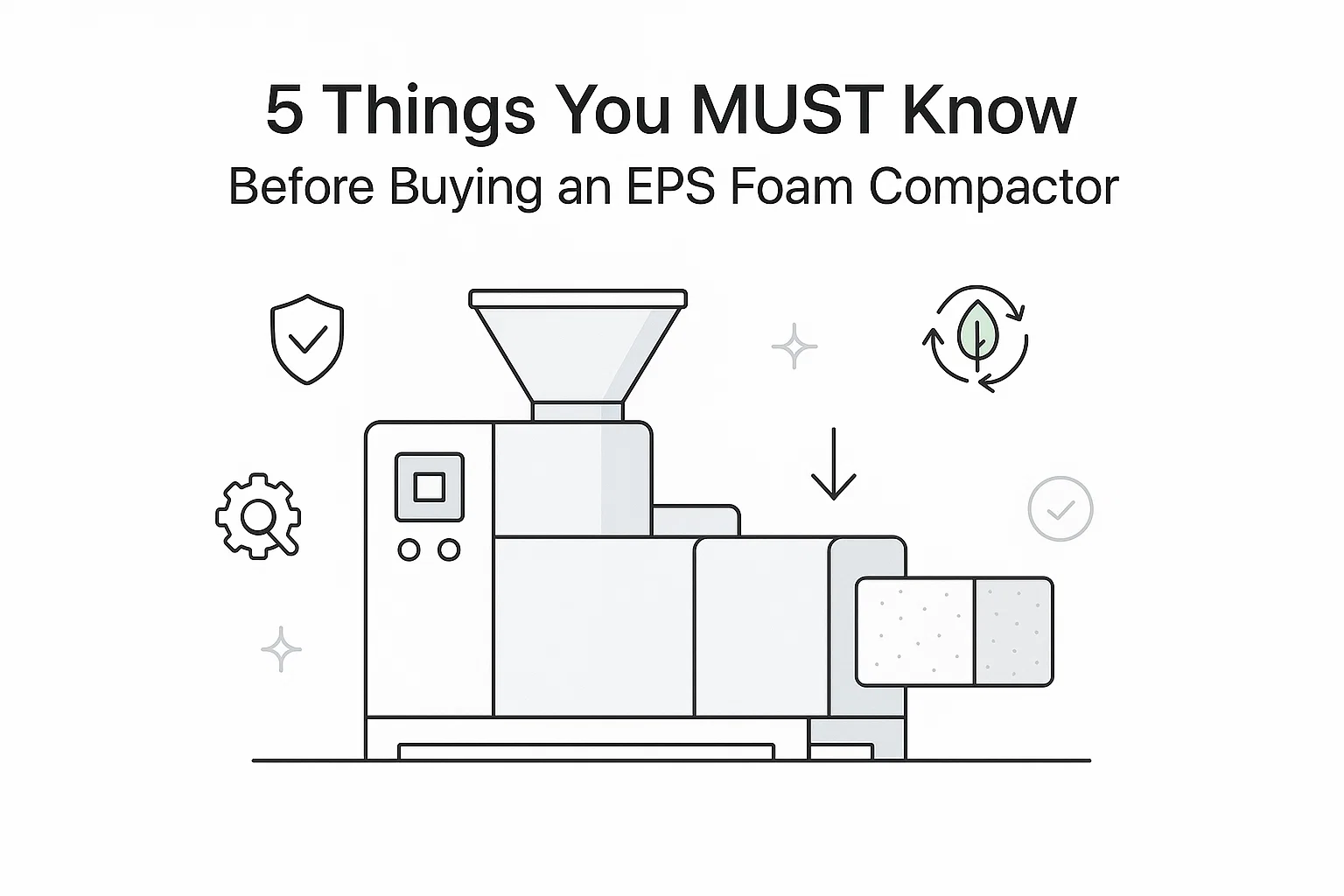
Expanded polystyrene (EPS) is a classic “big volume, low weight” waste stream. The EPS Industry Alliance summarizes the core problem well: EPS is a lightweight material that is “98 percent air,” which makes storage and transport inefficient if you ship it loose.[1]
An industrial EPS foam compactor solves that problem by turning loose foam into dense blocks (or, with heat, into dense ingots). This guide walks you through the buying decisions that affect real operating costs: logistics, labor time, energy use, safety, uptime, and whether your output is easy to sell.
Quick takeaways – Pick the densification method first (cold compaction vs. hot melt) because it drives power, ventilation, and output form. – Define the output block/ingot requirements with your downstream buyer (size, density, contamination) before you request quotes. – Size for peak days and your available run time, not “average” volume.
Cold compaction vs. hot melt (at a glance)
| Option | Cold compactor (screw press) | Hot melt densifier |
| How it works | Mechanical crushing + screw compression (no heat) | Crushing + heating + extrusion into an ingot |
| Output | Compressed EPS block | Melted EPS ingot |
| Operational considerations | Lower energy demand; simpler siting | Higher energy demand; plan ventilation and hot-surface safety |
| Typical fit | Warehouses, retailers, electronics/packaging producers | High-volume sites that want the densest output and can support thermal processing |
1. Choose the right technology: cold compaction vs. hot melt
Start with your constraints: – Power and ventilation: Hot melt systems add heating and require more attention to ventilation. If you need a non-thermal process, a cold press is often easier to deploy. – Contamination tolerance: If your EPS often includes labels, tape, or food residue, ask recyclers whether they prefer compressed blocks or melted ingots for that stream. – Output buyer preference: Some buyers want blocks (easy to break and reprocess); others prefer ingots for transport density. Ask before you decide.
If you’re comparing both options, these pages show the differences in equipment and output: – Cold press compaction: EPS foam cold press machine – Thermal densification: EPS foam melting machine
2. Compression ratio matters—but block quality is what gets accepted
Compression ratio is easy to market, but buyers and operators care about whether the output is: – Consistent (same block profile day to day) – Clean enough for the buyer’s spec – Easy to handle (doesn’t crumble, stack, or fall apart in transit)
Before you buy, get clarity on the end product spec and bake it into your RFQ:
| Confirm in your RFQ | Why it matters | How to verify |
| Output form (block vs. ingot) | Changes downstream handling and marketability | Ask your recycler for an acceptance spec + photos of preferred bales/blocks |
| Block/ingot dimensions | Affects palletizing, storage, and loading | Request a sample output or a site-reference video |
| Density consistency (not just “ratio”) | Inconsistent density creates handling issues and lower payouts | Weigh/measure multiple outputs across a shift; compare variance |
| Contamination limits | Contamination is a common rejection reason | Define what stays out (tape, labels, food) and train operators |
3. Size the compactor for your real waste stream (and your labor plan)
Under-sizing shows up fast: overtime, stockpiles, and operators babysitting the hopper. Over-sizing wastes capital and floor space.
A practical sizing method: 1. Measure EPS volume on a peak day (not a quiet day). Count bags, gaylords, or bins and estimate loose cubic volume. 2. Set your actual run time window (for example, “we can run the machine 2 hours per day without disrupting shipping”). 3. Plan the feed system (manual feeding vs. conveyor/silo) so the compactor’s rated capacity matches how you’ll load it.
If your site needs higher automation (conveyors, larger hopper, storage), start from the system view rather than just the compactor body: EPS foam hydraulic compactor system options.
4. Safety and compliance: guarding, dust, and ventilation are not optional
Industrial EPS machines have rotating components, pinch points, and (for hot melt) high-temperature surfaces. Your purchase spec should include safety and compliance expectations for your region.
- Machine guarding (US): OSHA’s general machine guarding requirements (29 CFR 1910.212) are a good baseline when you’re reviewing guards, access doors, and emergency stops.[2]
- Worker exposure (hot melt): If you melt EPS, plan ventilation and follow your local industrial hygiene program. Styrene is a recognized occupational chemical hazard; NIOSH provides reference exposure information that can support your internal review.[3]
- CE compliance (EU): For buyers in Europe (or exporting into Europe), the Machinery Directive is a core reference point for essential health and safety requirements.[4]
5. Total cost of ownership: wear parts, downtime, and service response
The cheapest quote can become the most expensive machine if you lose production days waiting for a screw, motor, or hydraulic component.
In your vendor evaluation, confirm: – Wear parts list (screw, cutter set, screens if applicable) and recommended stocking levels – Preventive maintenance intervals and what a “normal” service day looks like – Spare parts lead time and whether parts ship from stock – Training, commissioning support, and remote troubleshooting
A simple ROI check (transport savings + disposal + resale)
Most EPS compactor payback comes from logistics: – Before: loose EPS fills trucks/containers quickly. – After: dense blocks/ingots raise payload efficiency and reduce hauling frequency.
A quick worksheet to sanity-check ROI: 1. Monthly hauling cost (current) 2. Expected reduction in pickups after densification 3. Any disposal fee changes (some sites pay by pull; others by weight) 4. Expected revenue from blocks/ingots (if you have a buyer) 5. Add operating costs: labor time, electricity, and wear parts
If you want, share your average weekly EPS volume and current hauling method and we can help you size the equipment and estimate savings.
FAQ (buyer questions we hear often)
1) What compression ratio should I ask for—and how do I verify it?
Start with your downstream buyer: ask what form they accept (block vs. ingot) and whether they have a minimum density or a preferred block size. “Compression ratio” is only useful if it produces a consistent output you can stack and ship. The simplest verification method is a production trial: run the machine for a full shift, then weigh and measure multiple blocks/ingots and compare consistency. If the vendor can’t provide sample outputs, site references, or a trial plan, treat that as a risk.
2) Should I choose cold compaction or hot melt for contaminated EPS?
If your EPS is mostly clean packaging, cold compaction is often the simpler path because it avoids thermal processing and typically reduces siting complexity. If your site pushes very high volumes and your buyer pays more for denser ingots, hot melt can make sense—but plan for hot surfaces, higher power draw, and ventilation. For any stream with labels, tape, or food residue, confirm acceptance requirements with your recycler first; contamination, not the machine, is a common reason loads get downgraded.
3) How do I size throughput if my EPS is “all air” and hard to weigh?
Measure volume and labor, not just weight. Track a peak day: how many bags/bins/gaylords of EPS do you generate, and how many minutes per hour can staff realistically feed the machine? Convert that into an “available run time” target (for example, 60–120 minutes/day). Then request a vendor trial or a reference case using similar EPS types (packaging vs. construction insulation) to validate real-world throughput. To avoid misunderstandings, ask the supplier to quote capacity in the same unit you track (bags/hour, bins/hour, or loose cubic volume/hour). The goal is to avoid overflow during peak receiving days.
4) What site requirements should I confirm before ordering?
Confirm power (voltage/phase/Hz), footprint, and how you’ll handle incoming foam and outgoing blocks. If you choose hot melt, add ventilation requirements, hot-surface clearance, and where the ingot will cool and be staged safely. Also confirm noise and dust management expectations with your EHS team. Don’t forget material handling: where will blocks be stored, and will a pallet jack or forklift be used for staging and loading? For any install, ask for an electrical diagram, foundation/anchoring notes, and a commissioning checklist so the machine can be started without last-minute facility changes.
5) Which wear parts drive downtime, and what should I stock?
On compactors, the screw/auger and any cutting components are common wear items, especially if operators accidentally feed contaminants (wood, metal, straps). Ask the vendor for a wear parts list with recommended spares, typical service intervals, and photos of “end-of-life” wear so your team can inspect confidently. Also confirm whether parts are off-the-shelf (motors, hydraulics) or proprietary, and whether the supplier keeps critical spares in stock. Keeping a small kit of critical spares can prevent multi-week downtime waiting on a shipment, especially if your operation depends on daily pickups.
6) What safety and compliance questions should I include in my RFQ?
Request details on guarding (interlocks, access doors), emergency stops, lockout/tagout support, and safe maintenance access. In the US, OSHA’s machine guarding requirements are a practical reference when reviewing pinch points and rotating parts.[2] If you’re evaluating hot melt equipment, include ventilation and exposure-control considerations; NIOSH provides reference information for styrene that can support your internal review.[3] For EU buyers, ask for CE documentation aligned with the Machinery Directive.[4]
Next step: get a quote based on your EPS stream
If you want a recommendation based on your material and layout, start here: – Compare options: EPS recycling machine systems – Talk to an engineer: contact Energycle
