

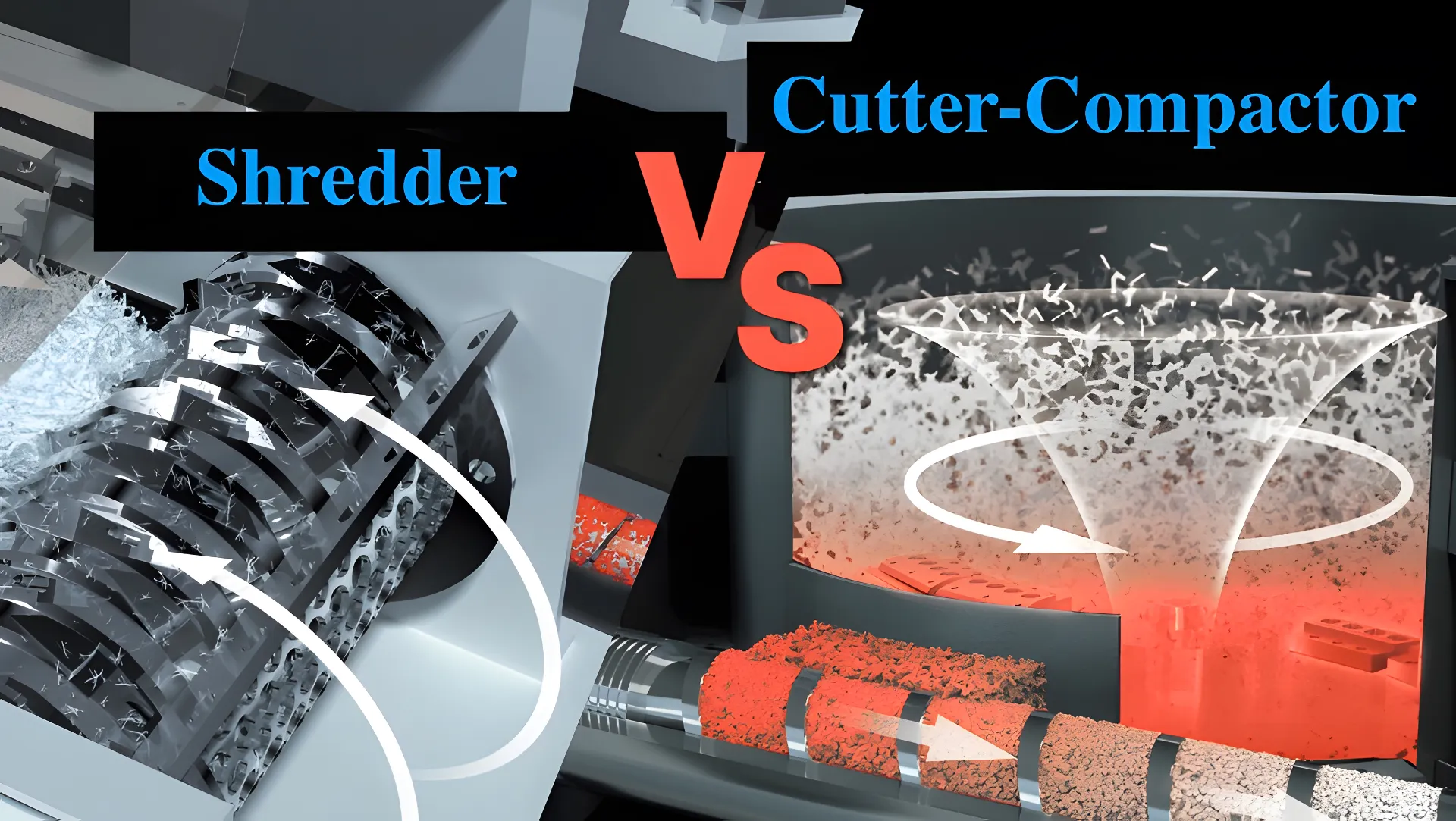
Al diseñar una línea de reciclaje de plástico, el principal obstáculo suele ser el mecanismo de alimentación. Los sistemas de cortadora-compactadora (integrados) y los sistemas alimentados por trituradora (modulares) solucionan este problema de forma diferente. Esta guía detalla los flujos de trabajo operativos, las necesidades de mantenimiento y los protocolos de resolución de problemas para cada uno, ayudando a los gerentes de planta a seleccionar la arquitectura adecuada para su planta.
Equipo relacionado: Trituradora de película de PE/PP, Extrusora trituradora de grumos.
Flujo de trabajo 1: El cortador-compactador (integrado)
Ideal para: Película postindustrial (LDPE/LLDPE), BOPP, CPP, bolsas tejidas
Cómo funciona
- Alimentación directa:Los desechos ligeros y esponjosos se transportan directamente al recipiente compactador.
- Densificación:Las cuchillas giratorias de alta velocidad cortan y calientan por fricción el material, aumentando la densidad aparente de ~50 kg/m³ a ~300 kg/m³.
- Dosificación tangencial:El material densificado y caliente se introduce mediante fuerza centrífuga en el tornillo del extrusor.
- Extrusión:El tornillo funde el polímero precalentado con un esfuerzo cortante mínimo, preservando así las propiedades del material (se minimiza la caída de VI).
Ventajas operativas
- Proceso de un solo paso:Elimina la necesidad de una trituradora, un transportador y un alimentador forzado separados.
- Autorregulación:Si la presión del extrusor aumenta, el compactador reduce la velocidad automáticamente (en PLC avanzados), evitando la sobrealimentación.
- Evaporación por humedad:El calor por fricción evapora la humedad de la superficie (hasta 5%), actuando como un presecador eficiente.
Solución de problemas
- “Puente material”Si el compactador se calienta demasiado (>110 °C para LDPE), el plástico se derrite formando un tronco en lugar de migajas. Solución: Aumente el caudal de agua de refrigeración del recipiente o reduzca la velocidad de las cuchillas.
- Desgaste de la cuchillaLas cuchillas sin filo generan menos calor, pero cortan mal. Es necesario afilarlas cada 40 a 80 horas para un rendimiento óptimo.
Flujo de trabajo 2: La línea alimentada por trituradora (modular)
Ideal para: Plásticos rígidos (HDPE/PP), grumos de purga, película contaminada
Cómo funciona
- Reducción de tamaño:El material se vierte en una trituradora grande de un solo eje, reduciéndolo a virutas de 40 mm.
- Almacenamiento en búfer:Las astillas se transportan a un silo o tolva de almacenamiento.
- Alimentación forzada:Un alimentador lateral o alimentador tipo crmmer empuja las virutas frías hacia el extrusor.
- Fusión por cizallamiento:El tornillo del extrusor generalmente hace la mayor parte del trabajo para fundir el plástico frío, lo que requiere una relación L/D más larga (normalmente 32:1 o superior).
Ventajas operativas
- Tolerancia a la contaminaciónLas trituradoras manejan el metal, la arena y el papel mejor que las compactadoras de alta velocidad.
- Versatilidad:Puede cambiar entre tamaños rígidos (tubos, trozos) y película (con la pantalla adecuada) sin necesidad de realizar grandes modificaciones.
- Arranque en frío:No es necesario “calentar” el compactador; el sistema está listo para funcionar inmediatamente.
Solución de problemas
- “Atasco del alimentador”La formación de puentes en el alimentador de película ligera es común. Solución: Utilice un agitador en la tolva de almacenamiento.
- Cegamiento de pantallaLas mallas de la trituradora se obstruyen fácilmente con la película húmeda. Solución: Use una malla más grande (50 mm o más) y utilice la extrusora para la mezcla final.
Tabla comparativa: Métricas operativas
| Métrico | Línea de cortadoras-compactadoras | Línea alimentada por trituradora |
|---|---|---|
| Tiempo de inicio | 15-30 minutos (fase de calentamiento) | Instantáneo (alimentación fría) |
| Habilidad del operador | Alto (Requiere equilibrio entre calor y velocidad) | Moderado (Enfoque mecánico) |
| Mantenimiento | Afilado de cuchillas (frecuente) | Rotación de cuchillos (periódica) |
| Eficiencia energética | ~0,30 kWh/kg | ~0,38 kWh/kg (debido a la alimentación en frío) |
| Espacio en el piso | Compacto (integrado) | Grande (componentes modulares) |
Recomendación del ingeniero
Si sus instalaciones procesan Película/fibra 80%, el Cortadora-Compactadora Es la mejor opción para eficiencia energética y estabilidad de rendimiento.
Si su instalación maneja corrientes mixtas rígidas/flexibles o altos niveles de contaminación, la Alimentado por trituradora La arquitectura proporciona la robustez y flexibilidad necesarias.
Preguntas frecuentes
¿Puede una cortadora-compactadora procesar plásticos rígidos?
Sí, pero es ineficiente. Las piezas rígidas son ruidosas y desgastan las cuchillas rápidamente. Está diseñado para materiales de paredes delgadas.
¿Con qué frecuencia debo cambiar las cuchillas de la trituradora?
En el caso del plástico limpio, los cuchillos cuadrados pueden durar entre 500 y 1000 horas por filo (4 filos en total). En el caso de los residuos posconsumo contaminados, este tiempo se reduce significativamente.
¿Qué sistema produce mejores pellets?
El Cortadora-Compactadora Generalmente produce mejores pellets para película porque la “fusión suave” preserva las cadenas de polímero, lo que resulta en una mayor resistencia a la tracción en el producto reciclado.
Referencias
[1] “Eficiencia energética en el reciclaje de plástico”,” Recicladores de plástico en Europa. Eficiencia energética en el reciclaje de plástico
[2] “Sistemas de alimentación por extrusión”,” Manual de ingeniería de plásticos. Sistemas de alimentación por extrusión
