

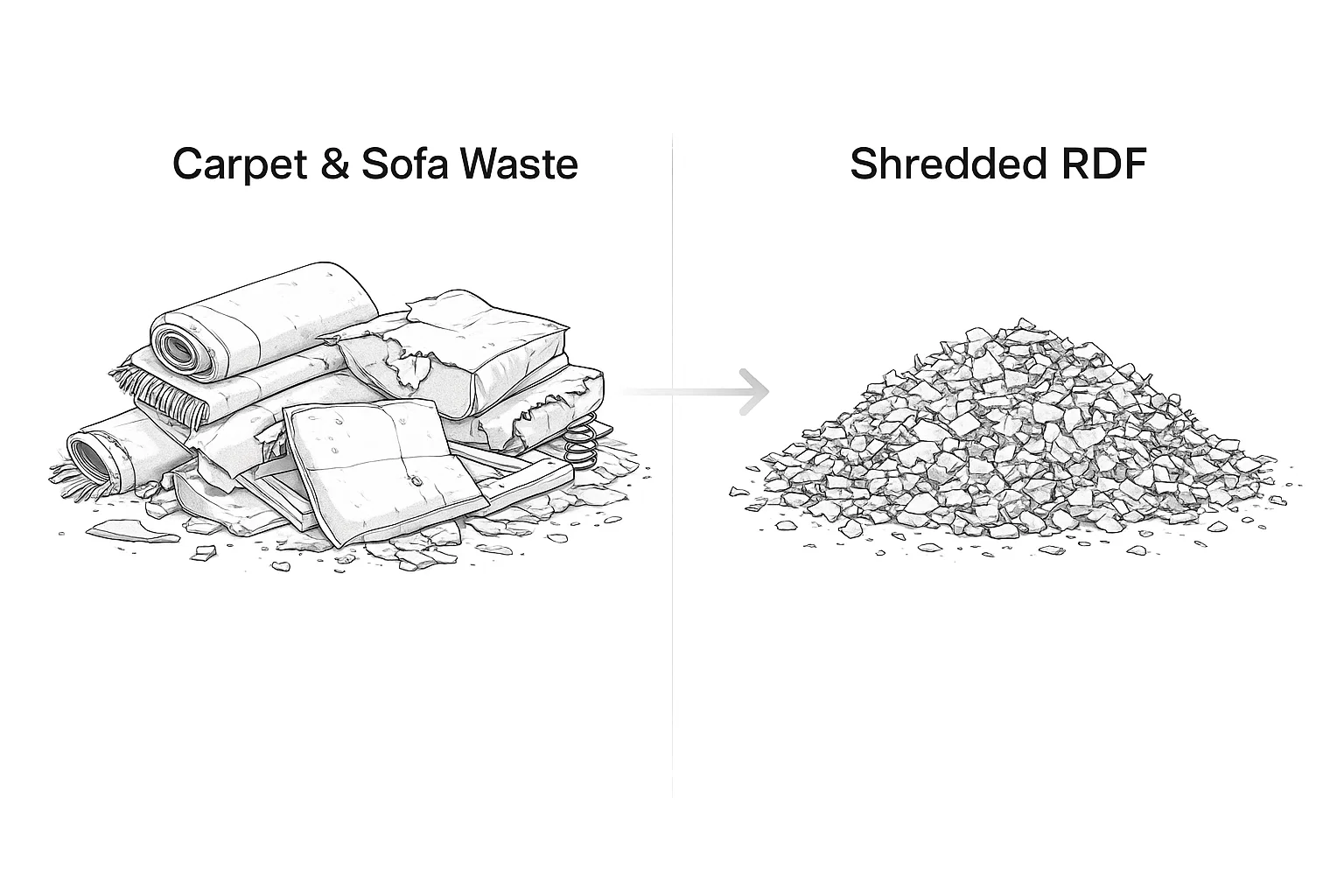
Post-consumer carpet is the “nemesis” of standard shredders. While the face fiber (Nylon, PP, or PET) is tough, the real killer is the backing. Often heavily filled with Calcium Carbonate (CaCO3) and contaminated with grit, carpet backing can act like a flexible grinding stone, dulling tool steel blades quickly (sometimes in tens of operating hours). This guide engineers a solution for high-volume carpet processing.
Related equipment: textile waste single shaft shredder.
The Chemistry of Wear: Why Blades Fail
Most industrial shredders use D2 or Cr12MoV steel (Hardness: 58-60 HRC).
* The Problem: Calcium Carbonate is soft (Mohs 3), but the sand/silica impurities often found in post-consumer carpet are hard (Mohs 7).
* The Result: Rapid abrasive wear. A standard blade set costing \$3,000 might last only 2 weeks in a 24/7 carpet line.
The Solution: Carbide-Tipped Knives
To process carpet economically, Tungsten Carbide inserts are often justified when backing abrasion and grit drive frequent knife changes.
* Hardness: 90+ HRC (virtually wear-proof against CaCO3).
* Design: A steel carrier with a brazed carbide tip.
* Cost vs. Life: Often costs several times more than D2, but can last several times longer in abrasive service.
* ROI: Downtime savings can pay for the upgrade quickly, but the payback depends on uptime, blade change labor, and contamination level.
High-Tensile Fibers: The “Winding” Risk
Nylon 6,6 face fibers are engineered not to break. When shredded, long loose strands tend to wrap around the rotor shaft, eventually burning out the bearings.
Required Machine Features:
1. Splined “Anti-Winding” Rotor: A textured shaft surface prevents fibers from slipping and tightening.
2. Close-Tolerance Cutting Gap: The gap between rotor and stator is often specified at $<0.5mm$ (depending on knife condition and rotor design). If the gap is 1.0mm, the nylon will simply fold over the blade instead of cutting, leading to a jam.
3. Shaft Protection Plates: Physical labyrinth seals bolted to the rotor ends to stop fiber migration into the bearing housing.
Application: Fuel vs. Fiber Recommendation
1. Waste-to-Energy (Cement Kilns)
- Goal: High BTU fluff for co-processing.
- Specification: <30mm particle size. Separation of calcium carbonate is less critical as it becomes part of the cement clinker.
- Machine: Heavy-Duty Single Shaft Shredder with Carbide Knives.
2. Closed-Loop Recycling (Depolymerization)
- Goal: Pure Nylon 6 or 6,6 Face Fiber.
- Process: Shredding -> Hammer Mill -> Density Separation.
- Machine: You need a “Shear Shredder” first to liberate the face fiber from the backing without pulverizing the glue, aiding downstream separation.
Operating Protocol for Carpet Rolls
Never feed a whole roll of broadloom carpet into a shredder unless it is a 100+ unit (100 HP / 75 kW minimum). The density of a tightly wound roll can stall a smaller rotor instantly.
* Best Practice: Use a Guillotine Shear to chop rolls into 1-meter “pucks” before feeding, or unwind the roll using a specialized feeder.
FAQ
Can I recycle car mats?
Automotive carpet is often PET with a heavy rubber/bitumen backing. It is even more abrasive than residential carpet. Carbide is mandatory.
Why is my shredder overheating?
Dull blades cause friction. In carpet, this friction melts the PP backing (melting point ~160°C). If you see “plastic lava” on your rotor, your blades are dull.
References
[1] “Carpet Abrasiveness Study,” Recycling Technology Today. Carpet Abrasiveness Study
[2] “Nylon 6,6 Tensile Properties,” DuPont Engineering Polymers. Nylon 6,6 Tensile Properties
