


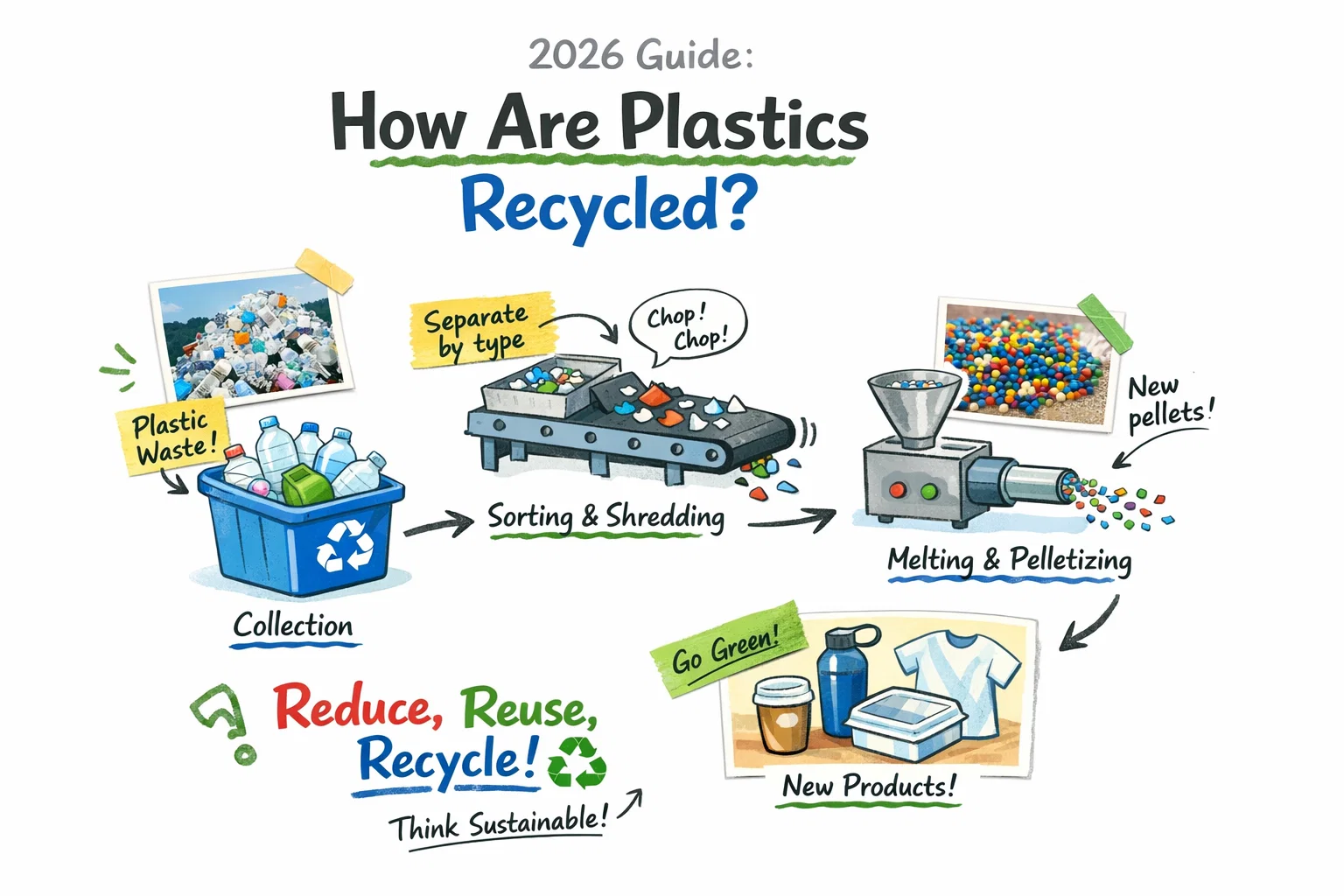
Plastic recycling isn’t one single technology—it’s a set of industrial routes that turn used plastic into usable feedstock again. The right route depends on your polymer type, contamination level, and the quality your customers expect.
In this guide, you’ll learn:
- How plastic recycling works in real facilities
- The four main recycling routes and when each makes sense
- The key process steps that protect output quality
- A practical decision framework for selecting the right route and line design
Quick Answer: How are plastics recycled?
Plastics are recycled through three core stages: collection, processing (sorting, cleaning, size reduction, and purification), and remanufacturing into new products. In practice, recyclers choose one of four routes—mechanical, chemical, dissolution (solvent-based physical recycling), oder Organisches Recycling—based on the plastic type and quality targets.
 – 1024x683.webp)
Why Collection & Sorting Decide Your Recycling Profit
The biggest misconception is that “recycling starts at the extruder.” In reality, recycling success starts upstream. Consistent input produces consistent output—and consistent output is what buyers pay for.
What can go wrong with poor feedstock?
- Mixed polymers that don’t melt or blend together cleanly
- High moisture (especially films) causing unstable extrusion
- Labels, adhesives, paper, sand, and metals causing black specks and gels
- Color variation that reduces end-market value
Buyer mindset: treat sorting as a profit center
Even if you plan a powerful recycling line, your project economics improve when you:
- Separate key streams early (PET vs HDPE vs PP; rigid vs film; natural vs colored)
- Remove contaminants before melt processing
- Control moisture and fines
The 4 Main Routes for Recycling Plastics
Below is a simplified buyer-focused comparison of the four routes.
Mechanical recycling (most common)
Am besten geeignet für: clean, sortable thermoplastics (PET, HDPE, PP, many LDPE/LLDPE films after proper washing/drying)
Ausgabe: flake or pellets for remanufacturing
Main limitation: sensitive to contamination, moisture, and mixed polymers
Chemical recycling (feedstock/monomers)
Am besten geeignet für: certain mixed or hard-to-mechanically-recycle streams where conversion economics make sense
Ausgabe: oil/gas feedstock or monomers (technology-dependent)
Main limitation: economics, permitting, and feedstock control
Dissolution recycling (solvent-based physical recycling)
Am besten geeignet für: selected polymers in mixed waste when purity and additive removal are critical
Ausgabe: purified polymer (then pelletized)
Main limitation: solvent management, selectivity, and process complexity
Organic recycling (for compostable/biodegradable plastics)
Am besten geeignet für: certified compostable plastics in the right organics infrastructure
Ausgabe: compost/biogas (system-dependent)
Main limitation: applies only to specific materials and facilities, not conventional plastics
Mechanical Recycling: Step-by-Step (What Actually Happens in a Plant)
Mechanical recycling is widely used because it can convert stable feedstock into sellable pellets with manageable operating costs—when the line is designed to control contamination and moisture.
Step 1: Collection
Material comes from post-consumer systems, commercial sources, or industrial scrap. The goal is to prevent valuable polymers from becoming “too mixed to separate.”
Käufertipp: Cleaner bales or cleaner industrial scrap can instantly improve pellet quality and profitability.
Step 2: Sorting (by resin type, color, and form)
Sorting separates:
- plastics from non-plastics (paper, metals, organics)
- resin types (PET, HDPE, PP, PS, etc.)
- natural vs colored
- rigid vs film
Warum es wichtig ist: Mixed resins reduce product quality and increase extrusion instability.
Step 3: Washing & decontamination
Washing removes:
- dirt, food residue, oils
- labels and adhesives
- dust, fines, and other contaminants
Buyer reality: Washing quality directly affects odor, black specks, filtration life, and pellet consistency.
Step 4: Size reduction (shredding/grinding)
Shredding/grinding creates consistent flake so it can be washed, separated, and melted more predictably.
Quality benefit: Uniform flake improves separation efficiency and stabilizes extrusion.
Step 5: Secondary separation & quality control
High-performing lines add steps after washing:
- metal removal
- density separation (where applicable)
- flake sorting for higher purity
Why this pays: Higher purity expands your end markets and raises sales price.
Step 6: Extrusion & pelletizing
Flake becomes pellets through controlled melting, filtration, degassing, and pelletizing.
Where pellet quality is won or lost
- Melt filtration strategy (screen packs, backflush, continuous filtration)
- Degassing performance (odor, volatiles, moisture)
- Stable melt temperature and pressure
- Pelletizing choice (strand, water ring, underwater—based on polymer and throughput)
Chemical Recycling: When Mechanical Isn’t the Best Fit
Chemical recycling describes technologies that convert plastic waste into chemical feedstocks or monomers. It can complement mechanical recycling, especially for streams that struggle with contamination, multilayer structures, or mixed polymers.
Common chemical recycling approaches
- Conversion processes (e.g., pyrolysis/gasification): break plastics into hydrocarbon feedstocks
- Depolymerization (technology-dependent): break certain polymers back into monomers or basic chemicals
Buyer warning: Chemical recycling still requires feedstock control. Successful projects rely on consistent input specs, strong pre-processing, and realistic business models.
Dissolution Recycling: Purification Without Breaking the Polymer Chain
Dissolution (solvent-based physical recycling) selectively dissolves a target polymer, separates contaminants, recovers the polymer, and then reprocesses it into pellets—without converting it into monomers.
Typical dissolution workflow
- Pre-sorting and preparation
- Dissolution of the target polymer in a controlled solvent system
- Filtration/centrifugation to remove insoluble contaminants
- Polymer recovery and solvent recovery
- Extrusion and pelletizing
Best use case: When you have a valuable polymer fraction that is difficult to purify with mechanical steps alone—and purity requirements justify added complexity.
Organic Recycling: For Compostable Plastics in the Right Infrastructure
Organic recycling uses microbiological treatment under aerobic (composting) or anaerobic (biogasification) conditions. It applies to certified compostable materials and requires appropriate processing conditions and local infrastructure.
Practical note: Organic recycling is not a solution for conventional plastics like PET, PP, HDPE, or typical LDPE films.
Buyer Decision Guide: How to Choose the Right Recycling Route
If you’re planning a recycling line, start with these four questions.
1) What is your feedstock—exactly?
- Polymer(s): PET, HDPE, PP, LDPE/LLDPE film, PS, PA (nylon), PVC?
- Form: bottles, rigid, film, fiber, mixed?
- Contamination: labels, adhesives, organics, sand, metals?
- Moisture: wet bales or washed flake?
2) What output do you need to sell?
- Clean flake for reprocessors?
- Pellets for molding/extrusion customers?
- Near-virgin appearance vs general-grade material?
3) What is your priority: quality, cost, or flexibility?
- Best ROI for clean streams: mechanical recycling
- Expand feedstock flexibility in certain cases: chemical recycling
- Target high-purity recovery from mixed waste: dissolution
- Only for certified compostables and proper infrastructure: organic recycling
4) What does your local market actually buy?
Your end market defines your specs. A line that produces “recycled pellets” is not enough—you need pellets that meet customer tolerance for color, odor, gels, and consistency.
Why Choose Energiecle for Plastic Recycling Machinery
Energycle supports buyers who need more than a standalone machine. We engineer recycling solutions that turn your specific scrap into stable, market-ready output—consistently.
What you get with Energycle
- Process-first line design: we match equipment to your feedstock and targets
- Quality-focused integration: washing, separation, drying, extrusion, filtration, pelletizing
- Modular scalability: start with a baseline line and expand capacity/purity stages
- Practical commissioning support: ramp up faster with clear operating guidance
- Export-ready documentation support: structured project documentation for professional installation planning
Next step
Send your material photos, target throughput (kg/h), and required output (flake or pellets). We’ll recommend the most practical process route and line configuration.
Häufig gestellte Fragen
What plastics are easiest to recycle?
Plastics that are widely sortable and have strong end markets are typically the easiest to recycle at scale. In many regions, that includes PET and HDPE packaging streams, plus certain PP rigid streams when sorting is available.
Why can’t all plastics be recycled mechanically?
Mechanical recycling works best when the feedstock is consistent and compatible. Mixed polymers, multilayer packaging, heavy contamination, and high moisture reduce pellet quality and can make processing uneconomic without advanced pre-treatment.
Is chemical recycling better than mechanical recycling?
Not “better”—different. Mechanical recycling is efficient for clean, sortable plastics and remains the mainstream route. Chemical recycling can address certain hard-to-mechanically-recycle streams, but it usually requires stricter feedstock control and different economics.
What is dissolution recycling in simple terms?
Dissolution recycling uses a solvent to selectively dissolve a target polymer, removes contaminants through separation steps, then recovers the polymer and reprocesses it into pellets—aiming for higher purity without converting it into monomers.
What are the main steps in a mechanical recycling line?
Most mechanical recycling lines follow: sorting → shredding/grinding → washing → separation → drying → extrusion & pelletizing, with quality control checkpoints throughout.
Welche Informationen sollte ich vorbereiten, bevor ich ein Angebot anfordere?
Prepare:
- Clear photos/videos of your feedstock (before and after shredding if available)
- Estimated throughput (kg/h)
- Contamination details (labels, organics, sand, metals, moisture)
- Target output (flake or pellets) and any quality requirements
- Available factory space and utilities (power, water, compressed air)
Can one line handle both rigid plastics and films?
Sometimes, but not always efficiently. Films typically demand stronger washing/drying and different handling to control moisture and bridging. Many buyers choose modular designs or dedicated sections to keep output stable.
How do I improve pellet quality the most?
Focus on three levers:
- Better sorting and contaminant removal
- Strong washing and moisture control
- Proper filtration/degassing and stable extrusion conditions
