

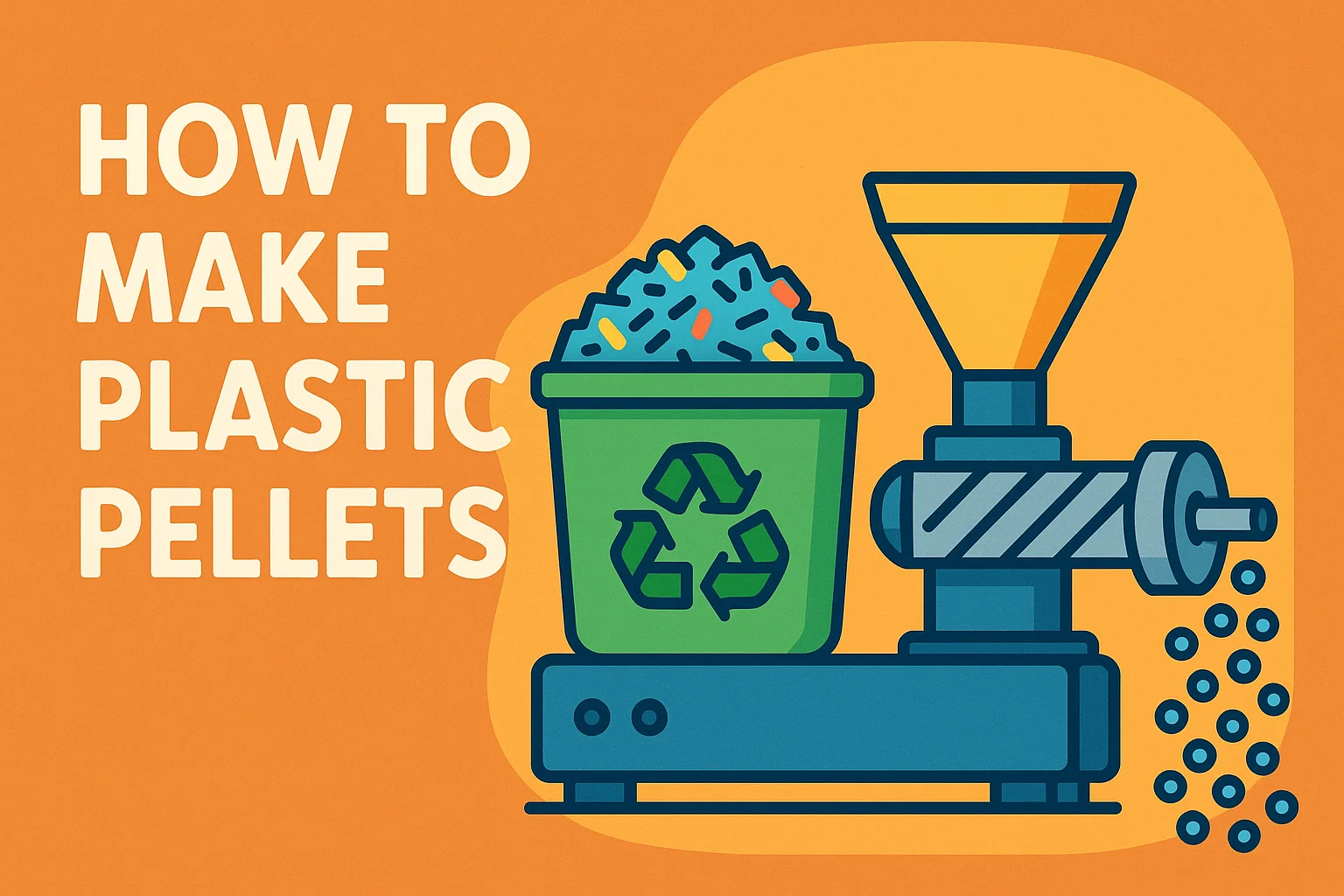
How to Make Plastic Pellets: A Step-by-Step Guide for PET, HDPE & LDPE
Plastic pellets (granules) are the standard feedstock for injection molding and extrusion. If you recycle PET bottles, HDPE containers, or LDPE films, you can turn waste into consistent, sellable material—but only when you control contamination, moisture, melt quality, and cutting stability. This guide explains the full pelletizing workflow with buyer-ready checkpoints, and shows what to look for in a professional pelletizing line.
What you’ll learn
Need a pelletizing line that matches your material and target output?
See our pelletizing equipment overview and typical configurations (rigid regrind, film, printed waste, degassing + filtration). Plastic Pelletizers by Energycle
The 7-step pelletizing process (what actually controls pellet quality)
If you want stable, saleable pellets, treat each step as a quality gate. Problems usually start early (sorting/moisture) and only show up later (black specs, bubbles, odor, weak pellets).
1Collection & Sorting (stop contamination before it starts)
You protect pellet quality by separating polymers and colors early. Mixed PET/PE/PP streams create unstable melting, inconsistent properties, and “off-spec” pellets that buyers reject.
- Separate by polymer: PET vs. HDPE vs. LDPE film must run on different settings (and often different feeding setups).
- Remove metals: magnets + metal detectors prevent screw/barrel damage.
- Handle PET bottles correctly: remove caps/labels; use float/sink separation (PET sinks; most caps/labels float).
2Shredding / Granulation (make the feed consistent)
You want uniform flake size so washing works better and the extruder feeds steadily. Oversized pieces melt unevenly and destabilize pressure.
- Typical flake target: ~5–12 mm depending on polymer and system.
- Films need special handling: fluffy LDPE/PP film can bridge and starve the extruder unless you densify/compact it.
- Buyer checkpoint: ask whether the line includes film compaction/densification for stable feeding.
3Washing (your cheapest way to improve pellet value)
Clean flakes melt more consistently and filter more easily. Residues (oil, glue, sand, paper) create odors, smoke, black specs, and die buildup.
- Common modules: friction washer, float/sink tank, hot wash (as needed), rinsing.
- PET note: sugars/adhesives and label glue matter; poor cleaning shows up as yellowing and specks.
- LDPE film note: agricultural film often needs more aggressive washing due to soil contamination.
4Drying (moisture control = stable extrusion)
You remove water before melting. Moisture turns into steam, creates bubbles, and can degrade certain polymers—especially PET.
- Mechanical dewatering: centrifugal dryer removes surface water quickly.
- Thermal drying: hot-air or desiccant drying improves stability; PET typically needs the strictest moisture control.
- Buyer checkpoint: request target moisture ranges and how the line verifies them (monitoring, sensors, process control).
5Extrusion (create a clean, homogeneous melt)
The extruder melts, mixes, pressurizes, and stabilizes the melt for pelletizing. A stable melt reduces die pressure swings and pellet size drift.
- Temperature stability: correct heating zones + screw design prevent burning and under-melting.
- Degassing (vacuum vent): removes volatiles/moisture/odor sources—especially helpful for printed or slightly wet feed.
- Filtration: screen packs + screen changers stop unmelted contaminants from reaching pellets.
6Pelletizing (cutting method determines pellet uniformity)
You turn molten plastic into uniform pellets. Your choice of strand vs. die-face affects throughput stability, pellet shape, and ease of operation.
- Strand: melt → strands → water bath → cutter. Simple and widely used.
- Die-face (water-ring): cut at the die; great for continuous operation and common in PE/PP recycling.
- Buyer checkpoint: ask how the system controls pellet length when throughput fluctuates (cutter speed control, pressure feedback).
7Cooling, Drying & QA (deliver a product buyers can run)
You cool pellets, remove surface moisture, and screen out fines/oversize. You then verify key metrics that buyers care about.
- Pellet drying: centrifugal dryer or air drying prevents clumping and improves packaging.
- Screening: removes fines/oversize for consistent downstream feeding.
- QA examples: appearance (specks), moisture, melt flow index (MFI), bulk density (as required by buyers).
Material-specific notes (PET vs. HDPE vs. LDPE)
| Material | What usually goes wrong | What you should control | What to ask your equipment supplier |
|---|---|---|---|
| PET | Moisture-driven degradation, yellowing, brittle pellets, inconsistent IV/MFI | Strict drying, stable temperature profile, clean filtration | Drying target & method, degassing configuration, filtration strategy, screw design |
| HDPE | Color contamination, odor from residues, black specs from poor filtration | Washing quality, stable melt, reliable screen changing | Screen changer type, motor/gearbox robustness, melt pressure stability features |
| LDPE film | Feeding instability (bridging), melt surging, poor pellet size control | Compaction/densification, consistent feeding, die-face pelletizing advantages | Does the line include compactor? How it prevents film bridging? Recommended pelletizer type? |
Pelletizing methods: strand vs. die-face (water-ring)
Both methods can produce excellent pellets. The right choice depends on your polymer, cleanliness, throughput, and how stable your melt flow is.
- Simple workflow: strands cool in water bath before cutting.
- Easy to maintain: widely used, familiar to most operators.
- Best fit: stable melt flow and cleaner feedstock.
Watch-outs: strand breaks, uneven strand flow, and downtime if strands snap frequently.
- Continuous cutting: cuts at the die face; often handles output variations better.
- Compact layout: integrated cooling + conveying.
- Best fit: PE/PP and film lines where stable, continuous operation matters.
Watch-outs: requires proper die-face management and consistent process control for best pellet shape.
If you recycle mixed-quality film or want a smoother continuous operation, die-face pelletizing often reduces sensitivity to strand handling issues. If your melt is stable and you want a straightforward configuration, strand pelletizing remains a reliable choice.
Decision guide: how to choose a pelletizing system (buyer-first)
If you want fewer surprises after purchase, decide from the material backward—not from the brochure forward. Use this checklist to align your line configuration with your feedstock and your pellet sales target.
ADefine your input reality
- Polymer type(s): PET / HDPE / LDPE / mixed?
- Form: rigid regrind, flakes, film, printed waste, post-consumer?
- Contamination: paper/labels, sand, oil, moisture, metal risk?
BDefine your output requirement
- Target markets: internal reuse vs. selling pellets to buyers?
- Quality: speck tolerance, odor tolerance, color stability?
- Required tests: MFI, moisture, bulk density, etc.?
CMatch the “must-have” modules
- Film: compactor/densifier to prevent bridging and stabilize feeding.
- Printed / odor risk: degassing (vacuum vent) to remove volatiles.
- Dirty feed: stronger filtration + practical screen change method to maintain uptime.
DProtect uptime and total cost
- Confirm gearbox, screw/barrel materials, and wear parts strategy.
- Ask how the system handles pressure spikes and foreign objects.
- Evaluate operator friendliness: access, cleaning time, control logic.
Why buyers choose Energycle (what you gain in real operation)
You don’t buy a pelletizer to “own a machine.” You buy it to run stable production, hit output targets, and deliver pellets that customers accept. Energycle focuses on practical engineering that protects your uptime and pellet quality.
- Material-matched configurations: we recommend layouts based on your feedstock (rigid vs. film vs. PET).
- Quality stability focus: process control + filtration/degassing options reduce specks, bubbles, and odor risks.
- Uptime mindset: robust core components and practical maintenance design to reduce unplanned stops.
- Clear technical communication: you get a configuration that fits your constraints, not generic promises.
- Buying a line that cannot feed film reliably (bridging and starving).
- Running without adequate filtration (black specs, clogged dies, buyer complaints).
- Ignoring moisture control (bubbles, unstable cutting, PET degradation risk).
- Overspending on features that don’t match your real input and output needs.
Recommended next step (fast and practical)
Send your material type, input form (film/rigid/flake), contamination level, target output (kg/h), and pellet application. We’ll suggest a suitable configuration and share options from our pelletizing range.
Start here: Energycle Plastic Pelletizers
FAQ
What pellet size should I target?
Most recycled plastic pellets are produced around 3–5 mm. The exact size depends on your downstream customer’s feeding system and product requirements. The key is consistency: uniform pellets feed better and produce more stable manufacturing output.
Do I always need washing?
If your feedstock contains dirt, labels, glue, oils, or sand, washing is one of the most cost-effective ways to raise pellet value and reduce defects. Clean input reduces filtration load, odor risk, and die buildup during extrusion.
Why does film recycling feel harder than rigid plastics?
Film is light and “fluffy,” so it bridges and feeds inconsistently. A compactor/densifier (or integrated cutting-compaction) stabilizes feeding and protects extrusion pressure, which directly improves pellet size uniformity and output stability.
When should I choose die-face pelletizing (water-ring) instead of strand?
If you run PE/PP (especially film) and want continuous operation with less sensitivity to strand handling, die-face methods can be a strong match. If your melt is stable and you prefer a straightforward configuration, strand pelletizing remains reliable and widely used.
What information should I prepare before requesting a quotation?
Prepare: polymer type(s), input form (flakes/film/rigid), contamination level, moisture condition, target output (kg/h), and pellet application (internal reuse or external buyers). With that, a supplier can recommend a configuration that matches your real operating conditions.
Conclusion
You can make high-quality pellets from PET, HDPE, and LDPE when you control the process end-to-end: keep polymers separated, clean and dry the feedstock, stabilize extrusion with proper degassing and filtration, and choose a pelletizing method that fits your material. When you align the system configuration with your real input and output goals, you protect uptime, reduce defects, and deliver pellets buyers can run confidently.
Explore pelletizing equipment and configurations
Plastic Pelletizers — see options for rigid plastics and film recycling, with practical configurations that prioritize stable production and pellet quality.
