

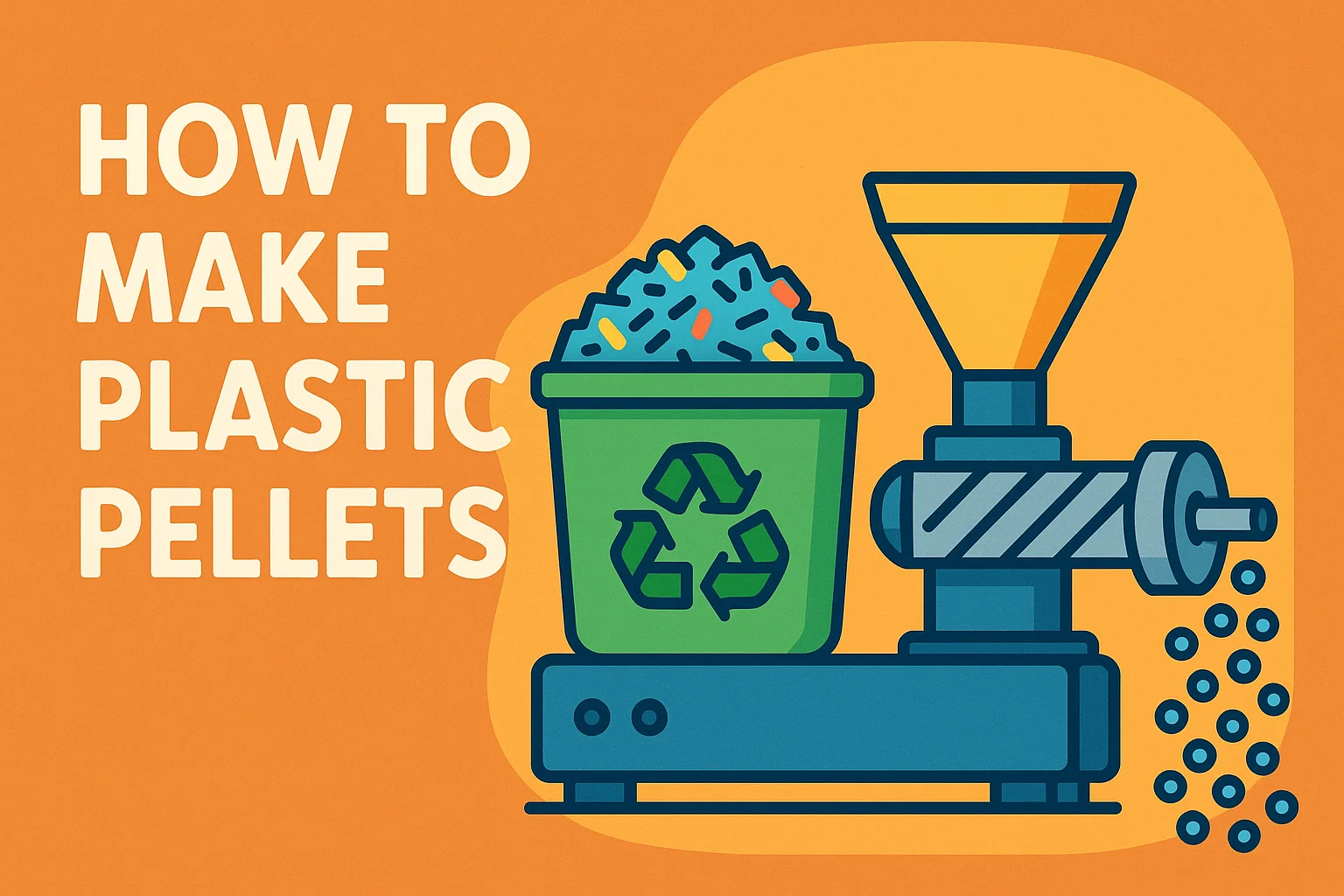
Hoe maak je plastic pellets: een stapsgewijze handleiding voor PET, HDPE en LDPE
Plastic granulaat (pellets) zijn de standaard basisstof voor injectiegieterijen en extrusie, geproduceerd op plastic granulaatmaken machines. Als je
recycle PET bottles, HDPE containers, or LDPE films,
u kunt afval omzetten in consistent, verkoopbaar materiaal—maar alleen wanneer u besmetting, vochtigheid beheert,
melt quality, and cutting stability.
Deze gids legt de volledige pelletisatie workflow uit met klantklaare controlepunten en laat zien wat u moet
for in a professional pelletiseren
lijn.
Kernfasen: sorteren → versnipperen → wassen → drogen → extruderen → pelletiseren
Kritieke risico's: gemengde polymeren, vocht, slechte filtratie, instabiele snijwerking
Heeft u een pelletiseerlijn nodig die aansluit op uw materiaal en gewenste output?
Zie ons overzicht van pelletisatie-apparatuur en typische configuraties (vast gerecycleerd materiaal, film, bedrukte
waste, degassing + filtration).
Kunststofpelletiseermachines van Energycle |
2026 Machine
Price List
Het 7-stappen pelletiseerproces (wat de pelletkwaliteit daadwerkelijk bepaalt)
If you want stable, saleable pellets, treat each step as a quality gate. Problems usually start early
(sorteren/vochtigheid) en verschijnen pas later (zwarte korrels, bubbels, geur, zwakke korrels).
1Verzamelen en sorteren (voorkom besmetting voordat deze begint)
U bescherm de pelletkwaliteit door polymeren en kleuren vroegtijdig te scheiden. Gemengde PET/PE/PPstromen
create unstable melting,
ongegelijkmatige eigenschappen en 'off-spec' pellets die kopers afwijzen.
- Scheiding op basis van polymeer: PET vs. HDPE vs. LDPE film must run on different
settings (and often different feeding setups). - Verwijder metalen: Magneten en metaaldetectoren voorkomen schade aan schroeven/loopstukken.
- Behandel PET-flessen op de juiste manier: remove caps/labels; use float/sink separation
(PET sinks; most caps/labels float).
2Versnipperen / Granuleren (zorg voor een consistente aanvoer)
U wilt een uniforme korrelgrootte zodat het wassen beter werkt en de extruder regelmatig voedt. Te grote
pieces melt unevenly and destabilize pressure.
- Typisch doelwit voor flakes: ~5–12 mm, afhankelijk van het polymeer en het systeem.
- Films vereisen speciale behandeling: schuimige LDPE/PP-film kan bruggen vormen en de
extruder unless you densify/compact it. - Controlepunt voor de koper: ask whether the line includes film
compaction/densification for stable feeding.
3Wassen (de goedkoopste manier om de waarde van pellets te verhogen)
Schone korrels smelten meer consistent en filteren gemakkelijker. Residuen (olie, lijm, zand, papier)
create odors, smoke, black specs, and die buildup.
- Gemeenschappelijke modules: friction washer, float/sink tank, hot wash (as needed),
rinsing. - Opmerking van PET: sugars/adhesives and label glue matter; poor cleaning shows up as
yellowing and specks. - Opmerking over LDPE-folie: agricultural film often needs more aggressive washing due
to soil contamination.
4Drogen (vochtbeheersing = stabiele extrusie)
Uw verwijdert water voordat het smelt. Vochtigheid verandert in damp, maakt bubbels en kan degradatie veroorzaken
certain polymers—especially PET.
- Mechanische ontwatering: centrifugaaldroger Verwijdert snel oppervlaktewater.
- Thermisch drogen: hot-air or desiccant drying improves stability; PET
typically needs the strictest moisture control. - Controlepunt voor de koper: verzoek de doelvochtigheidsbereiken en hoe de lijn dat verifieert
them (monitoring, sensors, process control).
5Extrusie (het creëren van een schone, homogene smelt)
De extruder smelt, mengt, drukt op en stabiliseert de smelt voor pelletisatie. Een stabiele smelt
reduces die pressure swings and pellet size drift.
- Temperatuurstabiliteit: correct heating zones + screw design prevent burning
and under-melting. - Ontgassing (vacuümontluchting): removes volatiles/moisture/odor sources—especially
helpful for printed or slightly wet feed. - Filtratie: schermpakketten + schermverversers stop ontmelkende verontreinigingen van
reaching pellets.
6Pelletiseren (de snijmethode bepaalt de uniformiteit van de pellets)
U verandert gesmolten plastic in uniforme korrels. Uw keuze tussen draad versus dopoppervlak beïnvloedt
throughput stability, pellet shape, and ease of operation.
- Streng: smelten → strengen → waterbad → snijder. Eenvoudig en veelgebruikt.
- Matrijsvlak (waterring): snijdt bij de dop; ideaal voor continue werking en
common in PE/PP recycling. - Controlepunt voor de koper: vraag hoe het systeem de lengte van de korrels controleert bij de capaciteit
fluctuates (cutter speed control, pressure feedback).
7Koeling, droging en kwaliteitscontrole (een product leveren dat kopers direct kunnen gebruiken)
koel de korrels af, verwijder oppervlakkige vochtigheid en zeef de fijnstoffen/te grote korrels uit. Vervolgens verifieer je de
metrics that buyers care about.
- Pelletdroging: centrifugaaldroger or air drying prevents clumping and
improves packaging. - Screening: Verwijdert fijne/grote deeltjes voor een consistente aanvoer stroomafwaarts.
- QA-voorbeelden: appearance (specks), moisture, melt flow index (MFI), bulk
density (as required by buyers).
Materiaalspecifieke opmerkingen (PET vs. HDPE vs. LDPE)
| Materiaal | Wat gaat er meestal mis? | Wat je moet controleren | Wat u aan uw leverancier van apparatuur moet vragen |
|---|---|---|---|
| HUISDIER | Door vocht veroorzaakte degradatie, vergeling, broze korrels, inconsistente IV/MFI-waarden. | Strikte droging, stabiel temperatuurprofiel, schone filtratie | Droogdoel en -methode, ontgassingsconfiguratie, filtratiestrategie, schroefontwerp |
| HDPE | Kleurverontreiniging, geur van resten, zwarte vlekjes door slechte filtratie. | Goede waskwaliteit, stabiel smeltpunt, betrouwbare zeefvervanging | Type zeefwisselaar, robuustheid van motor/versnellingsbak, stabiliteit van de smeltdruk |
| LDPE-folie | Instabiliteit van de toevoer (brugvorming), overmatige smelt, slechte beheersing van de korrelgrootte | Verdichting/densificatie, constante toevoer, voordelen van pelletiseren aan de matrijszijde | Bevat de productielijn een verdichter? Hoe wordt het samenklonteren van de folie voorkomen? Welk type pelletiseermachine wordt aanbevolen? |
problemen in de extruder. Een goed systeem helpt, maar kan geen onbeheerde problemen toveren
input.
Pelletiseermethoden: streng versus matrijsvlak (waterring)
beide methoden kunnen uitstekende korrels produceren. De juiste keuze hangt af van je polymer, schoonheid,
capaciteit en hoe stabiel je smelten debiet is.
- Eenvoudige workflow: Laat de strengen afkoelen in een waterbad voordat u ze knipt.
- Gemakkelijk te onderhouden: veel gebruikt, bekend bij de meeste operators.
- Het beste passend: stabiele smeltstroom en schonere grondstoffen.
Aandachtspunten: draadbreuken, ongelijkmatige draadstroom en stilstand als draden vaak breken.
- Continu snijden: cuts at the die face; often handles output variations
better. - Compacte lay-out: Geïntegreerde koeling + transport.
- Het beste passend: PE/PP- en folielijnen waar stabiele, continue werking van belang is.
Let op: vereist juiste beheersing van de mal en consistente procescontrole voor de beste korrel
shape.
If you recycle mixed-quality film or want a smoother continuous operation, die-face pelletizing often
reduces sensitivity to strand handling issues.
Als uw smelt stabiel is en u een eenvoudige configuratie wilt, blijft de draadkorrelisatie een
reliable choice.
Kunststofgranuleermachine: typen, kosten en hoe u de juiste kiest.
A plastic
pelletiseermachine zet schone plastic vlokken of film om in uniforme korrels klaar voor
fabricage. Uw keuze van korreliser type beïnvloedt de korrelvorm, doorvoersstabiliteit, arbeidsbehoeften,
en totale investering. Hier is een praktische vergelijking gebaseerd op werkelijke recyclingoperaties.
Waterringpelletiseermachine versus strengpelletiseermachine: welke past het beste bij uw bedrijf?
| Factor | Strandpelletiseerder | Waterring Pelletiseerder | Onderwater Pelletiseerder |
|---|---|---|---|
| Hoe het werkt | Smelt geëxtrudeerd tot strengen → afkoeling in waterbad → roterende snijder | Snijden aan de matrijszijde → waterring koelt en transporteert de pellets | Snijd onder water bij het matrijsvlak → korrels stollen direct |
| Korrelvorm | Cilindrisch | Bolvormig / bijna bolvormig | Bolvormig |
| Best voor | Stijf gerecycled materiaal (HDPE, PP, ABS) met stabiele smelttemperatuur. | PE/PP-folie, zachte kunststoffen, doorlopende lijnen | High-throughput compounding, technische kunststoffen |
| Typische capaciteit | 100–2.000 kg/u | 100–1.500 kg/u | 500–5.000+ kg/u |
| Prijsbereik (USD) | $10.000–$80.000 | $20.000–$120.000 | $50.000–$300.000+ |
| Arbeidsbehoeften | Handmatig draad inrijgen bij het opstarten; controleren op breuken. | Grotendeels geautomatiseerd; minimale tussenkomst van de operator. | Volledig geautomatiseerd; vakkundige installatie vereist. |
| Onderhoud | Eenvoudige meswisselingen; laag onderhoud cost |
Matrijsbeheer; gemiddeld onderhoud | Hoger onderhoud; gespecialiseerde onderdelen |
korrelpers biedt de laagste investering. Voor het recyclen van PE/PP-film waarbij de continuïteit van de operatie
matters, a water ring system reduces strand-handling headaches. See our full pelletiseren
methods comparison voor meer gedetailleerde technische informatie.
Snij- en verdichtingssysteem voor pelletering: de favoriete configuratie van folierecyclers
A schaarcompactor pelletizing system combines four functions in one integrated unit: cutting,
compacteren, plasticiseren en granuleren. De snellende roterende messen binnen de compacterkamer
shred and densify film scraps through frictional heat—bringing the material just below its melting
point—then force-feed it directly into the extruder screw. This eliminates the bridging and
feeding instability that plagues conventional film recycling setups.
- LDPE/LLDPE rekfolie en landbouwfolie
- PP geweven tassen en raffia
- Bedrukte of gelamineerde folie met geur-/vluchtigheidsrisico's
- Gemengde gerecyclede folie met variabel vochtgehalte
- Eentraps systeem: $45.000–$150.000
- Tweetraps (met extra ontgassing): $80.000–$250.000
- Capaciteitsbereik: 200–1.500 kg/u
- Vergelijk de opties: PE/PP
film pelletizing machines
Kunststofgranuleerlijn: wat een compleet systeem inhoudt
A plastic pelletizing line is not a single machine—it is a coordinated system of modules that
raw plastic afval omzetten in verkoopbare granulaat. De exacte configuratie hangt af van uw materiaal,
vervuilingsspiegel en het gewenste uitvoeringsdoel. Hier is wat een typische lijn omvat en wat elke fase kost.
| Fase | Apparatuur | Functie | Gemiddelde kosten (USD) |
|---|---|---|---|
| 1. Verkleining | Shredder / breker | Verklein de plastic deeltjes tot 5–12 mm. | $3.000–$25.000 |
| 2. Wassen | Frictie wasser, drijf-zink tank |
Verwijder vuil, etiketten, lijm en olie. | $15.000–$200.000 |
| 3. Drogen | Centrifugaaldroger, thermische droger | Verlaag het vochtgehalte tot onder de extrusiedrempel. | $5.000–$30.000 |
| 4. Extrusie | Enkelvoudige schroef of extruder met dubbele schroef |
Smelten, mengen, ontgassen, filteren | $10.000–$250.000 |
| 5. Pelletiseren | Strengesnijder / waterring / matrijsvlak | Snijd gesmolten plastic in gelijkmatige korrels. | $5.000–$80.000 |
| 6. Koeling en kwaliteitscontrole | Koeltransportband, trilzeef, silo | Koel, zeef de fijne deeltjes en bewaar ze voor verpakking. | $3.000–$15.000 |
costs $50,000–$150,000. Medium-capacity lines (500–1,500 kg/h) run $150,000–$350,000.
Voor gedetailleerde prijzen per capaciteitsniveau en materiaaltype, zie onze 2026 plastic
recycling machine price list. Voor een kostenanalyse specifiek voor pelletiseermachines, lees verder. what
drives pelletizer prices.
Korrels versus granulaat: wat is het verschil?
De termen "pellets" en "granulaat" worden vaak door elkaar gebruikt in de plastic recycling, maar ze verwijzen
naar verschillende producten met afwijkende productieprocessen en marktwaarden.
| Kenmerkend | Plastic korrels | Kunststofkorrels (gerecycled) |
|---|---|---|
| Vorm | Gelijkmatig cilindrisch of bolvormig (3–5 mm) | Onregelmatige, hoekige fragmenten |
| Productiemethode | Extrusie → smeltfiltratie → pelletiseren (streng- of matrijsvlaksnijden) | Versnipperen of vermalen zonder te smelten |
| Samenhang | Uniforme grootte, dichtheid en smeltstroom | Variabele grootte en bulkdichtheid |
| Stroomafwaartse voeding | Stabiele, voorspelbare dosering bij injectie/extrusie. | Kan leiden tot een ongelijkmatige toevoer of overbrugging. |
| Marktprijs | Hoger — kopers betalen een premie voor consistentie | Lagere prijs – beperkt tot kopers die met variabiliteit kunnen omgaan. |
| Beste toepassing | Verkoop aan fabrikanten die productiegereed materiaal nodig hebben. | Intern hergebruik of menging met nieuwe hars |
flakes adds $50–$200/ton in processing cost but typically earns $100–$400/ton more than
loose regrind. The voordelen
and limitations of recycled pellets Dat hangt sterk af van de kwaliteit van je grondstoffen en je doelmarkt.
Beslissingsgids: hoe u een pelletiseersysteem kiest (kopersperspectief)
Wilt u minder verrassingen na aankoop, beslis dan van het materiaal terug naar de brochure — niet van de brochure naar het materiaal
forward.
Gebruik deze checklist om uw lijnconfiguratie af te stemmen op uw grondstof en uw pelletverkoopdoel.
ADefinieer uw inputrealiteit
- Polymeertype(s): PET / HDPE / LDPE / gemengd?
- Vorm: stijf gerecycled materiaal, vlokken, folie, drukwerkafval, post-consumer?
- Verontreiniging: papier/etiketten, zand, olie, vocht, metaalrisico?
BDefinieer uw uitvoervereiste.
- Doelmarkten: intern hergebruik versus verkoop van pellets aan afnemers?
- Kwaliteit: tolerantie voor vlekjes, tolerantie voor geurtjes, kleurstabiliteit?
- Vereiste testen: MFI, vochtgehalte, bulkdichtheid, enz.?
CKies de modules die je absoluut nodig hebt.
- Film: Verdichter/compactor om brugvorming te voorkomen en de aanvoer te stabiliseren.
- Bedrukt / geurrisico: Ontgassing (vacuümventilatie) om vluchtige stoffen te verwijderen.
- Onzuivere voeding: stronger filtration + practical screen change method to
maintain uptime.
DBescherm de uptime en de totale kosten.
- Controleer de materialen van de versnellingsbak, de schroef/cilinder en wear
parts strategy. - Vraag hoe het systeem omgaat met drukpieken en vreemde voorwerpen.
- Beoordeel de gebruiksvriendelijkheid: toegankelijkheid, reinigingstijd, bedieningslogica.
pelletizing control.
Als u PET verwerkt, geef de voorkeur aan droogingsdiscipline, temperatuurstabiliteit en effectieve
degassing/filtration.
Waarom kopers voor Energycle kiezen (wat u in de praktijk wint)
You don’t buy a pelletizer to “own a machine.” You buy it to run stable production, hit output targets,
en leveren pellets die klanten accepteren.
Energycle richt zich op praktische engineering die uw uptime en pelletkwaliteit beschermt.
- Materiaalgecoördineerde configuraties: we recommend layouts based on your
feedstock (rigid vs. film vs. PET). - Focus op kwaliteitsstabiliteit: process control + filtration/degassing options
reduce specks, bubbles, and odor risks. - Uptime-mentaliteit: robust core components and practical maintenance design to
reduce unplanned stops. - Duidelijke technische communicatie: you get a configuration that fits your
constraints, not generic promises.
- Een productielijn kopen die de film niet betrouwbaar kan aanvoeren (door brugvorming en filmtekort).
- Werkt zonder adequate filtering (zwarte deeltjes, verstopte cilinders, klachten van kopers).
- Het negeren van vochtbeheersing (bubbels, instabiel snijden, risico op PET-degradatie).
- Te veel geld uitgeven aan functies die niet aansluiten op uw werkelijke input- en outputbehoeften.
Aanbevolen vervolgstap (snel en praktisch)
Stuur uw materiaaltype, inkomingsformulier (film/hard/klonter), vervuilingsscore, doeloutput
(kg/h), and pellet application.
We zullen een geschikte configuratie voorstellen en opties uit ons pelletiseringsassortiment delen.
Begin hier: Energycle Plastic
pelletiseermachines
Veelgestelde vragen over het maken van plastic korrels
Welke korrelgrootte moet ik nastreven?
De meeste gerecycleerde plastic pellets worden geproduceerd in een maat van ongeveer 3–5 mm. De exacte maat hangt af van uw downstream
customer’s feeding system and product requirements.
De sleutel is consistentie: uniforme korrels voeden beter en produceren een stabielere productie-uitvoer.
Moet ik me altijd wassen?
Als uw grondstof vuil, etiketten, lijm, oliën of zand bevat, is wassen een van de meest
cost-effective ways to raise pellet value and reduce defects.
Een schone input vermindert de filtratiebelasting, geurrisico's en die-aanbouw tijdens extrusie.
Waarom voelt het recyclen van folie harder aan dan het recyclen van harde kunststoffen?
Film is licht en 'fluffy', dus het bruggetje en voeden is onregelmatig. Een compactor/densifier (of
geïntegreerde snij-compressie) stabiliseert het voeden en beschermt de extrusiedruk,
wat direct de uniformiteit van de korrelgrootte en de productiestabiliteit verbetert.
Wanneer moet ik kiezen voor matrijs-vlak-pelletiseren (waterring) in plaats van strengpelletiseren?
Als u PE/PP (vooral film) wilt gebruiken en een continue werking wilt met minder gevoeligheid voor de draad
handling, die-face methods can be a strong match.
als uw smelt stabiel is en u een eenvoudige configuratie voorkeurt, blijft de draad pelletisatie
reliable and widely used.
Welke informatie moet ik voorbereiden voordat ik een offerte aanvraag?
Prepare: polymer type(s), input form (flakes/film/rigid), contamination level, moisture condition,
target output (kg/h),
en korreltoepassing (interne hergebruik of externe kopers). Met dat in gedachten kan een leverancier aanbevelen een
configuratie die past bij uw werkelijke bedrijfsomstandigheden.
Wat kost een machine voor het pelletiseren van kunststof?
Een enkele-schroefstraat pelletizer begint bij ongeveer €10.000 voor kleine capaciteiten (100-200 kg/h).
Water ring pelletizers range $20,000-$120,000. A complete pelletizing line including shredder,
wasmachine, droger en extruder kosten meestal €50.000-€350.000, afhankelijk van capaciteit en automatisering
level. See our korrelpers
cost analysis voor gedetailleerde analyses.
Wat is het verschil tussen plastic korrels en plastic granulaat?
Pellets zijn uniforme, cilindrische of sferische deeltjes (3-5 mm) die worden geproduceerd door extrusie en
gecontroleerde snijding. Granulaat (hergebruikte deeltjes) zijn onregelmatige fragmenten die worden geproduceerd door
samen met smelten. Pellets hebben hogere marktwaarden omdat ze consistentere voeding bieden in
manufacturing equipment and deliver predictable melt behavior.
Hoe maak ik HDPE-korrels van gerecyclede verpakkingen?
HDPE-pelletisatie volgt het standaard 7-stapsproces: sorteren op kleur, fijnhakken tot 8-12 mm schillen, wassen
met wrijving en drijf-zinken scheiding, drogen onder 1% vochtigheid, extruderen door een enkele spoel
systeem met schermfiltratie, en pelletiseren met een draadsnijder. De belangrijkste uitdaging is
het beheersen van kleurverontreiniging en het verwijderen van overblijvende geuren van post-consumercontainers.
Waterringpelletiseermachine of strengpelletiseermachine - welke moet ik kiezen?
Kies een draadsnijder voor harde plastics (HDPE, PP, ABS) met een schone, stabiele smeltstroom - het
kost minder en is eenvoudig te onderhouden. Kies voor een waterring pelletizer voor PE/PP-filmlijnen waar
continue, geautomatiseerde operatie van belang is en je downtime door breuk van de draad wilt volledige vergelijkingstabel boven.
Wat is een schaarcompactor pelletiseersysteem?
A schaarcompactor ontlopen. Zie het pelletizersysteem dat snijden, compacteren, plasticeren en pelletiseren combineert
in één geïntegreerd eenheid. Hoogsnijdende messen slijten en verdichten filmresten door wrijvingswarmte
en voeren het materiaal direct in het extruder in. Dit ontwerp is specifiek gebouwd voor
LDPE/LLDPE-film, PP-geweven zakken en andere zachte materialen die moeilijk door de voeding gaan
conventional extruder hoppers.
Conclusie
U kunt hoge kwaliteit granulaat maken van PET, HDPE en LDPE wanneer u het proces van begin tot einde beheerst: houd
polymers separated,
de basisstof schoon en droog, stabiliseer de extrusie met juiste ontgassing en filtratie, en kies een
granulatiemethode die past bij uw materiaal.
Wanneer u de systeemconfiguratie afstemt op uw daadwerkelijke in- en uitvoerdoelen, beschermt u de uptime,
defecten verminderen en granulaat leveren waar kopers met vertrouwen mee kunnen werken.
Ontdek pelletiseerapparatuur en -configuraties.
Kunststofpelletizers — zie opties
voor recycling van harde plastics en film, met praktische configuraties die de
stabiliteit van de productie en de kwaliteit van de granulaat hoog in het vaandel zetten.
