

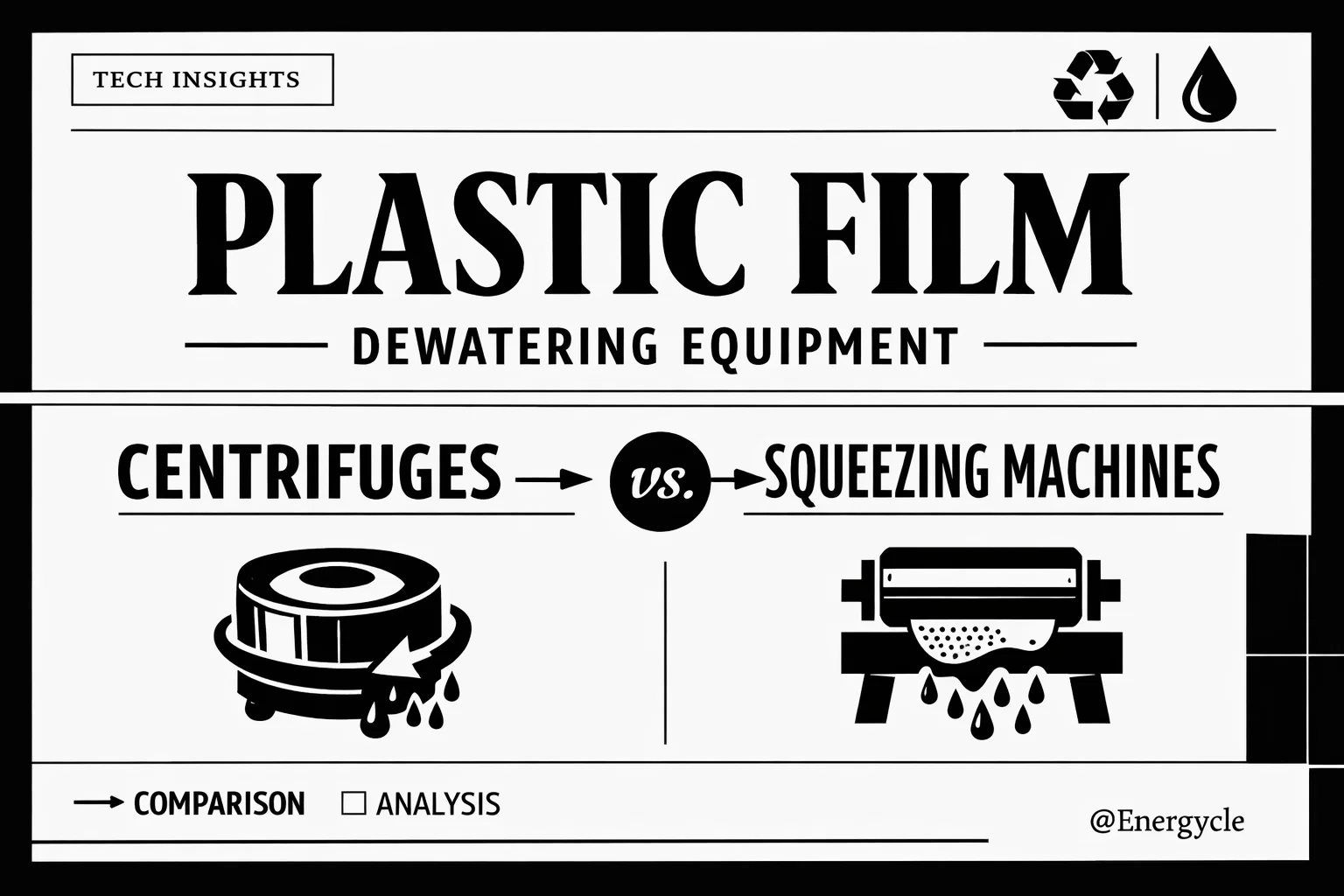
Plastic film dewatering equipment determines the thermal load and volumetric efficiency of downstream extrusion lines. Wet polyethylene (PE) and polypropylene (PP) films increase drying energy consumption and frequently cause bridging in extruder hoppers. Upgrading mechanical dewatering setups can decrease thermal drying times by up to 30%. Energycle engineers these systems to target the specific physical properties of flexible packaging and agricultural films.
Process Flow and Mechanical Principles
Removing surface and capillary moisture from flexible plastics requires equipment matched to the material’s structural limits. Facilities primarily install two categories of machinery: centrifugal systems and squeezing machines.
Centrifugal Dewatering Mechanics
A centrifugal dewatering machine applies high rotational G-forces to separate surface water from suspended plastic flakes. Research on high-density polyethylene (HDPE) film centrifugation demonstrates that flexible materials tend to form a dense “plastic cake” against the outer screen [1]. Capillary action traps residual water within the twisted layers and microscopic pores of this cake.
To break this capillary hold, systems require specific rotor configurations and precise material sizing. Maintaining feedstock flake dimensions between 1 and 2 cm prevents excessive overlapping and minimizes water retention. These systems typically achieve up to a 90% reduction in surface moisture within minutes.
Mechanical Squeezing Principles
Film squeezing machines process washed PP, PE, and woven bags through mechanical compression. A high-torque conical screw forces the wet material against a restrictive die or set of rollers. This physical compaction pushes liquid out through perforated barrel screens.
The intense mechanical friction generated during compaction produces heat, which initiates the evaporation of remaining moisture. This dual-action process lowers the final moisture content to under 5%. Facilities feeding this densified, pre-heated material into extruders regularly observe a 20% increase in pelletizing output [2].
Equipment Specifications and Performance Parameters
The choice between rotation-based and compression-based moisture removal dictates utility requirements and plant layout.
| Parameter | Centrifugal Dewatering | Squeezing Machines |
|---|---|---|
| Primary Mechanism | High-speed rotation (G-force) | Mechanical compaction (Conical Screw) |
| Target Moisture Output | Up to 90% water reduction | Under 5% final moisture |
| Ideal Feedstock | 1–2 cm HDPE/LDPE flakes | Washed PP, PE films, woven bags |
| Operational Advantage | Drops thermal dryer energy use by 15% | Increases extruder throughput by 20% |
| Space Requirement | Vertical or horizontal footprint | Highly compact inline integration |
Feedstock Constraints and Material Compatibility
Machine selection depends heavily on the incoming material geometry and thickness. Thin, highly flexible films dry rapidly under centrifugal forces but require correct screen sizing to prevent material loss. Thicker agricultural mulch films and non-woven fabrics demand the higher mechanical force provided by squeezing equipment.
Engineers must size the motor capacity precisely to the expected throughput. High-volume continuous operation will stall an underpowered rotor, causing immediate line bottlenecks. Operators must also match screen perforation sizes to the target polymer to prevent screen blinding.
Wear Parts, Maintenance, and Uptime Risks
Mechanical dewatering operates under severe friction and high-moisture conditions, accelerating component wear. Preventive maintenance dictates the operational lifespan of the system.
- Rotor Blades and Screw Flights: Subject to constant abrasion from microscopic contaminants; require hardfacing or regular replacement to maintain compression ratios.
- Stainless Steel Screens: Vulnerable to blinding from melted plastics or irregular flakes; require scheduled pressure washing and thickness inspections.
- Bearings and Seals: High-speed operation and water proximity necessitate strict lubrication schedules to prevent catastrophic bearing failure.
- Drive Motors: Belt tension and motor alignment must be checked monthly to prevent power transmission losses.
Commissioning and Site Acceptance Checklist
Verify equipment performance during Factory Acceptance Testing (FAT) or Site Acceptance Testing (SAT) using quantifiable metrics.
- Moisture Content Verification: Collect output samples every 30 minutes to verify final moisture remains under 5% (squeezers) or meets the 90% reduction baseline (centrifuges).
- Throughput and Load Testing: Run the system at 100% rated capacity for 4 continuous hours to monitor for motor amp spikes or thermal overload limits.
- Vibration Analysis: Record baseline displacement on centrifuge bearing housings to detect early signs of rotor imbalance.
- Discharge Consistency: Confirm that automated discharge mechanisms eject the processed material without bridging or jamming in the transition chutes.
Frequently Asked Questions
What causes high moisture retention in centrifugal dewatering systems?
Moisture retention in a centrifugal system typically results from incorrect flake geometry or insufficient rotor speed. HDPE and LDPE films tend to fold and trap water within capillary spaces, forming a dense material cake. Operators must maintain feedstock dimensions between 1 and 2 cm to prevent this capillary trapping. Additionally, screen blinding caused by degraded wipers restricts water ejection. Routine screen inspection and maintaining specified motor speeds ensure the machine achieves the required 90% moisture reduction margin.
How do film squeezing machines impact downstream extrusion energy costs?
Film squeezing machines compress lightweight materials like woven bags and polyethylene films into denser, semi-dry agglomerates. This physical compaction forces water through a barrel screen while generating internal friction heat, which evaporates residual moisture to under 5%. Feeding this dense, pre-heated material into an extruder prevents hopper bridging and stabilizes the melt pressure. Facilities replacing conventional thermal dryers with squeezing equipment frequently measure a 15% drop in total heating costs and a 20% increase in continuous extruder output.
What are the primary failure modes for film squeezing screws?
The most common failure mode for film squeezing screws is abrasive wear on the screw flights, which directly reduces the compression ratio and leaves excess moisture in the plastic. Secondary failures occur in the thrust bearings, which absorb immense axial loads during the compaction process. Insufficient lubrication or overloading the machine with oversized rigid plastics accelerates bearing degradation. Operators must specify hardfaced screw edges and monitor gearbox oil temperatures to maximize component lifespan and prevent unexpected line downtime.
Choosing Between Centrifugal and Squeezer Dewatering for Your Film Line
The decision between a centrifugal dewatering machine and a film squeezer depends on several factors specific to your recycling operation. Here is a practical comparison framework:
Film thickness and type: Thin films (under 30 microns) such as stretch wrap and agricultural film respond best to squeezing machines, which compress moisture out without the risk of film wrapping around a rotor. Thicker films (30–80 microns) like woven bags can be processed in high-speed centrifugal dewatering machines designed for flexible materials.
Target moisture level: Squeezers typically achieve 3–8% moisture content, while high-speed centrifugal machines for film reach 5–10%. For agglomeration or pelletizing, squeezer output is usually sufficient. For direct extrusion of thin film, a squeezer followed by a short thermal drying stage may be needed.
Throughput requirements: Film squeezers handle 300–2,000 kg/hr depending on model size. Centrifugal film dewatering machines typically process 500–3,000 kg/hr. For high-volume lines, centrifugal machines offer higher throughput per unit of floor space.
Energy consumption: Both methods are significantly more energy-efficient than thermal drying. Squeezers consume 15–30 kWh/ton, while centrifugal machines use 10–20 kWh/ton. The energy savings over thermal drying (80–150 kWh/ton) make either method essential for cost-effective plastic film recycling.
Maintenance Considerations for Film Dewatering Equipment
Both centrifugal and squeezer dewatering systems require regular maintenance, but the wear patterns differ:
- Squeezer machines: Main wear items are the screw flights, barrel liner, and discharge die. Abrasive contaminants (sand, glass) in poorly washed film accelerate wear. Typical screw replacement interval is 2,000–4,000 operating hours.
- Centrifugal machines: Screen perforations, bearings, and rotor balance are the primary maintenance concerns. Film wrapping around the rotor shaft is a common issue that requires proper feed preparation. See our centrifugal dryer maintenance guide for detailed schedules.
Regardless of which dewatering method you choose, proper upstream washing and contaminant removal significantly extend equipment life and reduce downtime. A well-designed plastic washing line with effective sink-float separation and friction washing removes the abrasive particles that cause premature wear in dewatering equipment.
