

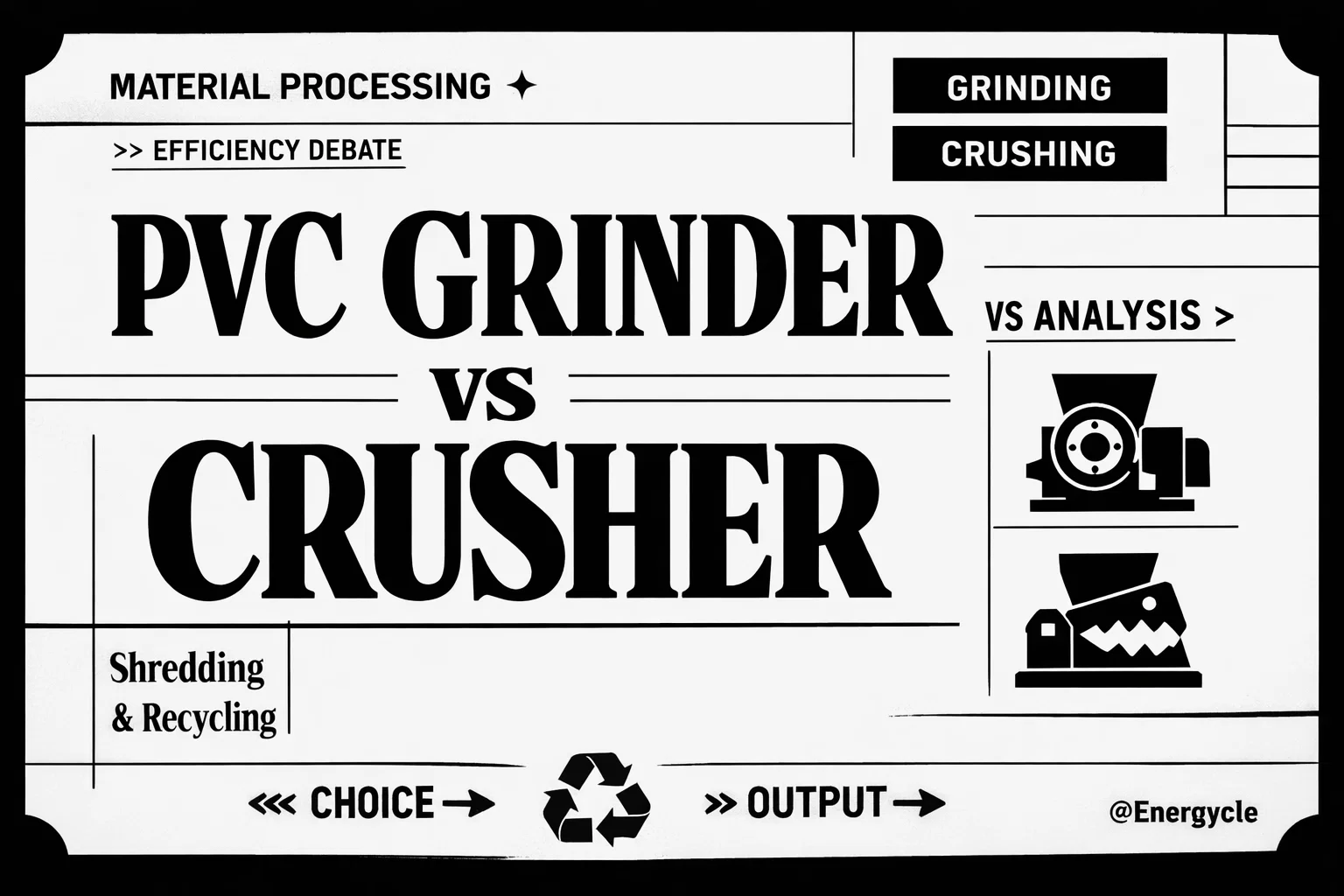
PVC grinding vs crushing determines the efficiency and output quality of plastic recycling and compounding lines. While operators often use these terms interchangeably, they represent two distinct mechanical processes applied sequentially. Crushing provides initial volume reduction for bulky waste, while grinding delivers precise, secondary size reduction to produce high-value, reusable powder. Energycle designs industrial size-reduction systems that integrate both stages to maintain material integrity and continuous throughput.
Selecting the correct process relies on incoming feedstock dimensions, required output particle size, and the thermal limitations of polyvinyl chloride. This guide details the mechanical differences, operating parameters, and equipment selection criteria for rigid PVC processing.
Primary Size Reduction: PVC Crushing
Operators deploy a PVC Crusher to break down large, rigid plastic items into coarse flakes or irregular chunks. This primary stage handles bulky waste directly, including long pipes, thick window profiles, rigid sheets, and manufacturing scrap.
Crushing machinery relies on heavy compression, impact forces, or high-speed rotary cutting knives. These mechanisms fracture the plastic rapidly until the pieces can pass through a sizing screen. The standard output range for crushed PVC falls between 5 mm and 20 mm.
Because crushing prioritizes volume reduction and uses intermittent cutting rather than sustained friction, it generates moderate heat and consumes less energy per ton. Facilities use crushers to prepare bulk materials for transport, compact factory waste, or pre-process scrap before it enters a fine milling system.
Secondary Size Reduction: PVC Grinding (Pulverizing)
PVC grinding, or pulverizing, takes the 5–20 mm coarse flakes generated by a crusher and reduces them into fine, uniform powder. An industrial PVC Grinder relies on continuous abrasion and friction generated by high-speed rotating discs, hammers, or mills to execute this secondary size reduction.
Grinders produce particle sizes between 0.1 mm and 0.5 mm, equivalent to a 30–80 mesh. Achieving this fine, uniform consistency is a strict prerequisite for downstream manufacturing. Compounders and manufacturers require 30–80 mesh powder to ensure rapid melting and proper blending with virgin PVC during re-extrusion or injection molding.
Unlike crushing, grinding generates extreme thermal loads due to high-speed friction. PVC is highly heat-sensitive; overheating causes the polymer to melt, degrade, or release corrosive hydrochloric acid (HCl) gas. Industrial PVC grinders require active water-cooling systems circulating through the mill housing and stationary discs to extract heat and protect the polymer’s molecular structure.
Technical Comparison Matrix
| Parameter | PVC Crushing | PVC Grinding (Pulverizing) |
|---|---|---|
| Target Input Material | Large, rigid items (pipes, window frames, sheets) | Pre-crushed coarse flakes (5–20 mm) |
| Working Principle | Compression, impact, or high-speed rotary knives | Abrasion and friction via rotating discs/mills |
| Output Size | 5 mm – 20 mm (Coarse flakes/chunks) | 0.1 mm – 0.5 mm (30–80 mesh powder) |
| Heat Generation | Moderate (Basic ambient air or water cooling) | High (Requires active water-cooling circuits) |
| Energy Consumption | Lower per ton (Fast volume reduction) | Higher per ton (Slower, precise reduction) |
| Primary Application | Initial volume reduction, transport prep | Preparation for re-extrusion, compounding |
Sequential Integration in Processing Lines
Industrial recycling operations rarely choose between these methods; they deploy them sequentially. Facilities feed raw, bulky PVC scrap into heavy-duty crushers to generate a consistent 5–20 mm regrind. This uniform coarse material then acts as a controlled, predictable feedstock for the pulverizer, preventing mechanical jams and motor overloads.
Moisture control between these stages is critical, particularly when recycling post-consumer waste that requires washing. Processing wet or damp material through a high-speed grinder causes severe powder agglomeration and instantly blinds the sizing screens. If your process includes wet granulation, passing the material through a centrifugal dewatering machine strips surface moisture from the flakes. This ensures a dry, continuous feed into the pulverizer chamber.
Equipment Selection and Maintenance Checks
Rigid PVC contains abrasive additives like calcium carbonate, which accelerates wear on cutting surfaces. Plant engineers must evaluate specific maintenance intervals and safety mechanisms when specifying equipment.
Prioritize the following operational criteria:
- Wear Part Replacement: Crusher rotary knives require frequent gap calibration and sharpening to maintain shear efficiency. Grinder discs or hammers require complete replacement or re-machining once throughput drops or motor amperage spikes.
- Thermal Monitoring: Grinding systems must feature automated temperature sensors linked to the feed system. The system must automatically reduce the feed auger speed if chamber temperatures approach PVC degradation thresholds.
- Dust Control: Generating 30–80 mesh powder creates airborne particulate hazards. Pulverizing lines require enclosed pneumatic conveying, high-velocity cyclone extraction, and pulse-jet baghouse filters to prevent combustible dust accumulation.
Frequently Asked Questions
Can I feed bulky PVC pipe directly into a grinding machine?
No. Grinding machines (pulverizers) require uniform, pre-sized feedstock measuring 5–20 mm. Feeding bulky items directly into a grinder will instantly jam the milling discs, trigger motor overload faults, and potentially shatter the internal components. You must process large rigid items through a primary crusher first.
Why does PVC grinding require higher energy consumption than crushing?
Grinding forces coarse plastic through a micro-gap between serrated discs, relying on sustained high-speed friction to achieve a 30–80 mesh powder. The continuous RPM required to generate this friction, combined with the power drawn by active water-cooling pumps and pneumatic conveying blowers, demands significantly higher motor amperage per ton processed compared to crushing.
How do I prevent PVC from degrading or melting during the grinding process?
You prevent thermal degradation by ensuring the grinder’s active water-cooling circuits operate at specified flow rates and temperatures. Industrial pulverizers circulate chilled water through the stationary disc housing and the bearing assemblies to extract friction heat. Additionally, automated feed systems must monitor chamber temperatures and slow the feed rate if heat approaches the polymer’s melting point.
