

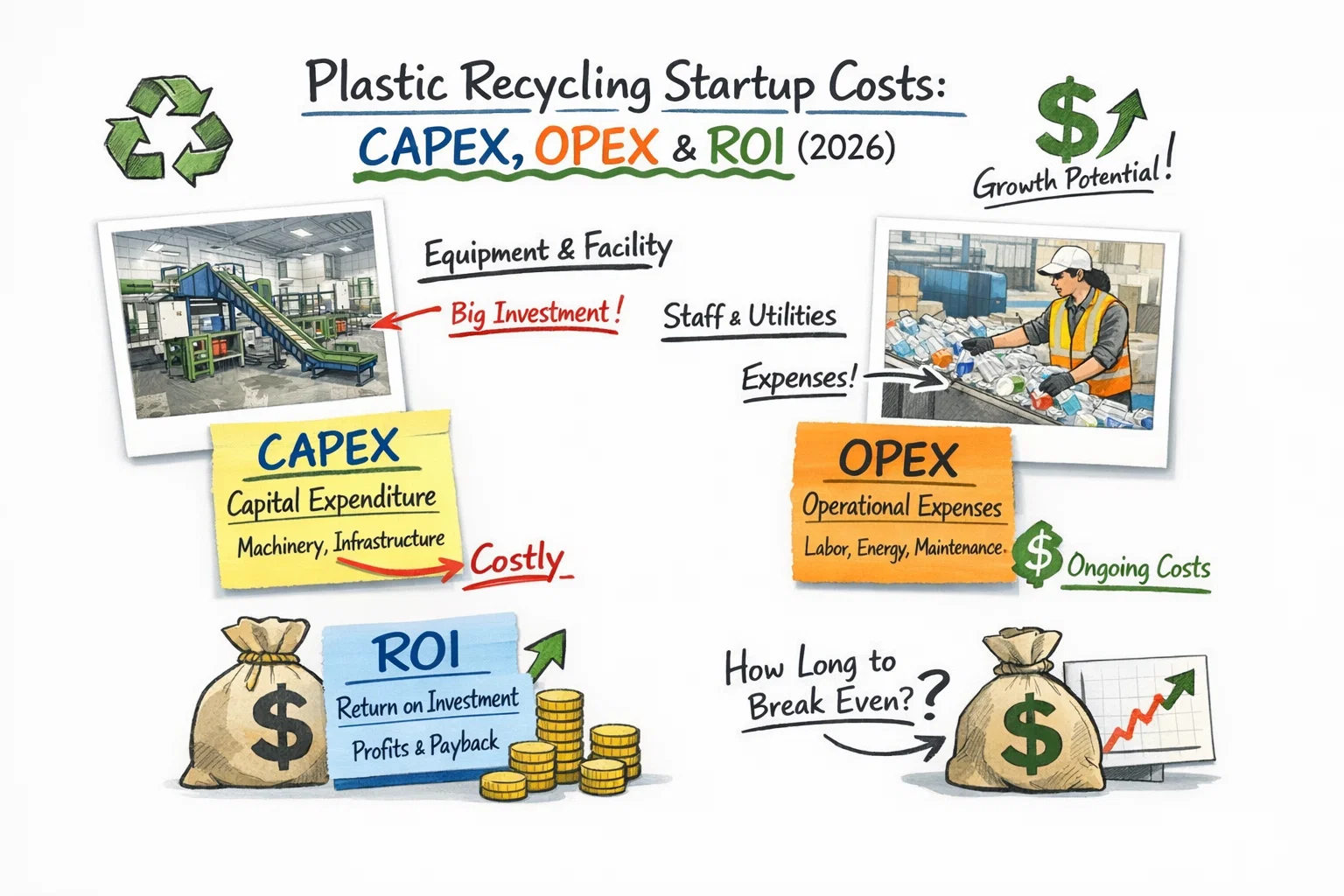
Plastic Recycling Startup Costs: CAPEX, OPEX and Break-Even
Plastic recycling startup cost cannot be reduced to a reliable global price range. The same nominal capacity can describe a dry granulation workshop, a washing line with wastewater treatment, or a complete pelletizing plant. A useful budget starts with a defined feed, saleable product, site, process boundary and acceptance test, then prices every capital and operating item with current local quotations.
Cost model at a glance
| Model section | What belongs in it | Common omission |
|---|---|---|
| Process equipment CAPEX | Sorting, size reduction, washing, separation, drying, pelletizing and controls | Ancillary conveyors, buffers, filters and rejects handling |
| Installed CAPEX | Freight, duty, unloading, foundations, erection, utilities and commissioning | Electrical distribution and water treatment |
| Development cost | Feed trials, engineering, permits, laboratory work and professional fees | Rent and payroll during approval and ramp-up |
| Working capital | Feed inventory, payroll, utilities, receivables and contingency | Cash tied up between buying waste and collecting sales |
| Fixed OPEX | Rent, core salaries, insurance, administration and financing | Costs incurred while the line is idle |
| Variable OPEX | Feed, transport, electricity, water, chemicals, wear parts and disposal | Rejects and quality failures |
| Revenue | Accepted dry output sold under documented buyer terms | Using input tonnes or headline market prices |
1. Define the project before asking what it costs
Write a one-page basis of design:
- polymer, product form, previous use and contamination;
- monthly feed that can be contracted through seasonal variation;
- required flake or pellet specification and named buyer type;
- target saleable dry output and planned shifts;
- site country, utilities, building and logistics;
- process boundary: sorting, shredding, washing, drying and/or pelletizing;
- permit, emissions, wastewater, fire and workplace requirements.
Without this scope, quotations will include different equipment and cannot be compared fairly.
2. Build process-equipment CAPEX by function
List every required process function rather than starting from a package price. A PET bottle line may need bale opening, bottle sorting and label removal. Agricultural film may need intensive prewashing and sand removal. Clean factory scrap may need only size reduction and extrusion.
For each item, record supplier, model, tested feed, capacity basis, included controls, materials of construction, motor list, guards, spares and warranty boundary. The separate plastic recycling machine price guide explains why capacity, automation and material condition change equipment quotations.
3. Convert equipment price into installed CAPEX
The machine invoice is not the plant cost. Add:
- packing, inland freight, port charges, ocean or air freight and insurance;
- customs classification, duty, taxes and broker fees;
- unloading, crane, storage and installation labour;
- foundations, platforms, drainage, guarding and building work;
- transformer, switchgear, cabling, power-factor or harmonic measures where required;
- water supply, recirculation, solids removal and wastewater treatment;
- compressed air, heating fuel, ventilation, dust or fume extraction;
- commissioning, performance tests and operator training.
Price these through local contractors against the supplier’s layout and load schedule. A generic percentage added to equipment cost can miss a major site constraint.
4. Budget environmental, health and safety systems
A recycling plant handles machinery, combustible material, dust or fumes, wastewater, chemicals and stored waste. Applicable controls depend on feed and jurisdiction. The IFC Environmental, Health and Safety Guidelines provide a reference framework, but local legal requirements take precedence.
Include environmental assessment, permits, sampling points, fire protection, machine guarding, hazardous-energy procedures, noise, ventilation, worker facilities, spill control and waste storage. Obtain advice before signing a building lease; the site may not support the planned activity.
5. Calculate working capital separately
Working capital funds operations before customer cash arrives. Model feed purchases, payroll, utilities, transport, consumables, laboratory tests and tax over the actual inventory and payment cycle. Include rejected loads and a commissioning period with lower output.
Do not assume that nameplate capacity is available from the first day. Operator training, feed variation, maintenance and buyer qualification can delay saleable production.
6. Model saleable dry output
Input throughput is not revenue. Labels, soil, moisture, incompatible plastic, fines and process rejects leave the line. Use representative trials to estimate saleable yield and operating availability:
Saleable output = dry input × saleable yield × operating availability
Define moisture on both input and output so that water does not inflate the mass. Use a conservative base case and show a lower-yield case.
7. Separate fixed and variable OPEX
| Fixed or step-fixed costs | Variable costs |
|---|---|
| Facility lease or depreciation | Purchased or collected feedstock |
| Core management and administration | Inbound and outbound transport |
| Insurance, licences and recurring professional fees | Electricity, fuel, water and process chemicals |
| Scheduled software, security and laboratory retainers | Knives, screens, filters, seals and other wear parts |
| Debt service or financing charges | Reject, sludge and wastewater disposal |
| Minimum staffing by shift pattern | Packaging and sales commissions where applicable |
Calculate unit cost per accepted dry tonne, not per input tonne. Include planned and unplanned downtime in annual production rather than spreading cost across theoretical capacity.
8. Use buyer-qualified revenue
Obtain written acceptance criteria, price basis, delivery term, payment timing and rejection procedure from more than one prospective buyer. A public spot price may describe a different colour, polymer, quality, volume or region.
Model flakes and pellets separately. Pelletizing can add filtration and consistency, but it also adds energy, maintenance and yield loss. A higher headline selling price does not guarantee a higher margin.
9. Calculate break-even without promising ROI
The U.S. Small Business Administration describes break-even units as fixed costs divided by selling price per unit minus variable cost per unit. For recycled plastic, use an accepted dry tonne as the unit:
Contribution per accepted tonne = net selling price − variable cost per accepted tonne
Break-even tonnes = period fixed costs ÷ contribution per accepted tonne
See the SBA’s business-planning and break-even guidance. Taxes, financing, depreciation and multiple products need local accounting treatment; use a qualified adviser for the financial model.
10. Stress-test the project
At minimum, test these adverse changes individually and together:
- less contracted feed;
- higher contamination and lower saleable yield;
- lower buyer price or rejected lots;
- higher electricity, transport or disposal cost;
- reduced availability or longer maintenance stops;
- permit or installation delay;
- longer customer payment time;
- currency movement on imported equipment and spares.
If the project fails when one plausible assumption changes, the headline payback estimate is not bankable.
Cost workbook structure
| Worksheet | Required columns |
|---|---|
| Assumptions | Source, date, base value, low case, high case and owner |
| CAPEX | Item, supplier, currency, tax, freight, installation and contingency |
| Mass balance | Wet input, dry input, rejects, saleable output and moisture |
| Utilities | Measured kWh, water and fuel per accepted tonne |
| OPEX | Fixed, variable, unit basis, escalation and payment timing |
| Revenue | Product grade, accepted tonnes, net price and receivable days |
| Cash flow | Monthly CAPEX, working capital, debt, tax and operating cash |
| Sensitivity | Yield, availability, price, feed cost, utility cost and delay |
Ways to reduce risk before reducing equipment scope
- Secure feed samples and trial data before ordering.
- Qualify the output with prospective buyers.
- Confirm land use, utilities, permits and wastewater at the site.
- Use a clear acceptance test and milestone-based payment terms.
- Phase the project only when each phase has its own saleable product.
- Keep working capital and contingency outside the equipment budget.
The plastic recycling business startup guide covers the wider sequence from feed sourcing to buyer development; this page focuses on the cost model.
Frequently asked questions
How much does it cost to start a plastic recycling plant?
There is no defensible global range without a defined process, site and output. Build a project budget from current equipment, installation, compliance, working-capital and operating quotations.
Which cost is most often missed?
Electrical and water infrastructure, wastewater, installation, rejected material and working capital are common omissions. The largest missing item depends on the site.
How should ROI be estimated?
Use saleable dry output, buyer-qualified net price, full variable and fixed costs, taxes and financing. Stress-test yield, availability, price, feed cost and delays; do not use a generic payback promise.
Request an equipment budget with an explicit boundary
Send Energycle the feed specification, required product, trial results, target saleable output, utility schedule and site country. A quotation for the appropriate plastic recycling solution should identify inclusions, exclusions, capacity basis and acceptance conditions so it can enter the broader project model correctly.
