

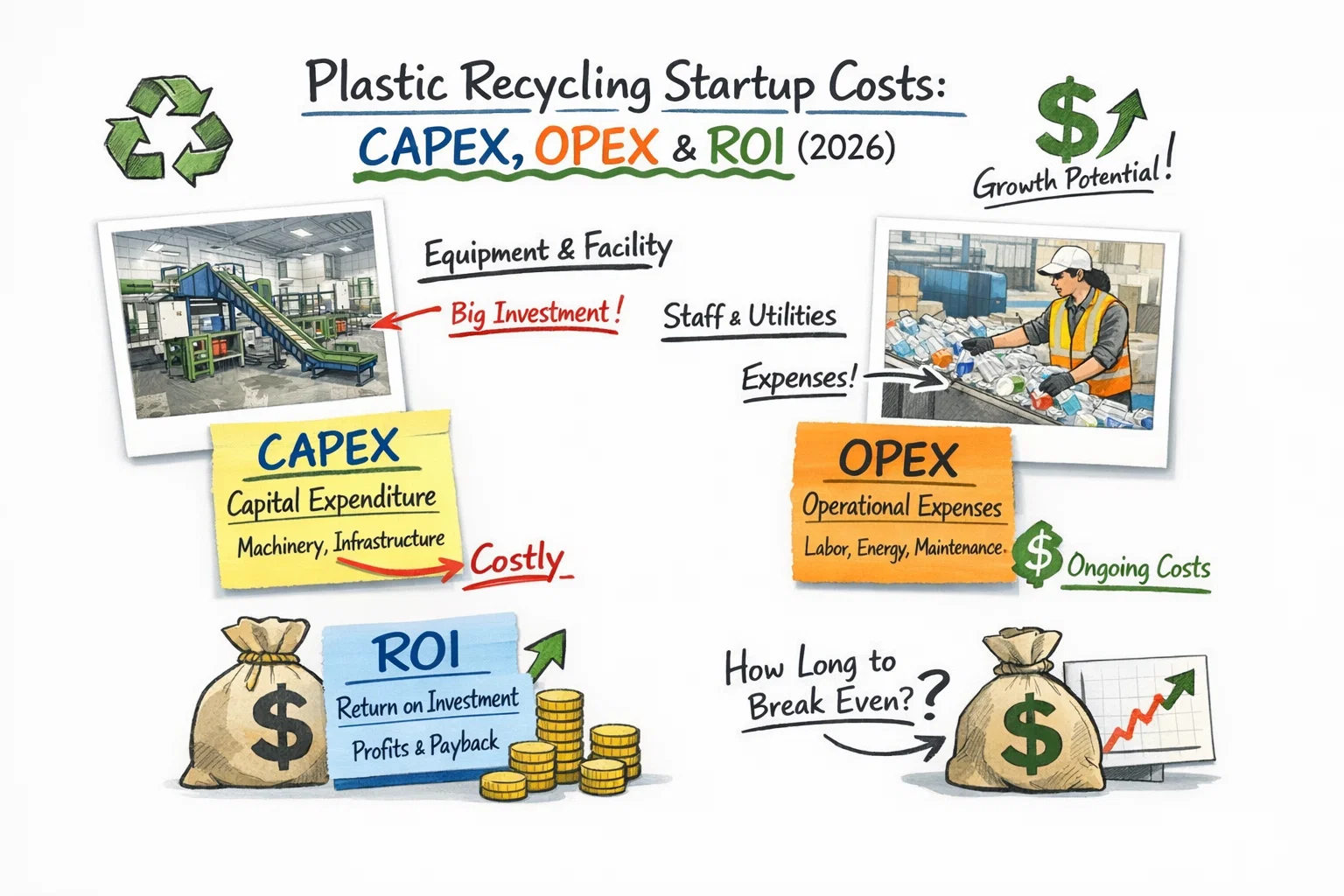
Coûts de lancement d'une entreprise de recyclage de plastique : CAPEX, OPEX et point de rentabilité
Le coût de démarrage d'une entreprise de recyclage de plastique ne peut pas être réduit à un prix mondial fiable. La même capacité nominale peut décrire une usine de granulation sèche, une ligne de lavage avec traitement des eaux usées ou une usine de granulation complète. Un budget utile commence par définir l'alimentation, le produit commercialisable, le site, les limites du processus et le test d'acceptation, puis évalue chaque poste de capital et d'exploitation avec des devis locaux actuels.
Modèle de coût à vue d'ensemble
| Section du modèle | Ce qui doit y figurer | Omission courante |
|---|---|---|
| Capex pour l'équipement de processus | Tri, réduction de taille, lavage, séparation, séchage, granulation et contrôle | Convoirs accessoires, tampons, filtres et traitement des rejets |
| Capex installé | Frais de transport, droits, déchargement, fondations, montage, services publics et mise en service | Distribution électrique et traitement de l'eau |
| Coûts de développement | Essais d'alimentation, ingénierie, permis, travail de laboratoire et frais professionnels | Loyer et salaires pendant l'approbation et le lancement |
| fonds de roulement | Inventaire d'alimentation, salaires, services publics, créances et prévisions | Argent bloqué entre l'achat de déchets et la collecte des ventes |
| Coûts fixes d'exploitation | Loyer, salaires de base, assurance, administration et financement | Coûts engagés pendant que la ligne est inutilisable |
| Coûts variables d'exploitation | Alimentation, transport, électricité, eau, produits chimiques, pièces usées et élimination | Rejets et échecs de qualité |
| Revenu | Sortie sèche acceptée vendue sous les termes du client documenté | Utilisation de tonnes d'entrée ou de prix du marché |
1. Définir le projet avant de demander ce que cela coûte
Écrire une page de base de conception :
- polymère, forme de produit, utilisation précédente et contamination ;
- alimentation mensuelle qui peut être contractée à travers les variations saisonnières ;
- spécification de paillette ou de granulé requise et type d'acheteur nommé ;
- sortie sèche commercialisable cible et shifts prévus ;
- pays du site, services publics, bâtiment et logistique ;
- process boundary: sorting, shredding, washing, drying and/or pelletizing;
- permit, emissions, wastewater, fire and workplace requirements.
Sans cette portée, les devis incluront des équipements différents et ne pourront pas être comparés de manière équitable.
2. Build process-equipment CAPEX by function
Listez chaque fonction de processus nécessaire plutôt que de commencer à partir d'un prix d'ensemble. Une ligne de bouteilles en PET peut nécessiter l'ouverture des balles, le tri des bouteilles et le retrait des étiquettes. Les films agricoles peuvent nécessiter un lavage préalable intensif et l'élimination du sable. Les déchets de fabrication propres peuvent nécessiter uniquement la réduction de taille et l'extrusion.
Pour chaque article, enregistrez le fournisseur, le modèle, le aliment en test, la capacité de base, les contrôles inclus, les matériaux de construction, la liste des moteurs, les gardes, les pièces de rechange et les limites de la garantie. Le guide des prix des machines de recyclage du plastique explique pourquoi la capacité, l'automatisation et l'état du matériau changent les devis d'équipements.
3. Convertir le prix de l'équipement en CAPEX installé
La facture de la machine n'est pas le coût de l'usine. Ajouter :
- packing, inland freight, port charges, ocean or air freight and insurance;
- customs classification, duty, taxes and broker fees;
- unloading, crane, storage and installation labour;
- foundations, platforms, drainage, guarding and building work;
- transformateur, équipement de commutation, câblage, mesures de facteur de puissance ou harmoniques où nécessaire ;
- water supply, recirculation, solids removal and wastewater treatment;
- compressed air, heating fuel, ventilation, dust or fume extraction;
- commissioning, performance tests and operator training.
Price these through local contractors against the supplier’s layout and load schedule. A generic percentage added to equipment cost can miss a major site constraint.
4. Budget environmental, health and safety systems
Une usine de recyclage de plastique gère des machines, des matériaux combustibles, de la poussière ou des fumées, des eaux usées, des produits chimiques et des déchets stockés. Les contrôles applicables dépendent de l'alimentation et de la juridiction. La IFC Directives environnementales, sanitaires et de sécurité fournir un cadre de référence, mais les exigences juridiques locales ont la priorité.
Inclure l'évaluation environnementale, les permis, les points de prélèvement d'échantillons, la protection contre l'incendie, la protection des machines, les procédures de gestion de l'énergie dangereuse, le bruit, la ventilation, les installations pour les travailleurs, le contrôle des fuites et le stockage des déchets. Obtenir des conseils avant de signer un bail de construction ; le site peut ne pas soutenir l'activité prévue.
5. Calculer séparément le capital de travail
Le capital de travail finance les opérations avant l'arrivée du cash des clients. Modéliser les achats de matière première, la paie, les services publics, le transport, les consommables, les tests de laboratoire et les impôts sur le stock réel et le cycle de paiement. Inclure les chargements rejetés et une période de mise en service avec une production réduite.
Ne pas supposer que la capacité indiquée sur l'étiquette est disponible dès le premier jour. La formation des opérateurs, les variations de la matière première, l'entretien et la qualification de l'acheteur peuvent retarder la production vendable.
6. Modéliser la production sèche vendable
Le débit d'entrée n'est pas un revenu. Étiquettes, terre, humidité, plastique incompatibles, particules fines et rejets de processus quittent la ligne. Utilisez des essais représentatifs pour estimer le rendement commercializable et la disponibilité opérationnelle :
Sortie commercializable = entrée sèche × rendement commercializable × disponibilité opérationnelle
Définissez l'humidité à la fois à l'entrée et à la sortie afin que l'eau ne gonfle pas la masse. Utilisez un cas de base conservateur et montrez un cas de rendement inférieur.
7. Séparez les coûts fixes et variables d'OPEX
| Coûts fixes ou variables en étapes | Coûts variables |
|---|---|
| Loyer du site ou amortissement | Matières premières achetées ou collectées |
| Gestion et administration centrale | Transport entrant et sortant |
| Assurance, licences et frais professionnels récurrents | Électricité, carburant, eau et produits chimiques de processus |
| Logiciels planifiés, mesures de sécurité et conservateurs de laboratoire | Couteaux, écrans, filtres, joints et autres pièces d'usure |
| Service de la dette ou frais de financement | Élimination des rejets, des boues et des eaux usées |
| Effectif minimum par schéma de quart | Emballage et commissions de vente le cas échéant |
Calculez le coût unitaire par tonne sèche acceptée, non par tonne d'entrée. Incluez les arrêts programmés et imprévus dans la production annuelle plutôt que de répartir les coûts sur la capacité théorique.
8. Utilisez le revenu qualifié par l'acheteur
Obtenez des critères d'acceptation écrits, le prix de base, le délai de livraison, le délai de paiement et la procédure de rejet de plus d'un acheteur potentiel. Un prix spot public peut décrire une couleur, un polymère, une qualité, un volume ou une région différente.
Modélisez les paillettes et les granulés séparément. La granulation peut ajouter la filtration et la cohérence, mais elle ajoute également de l'énergie, l'entretien et une perte de rendement. Un prix de vente au détail plus élevé ne garantit pas une marge plus élevée.
9. Calculez le point de seuil sans promettre un ROI
La Small Business Administration américaine décrit les unités de seuil de rentabilité comme des coûts fixes divisés par le prix de vente par unité moins le coût variable par unité. Pour le plastique recyclé, utilisez une tonne sèche acceptée comme unité :
Contribution par tonne acceptée = prix de vente net − coût variable par tonne acceptée
Tonnes seuil de rentabilité = coûts fixes de la période ÷ contribution par tonne acceptée
Voir les directives de planification d'entreprise et seuil de rentabilité de la SBA. Les impôts, le financement, l'amortissement et les produits multiples nécessitent un traitement comptable local ; utilisez un conseiller qualifié pour le modèle financier.
10. Testez la résistance du projet
Au minimum, testez ces changements négatifs individuellement et ensemble :
- alimentation moins contractée ;
- contamination accrue et rendement commercial inférieur ;
- prix d'achat inférieur ou lots rejetés ;
- coût d'électricité, de transport ou de traitement plus élevé ;
- disponibilité réduite ou arrêts de maintenance plus longs ;
- retard de permis ou d'installation ;
- délai de paiement client plus long ;
- mouvement de devise sur l'équipement importé et les pièces de rechange.
Si le projet échoue lorsque l'une des hypothèses plausibles change, l'estimation de remboursement initial n'est pas bancaire.
Structure du cahier des coûts
| Feuille de calcul | Colonnes requises |
|---|---|
| Hypothèses | Source, date, valeur de base, cas bas, cas haut et propriétaire |
| CAPEX | Article, fournisseur, devise, taxe, fret, installation et imprévu |
| Équilibre massique | Entrée humide, entrée sèche, rejets, sortie vendable et humidité |
| Consommations d'énergie | kWh mesurés, eau et carburant par tonne acceptée |
| Coûts opérationnels (OPEX) | Fixe, variable, base unitaire, indexation et délais de paiement |
| Revenu | Grade du produit, tonnes acceptées, prix net et jours de recouvrement |
| Flux de trésorerie | Coût CAPEX mensuel, fonds de roulement, dette, impôts et trésorerie opérationnelle |
| Sensibilité | Rendement, disponibilité, prix, coût des matières premières, coût des services publics et délai |
Méthodes pour réduire les risques avant de réduire la portée de l'équipement
- Sécurisez les échantillons d'alimentation et les données d'essai avant de passer commande.
- Qualifiez la sortie avec les acheteurs potentiels.
- Confirmez l'utilisation du terrain, les services publics, les permis et l'évacuation des eaux usées sur le site.
- Utilisez un test d'acceptation clair et des conditions de paiement basées sur des jalons.
- Étendez le projet uniquement lorsque chaque phase possède son propre produit commercializable.
- Maintenez le capital de travail et la trésorerie de secours en dehors du budget d'équipement.
Le guide de lancement d'entreprise de recyclage des plastiques couvre la séquence plus large allant de la sourcing des matières premières à la développement des acheteurs ; cette page se concentre sur le modèle de coût.
Questions fréquemment posées
Combien coûte la création d'une usine de recyclage de plastique ?
Il n'existe pas de gamme mondiale défendable sans un processus, un site et une production définis. Établissez un budget de projet à partir des équipements actuels, de l'installation, de la conformité, des devis de trésorerie et d'exploitation.
Quelle est la dépense la plus souvent oubliée ?
Les infrastructures électriques et hydrauliques, les eaux usées, les installations, les matériaux rejetés et le capital de travail sont des omissions communes. L'élément manquant le plus important dépend du site.
Comment estimer le retour sur investissement ?
Utilisez une production sèche vendable, un prix net qualifié par l'acheteur, tous les coûts variables et fixes, les taxes et le financement. Testez la rentabilité, la disponibilité, le prix, le coût des matières premières et les délais ; n'utilisez pas une promesse de remboursement générique.
Demandez un budget d'équipement avec une limite explicite
Envoyez à Energycle la spécification d'alimentation, le produit requis, les résultats de l'essai, la production cible vendable, le calendrier des services publics et le pays du site. Une offre pour le matériel approprié solution de recyclage du plastique doit identifier les éléments inclus, exclus, la base de capacité et les conditions d'acceptation afin qu'il puisse entrer correctement dans le modèle de projet plus large.
