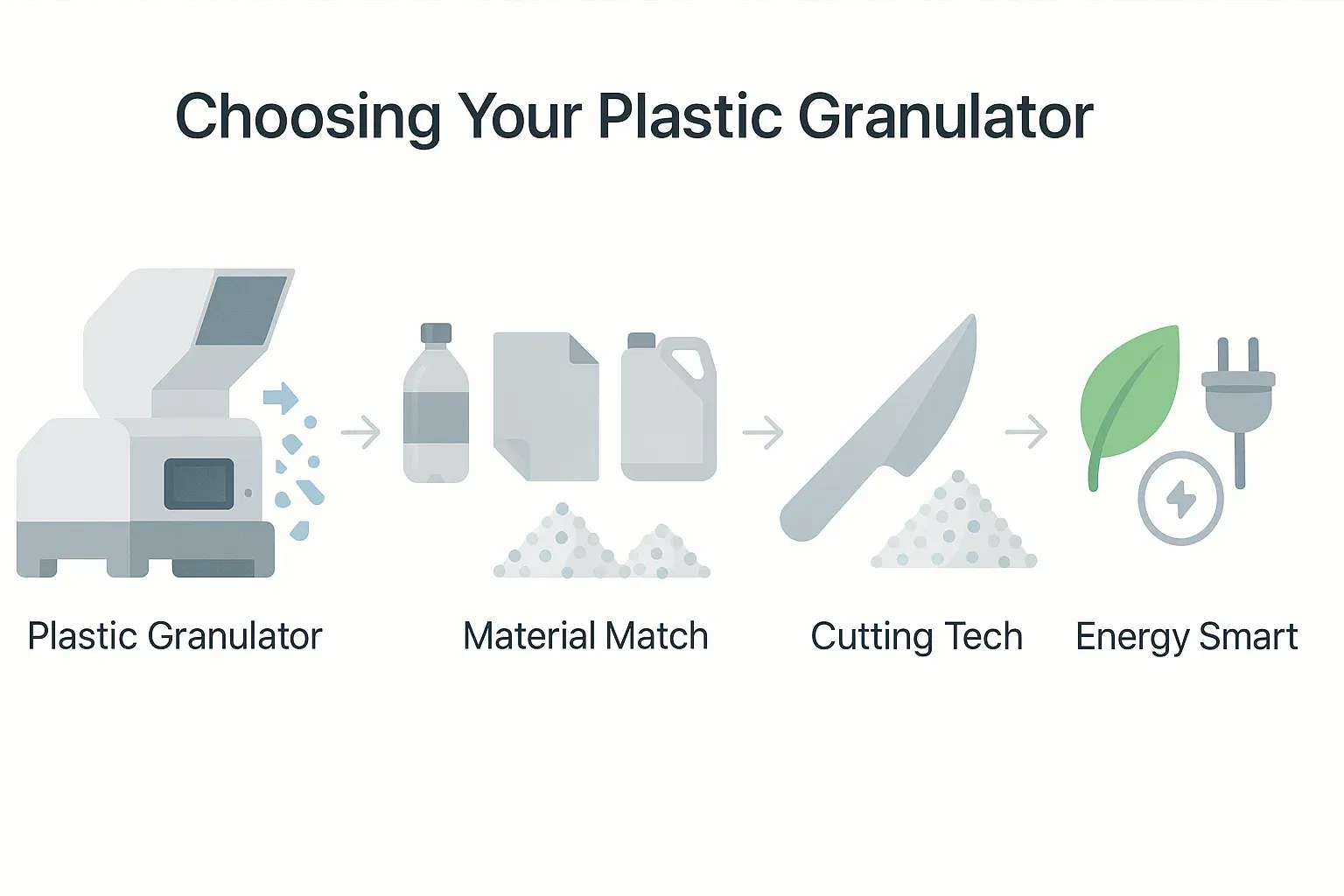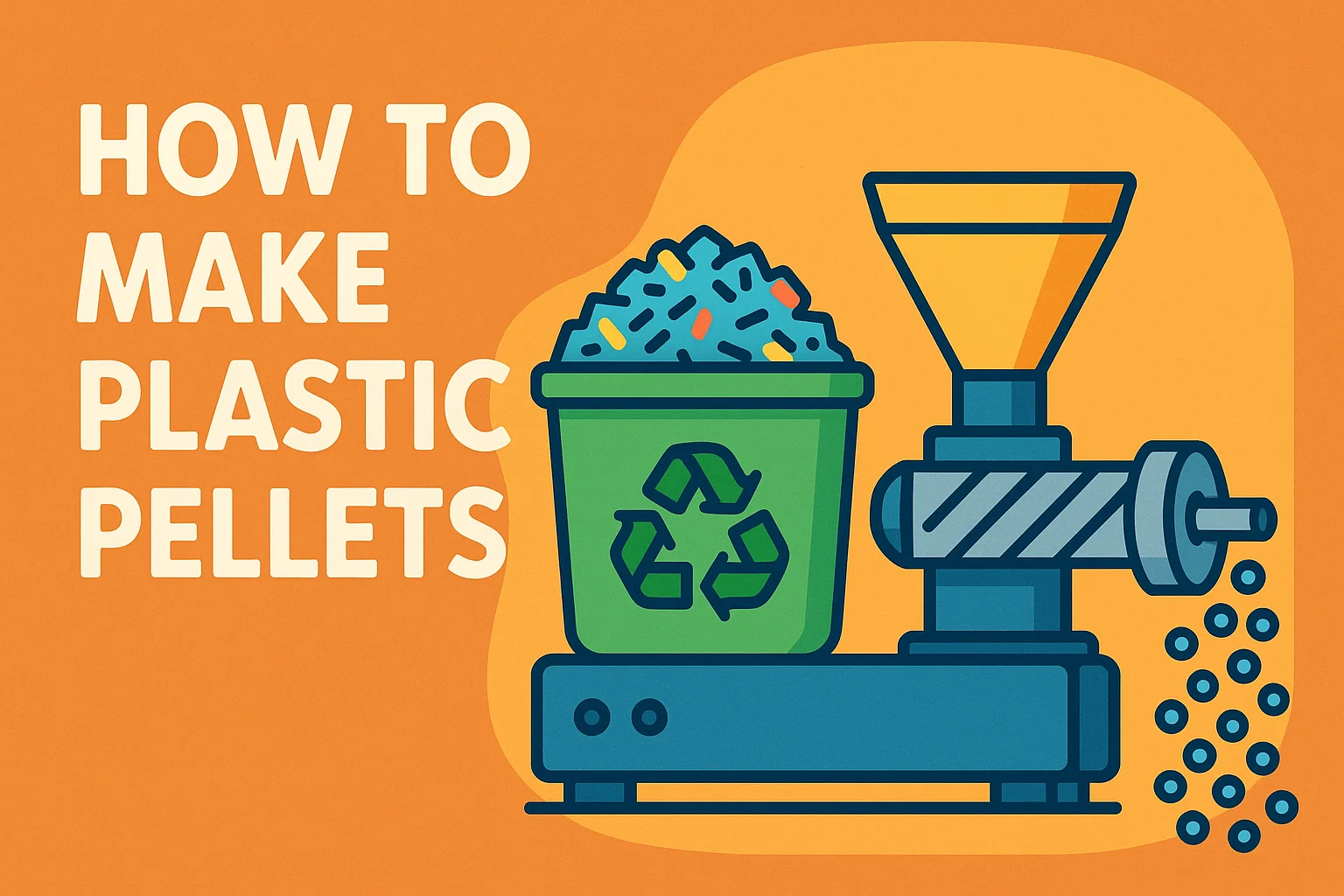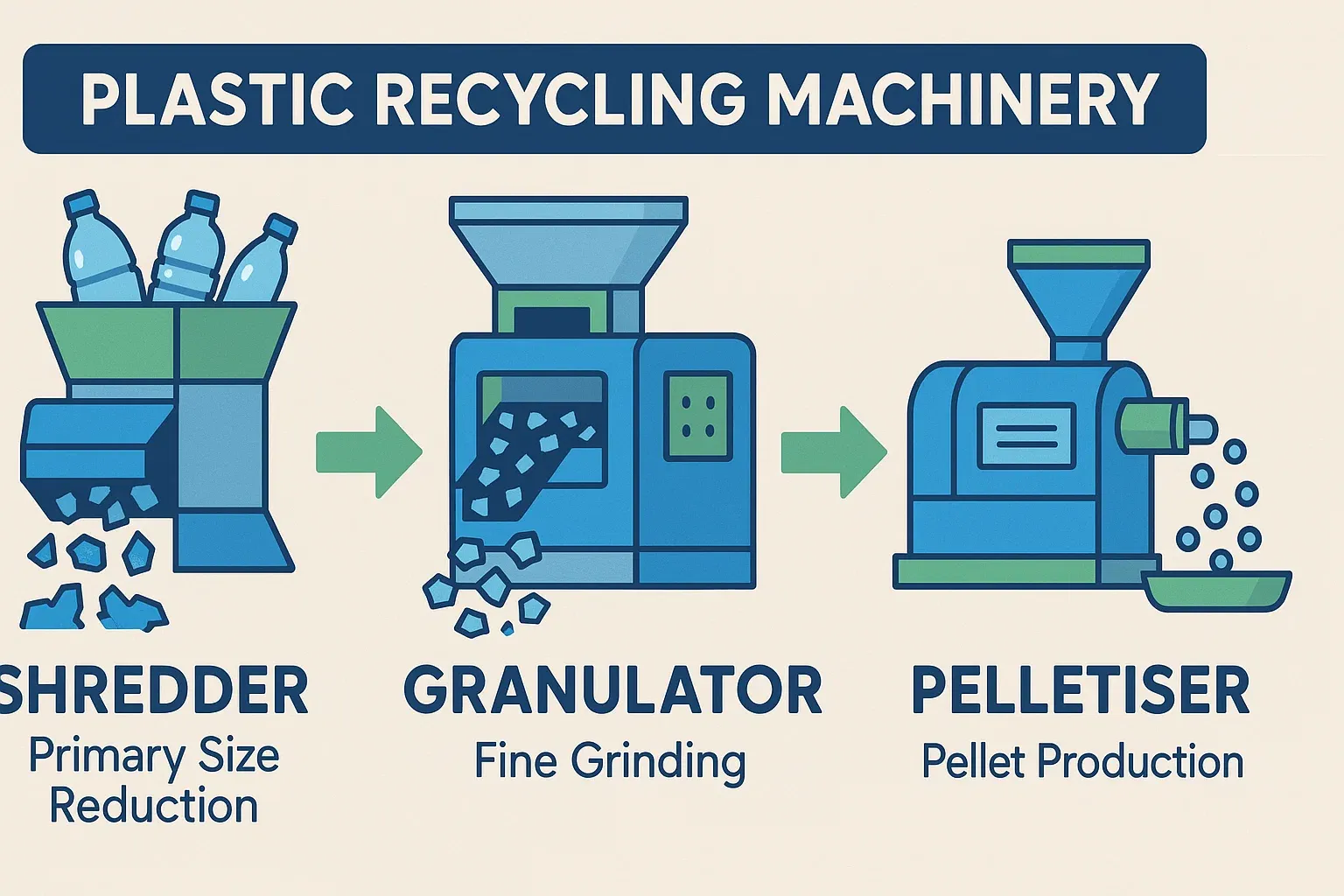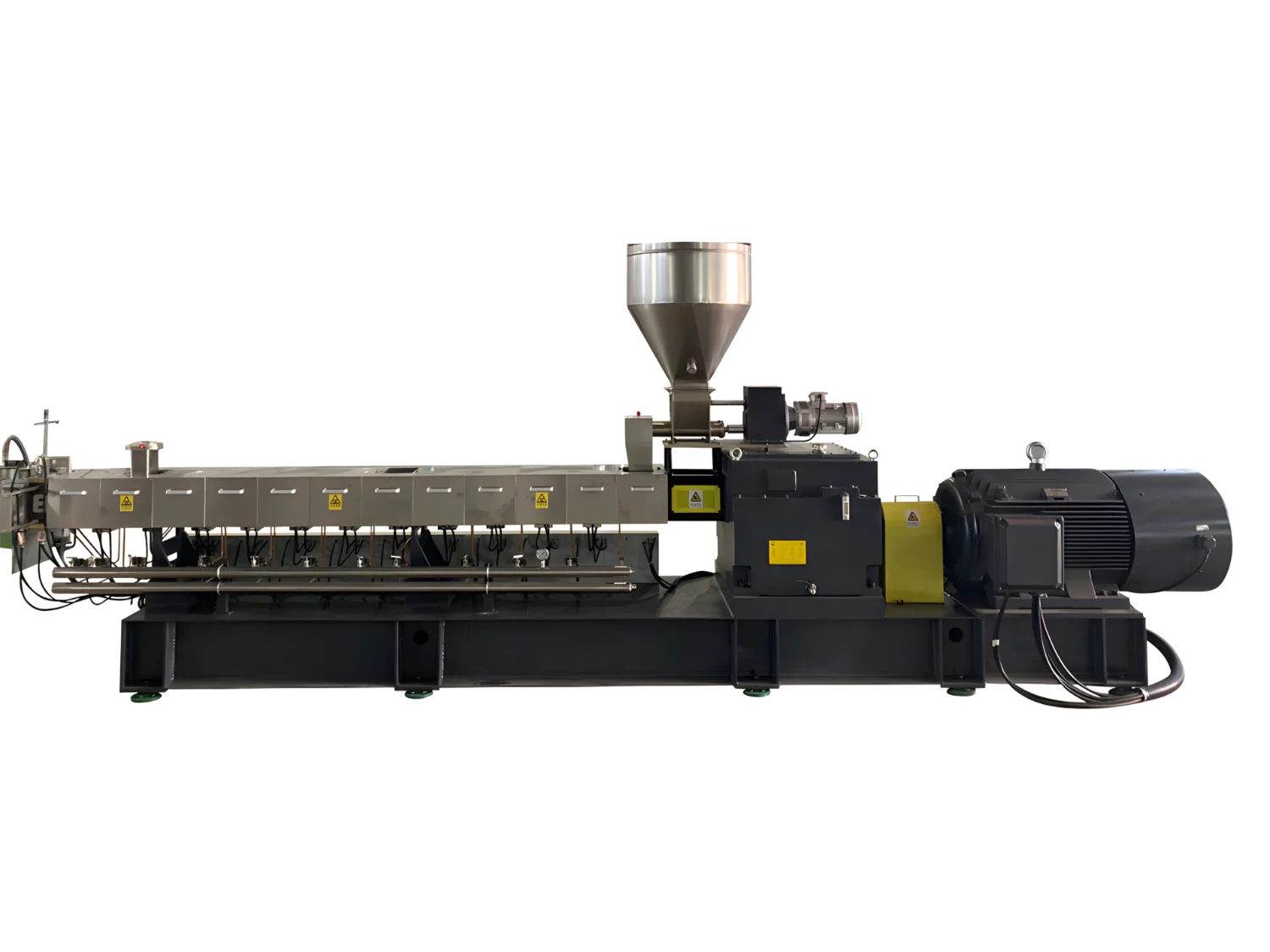
A Machine voor het pelletiseren van kunststof Het smelt versnipperd, gewassen of verdicht plastic afval en vormt het om tot uniforme pellets – de standaard grondstofvorm die spuitgieters, extruders en folieblazers kopen en verwerken. Pelletiseren is de laatste waardetoevoegende stap in plasticrecycling: het zet laagwaardige vlokken of vermalen plastic om in marktklare pellets met een waarde van 1.400 tot 1.200 euro per ton, afhankelijk van het polymeertype en de kwaliteit. Deze gids behandelt elk type pelletiseermachine, de daadwerkelijke specificaties, de afstemming van materiaal op machine, de selectie van het snijsysteem en een kader voor het specificeren van de juiste pelletiseerlijn voor uw bedrijf.
Wat is een kunststofgranuleermachine?
Een kunststofgranuleermachine (ook wel pelletiseermachine of granuleer-extruder genoemd) smelt kunststofmateriaal door middel van een verwarmd schroef- en cilindersysteem, filtert verontreinigingen eruit met een zeefwisselaar en perst vervolgens de gesmolten massa door een matrijsplaat waar een snijsysteem het in cilindrische of bolvormige korrels met een diameter van 2-5 mm snijdt. De korrels worden gekoeld (met water of lucht), gedroogd en verzameld in zakken of silo's. Leer de basisprincipes in onze handleiding: Wat is een kunststofpelletiseermachine en hoe werkt deze?
Belangrijke onderdelen van elke pelletiseerlijn:
- Voedingssysteem — een aandruk-, verdichtings- of snijcompactor die het materiaal verdicht en in de extruder voert.
- Extruder — een cilinder met één of twee schroeven die het plastic smelt, homogeniseert en onder druk zet
- Schermwisselaar — hydraulisch of handmatig filter dat verontreinigingen (papier, metaal, vuil) uit het smeltbad verwijdert
- Matrijsplaat — geperforeerde plaat die het gesmolten materiaal in strengen of direct in korrels vormt
- Snijsysteem — strengsnijder, waterringsnijder of onderwaterpelletiseermachine die de uiteindelijke pelletvorm creëert
- Koelen en drogen — een waterbad, luchtkoeling of centrifugaaldroger die de korrels stolt en droogt.
Soorten machines voor het pelletiseren van kunststof
Pelletiseermachine met één schroef
Het meest voorkomende type voor recyclingtoepassingen. Een enkele roterende schroef in een verwarmde trommel smelt en transporteert het plastic naar voren. Eenvoudig, betrouwbaar en goedkoper dan systemen met dubbele schroef. Het meest geschikt voor schone, voorgesorteerde grondstoffen (PE, PP, PET-vlokken, PS). Doorvoer: 100–1.500 kg/u. Zie onze enkelschroefs pelletiseermachine bereik.
Dubbelschroefs pelletiseermachine
Twee meedraaiende of tegengesteld draaiende schroeven zorgen voor een superieure menging, ontluchting en ontgassing. Vereist voor materialen die intensief gemengd moeten worden (kleurconcentraten, gevulde kunststoffen, technische kunststoffen) of die een hoog vocht- of vluchtig gehalte bevatten. Hogere kosten (1,5–2,5× ten opzichte van een enkele schroef), maar levert een betere pelletkwaliteit voor veeleisende toepassingen. Doorvoer: 200–3.000 kg/u.
Snijmachine Verdichter Pelletiseermachine
Integreert een snelle snij- en verdichter (agglomerator) direct vóór de extruder. De snij- en verdichter versnippert, verdicht en verwarmt folie, vezels en lichte materialen voor door wrijving, waarna deze direct in de extrudercilinder worden gevoerd. Dit elimineert de noodzaak voor een aparte agglomerator of verdichter, wat vloeroppervlak en energie bespaart. Ideaal voor PE/PP-folie, geweven zakken, non-woven textiel en raffia. Bekijk onze snijverdichter pelletiseerlijn.
Tweetraps pelletiseermachine
Deze machine maakt gebruik van twee extruders in serie: de eerste smelt en filtert, de tweede homogeniseert en bouwt druk op voor het pelletiseren. Het tweetrapsontwerp zorgt voor extra smeltfiltratie, betere ontgassing (twee ontluchtingszones) en een consistentere smeltkwaliteit. Het meest geschikt voor folie met veel opdruk, gemengd plastic van consumentenafval en materialen met een hoge mate van verontreiniging. Hogere investering, maar levert pellets van topkwaliteit op.
Vergelijking van pelletiseermachinetypen
| Type | Doorvoer | Motorvermogen | Beste voor | Relatieve kosten |
|---|---|---|---|---|
| Enkelvoudige schroef | 100–1.500 kg/u | 22–250 kW | Reinig PE/PP/PET-vlokken, vermalen | 1× (basislijn) |
| Dubbele schroef | 200–3.000 kg/u | 37–400 kW | Samenstellen, technische kunststoffen, hoge vochtigheid | 1,5–2,5× |
| Snijverdichtingsmachine | 200–1.500 kg/u | 55–300 kW | PE/PP-folie, geweven zakken, non-woven, raffia | 1,2–1,8× |
| Tweetraps | 300–2.000 kg/u | 75–400 kW | Bedrukte folie, gerecycled materiaal, hoge mate van verontreiniging | 1,5–2,0× |
Snijsystemen: Strand vs. Waterring vs. Onderwater
Het snijsysteem bepaalt de vorm, kwaliteit en doorvoer van de pellets. De keuze voor het juiste systeem hangt af van het type polymeer, de gewenste pelletgeometrie en de productiesnelheid. Voor een gedetailleerde vergelijking, zie strengvorming versus onderwaterpelletisering voor rPET.
| Snijinstallatie | Pelletvorm | Beste voor | Doorvoerbereik | Voordelen | Nadelen |
|---|---|---|---|---|---|
| Draden doorsnijden | Cilindrisch | PE, PP, PET, PS — het meest gerecyclede materiaal. | 100–1.500 kg/u | Eenvoudig, voordelig en gemakkelijk te onderhouden. | Draadbreuk bij materialen met een lage smeltsterkte |
| Waterringsnijden | Halfrond | PE, PP — met name folierecycling | 200–1.500 kg/u | Compact, geen gedoe met losse strengen, consistente korrels. | Niet ideaal voor materialen met een hoge smeltstroom. |
| Onderwater (UWP) | Bolvormig | PET, PA, TPE, technische kunststoffen | 500–5.000+ kg/u | Perfecte korrelvorm, hoge snelheid, stofvrij | Duur, complex, vereist meer onderhoud |
Bekijk onze waterring pelletiseersysteem voor toepassingen met geweven PP/PE-zakken.
Materiaal-pelletiseermachine-matching
Verschillende soorten kunststoffen vereisen verschillende extruderconfiguraties, temperaturen en snijsystemen. Hier is onze aanbeveling op basis van meer dan 500 installaties:
| Materiaal | Aanbevolen pelletiseermachine | Snijinstallatie | Kernpunten |
|---|---|---|---|
| PE-film (LDPE/LLDPE) | Snijverdichter + enkelvoudige schroef | Waterkring of -streng | Folie moet worden verdicht; een snij- en verdichtmachine is hiervoor ideaal. Zie PE/PP-foliegranulator |
| PP geweven tassen / raffia | Snijverdichter + enkelvoudige schroef | Waterring | Grote bulk — verdichting essentieel vóór extrusie |
| PET-flesvlokken | Enkelschroefs (met kristallisator/droger) | Strand of onder water | Moet drogen tot <50 ppm moisture; iv loss control critical. see PET-pelletiseermachine |
| Stijf HDPE/PP (kratten, vaten) | Enkelvoudige schroef | Streng | Gemakkelijk te pelletiseren; een doseerapparaat is voldoende. Zie stijve PP/HDPE-pelletiseermachine |
| Vliesstof / Meltblown | Snijverdichter + enkelvoudige schroef | Waterring | Ultralicht materiaal vereist een agressieve verdichting. Zie non-woven pelletiseerlijn |
| PA / Nylon | Dubbele schroef (met vacuümontluchting) | Onder water of strand | Hygroscopisch — vereist drogen en vacuümontgassing. |
| Gemengd post-consumer afval | Tweetraps | Strand of waterkring | Bij hoge verontreiniging is dubbele filtratie + ontgassing vereist. |
Voor gedetailleerde informatie over materiaalcompatibiliteit, lees verder. Welke soorten kunststoffen kunnen met een pelletiseermachine worden verwerkt?.
Specificaties van de pelletiseermachine (referentie)
Representatieve specificaties uit het assortiment enkelschroefs pelletiseermachines van Energycle:
| Model | Schroefdiameter | L/D-verhouding | Doorvoer | Motorvermogen | Typische toepassing |
|---|---|---|---|---|---|
| SJ-65 | Ø65 mm | 28:1–33:1 | 80–150 kg/u | 22–37 kW | Kleinschalig, stijf hervermalen |
| SJ-85 | Ø85 mm | 28:1–33:1 | 150–300 kg/u | 37–55 kW | PE/PP-folie, geweven zakken |
| SJ-100 | Ø100 mm | 28:1–33:1 | 250–500 kg/u | 55–90 kW | Middelgrote recyclinglijnen |
| SJ-120 | Ø120 mm | 28:1–33:1 | 400–800 kg/u | 90–132 kW | Recycling op grote schaal |
| SJ-150 | Ø150 mm | 28:1–33:1 | 600–1200 kg/u | 132–200 kW | Grote industriële lijnen |
| SJ-180 | Ø180 mm | 28:1–33:1 | 800–1.500 kg/u | 200–250 kW | Maximale doorvoer |
Bezoek onze productpagina voor kunststofgranulator Voor volledige specificaties en configuratieopties. Voor prijsinformatie, zie kostenfactoren van kunststofgranuleermachines En Vergelijking tussen budget- en high-end pelletiseermachines.
5-Step Selection Framework
Stap 1: Definieer het invoermateriaal
Identificeer het polymeertype (PE, PP, PET, PS, PA, enz.), de vorm (folie, vlokken, gerecycled materiaal, vezels), de mate van vervuiling (schoon in eigen beheer versus vervuild na gebruik) en het vochtgehalte. Dit bepaalt het type extruder, het aantal extrusietrappen en of een snijverdichter of voordroger nodig is.
Stap 2: Stel de doorvoerdoelstelling in
Bereken de benodigde pelletproductie in kg/u. Stem de output van de was-/drooglijn stroomopwaarts af op de capaciteit van de pelletiseermachine. Dimensioneer de pelletiseermachine altijd 20–301 TP7T boven uw huidige doorvoercapaciteit voor piekcapaciteit en toekomstige groei. Het laten draaien van een pelletiseermachine op 801 TP7T van de nominale capaciteit verlengt de levensduur van de schroef en de cilinder aanzienlijk.
Stap 3: Kies het snijsysteem
Strengesnijden voor eenvoud en de meeste recyclingtoepassingen. Waterring voor folierecyclers die compacte, consistente pellets willen. Onderwatersnijden voor PET, technische kunststoffen en hogesnelheidsproductie waarbij de pelletvorm belangrijk is voor de eindklant.
Stap 4: Specificeer de pelletkwaliteit
Definieer de gewenste korrelgrootte (doorgaans 3-4 mm) en het acceptabele vochtgehalte (<0,5% voor de meeste toepassingen, <50 ppm voor PET), eisen aan kleurconsistentie en maximale verontreinigingsniveaus. Deze specificaties bepalen de maaswijdte van de zeefwisselaar, het aantal filtratiestappen en het ontwerp van het koel-/droogsysteem.
Stap 5: Bereken ROI
Pellets worden verkocht voor $400–$1.200 per ton, afhankelijk van het polymeer en de kwaliteit – 2–5 keer de waarde van gewassen vlokken. Een pelletiseermachine met een capaciteit van 500 kg/u, die 8 uur per dag en 300 dagen per jaar draait, produceert 1.200 ton per jaar. Met een marge van $200 per ton boven de waarde van de vlokken, is dat een brutowinstmarge van $240.000 per jaar op een machine-investering van $80.000–$200.000 – terugverdientijd van 6–12 maanden.
Essentiële onderhoudsbehoeften
- DagelijksControleer de matrijsplaat op verstopte gaten; reinig de zeefwisselaar; controleer de watertemperatuur in het koelsysteem.
- WekelijksControleer het aanhaalmoment van de schroef en de stroomsterkte van de motor (een stijgende stroomsterkte duidt op slijtage van de cilinder); inspecteer de messen van de pelletsnijder.
- Maandelijks: Smeer de versnellingsbak; controleer de werking van de verwarmingselementen in elke zone; inspecteer de afdichtingen van de schermwisselaar.
- Elke 2000-4000 uur: Controleer de slijtage van de schroef en de cilinder (vervang deze wanneer de speling meer dan 0,5 mm per zijde bedraagt)
- JaarlijksVolledige inspectie van schroef, cilinder, matrijsplaat, versnellingsbak en elektrische systemen.
Voor complete onderhoudsprogramma's kunt u terecht op onze website. Checklist voor onderhoud van de pelletiseermachine En handleiding voor pelletiseermethoden.
Inleiding tot de Energycle
Energycle vervaardigt kunststofkorrelmachines Van laboratoriumunits met een capaciteit van 80 kg/u tot productielijnen met een capaciteit van 1.500 kg/u, plus complete kant-en-klare recyclingsystemen van wassen tot pelletiseren. Wij leveren:
- Gratis materiaaltest — Stuur ons uw plasticmonsters en wij testen de korrelkwaliteit op onze machines.
- Ontwerp van aangepaste lijnen — Extruder, snijsysteem en invoersysteem geconfigureerd voor uw specifieke materiaal en doorvoersnelheid
- Installatie en training — Inbedrijfstelling op locatie en training van de operators inbegrepen
- Na-verkoopondersteuning — reserveschroeven, cilinders, matrijsplaten en snijbladen met snelle levering
Neem contact op met ons ingenieurs-team Met uw materiaalsoort, doorvoereisen en gewenste pelletspecificaties adviseren wij u de juiste configuratie en sturen wij u binnen 48 uur een offerte.
Veelgestelde vragen
Wat kost een machine voor het pelletiseren van kunststof?
Kleine pelletiseermachines met één schroef (100–200 kg/u) kosten $25.000–$60.000. Middelgrote systemen (300–800 kg/u) kosten $60.000–$150.000. Grote productielijnen (800–1.500 kg/u) variëren van $150.000–$350.000. Complete turnkey-lijnen, inclusief wassen, drogen en pelletiseren, kosten $200.000–$800.000. Snijverdichtingssystemen kosten 20–50% meer dan de basismodellen met één schroef.
Wat is het verschil tussen een pelletiseermachine en een granuleermachine?
Een pelletiseermachine smelt plastic en perst het door een matrijs om uniforme pellets te vormen – de fysieke vorm van het materiaal wordt door verhitting veranderd. Een granulator snijdt massief plastic mechanisch in kleine stukjes (regrind) zonder het te smelten. Pellets zijn een direct verkrijgbare grondstof; regrind is een tussenproduct. Bekijk onze gedetailleerde vergelijking: pelletiseermachine versus granulator.
Welk type pelletiseermachine is het meest geschikt voor het recyclen van PE-folie?
Een snij- en verdichtingsmachine is de beste keuze voor PE/PP-folie. De geïntegreerde snij- en verdichtingsmachine verdicht de lichtgewicht folie door wrijvingsverwarming voordat deze in de extruder wordt gevoerd. Dit lost de grootste uitdaging bij folierecycling op (lage bulkdichtheid). Een waterring-snijsysteem produceert consistente, stofvrije pellets. Verwacht een doorvoer van 200–1500 kg/u, afhankelijk van de modelgrootte.
Welke doorvoercapaciteit kan ik verwachten van een kunststofgranulator?
De doorvoer is afhankelijk van de schroefdiameter, het motorvermogen en het materiaalsoort. Een schroef met een diameter van 65 mm verwerkt 80–150 kg/u; een schroef met een diameter van 120 mm verwerkt 400–800 kg/u; een schroef met een diameter van 180 mm bereikt 800–1500 kg/u. Foliematerialen pelletiseren sneller dan harde vlokken vanwege hun gemakkelijkere smeltbaarheid. De werkelijke doorvoer bedraagt doorgaans 75–851 TP7T van het nominale maximum tijdens continue productie.
Hoe maak ik de keuze tussen strengsnijden en waterringsnijden?
Het snijden van strengen is eenvoudiger en goedkoper: het smeltmateriaal verlaat de matrijs in strengen, gaat door een waterbad en wordt gesneden door een roterend mes. Het meest geschikt voor harde kunststoffen met een goede smeltsterkte. Bij het snijden in een waterring wordt het smeltmateriaal direct aan de matrijszijde in een waterkamer gesneden. Dit produceert rondere pellets zonder problemen met de verwerking van de strengen. Het meest geschikt voor folie-kwaliteit PE/PP, waarbij strengbreuk een probleem zou zijn.
Kan ik PET-flessenvlokken tot korrels verwerken?
Ja, maar PET vereist een speciale behandeling: de vlokken moeten worden gekristalliseerd en gedroogd tot een vochtgehalte van minder dan 50 ppm vóór extrusie (PET degradeert snel door vocht bij smelttemperaturen). Gebruik een pelletiseermachine met één of twee schroeven en vacuümontluchting. Strengsnijden of onderwaterpelletiseren werkt het beste. Het verlies aan intrinsieke viscositeit (IV) moet worden gecontroleerd – streef naar een daling van minder dan 0,02 dL/g tijdens de extruder. Zie onze Maattabel voor PET-vlokkenpelletiseermachines.
Welk onderhoud heeft een pelletiseermachine nodig?
Dagelijks: reinig de zeefwisselaar en inspecteer de matrijsplaat. Wekelijks: controleer de motorstroomsterkte en de scherpte van het snijblad. Maandelijks: smeer de versnellingsbak en inspecteer de verwarmingsbanden. Elke 2000-4000 uur: meet de slijtage van de schroef en de cilinder. De schroef en de cilinder zijn de meest slijtagegevoelige onderdelen – begroot $3000-$15000 voor vervanging, afhankelijk van de grootte. Het verwerken van schoon materiaal en het handhaven van de juiste temperaturen verlengt de levensduur van de onderdelen met een factor 2-3.
Is het granuleren van plastic winstgevend?
Ja, pelletiseren levert een waardevermeerdering op van 1.800 tot 1.800 per ton ten opzichte van gewassen vlokken. Een productielijn van 500 kg/u die in één ploegendienst draait (8 uur per dag, 300 dagen per jaar) produceert jaarlijks 1.200 ton pellets. Bij een conservatieve waardevermeerdering van 1.800 tot 200 per ton bedraagt de brutomarge 1.800 tot 240.000 per jaar, op een investering in apparatuur van 1.800 tot 1.800 tot 200.000. De meeste bedrijven verdienen hun investering binnen 6 tot 12 maanden terug. Pellets van gerecycled materiaal met een voedselveiligheidscertificaat leveren zelfs nog hogere prijzen op.
Gerelateerde bronnen
- Kunststofpelletiseermachines — Productassortiment
- Enkelschroefsmachine voor het pelletiseren van kunststof
- PP/PE-foliepelletiseermachine
- Rigide PP/HDPE Pelletizing Machine
- Waterring-pelletiseersysteem
- PET-vlokkenpelletiseermachine met enkele schroef
- Enkelschroefs pelletiseermachine voor PET: maattabel
- Snijverdichter pelletiseerlijn
- PP smeltgeblazen non-woven pelletiseerlijn
- Strand- versus onderwaterpelletisering voor rPET
- Kostenfactoren van pelletiseermachines
- Vergelijking tussen budget- en high-end pelletiseermachines
- Onderhoudslijst voor Pelletizers
- Verschillen tussen pelletiseermachine en granulator
- Welke kunststoffen kunnen tot korrels worden verwerkt?
- Plastic Recycling Machine: Compleet gids
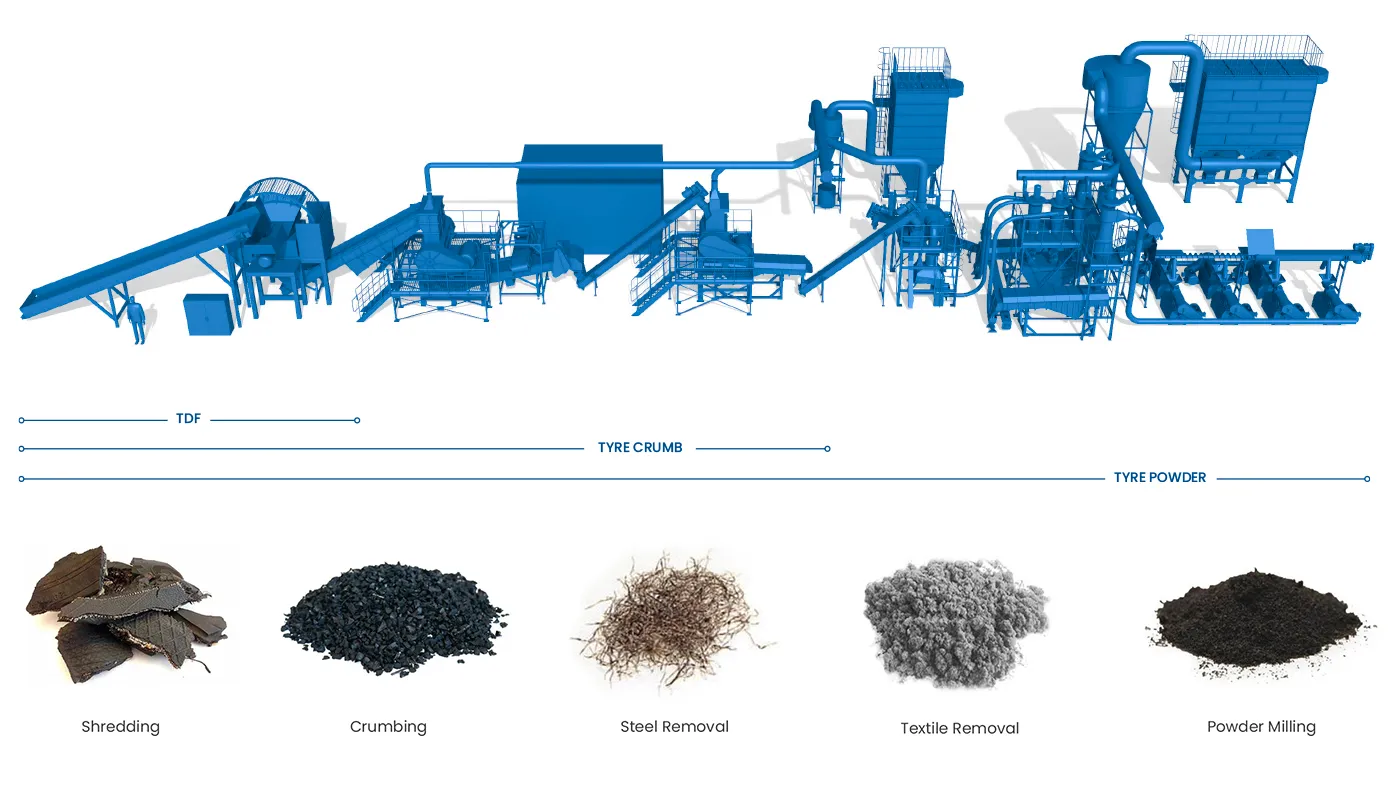
A bandenrecyclingmachine Het recyclingproces transformeert afgedankte banden – van personenauto's, vrachtwagens, terreinwagens en industriële voertuigen – tot herbruikbare materialen: rubbergranulaat, rubberpoeder, staaldraad en vezels. Met naar schatting 1,5 miljard afvalbanden die jaarlijks wereldwijd worden geproduceerd en steeds strengere stortverboden in Noord-Amerika, Europa en Azië, is bandenrecycling zowel een ecologische noodzaak als een winstgevende business. Deze gids behandelt elk type machine in het bandenrecyclingproces, de daadwerkelijke specificaties, de eindproducten en hun afzetmarkten, en een stapsgewijs raamwerk voor het bouwen of upgraden van een bandenrecyclinglijn.
Wat is een bandenrecyclingmachine?
Een bandenrecyclingmachine is elk apparaat dat wordt gebruikt om afvalbanden te verwerken tot herbruikbare grondstoffen. Geen enkele machine verwerkt een hele band tot een eindproduct; bandenrecycling vereist meerdere processen. reeks gespecialiseerde machines, Elke machine voert een specifieke fase uit: ontkorrelen (verwijderen van de stalen hiel), versnipperen (primaire verkleining), granuleren (secundaire verkleining), staalscheiding, vezelscheiding en malen (productie van fijn poeder). De term "bandenrecyclingmachine" verwijst doorgaans naar de complete lijn of naar de primaire versnipperaar die het systeem vormt.
Het bandenrecyclingproces: stap voor stap
Inzicht in het volledige proces helpt u bij het selecteren van de juiste apparatuur voor elke fase. Hieronder vindt u het standaard mechanische bandenrecyclingproces dat wordt gebruikt bij verwerking op omgevingstemperatuur:
Fase 1: Verzameling en inspectie
Afgedankte banden zijn afkomstig van bandenhandelaren, garages, wagenparkbeheerders en gemeentelijke inzamelpunten. Controleer op vervuiling (velgen nog gemonteerd, overmatige modder, chemische verontreiniging) en sorteer op type: personenautobanden (PCT), vrachtwagen- en busbanden (TBT) en offroadbanden vereisen elk verschillende verwerkingsparameters vanwege verschillen in formaat en staalgehalte.
Fase 2: Het verwijderen van de kralen
A bandenontvelmachine Verwijdert de stalen hieldraad uit de zijwand van elke band. Deze stap is cruciaal: achtergebleven hieldraad in de band beschadigt de messen van de shredder en vervuilt de rubberuitvoer. Een ontkrabber met één haak verwerkt 60-120 personenautobanden per uur. Het verwijderen van de hieldraad maakt het daaropvolgende shredderen (30-40%) ook energiezuiniger, omdat de shredder niet door geharde staalkabel hoeft te snijden.
Fase 3: Zijwand doorsnijden (optioneel)
Voor grote vrachtwagen- en OTR-banden, een bandensnijmachine Het scheidt de zijwanden van het loopvlak. Dit verkleint de hoeveelheid materiaal die de primaire shredder binnenkomt en maakt het mogelijk om zijwanden en loopvlakken apart te verwerken of als zodanig te verkopen voor specifieke toepassingen (bijvoorbeeld rubber voor zijwanden van transportbandbekleding). Lees meer over Waarom het doorsnijden van de zijwand belangrijk is bij het recyclen van banden..
Fase 4: Primaire versnippering
De bandenversnipperaar is de kernmachine in elke bandenrecyclinglijn. Een machine met lage snelheid en hoog koppel. dubbelassige versnipperaar Versnipperaars verscheuren hele banden (of voorgesneden delen) tot grove snippers van 50-100 mm. Primaire versnipperaars voor bandenrecycling gebruiken doorgaans motoren van 30-110 kW en verwerken 500-3000 kg per uur, afhankelijk van het type band en de grootte van de machine. Het eindproduct – in dit stadium bandenbrandstofchips (TDF-chips) genoemd – heeft al commerciële waarde als alternatieve brandstof.
Fase 5: Secundair versnipperen / granuleren
A banden granulator reduceert de spanen van 50–100 mm tot korrels van 5–20 mm. In dit stadium, De staaldraad komt los uit de rubbermatrix. en kan worden verwijderd door magnetische scheiders. Textielvezels scheiden zich ook af en worden verwijderd door luchtclassificatoren of trilzeven. De output is een mengsel van rubbergranulaat, los staaldraad en vezels. Zie onze gedetailleerde handleiding over Granulatoren voor afvalbanden en specificaties van de output.
Fase 6: Scheiding van staal en vezels
Bovenband-magnetische scheiders en magnetische trommels verwijderen staaldraadfragmenten uit de rubberkorrels, waarbij doorgaans 991 TP7T+ aan staal wordt verwijderd. Luchtscheiders en trilzeven verwijderen textielvezels (nylon, polyesterkoord). Het gescheiden staal wordt verkocht als schroot (1 TP8T100–1 TP8T200/ton); de vezels kunnen worden gebruikt als isolatiemateriaal of als brandstofadditief.
Fase 7: Fijn malen (optioneel)
Voor toepassingen met een hogere toegevoegde waarde, een rubberverpulveraar/vermaler Het verkleint de korrels verder tot fijn rubberpoeder (40–80 mesh / 0,2–0,4 mm). Fijn rubberpoeder brengt hogere prijzen op ($300–$600/ton) voor gebruik in gegoten rubberproducten, asfaltverbetering en sportvloeren. Cryogeen malen (het bevriezen van rubber met vloeibare stikstof vóór het malen) produceert een nog fijner poeder, maar verhoogt de verwerkingskosten met $50–$100/ton.
Soorten bandenrecyclingmachines
Hieronder vindt u alle machinetypes die in een bandenrecyclinglijn worden gebruikt, met specificaties uit het productieassortiment van Energycle:
| Machine | Functie | Doorvoer | Motorvermogen | Uitvoergrootte |
|---|---|---|---|---|
| Bandenontkorrelaar | Verwijder de hieldraad uit de zijwand van de band. | 60–120 banden/uur | 7,5–15 kW | Complete band (draad verwijderd) |
| Bandensnijder | Snijd de zijwanden van het loopvlak af. | 40–80 banden/uur | 5,5–11 kW | Zijwandstrips + loopvlakringen |
| Primaire versnipperaar (dubbele as) | Versnipper hele/doorgesneden banden tot snippers. | 500–3.000 kg/u | 30–110 kW | Chips van 50–100 mm |
| Bandengranulator | Verklein de spanen tot korrels en verwijder de draad. | 300–2.000 kg/u | 22–75 kW | 5–20 mm korrels |
| Magnetische scheider | Verwijder de staaldraad uit de korrels. | Komt overeen met de lijnsnelheid | 1.5–4 kW | Schone korrels + staaldraad |
| Luchtclassificator / Vezelscheider | Verwijder textielvezels uit de korrels. | Komt overeen met de lijnsnelheid | 3–7,5 kW | Schone korrels + vezels |
| Rubberen verpulveraar | Maal de korrels tot een fijn poeder. | 200–800 kg/u | 37–75 kW | Poeder met een maaswijdte van 40–80 mesh |
Uitkomstproducten en marktwaarde
Een bandenrecyclinglijn genereert meerdere inkomstenstromen. Inzicht in de eindproducten en hun afzetmarkten helpt u te bepalen hoe ver u het proces wilt laten gaan en in welke productiestappen u moet investeren.
| Uitgangsproduct | Maat | Marktprijs | Toepassingen |
|---|---|---|---|
| TDF-chips | 50–100 mm | $30–$80/ton | Brandstof voor cementovens, brandstof voor elektriciteitscentrales (vervangt steenkool) |
| Grof gemalen rubber | 5–20 mm | $120–$250/ton | Speelplaatsondergronden, sportvelden, mulch voor landschapsinrichting |
| Rubbergranulaat (fijn) | 1–5 mm | $200–$400/ton | Asfaltrubber (wegverharding), gegoten producten, sportvelden |
| Rubberpoeder | 40–80 mesh | $300–$600/ton | Rubbermengseladditief, waterdichting, auto-onderdelen |
| Stalen draad | — | $100–$200/ton | Recycling van staalschroot (gieterijen, mini-staalfabrieken) |
| Textielvezel | — | $20–$50/ton | Isolatie, brandstofadditief, geotextielvulling |
Een doorsnee personenautoband weegt 8-10 kg en bevat naar gewicht ongeveer 701 ton rubber, 151 ton staal en 151 ton textielvezels. De verwerking van 1.000 banden levert ruwweg 7 ton rubber, 1,5 ton staal en 1,5 ton vezels op.
TDF versus TDA versus rubbergranulaat: vergelijking van het eindproduct
De drie belangrijkste productcategorieën van bandenrecycling bedienen zeer verschillende markten. De diepte van uw verwerking bepaalt welke producten u kunt verkopen:
| Product | Verwerking vereist | Kapitaalinvestering | Omzet/ton | Marktvraag |
|---|---|---|---|---|
| TDF (Brandstof afkomstig van banden) | Alleen versnipperen (1 fase) | Laag ($80K–$200K) | $30–$80 | Stabiel — cementovens, elektriciteitscentrales |
| TDA (bandenafgeleid aggregaat) | Versnipperen + zeven | Laag-Middel ($100K–$250K) | $50–$120 | Groei — civieltechnische ophogingen, drainage |
| Korrelrubber | Versnipperen + granuleren + scheiden | Middelhoog ($200K–$600K) | $120–$600 | Sterk — sportvelden, asfalt, gegoten goederen |
Onze aanbeveling voor nieuwe activiteiten: Begin met de productie van TDF (laagste investering, directe opbrengst), en voeg vervolgens granuleer- en scheidingsapparatuur toe naarmate de cashflow dit toelaat. De shredder die voor de TDF-productie wordt aangeschaft, vormt de eerste stap in de productielijn voor rubbergranulaat – een investering die geen verspilling oplevert. Voor een gedetailleerde marktanalyse, zie onze gids over... Markten voor bandenrecycling: TDF vs. TDA vs. CRM.
Bandenverwerking voor personenauto's, vrachtwagens en vrachtwagens (OTR).
Verschillende soorten banden vereisen verschillende afmetingen van de apparatuur en verschillende verwerkingsmethoden:
| Parameter | Personenautoband | Vrachtwagen-/busband | OTR-band |
|---|---|---|---|
| Gewicht | 8–10 kg | 40–70 kg | 200–4.000 kg |
| Diameter | 550–700 mm | 900–1200 mm | 1.800–4.000 mm |
| Staalgehalte | 10–15% | 15–25% | 10–20% |
| Debeading | Standaard enkele haak | Zware ontkraalmachine | Hydraulische OTR-ontkrabber |
| Voorsnijden | Optioneel | Aanbevolen | Vereist |
| Grootte van de papiervernietiger | 30–55 kW | 55–90 kW | 90–200+ kW |
| Doorvoer (versnipperaar) | 500–2.000 kg/u | 800–2.500 kg/u | Op maat gemaakt per project |
Complete configuraties van bandenrecyclinglijnen
Basis TDF-lijn (laagste investering)
Ontkorrelmachine → primaire shredder → magnetische scheider → zeven. Uitvoer: 50–100 mm TDF-chips + staaldraad. Doorvoer: 500–2.000 kg/u. Investering: $80.000–$200.000. Terugverdientijd: 12–24 maanden bij 8 uur per dag gebruik.
Rubbergranulaatlijn (middelgrote investering)
Ontkorrelmachine → primaire shredder → granulator → magneetscheider → luchtclassificator → trilzeef. Uitvoer: 1–5 mm schoon rubbergranulaat + staal + vezels. Doorvoer: 300–1.500 kg/u afgewerkt granulaat. Investering: $200.000–$600.000. Terugverdientijd: 8–18 maanden. Bekijk onze video's. Proefdraai van de bandenrecyclinglijn.
Lijn met fijn rubberpoeder (hoogste waarde)
Complete rubbergranulaatlijn + rubberverpulveraar + fijnzeef + verpakking. Output: rubberpoeder met een maaswijdte van 40–80 mesh. Doorvoer: 200–800 kg poeder per uur. Investering: $400.000–$1.000.000+. Terugverdientijd: 12–24 maanden. Hoogste opbrengst per ton, maar vereist een groter kapitaal en meer gekwalificeerde operators.
5-Step Selection Framework
Stap 1: Bepaal uw grondstof
Personenautobanden, vrachtwagenbanden of offroadbanden? Gemengd of één type? Verwacht dagelijks/maandelijks volume in tonnen? Het type band bepaalt elke machinespecificatie in de productielijn — een productielijn voor personenauto's van 500 kg/u is een compleet andere opstelling dan een productielijn voor vrachtwagenbanden van 500 kg/u.
Stap 2: Kies je eindproduct
TDF-chips (eenvoudigst), rubbergranulaat (beste balans tussen investering en opbrengst) of fijn rubberpoeder (hoogste waarde, hoogste investering)? Onderzoek de lokale marktvraag – een rubbergranulaatlijn is zinloos als er geen kopers binnen een economisch haalbare transportafstand zijn. Identificeer minstens 2-3 potentiële kopers voordat u investeert.
Stap 3: Bepaal de grootte van uw lijn
Bereken de benodigde doorvoer op basis van uw bandenaanvoervolume. Een fabriek die 50 ton personenautobanden per dag verwerkt, heeft een primaire shreddercapaciteit nodig van ongeveer 3.000-4.000 kg/u (rekening houdend met 8-uursdiensten en een uptime van 801 ton). Dimensioneer de apparatuur altijd op basis van de piekcapaciteit plus een marge van 201 ton.
Stap 4: Plan je indeling
Een complete rubbergranulaatlijn vereist 500–2.000 m² overdekte ruimte plus een buitenterrein voor bandenopslag. Plan de materiaalstroom: bandenontvangst → ontvelen → versnipperen → granuleren → scheiden → zeven → productopslag. Houd rekening met ruimte voor onderhoudstoegang, reserveonderdelen en toekomstige uitbreiding.
Stap 5: Bereken ROI
Omzet = (hoeveelheid rubber × rubberprijs) + (hoeveelheid staal × staalprijs) + stortkosten (indien van toepassing voor het accepteren van banden). Kosten = afschrijving van apparatuur + elektriciteit + arbeid + onderhoud + huur. De meeste bandenrecyclingbedrijven rekenen 1 TP8T1–1 TP8T3 per band als stort-/acceptatiekosten — dit alleen al kan 30–501 TP7T aan operationele kosten dekken. Een rubbergranulaatlijn met een capaciteit van 1.000 kg/u genereert doorgaans een bruto jaaromzet van 1 TP8T300.000–1 TP8T600.000 met een marge van 40–601 TP7T.
Essentiële onderhoudsbehoeften
Bandenrecyclingapparatuur werkt onder zware omstandigheden: schurend rubber, ingebed staaldraad en hoge koppelbelastingen. Een gedisciplineerd onderhoudsprogramma is daarom essentieel:
- DagelijksControleer de messen van de shredder op beschadigingen, verwijder vastgelopen materiaal en controleer het oliepeil van de hydraulische systemen.
- WekelijksControleer de sterkte van de magnetische scheider, controleer de spanning en uitlijning van de transportband en inspecteer de zeven van de granulator op slijtagegaten.
- MaandelijksSmeer alle lagers, controleer de elektrische aansluitingen en de motortemperatuur, en controleer de asafdichtingen van de shredder.
- Elke 500-1000 uur: Draai of vervang de messen van de shredder (bij het verwerken van banden slijten de messen 2-3 keer sneller dan bij standaard plasticversnippering vanwege het contact met de staaldraad)
- JaarlijksVolledige machine-inspectie, vervanging van versleten zeven en voeringen, controle van de versnellingsbakolie, verificatie van de veiligheidssystemen.
De kosten voor zaagbladen vormen de grootste onderhoudsuitgave — budgetteer jaarlijks 5.000 tot 15.000 euro voor een middelgrote productielijn. Het gebruik van slijtvaste materialen voor de zaagbladen (D2, DC53 of hardfacing) verlengt de levensduur van de bladen met 40 tot 80 euro. Zie onze handleiding voor de metallurgie van shreddermessen.
Inleiding tot de Energycle
Energycle produceert complete bandenrecyclingmachine productielijnen — van ontkorrelen tot versnipperen, granuleren, scheiden en malen. Met installaties in Afrika, Zuidoost-Azië, het Midden-Oosten en Zuid-Amerika bieden wij:
- Gratis projectadvies — Vertel ons uw bandenaanbod, het beoogde product en uw budget; wij ontwerpen de optimale lijnconfiguratie.
- Kant-en-klare leidinglevering — alle machines, transportbanden, elektrische panelen en bedieningselementen vanuit één bron.
- Installatie en inbedrijfstelling — onze technici installeren ter plaatse en trainen uw operators.
- Reserveonderdelen en levering van messen — snelle levering van slijtageonderdelen om stilstand te minimaliseren
Neem contact op met ons ingenieurs-team Met uw bandentype, dagelijkse productievolume en beoogde eindproduct ontwerpen wij een productielijn en leveren wij binnen een week een complete offerte.
Veelgestelde vragen
Wat kost een bandrecyclingmachine?
Een basislijn voor het versnipperen van TDF (ontkorrelmachine + versnipperaar + magnetische scheider) kost $80.000–$200.000. Een complete lijn voor rubbergranulaat kost $200.000–$600.000. Een lijn voor fijn rubberpoeder met verpulveraar kost $400.000–$1.000.000+. Individuele machines: bandenversnipperaars $30.000–$150.000, ontkorrelmachines $8.000–$25.000, granulatoren $20.000–$80.000. De terugverdientijd varieert van 8 tot 24 maanden, afhankelijk van de configuratie en de lokale marktprijzen.
Wat is het proces van bandenrecycling?
Het standaard mechanische recyclingproces voor autobanden bestaat uit 6-7 stappen: (1) verzamelen en sorteren, (2) ontkrabben (verwijderen van de stalen hieldraad), (3) optioneel snijden van de zijwand, (4) primair versnipperen tot snippers van 50-100 mm, (5) granuleren tot 5-20 mm, (6) magnetische en luchtscheiding om staaldraad en vezels te verwijderen, en (7) optioneel fijnmalen tot poeder met een maasgrootte van 40-80 mesh. Elke stap voegt waarde toe aan het eindproduct.
Is het recyclen van autobanden winstgevend?
Ja, bandenrecycling genereert inkomsten uit meerdere bronnen: rubbergranulaat ($120–$600/ton, afhankelijk van de fijnheid), staaldraad ($100–$200/ton), stortkosten ($1–$3 per geaccepteerde band) en vezels ($20–$50/ton). Een middelgroot rubbergranulaatbedrijf dat 1.000 kg/u verwerkt, genereert doorgaans een bruto jaaromzet van $300.000–$600.000 met een winstmarge van 40–60% na aftrek van operationele kosten.
Welke maat shredder heb ik nodig voor het recyclen van autobanden?
Voor personenautobanden: een dubbele asversnipperaar van 30–55 kW verwerkt 500–2.000 kg/u. Voor vrachtwagenbanden: 55–90 kW voor 800–2.500 kg/u. Voor offroadbanden: 90–200+ kW, op maat gemaakt. Houd altijd rekening met het piekvolume plus een marge van 20% en de uptime van 80% (onderhoud, ploegwisselingen, onderbrekingen in de aanvoer).
Wat is het verschil tussen TDF, TDA en rubbergranulaat?
TDF (tire-derived fuel) bestaat uit grof versnipperde bandenfragmenten (50-100 mm) die als alternatieve brandstof in cementovens worden verbrand. TDA (tire-derived aggregate) bestaat uit versnipperde bandenfragmenten die als lichtgewicht vulmiddel worden gebruikt in civiele bouwprojecten. Rubbergranulaat is fijnkorrelig rubber (1-5 mm) dat wordt gebruikt in sportvelden, voor asfaltverbetering en in gegoten producten. Elk van deze producten vereist steeds meer verwerkingsapparatuur, maar is daardoor ook duurder.
Kan ik vrachtwagenbanden en autobanden op dezelfde lijn recyclen?
Ja, maar de lijn moet wel geschikt zijn voor de grotere banden. Een shredder die ontworpen is voor vrachtwagenbanden kan prima personenautobanden verwerken, maar andersom niet. Het belangrijkste verschil zit hem in het verwijderen van de hielrand – voor vrachtwagenbanden is een zware ontkrabber nodig. De verwerkingssnelheid daalt bij het verwerken van grotere banden, omdat het versnipperen van elke band langer duurt. Veel bedrijven verwerken autobanden en vrachtwagenbanden in aparte batches.
Hoe lang gaan de messen van een bandenversnipperaar mee?
De messen van bandenversnipperaars gaan 500 tot 1000 bedrijfsuren mee voordat ze moeten worden geroteerd of vervangen – dat is ongeveer 2 tot 4 maanden bij 8 uur per dag. De stalen hiel in banden zorgt voor 2 tot 3 keer snellere slijtage van de messen in vergelijking met standaard versnippering van plastic. Messen van D2- en DC53-gereedschapsstaal bieden de beste prijs-kwaliteitverhouding; messen met wolfraamcarbidepunten gaan langer mee, maar zijn 4 tot 6 keer duurder in aanschaf.
Welke vergunningen heb ik nodig voor het recyclen van autobanden?
De vereisten variëren per rechtsgebied, maar omvatten doorgaans: een vergunning voor afvalverwerking/recycling, een milieuvergunning (luchtverontreiniging, geluidsoverlast, lozing in het water), een brandveiligheidscertificaat (bandenopslag vormt een aanzienlijk brandrisico) en een bedrijfsvergunning. Sommige regio's hanteren ook limieten voor bandenopslag (maximaal aantal banden op locatie). Raadpleeg uw lokale milieudienst voordat u in apparatuur investeert.
Gerelateerde bronnen
- Bandenrecyclingmachine — Productassortiment
- Bandenversnipperaar
- Markten voor bandenrecycling: TDF vs TDA vs CRM-specificaties
- Afvalbanden granulatoren: Hoe ze werken
- Banden granulatoren: Draadseparatie en Kruimelrubber specificaties
- Machine voor het verwijderen van banddraad met enkele haak
- Afvalbanden snijmachine
- Bandenrubberrecycling-pulveriseermachine
- Waarom wordt de zijwand doorgesneden tijdens het recyclen van banden?
- Proefrit met recyclinglijn voor afvalbanden
- Dubbele asversnipperaar voor plastic, metaal en banden
- Handleiding voor de metallurgie van shreddermessen
- Plastic Recycling Machine: Compleet gids
Een wervelstroomscheider (ECS) recovers non-ferrous metals — aluminum cans, copper wire, brass fittings, zinc die-castings — from mixed waste streams by exploiting electromagnetic repulsion. If your recycling line processes municipal solid waste (MSW), auto shredder residue (ASR), electronic scrap, incineration bottom ash (IBA), or PET bottle flakes contaminated with aluminum closures, an eddy current separator is how you pull the non-ferrous value out. This guide covers the physics behind the technology, every ECS type Energycle offers, real operating parameters, and a step-by-step framework for specifying the right separator for your application.
What Is an Eddy Current Separator?
Een wervelstroomscheider is een elektromagnetische sorteermachine die non-ferrometalen scheidt van niet-metalen materialen op een transportband. Het kernmechanisme: een snel draaiende magnetische rotor in een niet-metalen trommel genereert snel wisselende magnetische velden. Wanneer geleidende metalen door deze velden bewegen, worden er elektrische stromen (wervelstromen) in de metalen stukken opgewekt, waardoor hun eigen magnetische velden ontstaan die het veld van de rotor tegenwerken. De resulterende afstotende kracht lanceert non-ferrometalen naar voren van de band, terwijl niet-geleidende materialen (plastic, glas, hout, papier) door de zwaartekracht van de band vallen.
De scheidingskracht is afhankelijk van het materiaal. conductivity-to-density ratio. Aluminum (high conductivity, low density) separates most easily. Copper and brass (high conductivity but higher density) require stronger fields or slower belt speeds. Stainless steel and lead respond poorly to eddy current separation due to low conductivity or very high density.
How Does an Eddy Current Separator Work?
Het werkingsprincipe volgt de wet van Faraday over elektromagnetische inductie en de wet van Lenz. Hieronder volgt het stapsgewijze proces:
Stap 1: Materiaaltoevoer
Pre-sorted material (ferrous metals already removed by magnetic drum or overband separator) feeds onto the ECS conveyor belt as a thin, uniform layer. A vibratory feeder upstream ensures monolayer distribution — stacked particles reduce separation efficiency by 30–50%.
Step 2: Magnetic Field Exposure
As material reaches the head pulley, it passes over the magnetic rotor spinning at 2,000–5,000 RPM inside a stationary shell. The rotor contains alternating N-S-N-S permanent magnets (typically NdFeB rare-earth) arranged around its circumference. This creates a rapidly changing magnetic field at the belt surface.
Step 3: Eddy Current Induction
Wanneer een geleidend metalen voorwerp dit wisselende veld binnengaat, worden er in het metaal circulerende elektrische stromen (wervelstromen) opgewekt. Volgens de wet van Lenz genereren deze wervelstromen hun eigen magnetisch veld dat het externe veld tegenwerkt, waardoor een afstotende (Lorentz) kracht ontstaat die het metalen voorwerp van de rotor afduwt.
Step 4: Trajectory Separation
Op elk deeltje werken gelijktijdig drie krachten in: (1) de afstotende kracht van de wervelstroom (voorwaarts/omhoog), (2) het momentum van de transportband (voorwaarts) en (3) de zwaartekracht (omlaag). Non-ferrometalen, die een extra afstotende impuls ontvangen, volgen een langere baan en komen terecht in de opvangbak voor metalen. Niet-geleidende materialen vallen eenvoudigweg van het uiteinde van de transportband in een aparte bak voor niet-metalen. Een verstelbare scheidingsplaat tussen de twee bakken stelt operators in staat het scheidingspunt nauwkeurig af te stellen.
Types of Eddy Current Separators
Different applications require different ECS designs. The main distinction is rotor geometry — concentric vs. eccentric — which determines the magnetic field pattern and optimal particle size range.
Concentric Pole Rotor ECS
The magnetic rotor is centered inside the shell drum. This produces a uniform, symmetrical field pattern ideal for standard recycling applications waarbij de deeltjesgrootte varieert van 20 tot 150 mm. Concentrische ECS-units zijn de werkpaarden in de industrie en worden gebruikt voor de recycling van huishoudelijk afval, bouw- en sloopafval, autosloopresten en algemene schrootverwerking. Ze bieden een betrouwbare scheiding met een hoge doorvoer en lagere onderhoudskosten.
Eccentric Pole Rotor ECS
The magnetic rotor is offset (eccentric) inside the shell, creating an intense but localized field zone. This concentrates maximum magnetic energy at the separation point, making eccentric ECS units effective for fine particles down to 5 mm. Applications include IBA (incinerator bottom ash) processing, zorba/zurik sorting, WEEE (waste electrical and electronic equipment) recovery, and fine aluminum recovery from glass cullet. Our high-recovery ECS for fine aluminum uses this design.
High-Frequency ECS
Uses more magnetic poles (typically 18–30 poles vs. 12–16 on standard units) and higher rotor speeds to create rapid field alternation. This design targets the smallest non-ferrous particles (5–20 mm) where standard concentric units lose effectiveness. High-frequency ECS is essential for fine fraction processing in IBA plants, wire-chopping lines, and small WEEE recycling.
Wet Eddy Current Separator
Materiaal wordt in een waterige slurry verwerkt in plaats van op een droge riem. Gebruikt waar de inkomende stof al nat is (bijv., slopschuwwater, resten van zware media-installaties) of waar stofbeheersing cruciaal is. Minder gebruikelijk dan droge ECS, maar noodzakelijk in specifieke metallurgische en mijnbouwanwendungen.
Type vergelijking van Eddy Current Separator
| Type | Deelgroottebereik | Rotorsnelheid | Polen | Beste toepassingen | Herstelpercentage |
|---|---|---|---|---|---|
| Concentrisch (Standaard) | 20–150 mm | 2,000–3,500 RPM | 12–16 | Huisvuil, bouw- en sloopafval, autosloperij, algemeen schroot | 90–95% |
| Excentrisch | 5–50 mm | 3,000–5,000 RPM | 14–22 | IBA, WEEE, zorba/zurik, fijn aluminium | 85–93% |
| Hoogfrequent | 5–20 mm | 3,500–5,000 RPM | 18–30 | Fijne fractie IBA, draad knippen, klein WEEE | 80–90% |
| Nat | 5–80 mm | 1,500–3,000 RPM | 12–18 | Slopschouw, natte mijnresten | 75–88% |
Belangrijke Bedrijfsparameters
Vijf parameters bepalen de prestaties van de eddy current separator. Het optimaliseren van deze parameters op basis van uw specifieke materiaalstroom is het verschil tussen de herwinningpercentages van 70% en 95%.
1. Rotor snelheid (RPM)
Een hogere rotor snelheid verhoogt de frequentie van het veldverschuiving en de afstotingskracht - maar alleen tot een bepaald punt. Buiten het optimale RPM voor een bepaalde deeltjesgrootte, neemt de prestatie af omdat de deeltjes te kort worden blootgesteld aan het veld. Typische bedrijfsbereik: 2.000–5.000 RPM. Start bij 3.000 RPM en pas aan op basis van herstelresultaten. Fijne deeltjes vereisen een hogere RPM; grote blikken van aluminium scheiden zich goed af bij lagere snelheden.
2. Riemsnelheid
De riemsnelheid beheerst drie factoren: de diepte van de materiaalbelasting (sneller = dunner laag), de verblijftijd in het magneetveld (sneller = minder blootstelling), en de traject van de deeltjes na de scheiding. Optimale riemsnelheid creëert een enkele deeltjesdunne laag zonder stapeling. Typische bereik: 1,5–3,0 m/s. Verhoog de riemsnelheid voor hoge doorvoersystemen; verlaag voor het herwinnen van fijne fracties.
3. Splitserpositie
De aanpasbare scheidingswand tussen metaal- en niet-metaal verzamelbakken. Het dichter bij de riem verplaatsen van de scheidser verhoogt de zuiverheid van het metaal maar vermindert de herwinning; het verder weg verplaatsen verhoogt de herwinning maar laat meer niet-metaalvervuiling toe. Stel de scheidserpositie in op basis van of je prioriteit is maximale herwinning (recyclingopbrengst) of maximale zuiverheid (vereisten van het downstreamproces).
4. Eenheidigheid van de voedslaag
Het meest over het hoofd gezien parameter. Gestapelde materialen blokkeren de toegang tot het magneetveld van lagere lagen, wat de herwinning vermindert met 30–50%. Gebruik een trillend voedapparaat om het materiaal in een uniforme monolagere te verspreiden voordat het de ECS kopas aanraakt. Voor nat of plakkerig materiaal, installeer een voor-screeningsstadium om fijne deeltjes te verwijderen die het bruggen vormen.
5. Voorafgaande verwijdering van ferromagnetische materialen
Ferromagnetische materialen (staal, ijzer) moeten worden verwijderd voordat de ECS. Staalstukken trekken aan de magneetrotorhuid, waardoor ze eromheen worden gewikkeld en de riem beschadigen, wat de effectiviteit van de scheiding van niet-ferromagnetische materialen vermindert en kostbare stilstand veroorzaakt. Altijd installeer een magnetische scheider bovenstroom — overbandmagneten, magneetdrums of wielmagneten om 99%+ van ferromagnetische vervuiling te verwijderen.
Materialen scheidingseffectiviteit
Niet alle niet-ferromagnetische materialen scheiden even goed. De beheersende factor is de geleidsverhouding tot dichtheid (σ/ρ) — hogere verhoudingen produceren sterke scheidingkrachten. Hier is hoe gebruikelijke materialen rangschikken:
| Materiaal | Geleidsverhouding (MS/m) | Dichtheid (kg/m³) | σ/ρ Verhouding | ECS Scheiding |
|---|---|---|---|---|
| Aluminium | 37.7 | 2,700 | 14.0 | Uitstekend — primaire doelmetal |
| Magnesium | 22.6 | 1,740 | 13.0 | Uitstekend |
| Koper | 59.6 | 8,960 | 6.7 | Goed — vereist een lagere riemsnelheid of hogere RPM |
| Koper | 15.9 | 8,500 | 1.9 | Matig — alleen grotere stukken |
| Zink | 16.6 | 7,130 | 2.3 | Gematigd |
| Lood | 4.8 | 11,340 | 0.4 | Slecht — te hoge dichtheid |
| Rvsstaal | 1.4 | 7,900 | 0.2 | Zeer slecht — gebruik sensor-gestuurde sortering |
Dit tabel legt uit waarom blikjes van aluminium het gemakkelijkst te herwinnen zijn met een ECS (hoogste σ/ρ-verhouding), terwijl rvs in plaats daarvan sensor-gestuurde sorteringstechnologieën vereist.
Specificaties Referentie
Energycle vervaardigt eddy current separators in werkbreedtes van 600 mm tot 2,000 mm. Hier zijn representatieve specificaties over de hele lijn:
| Model | Bandbreedte | Doorvoer | Motorvermogen | Rotordiameter | Rotorsnelheid |
|---|---|---|---|---|---|
| ECS-600 | 600mm | 1–3 t/h | 4 kW | Ø300 mm | Tot 4,000 RPM |
| ECS-800 | 800mm | 2–5 t/h | 5,5 kW | Ø300 mm | Tot 4,000 RPM |
| ECS-1000 | 1,000 mm | 3–8 t/h | 7,5 kW | Ø350 mm | Tot 3,800 RPM |
| ECS-1200 | 1.200 mm | 5–12 t/h | 11 kW | Ø350 mm | Tot 3,800 RPM |
| ECS-1500 | 1.500 mm | 8–18 t/h | 15 kW | Ø400 mm | Tot 3,500 RPM |
| ECS-2000 | 2.000 mm | 12–25 t/h | 22 kW | Ø400 mm | Tot 3,500 RPM |
Alle modellen beschikken over VFD (variabele frequentiedrive) voor roterende snelheidsaanpassing, NdFeB zeldzame aarde magneten, vervangbare niet-magnetische behuizing en aanpasbare scheidingsplaat. Bezoek onze eddy current separator productpagina voor volledige specificaties en configuratiemogelijkheden.
Toepassingen in de industrie
Eddy current separators dienen elke industrie die niet-ferromagnetische metalen uit gemengde materiaalstromen moet herwinnen:
Municipale afvalstoffen (MSW) Recycling
In materiaalrecyclinginstallaties (MRFs) herwint ECS blikjes van aluminium en andere niet-ferromagnetische metalen na het verwijderen van staal door magnetische separatie. Een typische MRF verwerkt 20–50 t/h en herwint met een enkele ECS-pas 95%+ van blikjes van aluminium. De herwonnen aluminium levert $800–$1,500/ton opbrengst — vaak de hoogstwaardige stroom in MSW-recycling. Zie onze volledige MSW-sorteermachine lineup.
Restmateriaal van automatische shredders (ASR)
After end-of-life vehicles are shredded, the mixed output contains aluminum engine parts, copper wiring, brass fittings, and zinc die-castings among plastic and glass. Multi-stage ECS processing (coarse fraction + fine fraction) recovers 85–92% of non-ferrous metals from ASR, adding $50–$120 per vehicle in recovered metal value.
Incineration Bottom Ash (IBA)
Waste-to-energy plant bottom ash contains 5–12% non-ferrous metals by weight — primarily aluminum and copper. Processing IBA through screening, magnetic separation, and eccentric/high-frequency ECS recovers metals worth €40–€80 per ton of ash processed. This application requires fine-particle ECS capability (down to 5 mm) due to the granular nature of IBA.
Electronic Waste (WEEE)
After shredding, e-waste contains copper, aluminum, brass, and precious metals mixed with plastic and circuit board fragments. ECS recovers the bulk non-ferrous metals; downstream sensor-based sorting or density separation further purifies the output. Typical recovery: 80–90% of aluminum and copper from shredded WEEE.
Recycling van PET-flessen
Aluminum closures and rings must be removed from PET flake streams to achieve food-grade purity. An ECS positioned after crushing and washing removes 98%+ of aluminum contamination, bringing metal content below the 50 ppm threshold required for bottle-to-bottle recycling. Learn more about achieving ≤50 ppm metal in recycled pellets.
Bouw- en sloopafval (C&D-afval)
Demolition debris contains aluminum window frames, copper pipe and wire, brass fixtures, and other non-ferrous metals. After primary crushing and ferrous removal, ECS recovers these high-value metals from the mixed aggregate, wood, and concrete stream.
Where ECS Fits in a Recycling Line
An eddy current separator never operates alone. Here is the typical position in a recycling line and the equipment it works alongside:
Typical processing sequence:
- Maatverkleining — shredder or crusher breaks material to processable size
- Screening — trommel or vibrating screen separates material into size fractions
- Ferrous removal — magnetische scheider (overband, drum, or pulley) removes steel and iron
- Eddy current separation — ECS recovers non-ferrous metals from remaining stream
- Further sorting — sensor-based sorting, density separation, or manual QC for final purity
Voor een maximaal rendement gebruiken veel installaties twee ECS-eenheden in serie: een concentrische eenheid voor de grove fractie (>20 mm) en een excentrische of hoogfrequente eenheid voor de fijne fractie (5–20 mm). Deze tweetrapsmethode wint 15–251 TP7T meer non-ferrometaal terug dan een systeem met één doorgang.
5-Step Selection Framework
Use this framework when specifying an eddy current separator for your operation:
Step 1: Characterize Your Feed Material
Identify the non-ferrous metals present (aluminum, copper, brass, zinc), their particle size distribution, percentage by weight in the feed, and moisture level. This determines whether you need a concentric, eccentric, or high-frequency ECS design and what recovery rate to expect.
Step 2: Determine Required Throughput
Measure your feed rate in tons per hour. The ECS belt width must handle this volume while maintaining monolayer feed distribution. A 1,000 mm belt handles 3–8 t/h depending on material bulk density; wider belts for higher throughput. Always size for peak capacity plus 20% margin.
Step 3: Choose Rotor Configuration
Concentrische rotor voor deeltjes >20 mm (standaardtoepassingen). Excentrische rotor voor deeltjes 5–50 mm (fijne fractie, IBA, WEEE). Hoogfrequente rotor voor deeltjes 5–20 mm (maximale terugwinning van fijne deeltjes). Als uw invoer zowel grove als fijne fracties bevat, plan dan twee ECS-units in serie.
Stap 4: Controleer voorliggende apparatuur
Bevestig dat de voorafgaande ferromagnetische verwijdering voldoende is (≤0.5% ferromagnetisch in ECS voeding). Verifieer dat het screenen/schalen de juiste fractiegrootte oplevert voor uw ECS-type. Zorg ervoor dat een trillend voedapparaat of verspreidingsconveyor is opgenomen voor een uniforme monolagere distributie. Het missen van een van de voorliggende stappen vermindert aanzienlijk de prestaties van de ECS.
Stap 5: Bereken ROI
Schat het jaarlijkse niet-ferrometallische herwinningstonnage × metaalwaarde per ton = bruto-inkomsten. Trek de ECS-bedrijfkosten (electriciteit, riemvervanging elke 12-18 maanden, rotorbekleedingsvervanging elke 3-5 jaar, onderhoudsarbeid) af. Meeste ECS-installaties halen de break-even periode binnen 6-18 maanden op basis van de herwonnen metaalwaarde alleen — aluminiumherwinning bij 95%-tarieven genereert $800–$1,500/ton inkomsten.
Onderhoud en probleemoplossing
Eddy current separators vereisen relatief weinig onderhoud in vergelijking met andere recyclingapparatuur, maar regelmatige controles voorkomen kostbare stilstand:
| Interval | Taak | Details |
|---|---|---|
| Dagelijks | Visuele inspectie | Controleer riemvolgnummer, splitserpositie en afvoergebieden op materiaalopbouw |
| Wekelijks | Controleer riemspanning | Verifieer riemspanning en uitlijning; misuitlijning veroorzaakt oneven slijtage en verminderde scheiding |
| Maandelijks | Lager smeermiddel | Smeer de rotor en aandrijfbewegingslagers volgens het schema van de fabrikant |
| Maandelijks | Shell inspectie | Controleer de niet-magnetische shell op slijtagevlekken van ferromagnetische verontreiniging; vervang indien doorgebroken |
| Kwartaal | Magnetisch veld controleren | Verifieer de sterkte van het rotormagnetisch veld met een gaussmeter — NdFeB-magneten degraderen <1% per jaar |
| Jaarlijks | Riem vervangen | Vervang de transportband; inspecteer de aandrijvingselementen, rollen en lagers |
| 3–5 jaar | Shell vervangen | Vervang de niet-magnetische rotorbekleeding (koolstofvezel of roestvrij staal) wanneer deze slijtage onder de minimale dikte is |
Algemene problemen en oplossingen:
- Lage herwinningsscore → Controleer de uniformiteit van de voedlaag (meest voorkomende oorzaak), verifieer dat de rotor snelheid overeenkomt met de deeltjesgrootte, inspecteer de splitserpositie
- Metaal in niet-metaalcontainer → Verhoog de rotor snelheid, verlaag de riem snelheid, of verplaats de splitser verder van de riem
- Niet-metaal in metaalcontainer → Verlaag de rotor snelheid, verhoog de riem snelheid, of verplaats de splitser dichter bij de riem
- Band beschadiging → Ferromagnetische verontreiniging bereikt de rotor; verbeter de voorliggende magnetische separatie
- Teugelings → Controleer de rotorbalans, de conditie van de kogellagers en de afstelling van de riemvolgordening
Inleiding tot de Energycle
Energycle vervaardigt wervelstroomscheiders in concentrische en excentrische configuraties met riembreedtes van 600 mm tot 2,000 mm. We bieden ook volledige sorteer- en recyclinglijnintegratie aan, inclusief:
- Gratis materiaaltest — stuur ons een monster van uw afvalstroom en we testen de scheidingsprestaties op onze ECS-eenheden
- Aangepaste rotorconfiguratie — polaantal, magneetklasse en rotorsnelheid geoptimaliseerd voor uw specifieke materiaal
- Volledige lijnontwerp — van knipsel tot zeef, magnetische scheidings, eddycurrentscheidings en sensorclassificatie
- Na-verkoopondersteuning — reservebanden, vervangende behuizingen, remote diagnose en ter plaatse ingebruikname
Neem contact op met ons ingenieurs-team met uw materiaaltype, capaciteit en doelmatigheid van metaalherwinning — we zullen de juiste ECS-configuratie aanbevelen en binnen 48 uur een gedetailleerde offerte verstrekken.
Veelgestelde vragen
Hoe werkt een eddy current separator?
Een eddycurrentscheider werkt door een magnetisch roterend wiel op een snelheid van 2.000–5.000 RPM in een niet-magnetische schaalbuis te laten draaien. Wanneer niet-magnetische metalen over het wiel passeren op een transportband, induceert het snel veranderende magnetische veld eddystromen binnen de metalen. Deze eddystromen creëren tegengestelde magnetische velden (volgens het Wetenschap van Lenz), die een afstotende kracht genereren die de metalen van de band afstuurt naar een aparte verzamelbak, terwijl niet-conductieve materialen eenvoudig aan het einde afvallen.
Welke metalen kan een eddy current separator recyclen?
Eddycurrentscheidingsapparaat herwint niet-magnetische metalen, waaronder aluminium (blikken, extrusies, gieten), koper (draad, buis, fittingen), lood, zink gietwerk, magnesium en andere geleidende niet-magnetische metalen. Aluminium heeft de hoogste herwinningsgraad (95%+) vanwege zijn hoge conductiviteit-dichtheidverhouding. De herwinning van koper en lood is ook goed (85–92%) met de juiste rotorsnelheid en riemsnelheid optimalisatie.
Wat is het verschil tussen concentrische en excentrische eddy current separators?
Een concentrische ECS heeft de rotor centreren binnen de schelp, waardoor een uniform veld ontstaat, ideaal voor deeltjes van 20–150 mm — de standaardkeuze voor de meeste recyclingtoepassingen. Een excentrische ECS verschuift de rotor om de maximale veldintensiteit te concentreren op het scheidingspunt, waardoor een effectieve herwinning van fijnere deeltjes tot 5 mm mogelijk is. Kies concentrisch voor algemene recycling; excentrisch voor IBA, WEEE en fijnfrac-toepassingen.
Wat is de deeltjesgrootte die een eddy current separator kan verwerken?
Standaard concentrische ECS-eenheden scheiden deeltjes van 20 mm tot 150 mm effectief. Excentrische en hoge-frequentie modellen verlengen het lagere bereik tot 5 mm. Deeltjes onder 5 mm kunnen meestal niet worden gescheiden door ECS en vereisen alternatieve technologieën zoals elektrostatische scheidings of nat zwaartekrachtconcentratie. Voor het beste resultaat, zeef uw materiaal in fracties en gebruik de juiste ECS-type voor elke fractie.
Wat kost een eddy current-scheider?
Kleine ECS-eenheden (600 mm riembreedte, 1–3 t/h) beginnen bij ongeveer $15,000–$25,000. Middelgrote modellen (1,000–1,200 mm, 5–12 t/h) kosten $30,000–$65,000. Grote industriële eenheden (1,500–2,000 mm, 12–25 t/h) variëren van $70,000–$150,000. De meeste installaties halen binnen 6–18 maanden hun investering terug op basis van de waarde van het herwonnen metaal — een installatie die 100 kg/h aluminium herwint, genereert $80,000–$150,000 jaarlijkse inkomsten bij huidige marktwaarden.
Waarom is het verwijderen van ferromagnetische materialen nodig voordat een eddy current separator wordt gebruikt?
Ferrometalen (staal, ijzer) worden aangetrokken door de ECS-magnetische rotor in plaats van afgestoten. Ze wikkelen zich om de schelp heen, beschadigen de riem, blokkeren de scheidings van niet-magnetische metalen en vereisen kostbare noodsituatie stilleggingen voor verwijdering. Installeer altijd magnetische drums, overbandmagneten of wielmagneten op de upstream om 99%+ van ferrometalen te verwijderen voordat de ECS.
Kan een eddy current-scheider koper herwinnen?
Ja, maar koper is moeilijker te scheiden dan aluminium vanwege de hogere dichtheid (8960 kg/m³ versus 2700 kg/m³ voor aluminium). Ondanks de uitstekende geleidbaarheid van koper, betekent de lagere verhouding tussen geleidbaarheid en dichtheid dat de afstotende kracht ten opzichte van de zwaartekracht zwakker is. Optimaliseer de koperwinning door lagere bandsnelheden, een hoger rotortoerental en een excentrisch rotorontwerp te gebruiken. Verwacht een koperwinning van 85–921 TP7T met de juiste optimalisatie.
Wat vereist een eddy current separator aan onderhoud?
Dagelijks: visuele inspectie van de riemvolgordening en afvoer. Wekelijks: controle van riemspanning. Maandelijks: smering van de kogellagers en inspectie van de schelpslijtage. Jaarlijks: vervanging van de riem. Elke 3–5 jaar: vervanging van de rotorshell. NdFeB-magneten vervagen minder dan 1% per jaar en duren typisch 15–20+ jaar. De totale jaarlijkse onderhoudskosten zijn meestal 3–5% van de aankoopprijs van het apparaat — veel lager dan de meeste recyclingmachines.
Gerelateerde bronnen
- Eddy Current Magnetic Separator — Productpagina
- Geavanceerde wervelstroomscheider voor recycling
- Hoog-herwinnings ECS voor fijn aluminium
- Opgehangen zelfontladende magnetische scheider
- Sorteermachines voor plasticrecycling
- MSW-sorteermachines
- Zakkenbreker voor het sorteren van huishoudelijk afval
- E-Scrap shredder voor WEEE
- Hoe ≤50 ppm metaal in gerecycleerde korrels te bereiken
- Plastic Recycling Machine: Compleet gids