

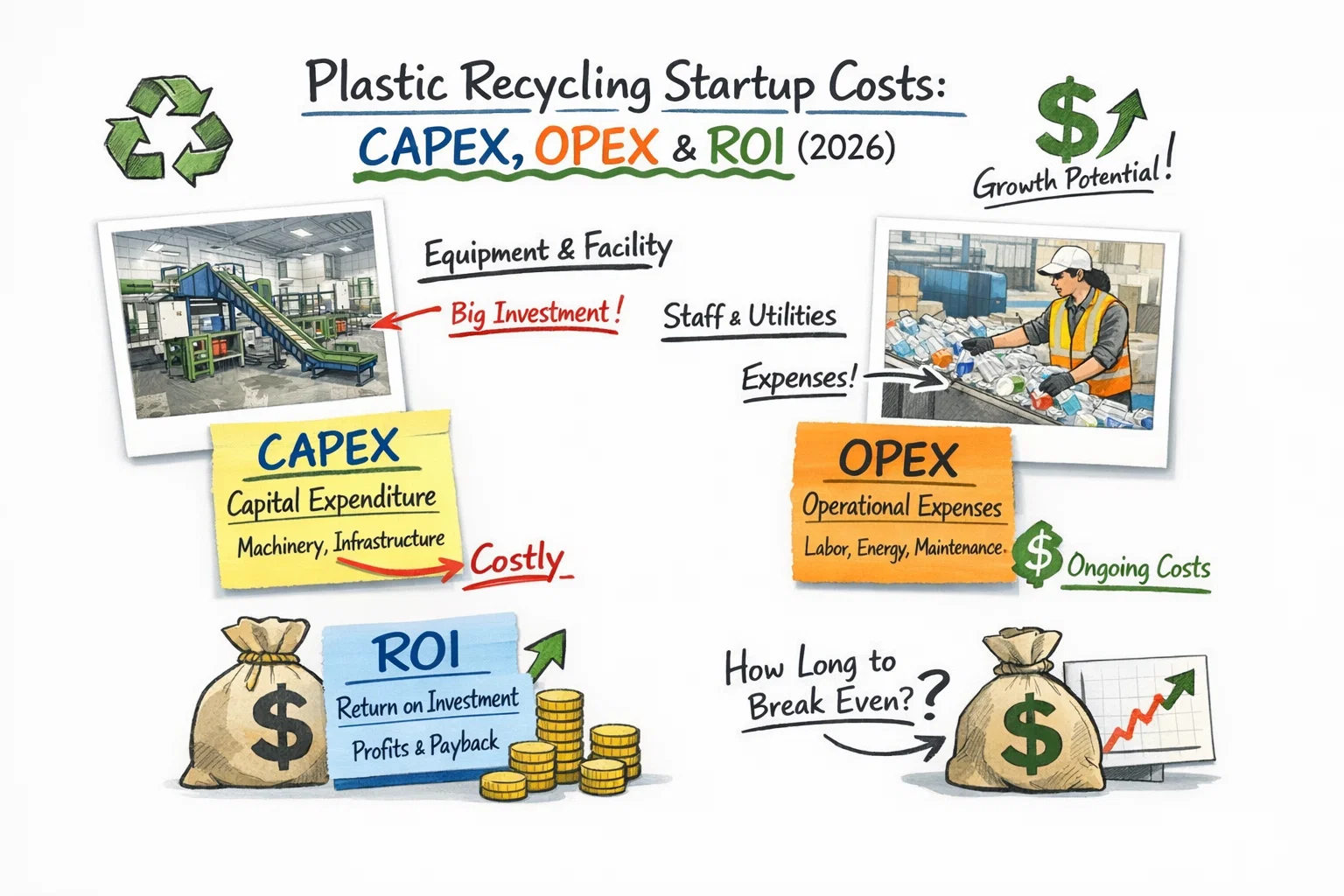
A plastic recycling plant costs between $400,000 and $1,300,000+ to launch, with machinery representing only 40–50% of total investment. The rest goes to facility buildout, electrical and water infrastructure, permits, feedstock inventory, and working capital.
That total number surprises most first-time buyers. They budget for equipment, then discover that installation, power upgrades, wastewater compliance, and three months of operating cash add another 50–60% on top. We see this pattern in nearly every market we serve.
This guide breaks down every cost category based on real project data from Energycle installations across 60+ countries. Whether you are planning a small 200 kg/h pilot plant or a 2,000 kg/h industrial facility, the numbers below will help you build a realistic budget — not a theoretical one.
Looking specifically for equipment pricing? See our 2026 plastic recycling machine price list for detailed costs by machine type, material, and capacity.
Quick Cost Snapshot
The table below summarizes total startup investment for a mid-size industrial plastic recycling plant (300–1,000 kg/h throughput). Small pilot projects will fall below these ranges; large fully automated facilities will exceed them.
| Cost Category | Estimated Range (USD) | % of Total |
|---|---|---|
| Machinery & process equipment | $200,000 – $800,000+ | 40–50% |
| Facility & infrastructure | $50,000 – $300,000 | 15–25% |
| Electrical & water systems | $25,000 – $110,000 | 5–10% |
| Permits, compliance & insurance | $15,000 – $40,000 | 3–5% |
| Feedstock initial inventory | $20,000 – $50,000 | 3–5% |
| Logistics & material handling | $20,000 – $80,000 | 3–8% |
| Working capital (3 months) | $100,000 – $200,000 | 15–20% |
| Total startup investment | $400,000 – $1,300,000+ | 100% |
Why the wide range? A 200 kg/h shredding-and-washing setup in Kenya with manual labor looks nothing like a 1,500 kg/h automated pelletizing plant in Germany. Capacity, automation level, material type, and local construction costs create the spread. The sections below help you pinpoint where your project falls.
CAPEX Breakdown: Where the Money Goes
Capital expenditure covers everything required to reach an operational, compliant facility. These are one-time costs that are difficult to reverse — and they directly shape your operating margins for years.
Machinery & Equipment: $200,000 – $800,000+
Recycling machinery is the largest single line item. Equipment quality is also the single most important factor influencing long-term ROI — low-cost machinery often results in higher energy consumption, frequent downtime, and inconsistent output quality that commands lower market prices.
| Process Stage | Typical Equipment | Price Range |
|---|---|---|
| Size reduction | Shredders, granulators, metal separation | $15,000 – $140,000 |
| Washing & separation | Friction washers, float-sink tanks, hot wash | $20,000 – $120,000 |
| Drying | Centrifugal dryers, thermal dryers, squeezers | $5,000 – $40,000 |
| Extrusion & pelletizing | Pelletizers, melt filters, strand cutters | $30,000 – $150,000+ |
| Conveyors & controls | Belt conveyors, screw conveyors, PLC panel | $10,000 – $50,000 |
High-capacity lines with advanced sorting, hot washing, and continuous melt filtration can exceed $800,000. For a detailed breakdown of individual machine prices, see our plastic recycling machine price list.
Facility & Infrastructure: $50,000 – $300,000
A recycling plant needs covered industrial space with adequate floor load capacity, ceiling height for conveyors, and room for material staging. Minimum requirements for a standard line:
- Floor area: 800–2,000 m² (8,600–21,500 sq ft) depending on throughput
- Ceiling height: 6–8 meters minimum for pelletizing lines with vertical feeders
- Floor loading: Reinforced concrete, 5+ ton/m² in equipment zones
- Access: Truck-accessible loading dock for feedstock delivery and pellet shipment
Leasing an existing industrial building and retrofitting it is the most cost-effective path for most startups — typically $50,000–$150,000 depending on location and condition. Purpose-built construction ranges from $200,000 to $1,000,000+ but is rarely necessary for first facilities.
Electrical & Water Systems: $25,000 – $110,000
This is the cost category most first-time buyers underestimate. Recycling lines consume significant power and water, and most leased industrial buildings need upgrades to handle the load.
- Electrical upgrades: $10,000–$50,000. Three-phase industrial power (380V/415V), upgraded panels, transformer if needed. A 500 kg/h line draws 200–400 kW.
- Water supply & treatment: $15,000–$60,000. Plastic washing consumes 2–5 m³ of water per ton of material. Settling tanks, filtration, and chemical treatment are required to meet discharge regulations — or to recirculate water in a closed-loop system.
In regions with strict environmental enforcement (EU, parts of Southeast Asia, South Africa), wastewater treatment can represent 30–40% of this category. Budget accordingly.
Permits, Compliance & Insurance: $15,000 – $40,000
Recycling facilities are regulated as industrial waste operations in most jurisdictions. Required items typically include:
- Environmental operating permit: $5,000–$15,000 (varies by country; can take 2–12 months to obtain)
- Fire safety compliance: $3,000–$10,000 for fire suppression, exits, material storage zoning
- Business registration & industrial license: $1,000–$5,000
- Insurance: $3,000–$10,000/year for property, liability, and equipment coverage
Time cost matters too. In some jurisdictions, environmental permits take 6–12 months. Factor this into your project timeline — rent payments on an empty facility while waiting for permits can add $20,000–$60,000 in carrying costs.
How Much Does a Recycling Plant Cost by Scale?
Total startup cost scales with throughput, but not linearly. Doubling capacity does not double your investment — facility, permits, and working capital grow slower than equipment cost. Here is what we see across Energycle projects worldwide.
Small-Scale Plant: 100–300 kg/h ($150,000 – $450,000)
Small-scale plants are the entry point for entrepreneurs, cooperatives, and pilot projects testing a local waste stream. A typical setup includes a shredder, granulator, washing system, and optional small pelletizer.
- Equipment: $60,000–$200,000
- Facility (leased, basic retrofit): $20,000–$60,000
- Infrastructure & permits: $15,000–$50,000
- Working capital: $40,000–$80,000
- Workforce: 5–10 workers per shift
- Monthly output: 30–100 tons
Best for: Markets with low labor costs, abundant informal waste supply, and growing local demand for recycled flakes. Common in Sub-Saharan Africa, South Asia, and parts of Southeast Asia.
Mid-Scale Plant: 300–1,000 kg/h ($400,000 – $1,000,000)
Mid-scale is the most common configuration for commercial recycling operations. These plants process post-consumer waste from municipal collection or industrial scrap from manufacturing facilities.
- Equipment: $200,000–$500,000
- Facility: $50,000–$200,000
- Infrastructure & permits: $30,000–$100,000
- Working capital: $100,000–$200,000
- Workforce: 10–25 workers (fewer with PLC automation)
- Monthly output: 100–350 tons
Best for: Buyers with confirmed feedstock supply and established output markets. This scale justifies PLC automation, which cuts labor cost by 40–60% and improves product consistency.
Large-Scale Plant: 1,000+ kg/h ($800,000 – $3,000,000+)
Large-scale facilities process high volumes for industrial buyers, bottle-to-bottle converters, and fiber manufacturers. They require sophisticated automation, AI-powered sorting, and continuous melt filtration.
- Equipment: $500,000–$1,500,000+
- Facility: $150,000–$500,000
- Infrastructure & permits: $80,000–$200,000
- Working capital: $200,000–$500,000
- Workforce: 20–50+ workers across multiple shifts
- Monthly output: 350–1,500+ tons
Best for: Experienced recyclers expanding capacity, vertically integrated manufacturers, and EPR-mandated collection operators in Europe and North America.
Key Takeaway: Start at the scale your feedstock supply supports — not the scale you hope to reach. Oversized equipment sitting idle burns cash through energy, maintenance, and depreciation without generating revenue.
OPEX: Monthly Operating Costs
Capital investment gets the attention, but operating expenses determine whether your plant is profitable. Below are monthly OPEX ranges for a mid-scale plant running 500 kg/h, 16 hours/day, 22 days/month (176 tons/month output).
Electricity & Water: $3,500 – $7,500/month
Energy is typically the second-largest operating cost after feedstock. A 500 kg/h washing and pelletizing line draws 200–400 kW total installed power, though actual consumption is lower (motors rarely run at full load simultaneously).
- Electricity: $3,000–$6,000/month at $0.08–$0.15/kWh (varies widely by country)
- Water: $500–$1,500/month. Closed-loop systems reduce water consumption by 85–90% vs. once-through systems
Energy-efficient equipment costs 10–20% more upfront but reduces electricity bills by 15–30%. Over a 10-year equipment lifespan, that savings compounds to $60,000–$180,000 — far exceeding the initial premium.
Labor & Training: $2,000 – $12,000/month
Labor cost varies enormously by region. A manual line in Nigeria might need 12 workers per shift at $150–$300/month each. The same throughput in Germany requires 4 workers at $3,000–$4,500/month each — making automation essential in high-wage markets.
| Operation Type | Workers per Shift | Monthly Labor Cost |
|---|---|---|
| Manual (basic controls) | 8–12 | Varies by region |
| Semi-automated (PLC) | 4–6 | 40–50% less than manual |
| Fully automated | 3–4 | 50–65% less than manual |
Budget $3,000–$8,000 for initial operator training. Equipment manufacturers like Energycle include commissioning and training in the project scope, but ongoing skill development — especially for pelletizer and extruder operators — is an investment that directly protects product quality and uptime.
Feedstock Procurement: $8,000 – $25,000/month
Feedstock is the largest operating cost for most recyclers. Baled plastic waste is not free — pricing depends on polymer type, contamination level, and regional supply dynamics.
| Material | Bale Price Range (2026) | Notes |
|---|---|---|
| PET bottles (post-consumer) | $150–$350/ton | Higher in supply-constrained markets |
| HDPE rigid (mixed color) | $200–$400/ton | Natural color commands premium |
| LDPE/LLDPE film | $80–$250/ton | Agricultural film at low end |
| PP rigid | $150–$350/ton | Automotive and industrial scrap higher quality |
Critical tip: Secure supply contracts before purchasing equipment. We have seen projects stall because the buyer invested in a 1,000 kg/h line but could only source 300 kg/h of feedstock consistently. Stable contracts with 2–3 suppliers reduce both price volatility and supply risk.
Maintenance & Spare Parts: $1,000 – $3,000/month
Regular maintenance protects uptime — the single most important profitability metric in recycling. Plan for:
- Blade sharpening/replacement: Every 200–500 operating hours for shredders, $500–$2,000 per set
- Screen and filter changes: Monthly for pelletizers, $200–$800 per change
- Bearing and seal replacement: Annual, $1,000–$3,000 across the line
- Spare parts inventory: Budget $5,000–$15,000 at startup (blades, screens, belts, bearings, motor couplings)
Choosing high-quality blade steel at purchase (SKD-11 or D2 grade) reduces sharpening frequency by 30–40% and extends blade life significantly.
OPEX Summary: For a 500 kg/h line running two shifts, expect total monthly operating costs of $15,000–$45,000 (excluding feedstock) or $25,000–$70,000 including feedstock. Your revenue needs to exceed this consistently to be viable.
Plastic Recycling Plant Setup Cost by Region
Equipment prices are relatively consistent worldwide (most recycling machinery ships FOB China), but total project cost varies significantly by region due to shipping, import duties, facility costs, labor rates, and regulatory complexity.
Africa: Kenya, Nigeria & South Africa
Africa is the fastest-growing market for plastic recycling investment. Lower facility and labor costs partially offset shipping expenses, making the total cost of ownership highly competitive.
- Kenya: 0% import duty on recycling machinery under EAC industrial tariff. Factory space in Nairobi industrial areas: $3–$5/m²/month. Total project cost for a 500 kg/h PET line: $280,000–$500,000
- Nigeria: Import duty 5–10%. Strong demand for HDPE/PP recycling driven by packaging industry. Lagos industrial space: $2–$4/m²/month. Total project cost: $300,000–$550,000
- South Africa: Duty exemptions available for qualifying equipment. Established recycling market with EPR mandates driving investment. Total project cost: $350,000–$700,000
Shipping from China to East/West African ports typically adds $3,000–$8,000 to equipment cost. Energycle has completed multiple installations across the continent and provides on-site commissioning and training.
South Asia: India & Bangladesh
South Asia has the highest density of plastic recycling operations globally, driven by abundant feedstock and strong export demand for recycled pellets.
- India: Import duty 7.5–10% + 18% GST (claimable as input credit). Extremely competitive domestic equipment market. Total project cost for a 500 kg/h line: $250,000–$500,000. Gujarat, Maharashtra, and Tamil Nadu are the primary recycling hubs.
- Bangladesh: Growing PET and garment waste recycling sector. Duty exemptions for export-oriented recyclers. Total project cost: $220,000–$450,000 (lower facility and labor costs)
Latin America: Mexico, Colombia & Brazil
Latin America offers strong domestic demand for recycled pellets from packaging and automotive manufacturers. Shipping from China costs $5,000–$12,000 depending on port.
- Mexico: 0% duty on recycling equipment under certain trade agreements. Proximity to US export market. Total project cost: $350,000–$700,000
- Colombia: Growing recycling mandates. Total project cost: $300,000–$600,000
- Brazil: Import duty up to 14%. Largest recycling market in Latin America. Total project cost: $400,000–$800,000
Europe & North America
The highest total project costs due to expensive facility space, strict environmental regulations, and high labor rates. However, recycled pellet selling prices are also highest in these markets — rHDPE pellets sell for $1,000–$1,400/ton in Europe vs. $600–$900/ton in emerging markets.
- Western Europe: Total project cost: $600,000–$2,000,000+. Full automation is standard (labor at $3,000–$5,000/month per worker). Strict wastewater discharge requirements add $30,000–$80,000.
- North America: Total project cost: $500,000–$1,500,000+. EPR legislation expanding rapidly. Many buyers choose Chinese-made equipment to reduce CAPEX while meeting throughput targets.
ROI & Breakeven Analysis
Every investment decision comes down to one question: how fast does the money come back? Here is a worked example using real project data.
Worked Example: 500 kg/h HDPE Rigid Recycling Plant
Investment:
- Complete washing + pelletizing line: $220,000
- Installation, electrical, water infrastructure: $35,000
- Facility lease deposit + retrofit: $30,000
- Working capital (3 months): $60,000
- Total startup: $345,000
Monthly Revenue:
- Operating 22 days/month x 16 hours/day x 500 kg/h = 176 tons/month
- Recycled HDPE pellet price (2026 average): $800–$1,100/ton
- Monthly gross revenue: $140,800–$193,600
Monthly Costs:
- Feedstock (HDPE bales at $200–$350/ton): $35,200–$61,600
- Electricity, water, labor, maintenance: $12,000–$22,000
- Total monthly cost: $47,200–$83,600
Monthly net profit: $57,200–$110,000
Payback period: 3–6 months on equipment cost, or 6–10 months on total startup investment.
Conservative vs. Optimistic Scenarios
The calculation above represents a well-managed operation with stable feedstock. Real-world variables can extend payback significantly. Here is what happens when conditions shift:
| Scenario | Key Assumption Change | Payback Period |
|---|---|---|
| Optimistic | Stable supply, strong pellet prices, 90%+ uptime | 6–10 months |
| Realistic | 70–80% uptime during ramp-up, moderate prices | 12–18 months |
| Conservative | Supply disruptions, price drops, learning curve | 18–36 months |
| Stress test | Feedstock cost +30%, pellet price -20% | 30–48 months |
Our recommendation: Model your business plan at the “Realistic” scenario, but ensure your cash reserves can survive the “Conservative” scenario. Projects that fail financially almost always underestimate ramp-up time and overestimate first-year utilization rates.
Plastic Recycling Cost Analysis: Hidden Costs Most Buyers Miss
After delivering recycling lines to 60+ countries, we have identified the cost items that consistently catch first-time investors off guard:
- Permit waiting time. Environmental permits take 3–12 months in many jurisdictions. If you have already signed a facility lease, you are paying rent on an empty building. Cost: $10,000–$60,000 in carrying costs.
- Ramp-up inefficiency. New operators produce 40–60% of rated capacity during the first 2–3 months. Your revenue model should not assume 100% throughput from day one.
- Feedstock quality surprises. Baled waste purchased from brokers often contains 10–25% contamination (wrong polymer, dirt, metal). Your effective throughput of saleable material is lower than gross input.
- Power factor penalties. Industrial equipment with large motors can trigger power factor surcharges from utilities. A power factor correction unit ($2,000–$5,000) eliminates this recurring charge.
- Pellet quality rejection. If your output does not meet buyer specifications (moisture, color, MFI), the pellets sell at 30–50% discount or get rejected entirely. Quality control equipment ($5,000–$15,000) pays for itself quickly.
- Logistics costs. Inbound feedstock and outbound pellet transport can run $5,000–$25,000/month depending on distances. Location selection near feedstock sources and buyers is one of the most impactful cost decisions.
- Unplanned equipment downtime. Every hour of downtime on a 500 kg/h line costs $100–$300 in lost production. Budget for redundancy in critical wear parts (blades, screens, bearings) to minimize repair time.
How to Reduce Startup Costs Without Sacrificing Quality
We regularly help buyers optimize their budgets. Here are the strategies that consistently deliver the biggest savings:
- Start with washing, add pelletizing later. A modular approach lets you begin with a $80,000–$150,000 washing line (selling clean flakes) and add pelletizing ($50,000–$150,000) once revenue is flowing. This reduces initial capital by 30–40%.
- Choose Chinese-made equipment. Chinese manufacturers like Energycle deliver 85–95% of European performance at 30–50% of the price. Our equipment operates in 60+ countries, including sites that previously used European brands. See our machine price comparison for details.
- Lease, do not build. Retrofitting an existing industrial building saves $100,000–$500,000+ vs. new construction, and gets you operational months faster.
- Skip automation if labor is cheap. In markets where skilled workers cost $150–$400/month, a manual line at $80,000 outperforms an automated line at $160,000 on ROI terms. Upgrade to automation when you scale.
- Negotiate feedstock contracts before buying equipment. Confirmed supply at a fixed price removes the biggest risk variable and makes financing easier to obtain.
- Buy a complete line, not individual machines. Integrated systems share conveyors, control panels, and water circuits — typically 10–15% less expensive than buying machines separately. Browse complete recycling solutions to compare configurations.
Next Steps: Get a Project-Specific Budget
The ranges in this guide cover the most common scenarios, but your project is unique. The fastest way to get a precise budget is to share three things with our engineering team:
- Material photos or samples — show us your actual feedstock (phone photos work). This determines contamination level, polymer type, and which process steps you need.
- Target capacity — how many kg/h or tons/day do you plan to process?
- Your location and end market — where the equipment ships to, and what your buyers require (flakes vs. pellets, color, certifications).
With these inputs, we deliver a transparent line-item quotation — typically within one business day.
Contact Energycle to start your project evaluation. We respond to every inquiry with a technical proposal, not a generic price sheet.
Frequently Asked Questions
How much does it cost to start a plastic recycling business?
Starting a plastic recycling business costs between $400,000 and $1,300,000+ for a mid-size industrial plant (300–1,000 kg/h). This includes machinery ($200,000–$800,000), facility ($50,000–$300,000), electrical and water infrastructure ($25,000–$110,000), permits ($15,000–$40,000), and working capital ($100,000–$200,000). Small-scale pilot plants can start from $150,000.
How much does a recycling plant cost to set up?
A recycling plant setup cost ranges from $150,000 for a small 100–300 kg/h facility to $3,000,000+ for a large 1,000+ kg/h automated plant. Machinery represents 40–50% of total cost. The remainder covers facility buildout, infrastructure, permits, logistics, and working capital. Your total cost depends on throughput capacity, material type, automation level, and regional factors.
What is the most profitable plastic to recycle?
PET and HDPE are the most profitable plastics to recycle in 2026. Recycled PET pellets (rPET) sell for $800–$1,200/ton with strong demand from fiber and food packaging manufacturers. Recycled HDPE pellets sell for $800–$1,100/ton. Both have established collection infrastructure and buyer networks, reducing sales risk compared to less common polymers.
Is a plastic recycling business profitable?
Yes — well-managed plastic recycling operations typically achieve net margins of 15–35% after ramp-up. A mid-scale plant processing 176 tons/month of HDPE can generate $57,000–$110,000 in monthly net profit. Profitability depends on three factors: feedstock cost, output pellet quality (and therefore selling price), and equipment uptime. Plants that maintain 80%+ uptime and consistent output quality are nearly always profitable.
How long does it take to recover the investment in a recycling plant?
Most recycling plants achieve payback within 18–36 months under conservative modeling that accounts for ramp-up time, market fluctuations, and occasional downtime. Well-managed operations with stable feedstock have reported payback as short as 6–10 months. The key variables are equipment uptime, feedstock cost stability, and recycled pellet selling price.
What are the biggest hidden costs in starting a recycling plant?
The most commonly overlooked costs are: electrical upgrades and power distribution ($10,000–$50,000), wastewater treatment systems ($15,000–$60,000), permit waiting time (rent payments on idle facility: $10,000–$60,000), ramp-up inefficiency (40–60% of rated capacity during first 2–3 months), and working capital for 3 months of feedstock and payroll ($100,000–$200,000).
Can I start a recycling business with $100,000?
$100,000 is tight but possible for a small-scale pre-processing operation — shredding and granulating plastic waste into flakes for sale to larger recyclers. A shredder + granulator setup at 100–200 kg/h costs $15,000–$40,000, leaving budget for a small facility, basic infrastructure, and initial working capital. This model works best in regions with low labor costs and accessible feedstock.
Should I produce flakes or pellets?
Flakes require lower CAPEX ($80,000–$200,000 for the line) and are simpler to operate. Pellets command higher market prices (typically 20–40% more per ton) but require an additional $50,000–$150,000 for the pelletizing system and tighter process control. If you are starting fresh with limited capital, begin with flakes and add pelletizing once revenue is established.
What equipment do I need to start plastic recycling?
The minimum equipment for a basic recycling operation includes a plastic shredder ($10,000–$80,000), a granulator ($8,000–$60,000), and a washing system ($20,000–$120,000). For pellet production, add a dryer ($5,000–$40,000) and a pelletizer ($30,000–$150,000). Complete turnkey lines from Energycle integrate all components with shared conveyors and controls.
How do I finance a plastic recycling plant?
Common financing approaches include: equipment leasing (reduces upfront CAPEX by 60–80%), bank loans (secured against equipment and facility), government grants and subsidies (available in many countries for recycling and circular economy projects), and investor equity. In Africa and South Asia, development finance institutions (DFIs) actively fund recycling projects. Having confirmed feedstock supply contracts and buyer off-take agreements significantly improves financing approval rates.
