

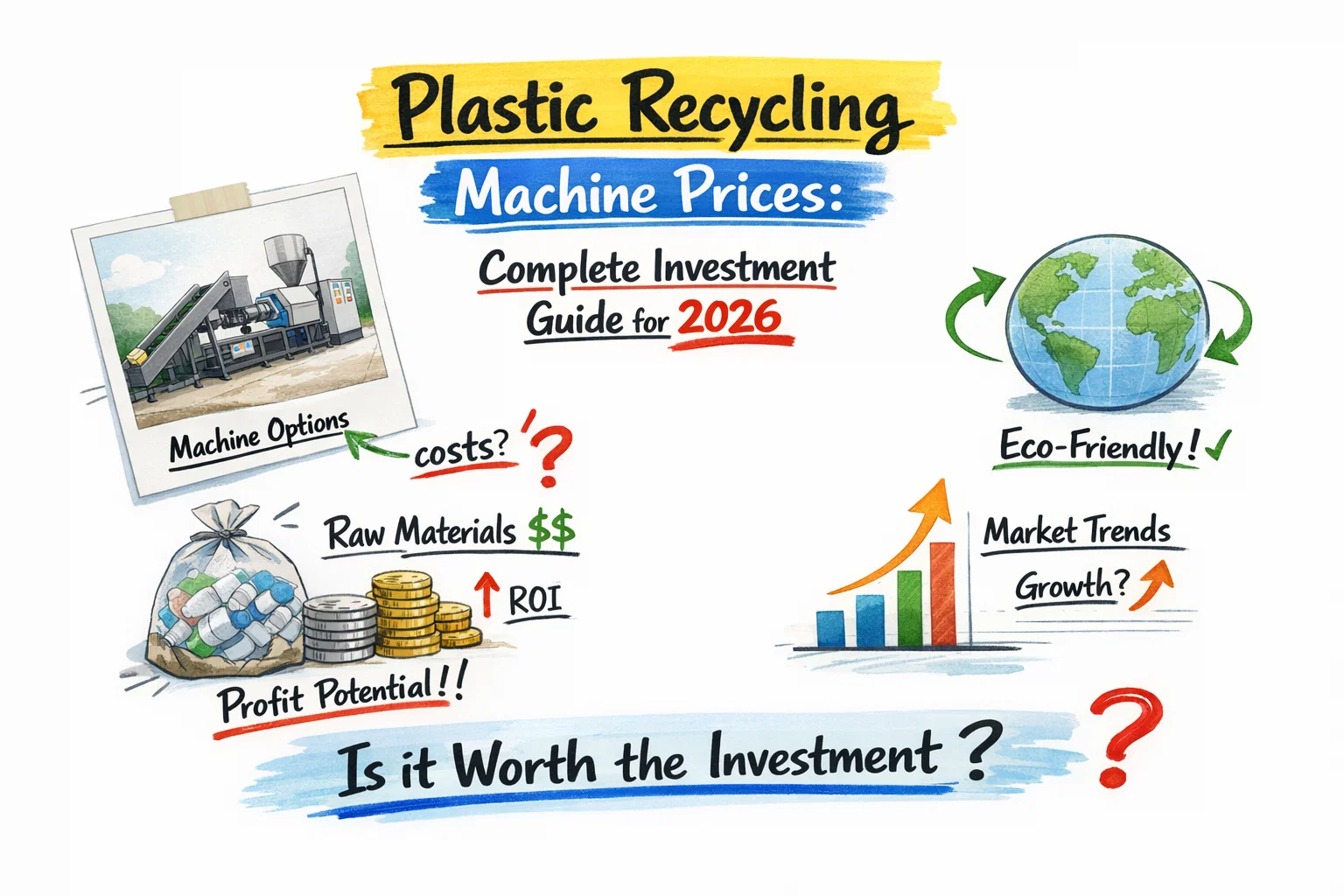
Prijzen van plasticrecyclingmachines: complete investeringsgids voor 2026
Editie 2026: Gebruik deze handleiding om een schatting te maken van de budgetten, configuraties te vergelijken en vervolgens door te klikken naar de juiste productpagina's voor gedetailleerde specificaties.
Prijsoverzicht van plasticrecyclingmachines (2026)
Startconfiguratie
Typisch: $15k–$60k
Het beste voor: basisverkleining + lokale ophaalservice
Versnipperaar/vergruizer + basis transport (geen wassen/pelletiseren)
Waslijn
Typisch: $80k–$250k
Het beste voor: PET / PP / HDPE met verontreiniging
De fasen zijn afhankelijk van de etiketten, lijm, olie/zand en de behoefte aan een hete wasbeurt.
Complete lijn (tot pellets)
Typisch: $150k–$300k
Het beste voor: verkoop van pellets van stabiele kwaliteit
Filtratieniveau + ontgassing + automatisering bepalen de hoogste kosten.
Belangrijke Investeringsinformatie
Inzicht in de prijzen van plasticrecyclingmachines is cruciaal voor bedrijven die de recyclingindustrie betreden. In plaats van alleen de "officiële prijzen" te vergelijken, is het belangrijk om te focussen op (1) de staat van het materiaal, (2) de capaciteit en (3) de vereiste kwaliteit van het eindproduct. Deze drie factoren bepalen de benodigde processtappen – en daarmee het werkelijke budget.
Het Begrijpen van de Markt voor Plastic Recycling Machines
De vraag naar recyclingapparatuur blijft groeien naarmate de regelgeving strenger wordt en merken hogere streefwaarden voor gerecycled materiaal hanteren. Voor kopers betekent dit meer keuzemogelijkheden, maar ook een grotere prijsvariatie afhankelijk van het automatiseringsniveau, de scheidingseisen en de gewenste kwaliteitsklasse.
Met de juiste apparatuurkeuze en een stabiele aanvoer van grondstoffen kunnen veel recyclingbedrijven winstgevend zijn. De meest consistente bedrijven zijn degenen die het proces afstemmen op de mate van vervuiling en de operationele kosten beheersen (energie, water, slijtageonderdelen en stilstand).
Typen Plastic Recycling Machines en Hun Prijzen
Scheikrachtapparatuur
Enkelassige shredder voor folie en zakken (specificaties en opties)
Prijsbereik: $3.000 – $15.000
Capaciteit: 50-500 kg/uur
Het beste voor: Zachte plastics zoals films en zakken
Versnipperaars met één as zijn een veelgebruikt instapmodel voor flexibele materialen. De uiteindelijke prestaties zijn afhankelijk van het rotorontwerp, de zeefgrootte en de maatregelen tegen het oprollen van materialen – de configuratie is dus belangrijker dan de basisprijs.“
Industriële shredder met dubbele as voor harde kunststoffen en grof afval.
Prijsbereik: $20.000 – $100.000
Capaciteit: 500-5.000 kg/uur
Het beste voor: Rigide plastics en gemengde afvalstromen
Dubbele-assystemen leveren een hoog koppel voor dikwandige onderdelen en gemengde materiaalstromen. De prijs wordt bepaald door de grootte van de frees, de tandwielkast, de sterkte van het frame en het automatiserings-/veiligheidspakket.
Was- en scheidingssystemen
| Systeemtype | Prijsbereik (USD) | Verwerkingscapaciteit | Belangrijkste kenmerken |
|---|---|---|---|
| Compacte Reinigingsunits | $15.000 – $50.000 | 200-1.000 kg/uur | Basisreiniging, handmatige sortering |
| Automatische Reinigingslijnen | $50.000 – $200.000 | 1.000-3.000 kg/uur | Meervoudige reiniging, dichtheidsscheiding |
| Industriële Reinigingsystemen | $200.000 – $1.000.000 | 3.000-15.000 kg/uur | Geavanceerde scheiding, waterrecycling |
Aanbevolen volgende stap: Vergelijk complete recyclingoplossingen per materiaal. .
Pelletisatie- en Extrusieapparatuur
Pelletiseermachine met één schroef voor standaard vlokken
Prijsbereik: $10.000 – $80.000
Het beste voor: Relatief schone, stabiele grondstof
Enkelschroefsystemen worden veel gebruikt voor kosteneffectieve pelletproductie. Het budget is afhankelijk van de schroefdiameter, de L/D-verhouding, de verwarmingszones, de filtratie en de pelletiseermethode.
Dubbelschroefsextruder voor verontreinigde of gemengde materialen
Prijsbereik: $80.000 – $250.000
Het beste voor: Hogere meng-/ontgassingsbehoeften
Dubbelschroefextruders verwerken complexere materialen met betere menging en ontgassing. Uw filtratie-/ontgassingsdoel is de belangrijkste factor die de totale productiekosten bepaalt.
Kosten per materiaalsoort: benodigde stappen en prijsbepalende factoren
| Materiaal | Typische workflow | Onmisbare modules | Belangrijkste kostenfactoren | Beste "Volgende klik"“ |
|---|---|---|---|---|
| PET-flessen | Sorteren → Etiketten verwijderen → (Heet) wassen → Spoelen → Drogen | Etiketverwijderaar, heet wassen, dichtheidsscheiding, droger | Lijm/etiketten, vereiste voor heet wassen, waterrecycling, uiteindelijke vochtigheid | Oplossingen voor het wassen en recyclen van PET |
| HDPE / PP stijf | Vermalen → Wassen → Drijven en zinken → Drogen → (Optioneel pelleteren) | Breker, wrijvingswasinstallatie, drijf-zinktank, droger | Verontreinigingsniveau, scheidingsbehoeften, automatiseringsniveau | Recyclinglijn voor harde kunststoffen |
| LDPE-folie | Versnipperen → Voorwassen → Uitpersen/Ontwateren → Drogen → (Optioneel pelleteren) | Enkelassige shredder, foliepers, droogsysteem | Vochtgehalte, zand/grond, persen versus thermisch drogen, anti-oprollen | Configuraties van filmvernietigers |
| PP geweven zakken | Versnipperen → Wassen → Drogen → Pelletiseren | Versnipperaar, wasfasen, pelletiseren met filtratie | Inkt/verontreiniging, smeltfiltratieniveau, kwaliteitseisen voor de output | Opties voor pelletiseermachines |
Praktische tip: De snelste manier om de investeringskosten (CAPEX) te beheersen, is door de workflow af te stemmen op uw werkelijke vervuilingsniveau en outputvereisten. Betaal niet voor stappen die u niet nodig hebt.
Wat deze prijzen doorgaans wel (en niet) omvatten
Inbegrepen (standaard)
- Hoofdmachine + standaard motor en versnellingsbak
- Standaard elektrische schakelkast / standaard bedieningselementen
- Standaard slijtageonderdelen (verschilt per model)
Vaak uitgesloten (bevestig dit in de offerte)
- Transportsysteem / silo's / platforms & staalconstructie
- Installatie en inbedrijfstelling / training van operators op locatie
- Waterrecycling, afvalwaterzuivering, stofafvang
- Aangepaste spanning/normen, certificeringen, reserveonderdelenpakketten
- Verzendkosten, lokale belastingen, inklaring.
Een eerlijke prijsvergelijking is pas mogelijk nadat de leveringsomvang (EXW/FOB/CIF), het automatiseringsniveau en de vereiste outputkwaliteit zijn bevestigd.
Volledige Investeringsanalyse voor Recyclinginstallaties
Kleine Schaal (500-2.000 ton/jaar)
Investeringsopdeling
- Apparatuurkosten: $50.000 – $200.000
- Faciliteitseisen: 500 – 2.000 vierkante meter
- Jaarlijkse omzetpotentieel: afhankelijk van de lokale grondstoffen en productkwaliteit
- Gebruikelijke terugverdientijd: Vaak geschat op 18-36 maanden (per geval verschillend).
Kleinschalige installaties zijn een praktische instapmogelijkheid wanneer er een stabiele lokale aanvoer is en een duidelijke afnemer voor de vlokken/pellets. De beste opstellingen houden het proces eenvoudig en richten zich op een hoge bedrijfszekerheid en een constante output.
Middelgrote Schaal (5.000-15.000 ton/jaar)
Voordelen
- Hoogere verwerkingsefficiëntie
- Betere schaalvoordelen
- Meer automatiseringsopties
- Meerdere productstromen
- Strengere kostenbeheersing per ton
Overwegingen
- Hoogere kapitaalvereisten (300.000-800.000)
- Grotere faciliteitseisen (5.000-20.000 vierkante meter)
- Meer complexe operaties
- Hoogere regelgevingscompliance
- Grotere marktgevaarlijke blootstelling
Industriële Schaal (20.000+ ton/jaar)
Grootschalige recyclinginstallaties kunnen investeringen van 1 tot 10 miljoen euro vergen, afhankelijk van de complexiteit van het materiaal en de mate van automatisering. Deze installaties kunnen het volgende omvatten:
- Geavanceerd sorteren om de scheiding en zuiverheid te verbeteren
- Geïntegreerde kwaliteitscontrole om te voldoen aan de eisen van premium kopers
- Water-/energieoptimalisatie om de operationele kosten te verlagen
- Schaalbare modulaire secties voor capaciteitsuitbreiding
Belangrijke factoren die de prijs van apparatuur beïnvloeden
Capaciteit en capaciteitsvereisten
De verwerkingscapaciteit hangt sterk samen met de kosten van de apparatuur, omdat een hogere doorvoer sterkere rotors, krachtigere aandrijvingen, zwaardere frames en robuustere veiligheids- en besturingssystemen vereist.
Niveau van automatisering en integratie van technologie
Automatiseringsfuncties die de efficiëntie kunnen verbeteren en de arbeidskosten kunnen verlagen, zijn onder andere:
- Optische/geavanceerde sortering: extra kosten, hogere zuiverheid van het eindproduct
- PLC-besturingssystemen: hogere aanschafkosten, eenvoudigere bediening en stabiliteit
- Monitoring- en onderhoudsplanning: Vermindert uitvaltijd door middel van gepland onderhoud.
Reputatie van het merk en oorsprong van de productie
| Oorsprong van het apparaat | Typische prijspositie | Belangrijkste voordelen | Beste pasvorm |
|---|---|---|---|
| Europese fabrikanten | Premie | Geavanceerde technologie, robuuste constructie | Hoge automatiseringsgraad en strenge productie-eisen |
| Chinese fabrikanten | Waarde | Kosten-effectief, snelle aanpassing | Het beste rendement op investering (ROI) wordt behaald wanneer de specificaties goed gedefinieerd zijn. |
| Noord-Amerikaanse fabrikanten | Premiumwaarde | Lokale ondersteuning, vertrouwd met de regelgeving | Projecten die een lokale dienstverlening vereisen |
Financiële prestaties: TCO & ROI (Wat telt in de praktijk)
Checklist voor de totale eigendomskosten (TCO)
- Slijtageonderdelen: messen, schermen, schroeven, verwarmingselementen, lagers
- Energie per ton: hangt af van het motorvermogen, de droogmethode en de scheidingsfasen.
- Waterbeheer: verbruik, filtratie, recycling, afvalwaterverwerking
- Uitvaltijd: onderhoudsintervallen en beschikbaarheid van reserveonderdelen
- Arbeid: sorteerintensiteit + automatiseringsniveau
Modellen voor het genereren van inkomsten
Recyclingbedrijven genereren doorgaans inkomsten via een of meer bronnen:
- Verkoop van vlokken/pellets: De prijs is sterk afhankelijk van de zuiverheid en consistentie.
- Verwerkingskosten voor afval: afhankelijk van de lokale economische omstandigheden voor de inzameling
- Bijproductstromen: Scheid waardevolle fracties waar mogelijk.
Terugverdientijd van de investering
Het rendement op investering (ROI) varieert sterk afhankelijk van de grondstofkosten, de mate van verontreiniging, de lokale energieprijs, de opbrengst en de productkwaliteit. De meeste projecten berekenen de terugverdientijd aan de hand van conservatieve aannames en geven prioriteit aan een stabiele bedrijfszekerheid boven maximale doorvoer.
Kader voor besluitvorming over apparatuurkeuze
Stapsgewijze selectieprocedure
- Definieer verwerkingsvereisten: soorten plastic, volume, verontreiniging, productiedoelstelling
- Bevestig de workflow: Voeg alleen fasen toe die daadwerkelijke problemen oplossen.
- Model TCO: energie + slijtageonderdelen + water + stilstand
- Beoordeel de capaciteit van de leverancier: ondersteuning, training, reserveonderdelen, levertijd
- Plan voor schaalbaarheid: modulaire uitbreidings- en upgrademogelijkheden
Kwaliteit versus kostenoverwegingen
De initiële prijs is belangrijk, maar de totale eigendomskosten (TCO) bepalen de winstgevendheid. Beter afgestemde apparatuur levert vaak het volgende op:
- Minder uitvaltijd: stabiele output en voorspelbaar onderhoud
- Hoogere outputkwaliteit: betere acceptatie door kopers en prijsstelling
- Lagere eenheidskosten: per ton energie-/wateroptimalisatie
Ontvang snel een nauwkeurige offerte
Stuur 5 inputs op — ontvang een nauwkeurige configuratie en offerte
- Materiaalfoto's + verontreiniging (etiketten, zand, olie)
- Doelcapaciteit (kg/u)
- Uitvoervorm (vlokken of korrels) + gewenste specificaties (vochtgehalte/MFI)
- Voeding (spanning/Hz)
- Leveringsomvang (alleen apparatuur / turnkey / installatie)
We zullen reageren met een aanbevolen processtroomschema en een gespecificeerde offerte.
Conclusie
De prijs van apparatuur voor plasticrecycling in 2026 kan het beste worden begrepen als "configuratie-gebaseerd", niet als een vast bedrag. De beste aanpak is om de workflow af te stemmen op uw materiaal- en outputvereisten, te controleren wat er inbegrepen is en de totale eigendomskosten (slijtageonderdelen, energie, water, stilstand) te evalueren voordat u een definitieve investeringsbeslissing neemt.
Als u foto's van het materiaal, de capaciteit en de gewenste eindkwaliteit met ons deelt, kunnen we het juiste proces aanbevelen en een nauwkeurige, vergelijkbare offerte opstellen.
