

Recycling-Focused Twin-Screw Pelletizing
Twin-Screw Extruder System for Plastic Recycling
A recycling-focused co-rotating twin-screw pelletizing system for prepared plastic flakes and regrind that require intensive melt homogenization, devolatilization, and filtration before pellet production. It is selected for recycled-pellet projects; formulation-heavy masterbatch, high-filler, and reinforced compounds belong to the dedicated Twin-Screw Compounding & Extrusion Line.
Why Choose a Recycling-Focused Twin-Screw Pelletizing System
This system is designed for prepared recycled flakes and regrind that need stronger melt homogenization, devolatilization, and filtration than a standard single-screw route before pellet production.
Modular Screw and Barrel Layout
The building-block design lets the system be adjusted around your polymer, product geometry, venting need, and downstream line layout.
Accurate Temperature Control
Independent heating zones help maintain stable melt viscosity and improve day-to-day production consistency.
Multiple Gearbox and Torque Options
Different torque series and drive arrangements allow the line to be sized around throughput, resin type, and product duty.
Self-Cleaning Screw Interaction
Co-rotating intermeshing screws help reduce dead zones and residue accumulation, which supports more stable long-run extrusion.
Flexible Feeding and Venting Configurations
Main feed, side feed, venting, and vacuum sections can be combined according to the polymer system and downstream product target.
Maintenance-Friendly Service Layout
Replaceable wear sections and modular service access help reduce downtime and simplify long-term maintenance planning.
Typical Applications for Recycling Pelletizing
This system is intended for recycled-pellet projects, not profile, pipe, or sheet production.
Washed Rigid Flakes and Regrind
Processes prepared PP, PE, and compatible rigid-plastic flakes that need stronger melt homogenization before pelletizing.
PET and Polyester Recycling
Can be configured for properly dried PET or polyester feed when the project requires controlled melting, vacuum devolatilization, and pellet production.
Printed and Volatile-Bearing Regrind
Supports prepared recycled feed that needs additional devolatilization to reduce moisture and process volatiles before filtration and pelletizing.
Compatible Recycled Polymer Blends
Helps homogenize compatible recycled resin streams when stable melt quality is required without a formulation-heavy compounding recipe.
High-Filtration Recycling Projects
A suitable route when recycled feed requires configurable venting, staged filtration, and closer melt-quality control.
Complete Recycling Pelletizing Lines
Can be integrated with feeding, vacuum, melt filtration, pellet cutting, cooling, drying, and conveying equipment as a complete recycling line.
How the Twin-Screw Recycling Pelletizing System Works
The exact layout varies by polymer and feed condition, but the core route remains feeding, melting, devolatilization, filtration, and pelletizing.
Feed Prepared Recycled Material
Washed and suitably dried flakes or regrind enter through controlled feeding selected for the material form and bulk density.
Homogenize and Melt
The co-rotating screws plasticize and homogenize the recycled feed while maintaining stable melt development and output pressure.
Devolatilize Under Vacuum
Atmospheric venting and optional vacuum zones remove moisture and process volatiles according to the feed condition and pellet-quality target.
Filter the Melt
The melt passes through a screen changer selected for the contamination level and required filtration continuity.
Pelletize and Handle the Output
The filtered melt is cut into pellets, then cooled, dried, and conveyed using a method matched to the polymer and project requirements.
Twin-Screw Recycling System vs Compounding and Single-Screw Alternatives
Use this page for recycling-focused pellet output. Choose the separate compounding line when formulation control, fillers, additives, masterbatch, or reinforcement are the main requirement.
| Decision Factor | Twin-Screw Recycling System | Twin-Screw Plastic Extruder | Single-Screw Pelletizer |
|---|---|---|---|
| Primary Goal | Recycling pellet production from prepared flakes and regrind | Compounding and pelletizing formulated materials | Standard pellet recovery from prepared scrap |
| Downstream Focus | Integrated melt filtration, pellet cutting, and pellet handling | Integrated pellet cutting and pellet handling | Pelletizing and discharge |
| Best Process Fit | Recycling projects that need stronger homogenization and devolatilization | High-value compounds, masterbatch, and additive mixing | General recycling projects with simpler feed and lower complexity |
| Mixing Intensity | High for recycling-focused melt homogenization | Highest for formulation and dispersion | Lower than twin-screw systems |
| When to Choose | When recycled feed needs twin-screw homogenization, devolatilization, or filtration before pellet production | When additives, fillers, masterbatch, or reinforced formulations define the product | When feed is prepared and a standard pelletizing route is sufficient |
Swipe horizontally to view the full table.
Technical Specifications
Final sizing depends on polymer type, feed form, moisture, contamination, filtration demand, target pellet quality, and required throughput.
| Screw Diameter | 50 – 150 mm |
|---|---|
| L/D Ratio | Up to 68:1 |
| Max Screw Speed | Up to 600 rpm |
| Motor Power | 55 – 450 kW |
| Max Capacity | 150 – 2000 kg/h |
Swipe horizontally to view the full table.
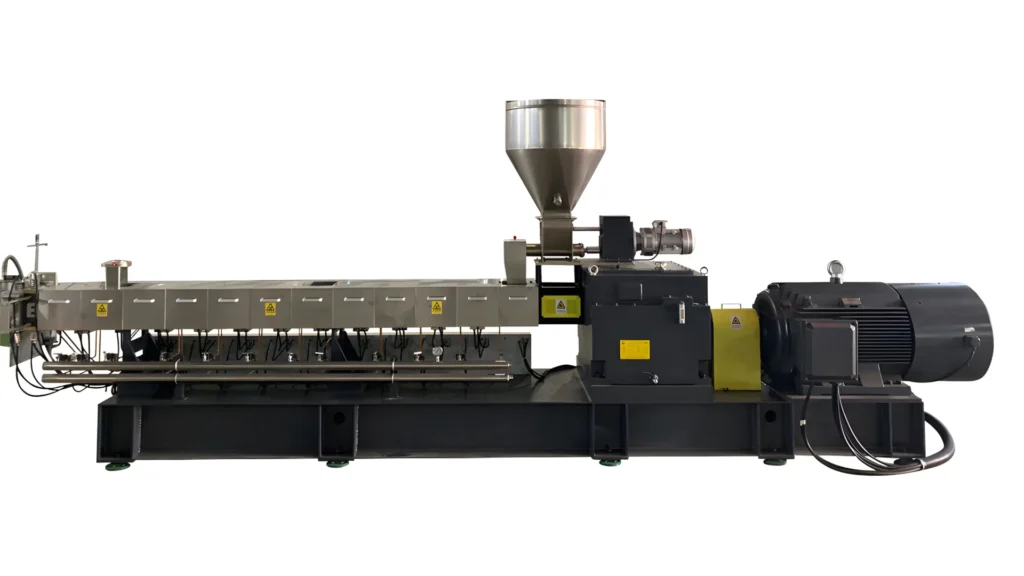
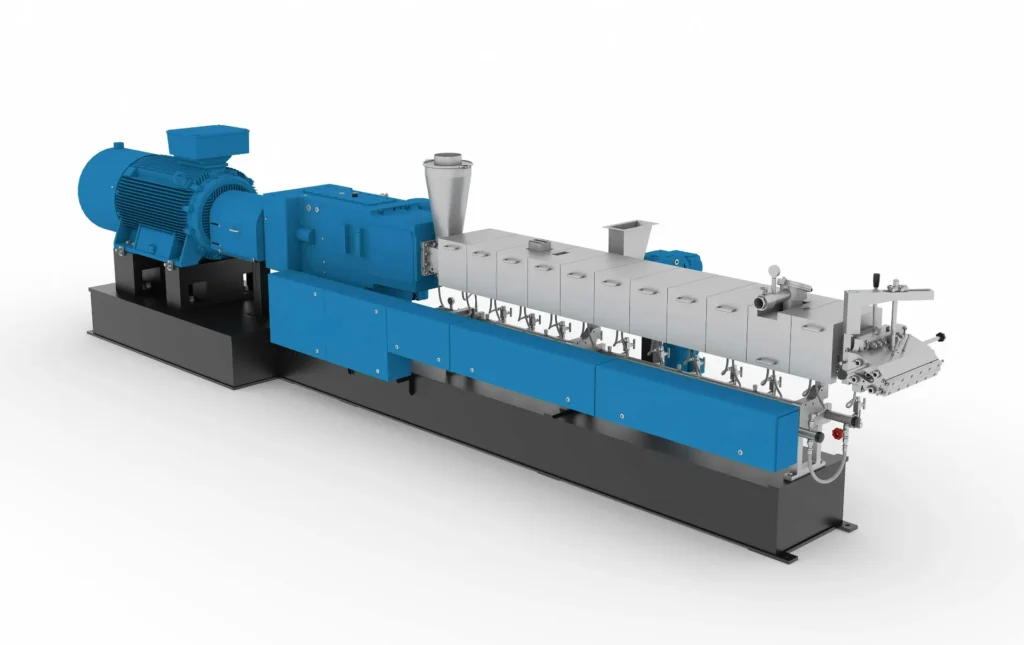
Machine Gallery
Reference views of the co-rotating twin-screw extruder system and pelletizing configuration.
Video Overview
A quick look at the modular twin-screw system and its recycling-pellet configuration options.
Frequently Asked Questions
Questions buyers ask when comparing recycling-focused twin-screw pelletizing, compounding, and simpler single-screw routes.
It is intended for washed and suitably dried thermoplastic flakes or regrind. Final suitability depends on polymer compatibility, feed preparation, moisture, contamination, and the required recycled-pellet quality.
This recycling-focused system starts with prepared flakes or regrind and prioritizes melt homogenization, devolatilization, filtration, and stable pellet output. The separate compounding line is intended for recipes built around fillers, additives, masterbatch, reinforcement, or intensive formulation control.
Choose the twin-screw recycling route when feed variation, moisture or volatiles, and melt-quality requirements call for stronger homogenization and devolatilization. A single-screw pelletizer is often sufficient for cleaner, more stable feed that needs a simpler recovery route.
Strand, water-ring, or another pellet-cutting method can be matched to the polymer, melt behavior, throughput, and pellet-handling requirements. The final method is confirmed after material review and testing when needed.
Please share the polymer, feed form, washing and drying condition, moisture, contamination, target throughput, required pellet quality, and preferred pelletizing method.
Need a Twin-Screw Recycling Pelletizing Layout Matched to Your Feedstock?
Send us your polymer type, feed form, moisture, contamination, target throughput, and pellet-quality requirement. We will help define screw diameter, L/D ratio, venting, filtration, pellet cutting, and support equipment.