

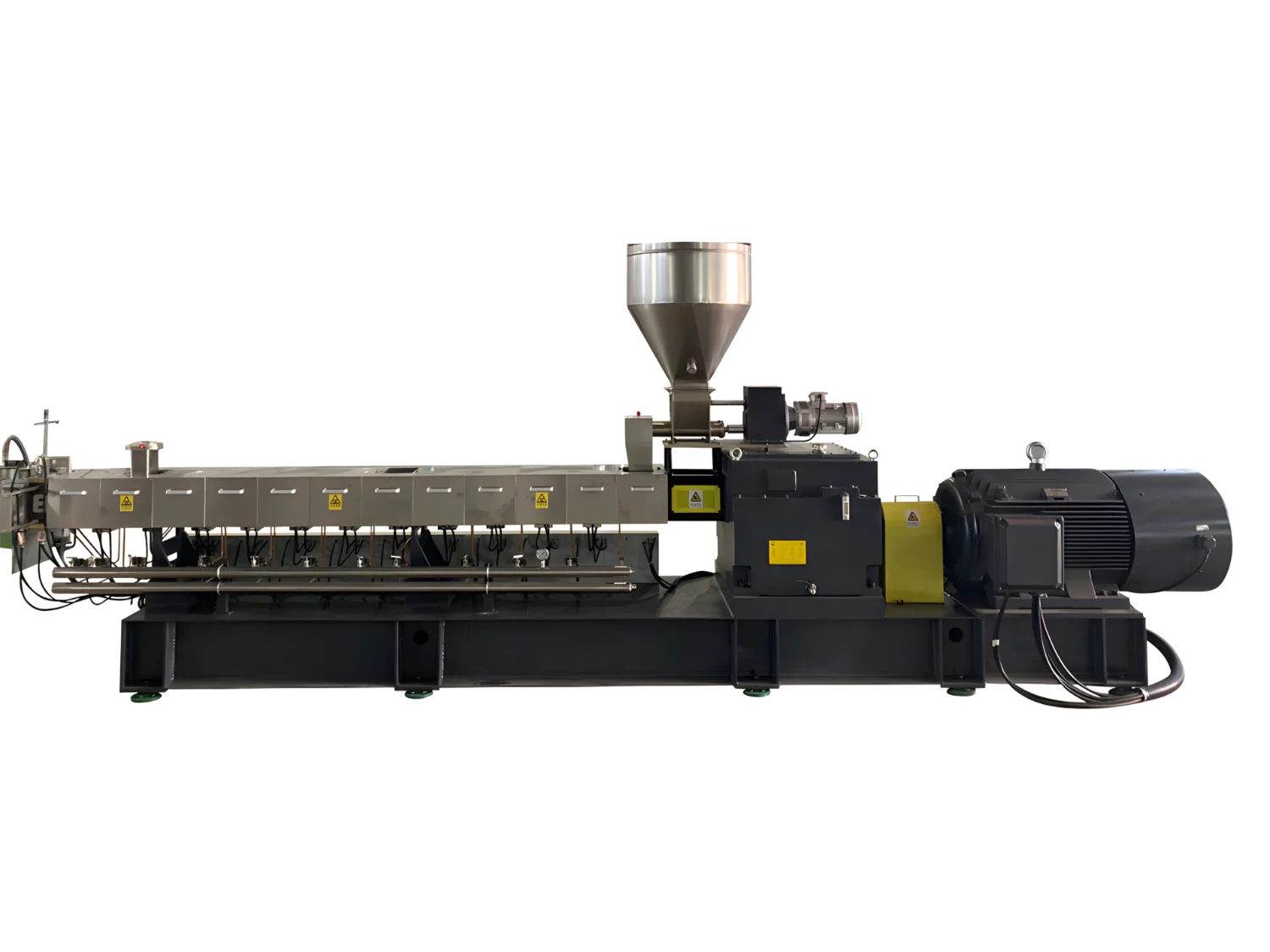
A maszyna do granulowania plastiku melts shredded, washed, or densified plastic waste and reshapes it into uniform pellets — the standard raw material form that injection molders, extruders, and film blowers purchase and process. Pelletizing is the final value-adding step in plastic recycling: it converts low-value flakes or regrind into market-ready pellets worth $400–$1,200/ton depending on polymer type and quality. This guide covers every pelletizer type, real specifications, material-to-machine matching, cutting system selection, and a framework for specifying the right pelletizing line for your operation.
What Is a Plastic Pelletizing Machine?
A plastic pelletizing machine (also called a pelletizer or granulating extruder) melts plastic input material through a heated screw-and-barrel system, filters out contaminants via a screen changer, then pushes the melt through a die plate where a cutting system chops it into cylindrical or spherical pellets of 2–5 mm diameter. The pellets are cooled (by water or air), dried, and collected in bags or silos. Learn the fundamentals in our guide: What Is a Plastic Pelletizer and How Does It Work?
Key components of every pelletizing line:
- System karmienia — force feeder, crammer, or cutter compactor that densifies and feeds material into the extruder
- Wytłaczarka — single-screw or twin-screw barrel that melts, homogenizes, and pressurizes the plastic
- Screen changer — hydraulic or manual filter that removes contaminants (paper, metal, dirt) from the melt
- Die plate — perforated plate that shapes the melt into strands or directly into pellets
- System tnący — strand cutter, water ring cutter, or underwater pelletizer that forms final pellet shape
- Cooling and drying — water bath, air cooling, or centrifugal dryer that solidifies and dries pellets
Rodzaje maszyn do granulacji tworzyw sztucznych
Pelletyzator jednoślimakowy
The most common type for recycling applications. A single rotating screw inside a heated barrel melts and conveys plastic forward. Simple, reliable, and lower cost than twin-screw systems. Best for clean, pre-sorted feedstock (PE, PP, PET flakes, PS). Throughput: 100–1,500 kg/h. See our single-screw pelletizing machine range.
Twin-Screw Pelletizer
Two co-rotating or counter-rotating screws provide superior mixing, venting, and degassing. Required for materials that need intensive compounding (color concentrates, filled plastics, engineering plastics) or that contain high moisture or volatile content. Higher cost (1.5–2.5× single-screw) but produces better pellet quality for demanding applications. Throughput: 200–3,000 kg/h.
Cutter Compactor Pelletizer
Integrates a high-speed cutter compactor (agglomerator) directly before the extruder. The cutter compactor shreds, densifies, and pre-heats film, fiber, and lightweight materials through friction — then feeds directly into the extruder barrel. This eliminates the need for a separate agglomerator or densifier, saving floor space and energy. Ideal for PE/PP film, woven bags, nonwoven fabric, and raffia. See our cutter compactor pelletizing line.
Two-Stage Pelletizer
Uses two extruders in series: the first melts and filters, the second homogenizes and builds pressure for pelletizing. The two-stage design provides extra melt filtration, better degassing (two venting zones), and more consistent melt quality. Best for heavily printed film, post-consumer mixed plastics, and materials with high contamination. Higher investment but produces premium-quality pellets.
Pelletizer Type Comparison
| Typ | Przepustowość | Moc silnika | Najlepszy dla | Koszt względny |
|---|---|---|---|---|
| Single-Screw | 100–1,500 kg/h | 22–250 kW | Clean PE/PP/PET flakes, regrind | 1× (podstawowy) |
| Twin-Screw | 200–3,000 kg/h | 37–400 kW | Compounding, engineering plastics, high-moisture | 1.5–2.5× |
| Zagęszczarka Cutter | 200–1,500 kg/h | 55–300 kW | PE/PP film, woven bags, nonwoven, raffia | 1.2–1.8× |
| Two-Stage | 300–2,000 kg/h | 75–400 kW | Printed film, post-consumer mix, high contamination | 1.5–2.0× |
Cutting Systems: Strand vs. Water Ring vs. Underwater
The cutting system determines pellet shape, quality, and throughput. Choosing the right one depends on your polymer type, required pellet geometry, and production speed. For an in-depth comparison, see strand vs. underwater pelletizing for rPET.
| System cięcia | Kształt granulek | Najlepszy dla | Zakres przepustowości | Zalety | Wady |
|---|---|---|---|---|---|
| Cięcie pasm | Cylindryczny | PE, PP, PET, PS — most recycling | 100–1,500 kg/h | Simple, low cost, easy maintenance | Strand breakage with low-melt-strength materials |
| Water Ring Cutting | Semi-spherical | PE, PP — especially film recycling | 200–1,500 kg/h | Compact, no strand handling, consistent pellets | Not ideal for high-melt-flow materials |
| Underwater (UWP) | Kulisty | PET, PA, TPE, engineering plastics | 500–5,000+ kg/h | Perfect pellet shape, high-speed, dust-free | Expensive, complex, higher maintenance |
See our water ring pelletizing system for PP/PE woven bag applications.
Material-to-Pelletizer Matching
Different plastics require different extruder configurations, temperatures, and cutting systems. Here is our recommendation based on 500+ installations:
| Tworzywo | Recommended Pelletizer | System cięcia | Key Notes |
|---|---|---|---|
| PE Film (LDPE/LLDPE) | Cutter Compactor + Single-Screw | Water ring or strand | Film needs densifying; cutter compactor is ideal. See PE/PP film pelletizer |
| PP Woven Bags / Raffia | Cutter Compactor + Single-Screw | Water ring | High bulk — compaction essential before extrusion |
| Płatki z butelek PET | Single-Screw (with crystallizer/dryer) | Strand or underwater | Must dry to <50 ppm moisture; iv loss control critical. see PET pelletizer |
| Rigid HDPE/PP (crates, drums) | Single-Screw | Strand | Easy to pelletize; force-feeder sufficient. See rigid PP/HDPE pelletizer |
| Nonwoven / Meltblown | Cutter Compactor + Single-Screw | Water ring | Ultra-light material requires aggressive densification. See nonwoven pelletizing line |
| PA / Nylon | Twin-Screw (with vacuum venting) | Underwater or strand | Hygroscopic — needs drying + vacuum degassing |
| Mieszane Post-Consumer | Two-Stage | Strand or water ring | High contamination requires double filtration + degassing |
For detailed material compatibility, read jakie rodzaje tworzyw sztucznych można przetwarzać za pomocą granulatora.
Pelletizer Specifications Reference
Representative specifications from Energycle’s single-screw pelletizer range:
| Model | Średnica śruby | Współczynnik L/D | Przepustowość | Moc silnika | Typowe zastosowanie |
|---|---|---|---|---|---|
| SJ-65 | Ø65 mm | 28:1–33:1 | 80–150 kg/h | 22–37 kW | Small-batch, rigid regrind |
| SJ-85 | Ø85 mm | 28:1–33:1 | 150–300 kg/h | 37–55 kW | PE/PP film, woven bags |
| SJ-100 | Ø100 mm | 28:1–33:1 | 250–500 kg/h | 55–90 kW | Medium recycling lines |
| SJ-120 | Ø120 mm | 28:1–33:1 | 400–800 kg/godz. | 90–132 kW | High-volume recycling |
| SJ-150 | Ø150 mm | 28:1–33:1 | 600–1,200 kg/h | 132–200 kW | Large industrial lines |
| SJ-180 | Ø180 mm | 28:1–33:1 | 800–1,500 kg/h | 200–250 kW | Maximum throughput |
Odwiedź naszą plastic pelletizer product page for complete specifications and configuration options. For pricing guidance, see plastic pelletizer machine cost factors I budget vs. high-end pelletizer comparison.
5-krotny framework wyboru
Step 1: Define Input Material
Identify polymer type (PE, PP, PET, PS, PA, etc.), form (film, flake, regrind, fiber), contamination level (clean in-house vs. dirty post-consumer), and moisture content. This determines extruder type, number of stages, and whether you need a cutter compactor or pre-dryer.
Step 2: Set Throughput Target
Calculate required pellet output in kg/h. Match upstream washing/drying line output to pelletizer capacity. Always size the pelletizer 20–30% above your current throughput for surge capacity and future growth. Running a pelletizer at 80% of rated capacity extends screw and barrel life significantly.
Step 3: Choose Cutting System
Strand cutting for simplicity and most recycling applications. Water ring for film recyclers wanting compact, consistent pellets. Underwater for PET, engineering plastics, and high-speed production where pellet shape matters for end customers.
Step 4: Specify Pellet Quality
Define target pellet size (typically 3–4 mm), acceptable moisture content (<0.5% for most applications, <50 ppm for PET), color consistency requirements, and maximum contamination levels. These specifications determine screen changer mesh size, number of filtration stages, and cooling/drying system design.
Krok 5: Oblicz zwrot z inwestycji
Pellets sell for $400–$1,200/ton depending on polymer and quality — 2–5× the value of washed flakes. A 500 kg/h pelletizer running 8 hours/day, 300 days/year produces 1,200 tons annually. At $200/ton margin over flake value, that is $240,000/year gross margin from a machine investment of $80,000–$200,000 — payback in 6–12 months.
Maintenance Essentials
- Codziennie: Inspect die plate for blocked holes; clean screen changer; check water temperature in cooling system
- Tygodnik: Verify screw torque and motor amperage (rising amps indicates barrel wear); inspect pellet cutter blades
- Miesięczny: Lubricate gearbox; check heater band function on each zone; inspect screen changer seals
- Every 2,000–4,000 hours: Measure screw and barrel wear (replace when clearance exceeds 0.5 mm per side)
- Rocznie: Full inspection of screw, barrel, die plate, gearbox, and electrical systems
For complete maintenance programs, see our pelletizer maintenance checklist I przewodnik po metodach peletyzacji.
Rozpoczęcie pracy z Energycle
Energycle produkuje plastic pelletizing machines from 80 kg/h laboratory units to 1,500 kg/h production lines, plus complete turnkey recycling systems from washing through pelletizing. We provide:
- Bezpłatne badanie materiałów — send us your plastic samples and we test pellet quality on our machines
- Custom line design — extruder, cutting system, and feeding system configured for your specific material and throughput
- Installation and training — on-site commissioning and operator training included
- Wsparcie po sprzedaży — spare screws, barrels, die plates, and cutter blades with fast delivery
Skontaktuj się z naszym zespołem inżynierii with your material type, throughput requirement, and desired pellet specifications — we will recommend the right configuration and provide a quotation within 48 hours.
Często zadawane pytania
Ile kosztuje maszyna do granulowania plastiku?
Small single-screw pelletizers (100–200 kg/h) cost $25,000–$60,000. Mid-range systems (300–800 kg/h) cost $60,000–$150,000. Large production lines (800–1,500 kg/h) range from $150,000–$350,000. Complete turnkey lines including washing, drying, and pelletizing cost $200,000–$800,000. Cutter compactor systems add 20–50% over basic single-screw models.
Jaka jest różnica pomiędzy peletyzatorem i granulatorem?
A pelletizer melts plastic and extrudes it through a die to form uniform pellets — it changes the physical form of the material through heating. A granulator mechanically cuts solid plastic into small pieces (regrind) without melting. Pellets are market-ready raw material; regrind is an intermediate product. See our detailed comparison: pelletizer vs. granulator.
Which pelletizer type is best for PE film recycling?
A cutter compactor pelletizer is the best choice for PE/PP film. The integrated cutter compactor densifies lightweight film through friction heating before feeding it into the extruder — solving the biggest challenge in film recycling (low bulk density). A water ring cutting system produces consistent, dust-free pellets. Expect 200–1,500 kg/h throughput depending on model size.
What throughput can I expect from a plastic pelletizer?
Throughput depends on screw diameter, motor power, and material type. A Ø65 mm single-screw handles 80–150 kg/h; a Ø120 mm handles 400–800 kg/h; a Ø180 mm reaches 800–1,500 kg/h. Film materials pelletize faster than rigid flakes due to easier melting. Actual throughput is typically 75–85% of rated maximum during sustained production.
How do I choose between strand cutting and water ring cutting?
Strand cutting is simpler and cheaper — melt exits the die as strands, passes through a water bath, and is cut by a rotary blade. Best for rigid plastics with good melt strength. Water ring cutting cuts melt directly at the die face in a water chamber — produces rounder pellets with no strand-handling issues. Best for film-grade PE/PP where strand breakage would be a problem.
Can I pelletize PET bottle flakes?
Yes, but PET requires special handling: flakes must be crystallized and dried to below 50 ppm moisture before extrusion (PET degrades rapidly with moisture at melt temperatures). Use a single-screw or twin-screw pelletizer with vacuum venting. Strand cutting or underwater pelletizing works best. IV (intrinsic viscosity) loss should be monitored — target less than 0.02 dL/g drop through the extruder. See our PET flake pelletizer sizing guide.
What maintenance does a pelletizer require?
Daily: clean screen changer and inspect die plate. Weekly: check motor amperage and cutter blade sharpness. Monthly: lubricate gearbox and inspect heater bands. Every 2,000–4,000 hours: measure screw and barrel wear. The screw and barrel are the highest-cost wear items — budget $3,000–$15,000 for replacement depending on size. Running clean material and maintaining proper temperatures extends wear life 2–3×.
Is plastic pelletizing profitable?
Yes — pelletizing adds $200–$600/ton in value over washed flakes. A 500 kg/h line running one shift (8h/day, 300 days/year) produces 1,200 tons of pellets annually. At a conservative $200/ton value-add, gross margin is $240,000/year from a $100,000–$200,000 equipment investment. Most operations achieve payback within 6–12 months. Post-consumer recycled pellets with food-grade certification command even higher premiums.
Związane zasoby
- Pelletizery Plastikowe — Zasób Produktów
- Maszyna do granulacji plastiku jednoślimakowego
- Maszyna do granulowania folii PP/PE
- Sztywna maszyna do wytwarzania granulatów PP/HDPE
- System granulacji pierścieniem wodnym
- PET Flake Single-Screw Pelletizer
- Single-Screw Pelletizer for PET: Sizing Guide
- Linia do peletyzacji zagęszczarki Cutter
- Linia do granulacji włóknin PP Meltblown
- Strand vs. Underwater Pelletizing for rPET
- Pelletizer Machine Cost Factors
- Budget vs. High-End Pelletizer Comparison
- Lista kontrolna konserwacji pelletizerów
- Różnice między pelletizerem a granulatorem
- What Plastics Can Be Pelletized?
- Maszyna do recyklingu plastiku: Kompleksowy Przewodnik
