

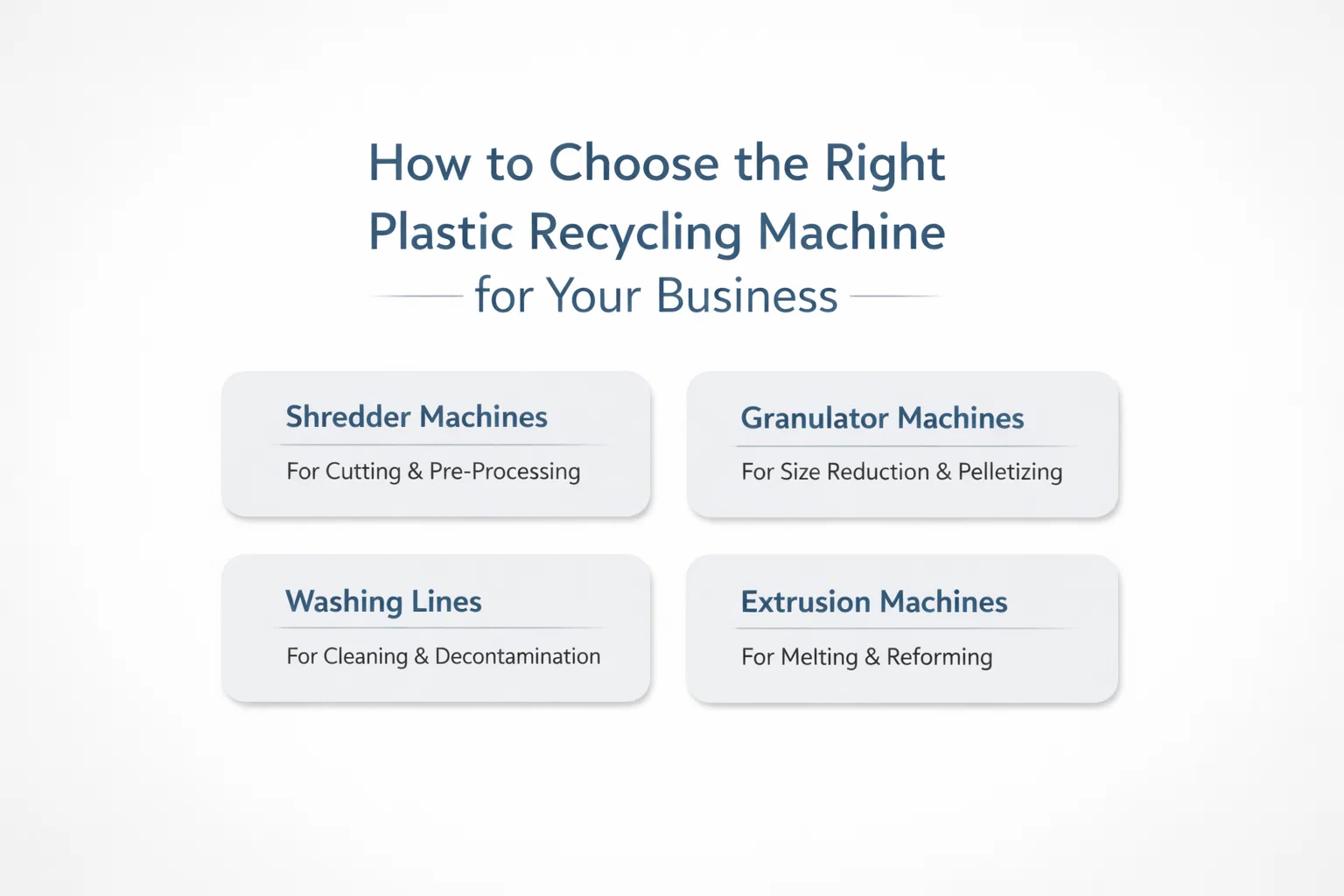
Comment choisir la machine de recyclage de plastique adaptée à votre entreprise
Trouver le bon machine de recyclage de plastique Cela exige bien plus qu'une simple comparaison des spécifications ; il est indispensable d'adopter une approche stratégique de vos sources de matières premières et de vos objectifs de production. Dans le contexte industriel de 2026, un traitement efficace des déchets est essentiel à la rentabilité. Qu'il s'agisse de bouteilles post-consommation ou de rebuts de production, l'équipement que vous choisirez aura un impact direct sur votre réussite opérationnelle. prix de la machine de recyclage du plastique Bien que le chiffre soit souvent le premier que les acheteurs regardent, la véritable valeur réside dans la façon dont la technologie s'adapte à votre flux de déchets spécifique.
Ce guide examine les facteurs critiques que vous devez évaluer pour construire une ligne de recyclage performante, vous assurant ainsi un retour sur investissement optimal.
1. Évaluez le type et l'état de votre matériel.
Avant de contacter les fabricants, il vous faut un profil précis de votre matière première. Le fonctionnement des machines de recyclage du plastique varie selon la densité, le taux d'humidité et la forme du plastique. Un mauvais choix de système d'alimentation ou de découpe est la cause la plus fréquente des goulots d'étranglement de la production.
Plastiques rigides vs. plastiques flexibles
La forme physique de vos déchets détermine les exigences de prétraitement :
- Plastiques souples (films LDPE, LLDPE, sacs tissés PP) : Ces matériaux sont légers et volumineux. Les trémies standard se bouchent ou se bloquent souvent. Il vous faut une machine avec un système intégré. fraise-compacteur Ce composant densifie le matériau par la chaleur de friction avant de l'introduire dans l'extrudeuse, assurant ainsi un débit de production stable.
- Plastiques rigides (bouteilles en PEHD, tuyaux en PP, caisses en ABS) : Ces pièces nécessitent une réduction de taille importante. Une puissante broyeur de plastique La première étape consiste généralement à démonter les objets encombrants. Ensuite, une granulateur de plastique elle affine le matériau en flocons uniformes, qui sont ensuite prêts pour l'extrusion.
Déchets propres vs. déchets contaminés
Les déchets post-consommation contiennent souvent de la saleté, de l'huile, des étiquettes en papier et de l'humidité. Si vous transformez des paillettes lavées, votre extrudeuse doit être équipée d'un système de dégazage (ventilation) spécifique pour éliminer la vapeur et les composés volatils. Le traitement de matériaux humides avec une machine standard entraînera la formation de bulles et de granulés fragiles. Pour les films fortement imprimés, privilégiez les systèmes à double ventilation qui garantissent des granulés réutilisables de haute qualité.
2. Évaluation du débit et de la capacité
Les exigences en matière de capacité déterminent à la fois l'emprise physique de la ligne et le résultat final prix de la machine de recyclage du plastique. Les fabricants indiquent généralement la puissance des machines en kilogrammes par heure (kg/h).
Soyez réaliste quant à vos besoins en volume de production. Une machine sous-dimensionnée limitera votre croissance, tandis qu'une machine surdimensionnée gaspillera de l'énergie et de l'espace. Il est conseillé de choisir un système capable de gérer votre volume de production maximal actuel, avec une marge de 20 à 30% pour les développements futurs.
Vous recherchez des équipements à haut rendement ?
Découvrez notre gamme de systèmes de recyclage avancés conçus pour les plastiques rigides et souples. Obtenez des spécifications précises, des configurations personnalisées et des informations sur les prix.
Voir les modèles de machines3. Comprendre le prix d'une machine de recyclage du plastique
Le coût des équipements de recyclage varie considérablement en fonction de la qualité des composants et du niveau d'automatisation. Si un coût initial plus faible peut paraître attractif, il masque souvent des frais d'exploitation plus élevés à long terme.
Principaux facteurs influençant les prix :
- Qualité des composants : Les machines utilisant des moteurs et des réducteurs génériques sont moins chères mais sujettes aux pannes. Les modèles haut de gamme utilisent des marques reconnues (comme Siemens ou ABB) et des vis bimétalliques résistantes à l'usure, ce qui justifie leur prix plus élevé par leur longévité.
- Automation: Les lignes entièrement automatisées dotées de panneaux de commande intelligents permettent de réduire les coûts de main-d'œuvre, mais augmentent l'investissement initial.
- Technologie de filtration : Les filtres laser ou à rétrolavage avancés permettent de traiter des matériaux plus sales sans arrêts constants pour changer les écrans, ce qui augmente considérablement la productivité.
Pour une perspective plus large sur les normes industrielles et les définitions du recyclage, %% offre d'excellentes ressources techniques.
4. Efficacité énergétique et coûts d'exploitation
En 2026, les coûts énergétiques demeurent un poste de dépense majeur pour toute usine de recyclage. Les machines modernes de recyclage du plastique utilisent des variateurs de fréquence et des éléments chauffants infrarouges afin de minimiser la consommation d'énergie. Lors de la comparaison des devis, demandez la consommation énergétique précise par kilogramme de produit. Une machine permettant d'économiser 15% sur les factures d'électricité amortira son prix d'achat plus élevé en quelques années seulement.
5. Assistance après-vente et pièces détachées
Même les meilleures machines lourdes nécessitent un entretien. La disponibilité des pièces détachées et de l'assistance technique est aussi importante que la machine elle-même. Assurez-vous que votre fournisseur propose :
- Expédition rapide des pièces consommables (lames, grilles, résistances).
- Capacités de dépannage à distance via une connexion Internet.
- Formation complète des opérateurs pour prévenir toute mauvaise manipulation.
Réflexions finales
Choisir le bon équipement, c'est trouver un équilibre entre vos besoins en matériaux, vos objectifs de production et votre budget. Il est important de considérer le coût total de possession plutôt que le seul coût initial. prix de la machine de recyclage du plastique, Vous vous assurez ainsi un atout fiable qui dynamise votre entreprise. Chez Energycle, nous vous accompagnons dans vos choix afin de trouver la solution idéale pour vos installations.
Foire aux questions
L'extrudeuse monovis est la norme pour le recyclage de matériaux propres et pré-broyés comme les paillettes de film PE. extrudeuse à double vis offre de meilleures capacités de mélange et de formulation, ce qui le rend idéal pour l'ajout de charges, de mélanges-maîtres ou la modification des propriétés des matériaux.
Le traitement de l'humidité nécessite des composants spécifiques, tels que des systèmes de dégazage sous vide et des pompes à vide plus puissantes. Ces ajouts augmentent la complexité et le prix de la machine, mais sont indispensables au traitement des déchets lavés ou post-consommation afin d'éviter les défauts dans les granulés finaux.
En général, non. Les différents plastiques ont des points de fusion et des caractéristiques d'écoulement différents. Si certaines machines peuvent traiter des groupes de plastiques compatibles (comme le PE et le PP), le traitement de matériaux incompatibles (comme le PVC et le PET) sur une même ligne entraîne généralement une contamination et des dommages matériels.
