

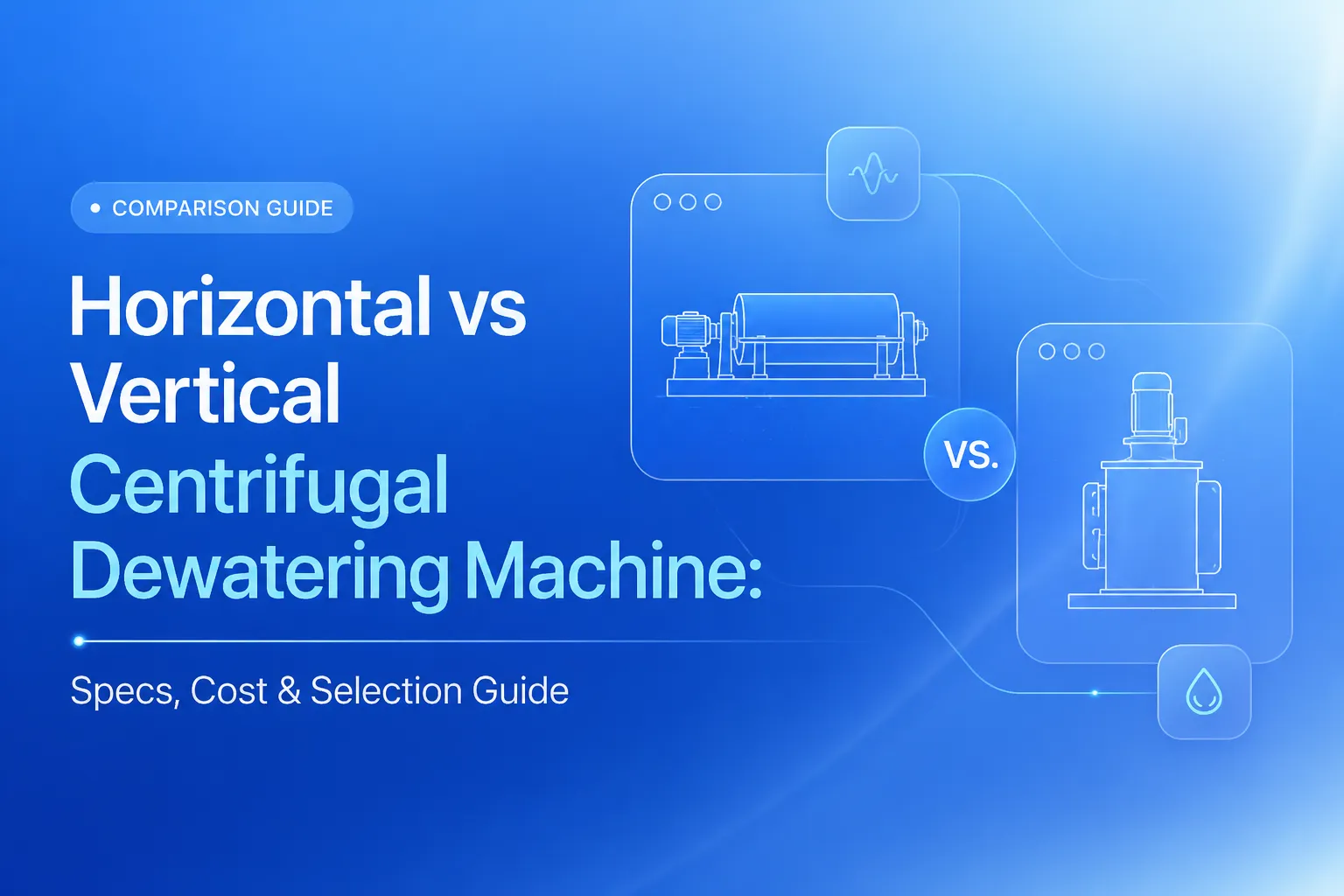
Kako biste izabrali odgovarajuću mašinu za odvajanje vode iz plastične linije za recikliranje, potrebno je prvo doneti odluku u vezi sa izborom tipa centrifugalne mašine. horizontal or vertical orientation. The choice affects floor space, capacity ceiling, dewatering uniformity, maintenance access, and capital cost — sometimes by 2–3× across all five factors. This guide covers the engineering difference, real specifications, side-by-side comparison, and a 5-step decision framework so you can specify the right machine for your line on the first try.
Quick Answer: Which Should You Choose?
| Your Situation | Preporučeno |
|---|---|
| Throughput under 800 kg/h, limited floor space, simple maintenance team | Vertikala centrifugalna odvodomerna mašina |
| Throughput 1,000+ kg/h, continuous operation, uniform output critical | Horizontal centrifugal dewatering machine |
| PET bottle flake line, 24/7 operation | Horizontal (with optional pre-stage vertical) |
| Pilot line, R&D, or small workshop | Vertikalno |
| Mixed rigid waste (HDPE crates, PP drums) at high volume | Horizontal |
Both are centrifugalni strojevi za odvodnjavanje Како функционише ова машина? Какво је њен принцип рада?.
The Engineering Difference
Vertikala centrifugalna odvodomerna mašina
The rotor shaft sits vertically. Wet flakes feed in from the top of the chamber, the rotor spins at 1,200–1,500 RPM, water exits radially through the screen, and dewatered flakes discharge from a side or bottom port. Material spends roughly 2–5 seconds inside the chamber.
The footprint is compact — typically 1.0 × 1.5 m for a 400–800 kg/h unit — and the machine sits self-contained on its base. Internal access for screen and rotor inspection is straightforward: lift the top cover and the components are visible. No conveyor or feed paddle needs alignment.
Horizontal Centrifugal Dewatering Machine
The rotor shaft runs horizontally inside a longer screen drum (typically 1.5–2.5 m long). Wet flakes enter at one end, paddles or screw flights on the rotor convey material along the screen while spinning at 800–1,200 RPM, and dewatered material discharges at the far end. Residence time is longer — typically 5–10 seconds — and the longer travel path produces more consistent moisture across the output stream.
Footprint is larger (typically 2.5 × 1.5 m for a 1,500 kg/h unit), but throughput per square meter of floor space is comparable to vertical units. Maintenance requires removing end covers and sliding the rotor out — more involved than a vertical unit but still a 1–2 hour task with two technicians.
Side-by-Side Comparison
| Faktor | Vertikalno | Horizontal |
|---|---|---|
| Razmak proizvodnje | 200–1,000 kg/h | 800–3,500 kg/h |
| Snaga motora | 22–45 kW | 37–90 kW |
| brzina rotora | 1,200–1,500 RPM | 800–1,200 RPM |
| Vrijeme provedenog времена | 2–5 sekundi | 5–10 sekundi |
| Izlazna vlažnost (tvrdi komadići) | 3–5% | 2–4% |
| Output uniformity | Umjereno | Visoka (dugotrajan kontakt s mrežom) |
| Tlocrtna površina | ~1.5 m² | ~3.5 m² |
| Potrebno prostor za glavu | 2.5–3.0 m (visina komore) | 1.5–1.8 m |
| Trošak ulaganja (USD) | $8,000–$18,000 | $15.000–$45.000 |
| Energija po tuni isušenog materijala | 30–45 kWh/tuna | 25–40 kWh/tuna |
| Složenost održavanja | Niska (gornji pristup) | Srednja (uklanjanje krajnje pokrivnice) |
| Najbolji materijal | PET komadići, tvrdi regrind HDPE/PP, niski volumeni mješovitog | PET komadići od boća (visoki volumeni), HDPE kutije, neprekidni regrind PP |
Ključna stvar: Uspon na cijenu, prostor za postavljanje i jednostavnost održavanja. Horizontalni postoji na proizvodnji, uniformnosti izlaza i energetskoj učinkovitosti po tuni na velikom skupu. Prekidački točka je oko 1,000 kg/h — ispod toga, okomiti je gotovo uvijek pravi izbor; iznad toga, horizontalni gotovo uvijek je pravi izbor.
Gdje se svaki mjesto u liniji za recikliranje
Linija za komadiće od PET boća
Za recikliranje PET boća iznad 1 tona/h, horizontalna centrifugalna isušavanje je standardna. Dugotrajan kontakt s mrežom uklanja ostatke etikete i sitne čestice zajedno s vodom, a nizak brzina rotora smanjuje lomljenje komadića na PET (koji je gušći nego HDPE ili PP). Ispod 800 kg/h, okomiti stroj je dovoljan — često se koristi u manjim operacijama za PET rekreaciju i pilot linijama. Neki visoki specijalni PET linije pokreću okomiti jedinicu kao fazu poliranja nakon horizontalni primarni, postizavajući ispod 2% vlažnosti prije termalna sušilica.
HDPE / PP tvrdi regrind
Za očišćene HDPE kutije ili PP cijev regrind, obje orijentacije rade dobro. Odluka je čistotno količina proizvodnje i budžet: okomiti za operacije ispod 1 tona/h, horizontalni za veće kapacitete. HDPE i PP toleriraju više brzina rotora bez lomljenja, tako da okomiti strojevi na 1,500 RPM rade efikasno s tim materijalima.
Linije za film PE / PP
Стандардни машине за центрифугално деуважавање чврстих флакова – вертикалне или хоризонталне – нису оптимизирани за рециклирађе филма који собира се око падела ротора. За рециклираџе филма треба користити brzinski centrifugalni stroj za odvodnjavanje plástika (anti-wrap rotor design) or a aparat za cijeđenje filma Ови уређаји су специјално дизајнирани за флексибилне материјале.
Mixed Rigid Waste / Pilot Lines
For research, pilot, or low-throughput operations processing mixed rigid plastics, vertical centrifugal dewatering machines are the practical default. Capital cost is 2–3× lower, footprint fits in a corner of a workshop, and a single operator can run and maintain the unit. Most equipment manufacturers (including Energycle) offer entry-level vertical units at 22–37 kW for under $12,000 USD.
5-Step Decision Framework
Step 1: Define Your Throughput
Identify your peak hourly material flow in kg/h, not your daily tonnage divided by 24 hours. Recycling lines run in batches with cleanup gaps, so peak feed rate is typically 1.5–2× the daily-average rate. If your line processes 10 tons over an 8-hour shift, your peak is approximately 1,500–1,800 kg/h — choose horizontal.
Step 2: Audit Your Floor Space and Headroom
Vertical units need 2.5–3.0 m of vertical clearance for the chamber height plus crane access for screen removal. Horizontal units need 2.5–4.5 m of length plus working space at both ends. Measure actual available footprint i headroom — vertical machines fail to install in low-ceiling buildings even when the floor footprint fits.
Step 3: Specify Output Moisture Requirement
If your downstream process is direct extrusion of HDPE or PP, 3–5% moisture is acceptable — vertical handles this. If your downstream is PET pelletizing or any application requiring sub-2% moisture, you will need a horizontal centrifugal dewatering machine followed by a termalna sušilica. Read our centrifugal vs thermal drying energy comparison Мы не можем выполнить эту задачу.
Step 4: Calculate Total Cost of Ownership
Vertical capital cost is lower (sometimes by half), but horizontal energy cost per ton is also lower at scale. For a line running 4,000 hours/year:
- Vertical unit (45 kW, 800 kg/h): $12,000 capital + ~$7,200/year energy at $0.10/kWh = $19,200 first-year, $7,200/year ongoing
- Horizontal unit (55 kW, 1,500 kg/h): $25,000 capital + ~$8,800/year energy = $33,800 first-year, $8,800/year ongoing
For the same throughput requirement, the horizontal unit pays back its higher capital cost over 4–6 years through lower per-ton energy and lower labor cost (one operator handles 2× the throughput).
Step 5: Verify Maintenance and Service Access
Vertical: top cover lifts, screen and rotor lift out — 30 minutes for screen change, no tools beyond a wrench. Horizontal: end covers unbolt, rotor slides out on rails — 1–2 hours for screen change, requires two technicians and a lift point. If your maintenance team is small or external, vertical is easier. If you have an in-house mechanical team and value uptime over service simplicity, horizontal is fine.
Common Misconceptions
“Vertical is always cheaper to run”
Not above 1,000 kg/h. At higher throughput, horizontal is more energy-efficient per ton because the longer residence time achieves the same dewatering with a lower-speed rotor (lower kW per kg processed). Vertical units pay an energy penalty when pushed near their throughput ceiling.
“Horizontal handles all materials better”
Not film. Both orientations struggle with film unless purpose-designed for it. For film, use an anti-wrap film centrifugal dewatering machine or a screw-press film squeezer.
“Vertical units cannot reach low moisture”
Oni mogu biti — prikladni za direktnu ekstruziju HDPE/PP (cilj 3–5%). Ne mogu postići sub-2% u jednom prolazu; to zahtijeva ili horizontalni jedinicu ili vertikalni primarni plus fazu toplinskog završetka.
Često postavljana pitanja
Kakva je razlika između horizontalne i vertikalne centrifugalne sušilne mašine?
The difference is rotor shaft orientation, which affects throughput, residence time, and output uniformity. Vertical units have a vertical rotor with 2–5 second residence time, suit 200–1,000 kg/h throughput, and have a compact footprint. Horizontal units have a horizontal rotor with paddles that convey material along a longer screen — 5–10 second residence time, 800–3,500 kg/h capacity, more uniform dewatering, but larger footprint and higher capital cost.
Koji je bolji za recikliranje praha od PET boća?
For PET bottle flake lines above 1 ton/h, horizontal centrifugal dewatering is the industry standard. The longer screen contact removes label fragments and fines, and the lower rotor speed reduces flake breakage. Below 800 kg/h, a vertical centrifugal dewatering machine is sufficient. High-spec PET lines often combine both: horizontal primary plus vertical polishing.
Koliko košta vertikalna ili horizontalna centrifugalna stroj za odvajanje vode?
Vertikalne centrifugalne odvajalice vode tipično kostaju $8,000–$18,000 USD za jedinice od 22–45 kW (kapacitet 200–1,000 kg/h). Horizontalne centrifugalne odvajalice vode kostaju $15,000–$45,000 USD za jedinice od 37–90 kW (kapacitet 800–3,500 kg/h). Pri isti propusnosti, horizontalne jedinice kostaju 50–80% više na početku ali donose 10–20% manju potrošnju energije po tuni, vraćajući razliku unutar 4–6 godina za linije kontinuirane operacije.
Mogu li koristiti vertikalnu centrifugalnu sušilnicu za visokotrafične PET linije?
It is possible by paralleling two or three vertical units, but rarely the cost-effective choice above 1.5 tons/h. A single horizontal centrifugal dewatering machine at 2,000 kg/h has lower capital cost than three 700 kg/h vertical units in parallel, plus simpler control logic and one maintenance schedule. Horizontal becomes the standard above 1 ton/h for this reason.
Kakav je razine vlažnosti mogu postići različite vrste na tvrdim plastičnim luskama?
Vertikalne jedinice tipično postizaju izlaznu vlažnost 3–5% na očišćenim PET, HDPE ili PP čaharama u jednom prolazu. Horizontalne jedinice postizaju vlažnost 2–4% pod sličnim uvjetima, uglavnom zbog duljeg kontakta mreže. obje zahtijevaju nizvodnu termalna sušilica to reach sub-1% moisture for PET pelletizing or extrusion-grade applications.
Zaključak
The horizontal vs vertical centrifugal dewatering machine choice is determined by throughput, output uniformity requirement, and total cost of ownership — not by personal preference or supplier preference. Below 1 ton/h, vertical is almost always the right answer. Above 1 ton/h, horizontal is almost always the right answer. PET bottle flake lines and applications requiring uniform sub-3% moisture push the decision toward horizontal earlier.
Energycle manufactures both vertical and horizontal centrifugalni strojevi za odvodnjavanje for plastic recycling lines from 200 kg/h to 3,500 kg/h. Kontaktirajte našu inžinjerijsku tim with your throughput, material type, and downstream process — we will recommend the orientation, motor sizing, and screen specification for your specific line.
