

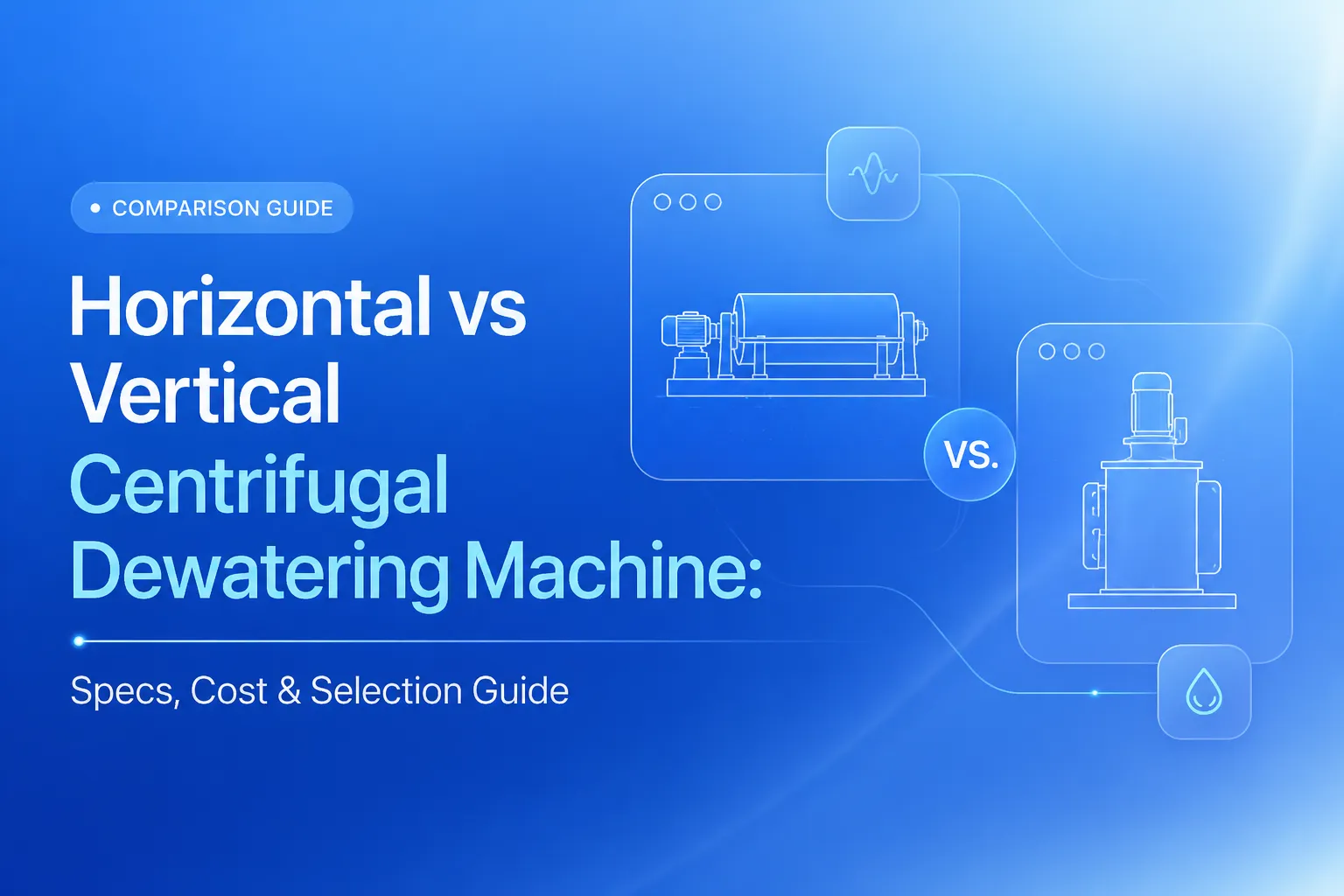
Buying a centrifugal dewatering machine for a plastic recycling line comes down to one early decision: horizontal or vertical orientation. The choice affects floor space, capacity ceiling, dewatering uniformity, maintenance access, and capital cost — sometimes by 2–3× across all five factors. This guide covers the engineering difference, real specifications, side-by-side comparison, and a 5-step decision framework so you can specify the right machine for your line on the first try.
Quick Answer: Which Should You Choose?
| Your Situation | Recommended |
|---|---|
| Throughput under 800 kg/h, limited floor space, simple maintenance team | Vertical centrifugal dewatering machine |
| Throughput 1,000+ kg/h, continuous operation, uniform output critical | Horizontal centrifugal dewatering machine |
| PET bottle flake line, 24/7 operation | Horizontal (with optional pre-stage vertical) |
| Pilot line, R&D, or small workshop | Vertical |
| Mixed rigid waste (HDPE crates, PP drums) at high volume | Horizontal |
Both are centrifugal dewatering machines built on the same operating principle — high-speed rotor spinning inside a perforated screen. The orientation of the rotor shaft determines almost everything else.
The Engineering Difference
Vertical Centrifugal Dewatering Machine
The rotor shaft sits vertically. Wet flakes feed in from the top of the chamber, the rotor spins at 1,200–1,500 RPM, water exits radially through the screen, and dewatered flakes discharge from a side or bottom port. Material spends roughly 2–5 seconds inside the chamber.
The footprint is compact — typically 1.0 × 1.5 m for a 400–800 kg/h unit — and the machine sits self-contained on its base. Internal access for screen and rotor inspection is straightforward: lift the top cover and the components are visible. No conveyor or feed paddle needs alignment.
Horizontal Centrifugal Dewatering Machine
The rotor shaft runs horizontally inside a longer screen drum (typically 1.5–2.5 m long). Wet flakes enter at one end, paddles or screw flights on the rotor convey material along the screen while spinning at 800–1,200 RPM, and dewatered material discharges at the far end. Residence time is longer — typically 5–10 seconds — and the longer travel path produces more consistent moisture across the output stream.
Footprint is larger (typically 2.5 × 1.5 m for a 1,500 kg/h unit), but throughput per square meter of floor space is comparable to vertical units. Maintenance requires removing end covers and sliding the rotor out — more involved than a vertical unit but still a 1–2 hour task with two technicians.
Side-by-Side Comparison
| Factor | Vertical | Horizontal |
|---|---|---|
| Throughput range | 200–1,000 kg/h | 800–3,500 kg/h |
| Motor power | 22–45 kW | 37–90 kW |
| Rotor speed | 1,200–1,500 RPM | 800–1,200 RPM |
| Residence time | 2–5 seconds | 5–10 seconds |
| Outlet moisture (rigid flakes) | 3–5% | 2–4% |
| Output uniformity | Moderate | High (longer screen contact) |
| Footprint | ~1.5 m² | ~3.5 m² |
| Headroom required | 2.5–3.0 m (chamber height) | 1.5–1.8 m |
| Capital cost (USD) | $8,000–$18,000 | $15,000–$45,000 |
| Energy per ton dewatered | 30–45 kWh/ton | 25–40 kWh/ton |
| Maintenance complexity | Low (top access) | Moderate (end-cover removal) |
| Best material | PET flakes, HDPE/PP rigid regrind, low-volume mixed | PET bottle flakes (high volume), HDPE crates, continuous PP regrind |
Key Takeaway: Vertical wins on cost, footprint, and maintenance simplicity. Horizontal wins on throughput, output uniformity, and energy efficiency per ton at scale. The crossover point is around 1,000 kg/h — below it, vertical is almost always the right call; above it, horizontal almost always.
Where Each Fits in the Recycling Line
PET Bottle Flake Line
For PET bottle recycling above 1 ton/h, horizontal centrifugal dewatering is standard. The longer screen contact removes label residue and fines along with water, and the lower rotor speed reduces flake breakage on PET (which is more brittle than HDPE or PP). Below 800 kg/h, a vertical machine is sufficient — common in smaller PET reclaim operations and pilot lines. Some high-spec PET lines run a vertical unit as a polishing stage after a horizontal primary, achieving sub-2% moisture before the thermal dryer.
HDPE / PP Rigid Regrind
For washed HDPE crate or PP drum regrind, both orientations work well. The decision is purely throughput and budget: vertical for sub-1 ton/h operations, horizontal for higher capacities. HDPE and PP tolerate higher rotor speeds without breakage, so vertical machines at 1,500 RPM perform efficiently on these materials.
PE / PP Film Lines
Film is a different problem. Standard rigid-flake centrifugal dewatering machines — vertical or horizontal — are not optimized for film, which wraps around rotor paddles. For film recycling, use a high-speed plastic film centrifugal dewatering machine (anti-wrap rotor design) or a film squeezer instead. These are purpose-built for flexible material.
Mixed Rigid Waste / Pilot Lines
For research, pilot, or low-throughput operations processing mixed rigid plastics, vertical centrifugal dewatering machines are the practical default. Capital cost is 2–3× lower, footprint fits in a corner of a workshop, and a single operator can run and maintain the unit. Most equipment manufacturers (including Energycle) offer entry-level vertical units at 22–37 kW for under $12,000 USD.
5-Step Decision Framework
Step 1: Define Your Throughput
Identify your peak hourly material flow in kg/h, not your daily tonnage divided by 24 hours. Recycling lines run in batches with cleanup gaps, so peak feed rate is typically 1.5–2× the daily-average rate. If your line processes 10 tons over an 8-hour shift, your peak is approximately 1,500–1,800 kg/h — choose horizontal.
Step 2: Audit Your Floor Space and Headroom
Vertical units need 2.5–3.0 m of vertical clearance for the chamber height plus crane access for screen removal. Horizontal units need 2.5–4.5 m of length plus working space at both ends. Measure actual available footprint and headroom — vertical machines fail to install in low-ceiling buildings even when the floor footprint fits.
Step 3: Specify Output Moisture Requirement
If your downstream process is direct extrusion of HDPE or PP, 3–5% moisture is acceptable — vertical handles this. If your downstream is PET pelletizing or any application requiring sub-2% moisture, you will need a horizontal centrifugal dewatering machine followed by a thermal dryer. Read our centrifugal vs thermal drying energy comparison for the energy math behind this decision.
Step 4: Calculate Total Cost of Ownership
Vertical capital cost is lower (sometimes by half), but horizontal energy cost per ton is also lower at scale. For a line running 4,000 hours/year:
- Vertical unit (45 kW, 800 kg/h): $12,000 capital + ~$7,200/year energy at $0.10/kWh = $19,200 first-year, $7,200/year ongoing
- Horizontal unit (55 kW, 1,500 kg/h): $25,000 capital + ~$8,800/year energy = $33,800 first-year, $8,800/year ongoing
For the same throughput requirement, the horizontal unit pays back its higher capital cost over 4–6 years through lower per-ton energy and lower labor cost (one operator handles 2× the throughput).
Step 5: Verify Maintenance and Service Access
Vertical: top cover lifts, screen and rotor lift out — 30 minutes for screen change, no tools beyond a wrench. Horizontal: end covers unbolt, rotor slides out on rails — 1–2 hours for screen change, requires two technicians and a lift point. If your maintenance team is small or external, vertical is easier. If you have an in-house mechanical team and value uptime over service simplicity, horizontal is fine.
Common Misconceptions
“Vertical is always cheaper to run”
Not above 1,000 kg/h. At higher throughput, horizontal is more energy-efficient per ton because the longer residence time achieves the same dewatering with a lower-speed rotor (lower kW per kg processed). Vertical units pay an energy penalty when pushed near their throughput ceiling.
“Horizontal handles all materials better”
Not film. Both orientations struggle with film unless purpose-designed for it. For film, use an anti-wrap film centrifugal dewatering machine or a screw-press film squeezer.
“Vertical units cannot reach low moisture”
They can — adequate for HDPE/PP direct extrusion (3–5% target). They cannot reach sub-2% in a single pass; that requires either a horizontal unit or a vertical primary plus a thermal finishing stage.
Frequently Asked Questions
What is the difference between a horizontal and vertical centrifugal dewatering machine?
The difference is rotor shaft orientation, which affects throughput, residence time, and output uniformity. Vertical units have a vertical rotor with 2–5 second residence time, suit 200–1,000 kg/h throughput, and have a compact footprint. Horizontal units have a horizontal rotor with paddles that convey material along a longer screen — 5–10 second residence time, 800–3,500 kg/h capacity, more uniform dewatering, but larger footprint and higher capital cost.
Which is better for PET bottle flake recycling?
For PET bottle flake lines above 1 ton/h, horizontal centrifugal dewatering is the industry standard. The longer screen contact removes label fragments and fines, and the lower rotor speed reduces flake breakage. Below 800 kg/h, a vertical centrifugal dewatering machine is sufficient. High-spec PET lines often combine both: horizontal primary plus vertical polishing.
How much does a vertical vs horizontal centrifugal dewatering machine cost?
Vertical centrifugal dewatering machines typically cost $8,000–$18,000 USD for 22–45 kW units (200–1,000 kg/h capacity). Horizontal centrifugal dewatering machines cost $15,000–$45,000 USD for 37–90 kW units (800–3,500 kg/h capacity). At the same throughput, horizontal units cost 50–80% more upfront but deliver 10–20% lower energy cost per ton, paying back the difference within 4–6 years for continuous-operation lines.
Can I use a vertical centrifugal dryer for high-throughput PET lines?
It is possible by paralleling two or three vertical units, but rarely the cost-effective choice above 1.5 tons/h. A single horizontal centrifugal dewatering machine at 2,000 kg/h has lower capital cost than three 700 kg/h vertical units in parallel, plus simpler control logic and one maintenance schedule. Horizontal becomes the standard above 1 ton/h for this reason.
What moisture level can each type achieve on rigid plastic flakes?
Vertical units typically achieve 3–5% outlet moisture on washed PET, HDPE, or PP flakes in a single pass. Horizontal units achieve 2–4% moisture under similar conditions, mostly because of longer screen contact time. Both require a downstream thermal dryer to reach sub-1% moisture for PET pelletizing or extrusion-grade applications.
Conclusion
The horizontal vs vertical centrifugal dewatering machine choice is determined by throughput, output uniformity requirement, and total cost of ownership — not by personal preference or supplier preference. Below 1 ton/h, vertical is almost always the right answer. Above 1 ton/h, horizontal is almost always the right answer. PET bottle flake lines and applications requiring uniform sub-3% moisture push the decision toward horizontal earlier.
Energycle manufactures both vertical and horizontal centrifugal dewatering machines for plastic recycling lines from 200 kg/h to 3,500 kg/h. Contact our engineering team with your throughput, material type, and downstream process — we will recommend the orientation, motor sizing, and screen specification for your specific line.
