

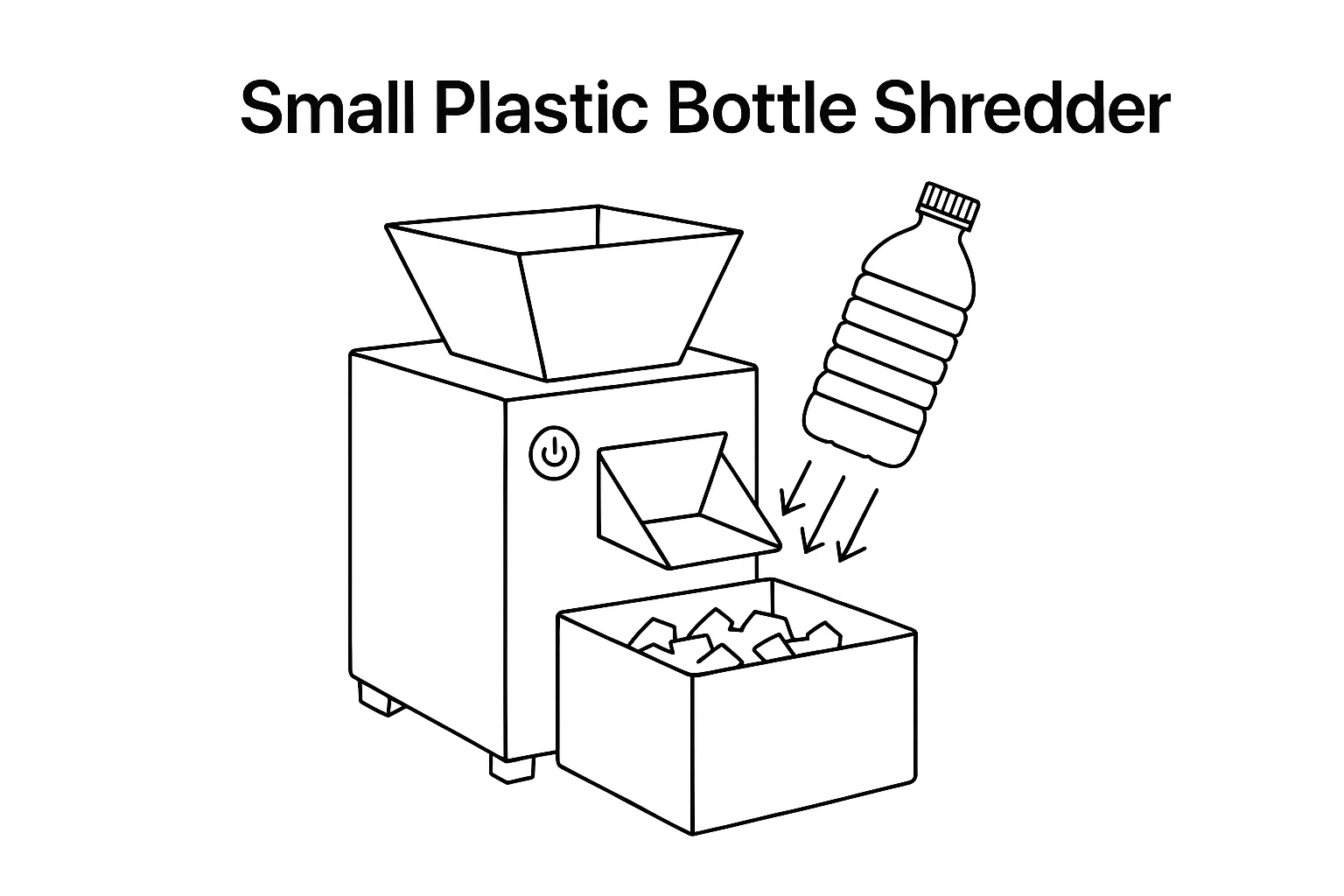
A niszczarka do plastiku na biurko bridges the gap between office paper shredders and full-scale industrial shredding lines. These compact machines — typically under 800 mm long and powered by 0.75–3 kW motors — process 5–50 kg/h of plastic waste right at the source: beside an injection molding press, inside a 3D printing lab, on a university research bench, or in a small recycling workshop. If you generate small batches of plastic scrap and want to shred it on-site instead of paying for external processing, this guide covers every desktop shredder type, real specifications, application matching, and a framework for choosing the right unit.
What Is a Desktop Plastic Shredder?
A desktop plastic shredder is a compact, low-power size-reduction machine designed for small-batch plastic processing in space-constrained environments. Unlike industrial shredders that occupy 3–10 m² of floor space and require 15–132 kW drives, desktop models fit on a workbench or small table, run on single-phase 220V power, and operate at noise levels of 70–85 dB — quiet enough for lab and workshop environments without dedicated soundproofing.
Despite their compact size, desktop shredders use the same cutting principles as industrial units: counter-rotating shafts (dual-shaft) or a single rotor with fixed knives shear material into pieces sized by the screen or blade gap. Output particle size ranges from 5–20 mm depending on configuration — suitable for direct feeding into small extruders, granulatory, or filament makers.
Who Needs a Desktop Shredder?
Desktop plastic shredders serve a growing range of users who generate small quantities of plastic waste and need on-site processing:
- 3D printing labs and makerspaces — shred failed prints, support material, and purge waste into flakes for filament extrusion. A single FDM printer generates 0.5–2 kg of waste per week; a farm of 10+ printers justifies a desktop shredder within months. See our guide on recycling 3D printing waste with a mini shredder
- Injection molding QC departments — shred test shots, first-article rejects, and color-change purge material. Regrind returns directly to the press hopper, eliminating scrap disposal costs
- University and R&D laboratories — process small material samples for testing, characterization, or experimental recycling research without scheduling time on full-scale equipment
- Small recycling startups — begin operations with minimal capital investment ($2,000–$8,000) and scale up as volume grows
- Schools and educational programs — demonstrate recycling concepts with safe, compact equipment that students can operate under supervision
- E-waste preprocessing — shred small electronic housings, cable jackets, and circuit board edges. See our e-scrap shredder guide for larger-scale e-waste operations
Types of Desktop Plastic Shredders
Mini Dual-Shaft Shredder
The most common desktop shredder type. Two counter-rotating shafts with interlocking blades pull material in and shear it between the cutting edges. Dual-shaft designs are self-feeding (material is drawn in by the rotating shafts), handle a wide range of material shapes, and produce relatively uniform output. Typical desktop dual-shaft models use 14–28 blades per shaft, 1.5–3 kW motors, and process 10–50 kg/h. Watch our mini twin-shaft shredder test run.
Mini Single-Shaft Shredder
Uses one rotating shaft with fixed counter-knives and a sizing screen. Single-shaft desktop models produce more uniform output than dual-shaft types and allow precise particle size control through screen selection (6–15 mm typical). They require a pusher or gravity feed since they do not self-feed like dual-shaft units. Better suited for consistent feedstock like 3D printing waste or injection molding runners where material shape is predictable. See our desktop compact shredder test video.
Hand-Crank Shredder
Manual, unpowered units for the smallest volumes — under 2 kg/h. Used in educational settings, Precious Plastic community workshops, and portable demonstrations. No electricity required, but limited to thin materials under 2 mm (bottle caps, thin-wall containers). Not suitable for production use.
Compact Granulator
While technically a granulator rather than a shredder, compact benchtop granulators serve the same niche. They use high-speed rotating knives (1,000–3,000 RPM) against fixed bed knives to produce fine, uniform granules in a single pass. Best for brittle plastics (ABS, PLA, PETG) from 3D printing. Output is finer (3–8 mm) than shredder output, feeding directly into small extruders without additional size reduction. Learn more in our plastic granulator product range.
Desktop Shredder Specifications Comparison
| Specyfikacja | Mini Dual-Shaft | Mini Single-Shaft | Hand-Crank | Compact Granulator |
|---|---|---|---|---|
| Moc silnika | 1.5–3 kW | 0.75–2.2 kW | Podręcznik | 1.5–4 kW |
| Przepustowość | 10–50 kg/h | 5–30 kg/h | 0.5–2 kg/h | 5–20 kg/h |
| Rozmiar wyjściowy | 10–20 mm | 6–15 mm (screen) | 5–15 mm | 3–8 mm |
| Materiał ostrza | H13 / D2 tool steel | D2 / SKD-11 | Stal węglowa | D2 / SKD-11 |
| Blade Count | 28–56 (14–28 per shaft) | 3–6 rotor + 2 bed | 6–12 | 3–5 rotor + 2 bed |
| Zasilacz | 220V single-phase | 220V single-phase | Nic | 220V single-phase |
| Ślad stopy | 600×300–800×400 mm | 500×250–700×350 mm | 300×200 mm | 400×300–600×400 mm |
| Waga | 80–150 kg | 50–100 kg | 5–15 kg | 60–120 kg |
| Poziom hałasu | 75–85 dB | 70–80 dB | 50–65 dB | 75–85 dB |
| Przedział cenowy | $3,000–$8,000 | $2000–$6000 | $100–$500 | $2,500–$7,000 |
Materials You Can Process
Desktop shredders handle most thermoplastics up to 5–8 mm wall thickness. Here is a material compatibility guide based on our testing:
| Tworzywo | Przykłady | Desktop Shredder Suitability | Notatki |
|---|---|---|---|
| PLA | 3D prints, packaging | Doskonały | Brittle, shreds cleanly with minimal dust |
| ABS | 3D prints, electronic housings | Doskonały | Clean fracture, low blade wear |
| PETG | 3D prints, bottles (thin) | Dobry | Slightly flexible — dual-shaft preferred |
| HDPE | Caps, small containers | Dobry | Tough — needs adequate motor power |
| PP | Cups, runners, thin parts | Dobry | Flexible thin PP may wrap on single-shaft |
| PCV | Small pipe sections, profiles | Umiarkowany | Low-speed only to prevent heat/HCl release |
| Nylon (PA) | 3D prints, cable ties | Umiarkowany | Tough and flexible — slow feed rate |
| TPU / Flexible | 3D prints, seals | Słaby | Bends rather than cuts — not recommended |
| Rubber | Small gaskets, trim | Słaby | Requires cryo-treatment or industrial shredder |
Desktop vs. Industrial Shredders: When to Scale Up
Desktop shredders are not downsized industrial machines — they are purpose-built for different operating conditions. Understanding the boundary helps you avoid buying equipment that is too small or too large for your needs.
| Parametr | Desktop Shredder | Niszczarka przemysłowa |
|---|---|---|
| Przepustowość | 5–50 kg/h | 200–5,000+ kg/h |
| Moc silnika | 0.75–3 kW (single-phase) | 15–132 kW (three-phase) |
| Duty Cycle | Batch / intermittent (1–4 hrs/day) | Continuous (8–24 hrs/day) |
| Max Wall Thickness | 5–8 mm | 20–100+ mm |
| Powierzchnia podłogi | 0.2–0.5 m² | 3–15 m² |
| Instalacja | Plug-and-play, no foundation | Bolted to foundation, electrical panel |
| Price | $2,000–$8,000 | $15,000–$200,000+ |
| Najlepszy dla | Labs, 3D printing, small QC, education | Recycling facilities, production lines |
Scale-up triggers: If you consistently exceed 30 kg/h, run the desktop unit more than 4 hours/day, or process material thicker than 8 mm, move to an industrial single-shaft shredder Lub sztywna niszczarka do plastiku. Our niszczarki do filmów I niszczarki tekstyliów handle specialized materials at industrial scale.
3D Printing Waste: The Fastest-Growing Desktop Shredder Application
The 3D printing industry generates an estimated 8–15% waste rate by weight — failed prints, support structures, rafts, brims, and calibration prints. A mid-size print farm (10–20 printers) produces 5–20 kg of waste per week. Shredding this waste on-site and extruding it into new filament creates a closed-loop recycling system that cuts material costs by 40–60%.
Closed-loop 3D printing recycling workflow:
- Collect and sort — separate PLA, ABS, PETG, and nylon by type (mixed materials produce poor filament)
- Strzęp — desktop shredder reduces prints to 5–10 mm flakes
- Suchy — dehumidify flakes to <0.05% moisture (critical for extrusion quality)
- Extrude — desktop filament extruder converts flakes to 1.75 mm or 2.85 mm filament
- Print — use recycled filament for non-critical parts, prototypes, and functional prints
For a complete walkthrough including equipment selection and quality tips, read our detailed guide: Jak poddawać recyklingowi odpady powstałe w wyniku drukowania 3D za pomocą małej niszczarki biurkowej.
5-krotny framework wyboru
Step 1: Define Your Material and Volume
List every material you will shred (PLA, ABS, HDPE, PP, etc.), the maximum wall thickness, and your daily/weekly waste volume in kilograms. Material type determines blade specification; volume determines throughput requirement and duty cycle.
Step 2: Choose Shredder Type
Dual-shaft for mixed shapes and self-feeding convenience. Single-shaft for uniform output with screen-controlled particle size. Hand-crank only for demonstration and micro-volumes. Compact granulator if you need fine, uniform particles for direct extrusion.
Step 3: Match Output to Downstream Process
If feeding a filament extruder: target 3–8 mm output (granulator or single-shaft with fine screen). If feeding a pelletizer or larger extruder: 10–15 mm is sufficient (dual-shaft). If stockpiling for sale to recyclers: any output size works.
Step 4: Verify Power and Space
Confirm available electrical supply (most desktop units run on standard 220V single-phase). Measure your workbench or floor space. Desktop shredders weigh 50–150 kg — verify your surface can support the weight plus vibration loads. Plan for extraction: shredding produces plastic dust; a simple vacuum collection bag or cyclone is recommended.
Step 5: Calculate Payback
Compare the cost of a desktop shredder ($2,000–$8,000) against your current waste disposal costs plus the value of recovered material. A 3D printing lab shredding 10 kg/week of PLA (worth ~$20/kg as filament) recovers $200/week in material value — paying back a $4,000 shredder in 20 weeks. Injection molding shops with higher scrap volumes see payback in 2–6 months.
Safety and Operation Tips
- Wear hearing protection — even compact shredders reach 75–85 dB during operation, equivalent to a vacuum cleaner at full power
- Use safety glasses — small plastic fragments can eject from the feed opening during shredding
- Never reach into the cutting chamber — use a pusher stick for manual feeding; wait for full stop before any inspection
- Remove metal contaminants — screws, inserts, and metal fasteners destroy shredder blades. Inspect material before feeding; use a magnet to check for ferrous debris
- Operate in ventilated space — shredding produces fine dust, especially from PVC and ABS. A dust collection bag or workshop ventilation prevents inhalation
- Follow duty cycle limits — desktop shredders are designed for intermittent operation (typically 30–60 min on, 15 min cooling). Continuous overloading causes motor overheating
- Keep blades sharp — dull blades tear rather than cut, producing more dust, generating more heat, and increasing motor load. Regrind or replace per manufacturer schedule. See our blade replacement guide
Maintenance Schedule
| Interwał | Zadanie | Bliższe dane |
|---|---|---|
| After each use | Clear cutting chamber | Remove residual material and dust; inspect for jammed pieces |
| Tygodnik | Blade inspection | Check for chips, cracks, and excessive wear; verify blade gap |
| Miesięczny | Smarowanie | Grease bearings and gearbox per manufacturer schedule |
| Miesięczny | Electrical check | Inspect power cord, switch, and motor housing for damage or overheating |
| Every 200–400 hours | Blade resharpening | Regrind blade edges; most desktop blades allow 3–5 regrinds before replacement |
| Rocznie | Full service | Replace worn blades, check motor brushes (if brushed motor), verify gearbox oil level |
For detailed maintenance procedures applicable to both desktop and industrial units, see our shredder maintenance guide I 6 ways to extend shredder lifespan.
Rozpoczęcie pracy z Energycle
Energycle produkuje desktop and mini shredders alongside our full range of granulatory plastiku and industrial shredders. Whether you need a single benchtop unit or a complete small-scale recycling setup, we provide:
- Bezpłatne badanie materiałów — send us your plastic samples and we verify shredding performance on our machines
- Custom blade configurations — blade count, material, and gap optimized for your specific plastics
- Voltage customization — 110V, 220V, or 380V configurations for any market
- Complete desktop recycling setups — shredder + washer + dryer + small extruder for closed-loop operations
- No minimum order quantity — single units available for labs and startups
Contact our team with your material type, estimated volume, and intended use — we will recommend the right desktop shredder and provide a quotation within 48 hours.
Często zadawane pytania
What is a desktop plastic shredder?
A desktop plastic shredder is a compact, low-power machine (0.75–3 kW) that fits on a workbench or small table and shreds plastic waste into 5–20 mm flakes at rates of 5–50 kg/h. It uses the same cutting principles as industrial shredders — counter-rotating blades or single-rotor-with-screen designs — but in a package designed for labs, 3D printing studios, small workshops, and educational facilities.
Can a desktop shredder process 3D printing waste?
Yes — 3D printing waste is one of the primary applications. Desktop shredders handle PLA, ABS, PETG, and nylon prints effectively. The shredded flakes can feed directly into a filament extruder to create recycled 3D printing filament, reducing material costs by 40–60%. Sort materials by type before shredding for the best filament quality.
Ile kosztuje stacjonarny shredder do recyklingu plastiku?
Hand-crank models cost $100–$500. Motorized mini single-shaft shredders range from $2,000–$6,000. Mini dual-shaft shredders cost $3,000–$8,000. Compact benchtop granulators fall in the $2,500–$7,000 range. Total cost of ownership is low — electricity costs under $0.50/hour, and blade resharpening every 200–400 hours adds roughly $50–$150 per service.
What is the difference between a mini shredder and a mini granulator?
A mini shredder uses low-speed, high-torque cutting (50–200 RPM) to tear material into 10–20 mm pieces. A mini granulator uses high-speed knives (1,000–3,000 RPM) with a sizing screen to produce fine, uniform granules of 3–8 mm. Choose a shredder for mixed shapes and tough materials; choose a granulator for brittle plastics where you need uniform, fine output for direct extrusion.
How loud is a desktop plastic shredder?
Most motorized desktop shredders operate at 70–85 dB — comparable to a vacuum cleaner or food blender. Hearing protection is recommended for extended operation. Hand-crank models are significantly quieter at 50–65 dB. Noise varies with material hardness: shredding brittle PLA is louder than cutting soft PE due to the snapping fracture pattern.
What materials can a desktop shredder NOT process?
Desktop shredders cannot handle: metals (even thin aluminum sheet), rubber and TPU (too flexible — bends instead of cutting), thermoset plastics (fiberglass, epoxy — too hard and abrasive), and materials thicker than 8 mm. They are also not designed for continuous industrial production — if you run more than 4 hours/day, move to an industrial shredder.
How long do desktop shredder blades last?
H13 or D2 tool steel blades last 200–400 operating hours processing standard plastics (PLA, ABS, PE, PP) before needing resharpening. Each blade allows 3–5 regrinds before replacement. Abrasive materials like glass-filled nylon reduce blade life by 50–70%. Budget $50–$150 per resharpening and $200–$500 for a full blade set replacement.
Do I need three-phase power for a desktop shredder?
No. Desktop shredders run on standard single-phase 220V power — the same outlet used for most workshop tools. This is a key advantage over industrial shredders, which require three-phase 380–480V electrical supply with dedicated circuit breakers. Custom 110V configurations are also available for markets using that standard.
Związane zasoby
- Mini Desktop Small Shredder — Product Page
- Jak poddawać recyklingowi odpady powstałe w wyniku drukowania 3D za pomocą małej niszczarki biurkowej
- Desktop Compact Small Shredder — Test Video
- Mini Twin-Shaft Shredder — Test Video
- Uniwersalny rozdrabniacz jednowałowy
- Metalurgia ostrza niszczarki: D2 vs DC53 vs napawanie
- Jak wymienić i konserwować ostrza niszczarki
- Single Shaft Shredder Maintenance Guide
- Single Shaft Shredder Troubleshooting
- E-Scrap Shredder: Data Destruction & Li-Ion Safety
- Ostrza zamienne do niszczarek do plastiku
- Shredder Blade Materials: CPM 10V vs Carbide Inlays
- Maszyna do recyklingu plastiku: Kompleksowy Przewodnik
