

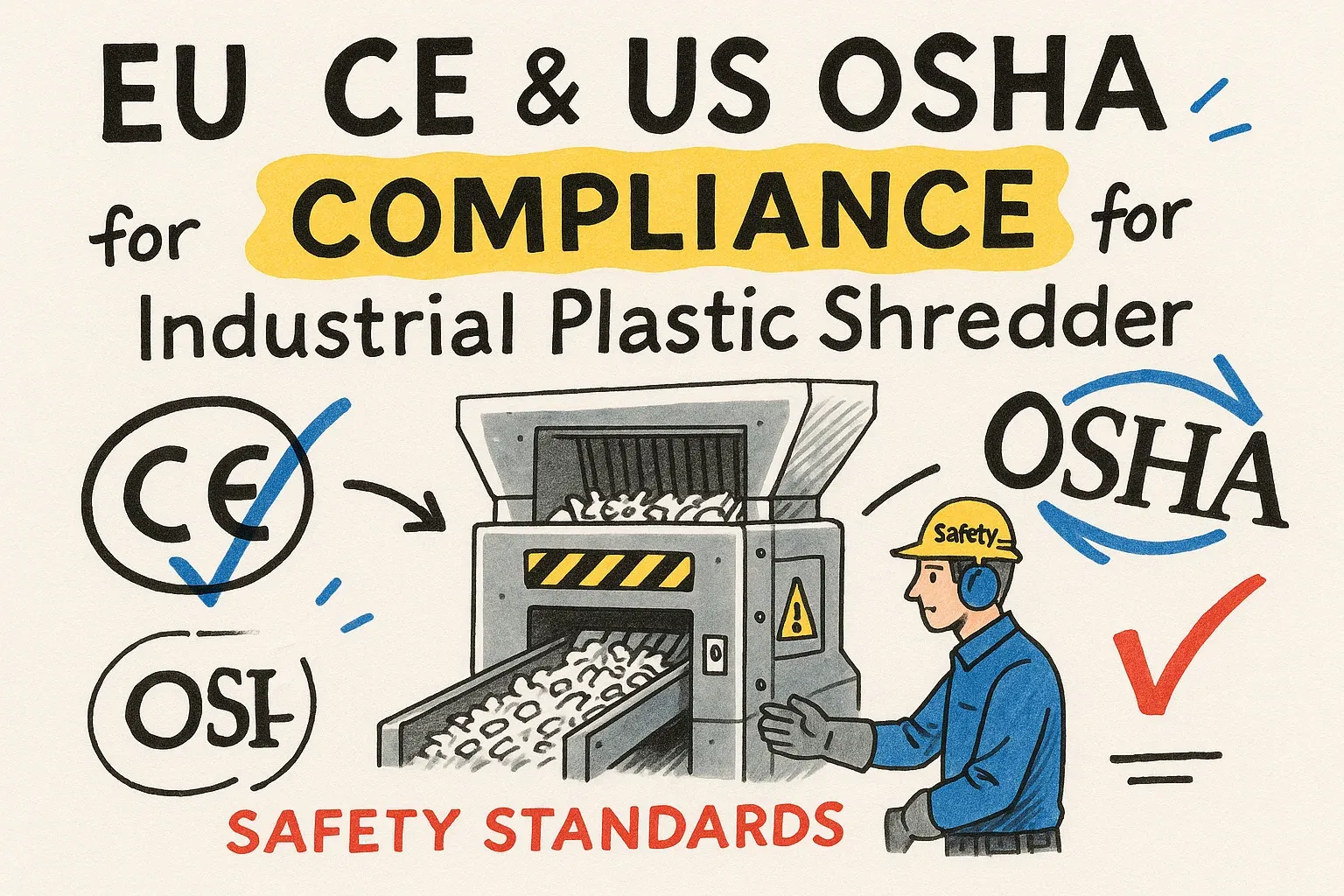
Regulatory compliance for industrial shredders is bifurcated by geography and responsibility. In Europe, CE marking is tied to manufacturer obligations under the EU machinery framework and harmonized standards (commonly including EN 12012-1 for size reduction machines). In the USA, OSHA standards emphasize employer responsibilities for safe operation (e.g., lockout/tagout under 29 CFR 1910.147). This guide translates these frameworks into practical procurement questions and engineering controls.
Compliance note: Requirements vary by country, state, and local authority (AHJ), and they also depend on the exact machine configuration and risk assessment. Use this guide as a starting point and validate against the applicable standard text and your local compliance professional.
Related equipment: single shaft shredder, double shaft shredder (plastic & metal).
1. Design Standards: EU CE Compliance (Machinery Framework)
To be legally placed on the EU market, a shredder is required to satisfy the applicable Essential Health and Safety Requirements under the EU machinery framework. EN 12012-1:2018 is a commonly used harmonized standard for “size reduction machines” that manufacturers may apply to help demonstrate conformity (alongside a risk assessment).
Mandatory Design Features
- Feed Hopper Geometry: The distance from the outer edge of the hopper to the rotor is typically designed to exceed operator reach (see ISO 13857 principles). Large openings commonly require additional guarding (e.g., tunnel guards or conveyor feeding) based on risk assessment.
- Safety Interlocks: Safety-rated interlocks on maintenance doors are typical. The required performance level and stopping/locking method depend on the risk assessment, but common approaches include monitored stopping time, zero-speed monitoring, and guard locking until the rotor is stationary.
- Noise Emissions: When measured noise is high (often referenced around 80 dB(A) and above), documentation and warnings about hearing protection are commonly expected; exact obligations depend on the applicable directive/standard and the measurement method. Industrial shredders often benefit from sound-dampening enclosures if the site target is <85 dB(A) at operator positions.
Manufacturer Documentation
A CE-marked shredder is typically delivered with: 1. Declaration of Conformity (DoC): Signed by the manufacturer. 2. Safety Manual: In the local language of the operator. 3. Circuit Diagrams: For electrical, hydraulic, and pneumatic systems.
2. Operational Standards: US OSHA Compliance
In the US, the liability shifts to the employer. A shredder can be “safe” when bought, but “unsafe” if used improperly. OSHA inspectors focus on 29 CFR 1910.
Lockout/Tagout (LOTO) – 1910.147
This is among the most frequently cited safety gaps in many industrial facilities, including recycling operations. * Requirement (common): Provide a main disconnect switch that accepts a padlock. * Procedure: Before blade changes or jam clearing, isolate hazardous energy sources per your LOTO program. Modern shredders can facilitate this with “zone separation” (e.g., isolating the rotor motor while keeping the control panel live for diagnostics).
Machine Guarding – 1910.212
- Point of Operation: Unlike CE, OSHA often accepts “distance guarding” (rails/barriers) for older machines.
- Conveyor Nip Points: Infeed conveyors commonly include emergency stop pull-cords along their length (confirm applicable requirements and best practice for your jurisdiction).
Combustible Dust – NFPA 652
Plastic dust (especially from shredding) can be combustible. Many facilities use NFPA 652 as a recognized good-practice framework; enforcement and expectations depend on the jurisdiction and hazard analysis. Common engineering controls include: * Explosion Venting: On dust collectors connected to the shredder. * Spark Detection: In pneumatic lines transporting regrind.
Comparison Table: CE vs. OSHA
| Feature | EU CE (Manufacturer Responsibility) | US OSHA (Employer Responsibility) |
|---|---|---|
| Safety Focus | Design & Construction (EN 12012-1) | Control of Hazardous Energy (LOTO) |
| Guarding | Physical Tunnel Guards (Mandatory) | Barriers / Light Curtains (Accepted) |
| Electrical | EC 60204-1 (400V / 50Hz) | NFPA 79 / UL 508A (480V / 60Hz) |
| Noise Limit | Often targets < 80 dB(A); otherwise warn (varies) | Hearing Program required > 85 dB(A) |
| Liability | Manufacturer (if accident occurs) | Employer (Worker Compensation/Fines) |
Technical Specifications for Compliance
To ensure broad compliance coverage, request the following “gold standard” spec (then confirm against local rules and your risk assessment):
- Dual-Channel Safety Relay: Ensures that if one safety switch fails, the machine still stops (Category 3 or 4 architecture).
- Trapped Key Interlock system: A mechanical key system where the maintenance gate key can only be released when the main power switch is locked in the “OFF” position. This physically forces LOTO.
- Hydraulic Safety Valve: A check valve on the hydraulic ram prevents it from moving unexpectedly during maintenance, even if a hose bursts.
FAQ
Does a Chinese shredder need UL Listing for the motor?
For the US market, having UL-Listed components (contactors, breakers) is often required by local electrical inspectors (AHJ), even if not strictly by OSHA. The full panel can be UL 508A certified.
What is the difference between PL-c and PL-d safety?
PL (Performance Level) measures the reliability of safety functions. PL-d (required for shredders) means the system is “fail-safe”—a single fault (like a stuck switch) will not lead to the loss of the safety function.
Can I operate a shredder without a dust collector in the EU?
Generally, no. Under ATEX directives and worker health rules, uncontained plastic dust (especially PVC or glass-filled) creates an illegal working environment.
References
[1] “Control of Hazardous Energy (Lockout/Tagout) — 29 CFR 1910.147”, OSHA. Control of Hazardous Energy (Lockout/Tagout) — 29 CFR 1910.147 [2] Machinery Directive 2006/42/EC and Machinery Regulation (EU) 2023/1230, EUR-Lex. EUR-Lex EUR-Lex
