

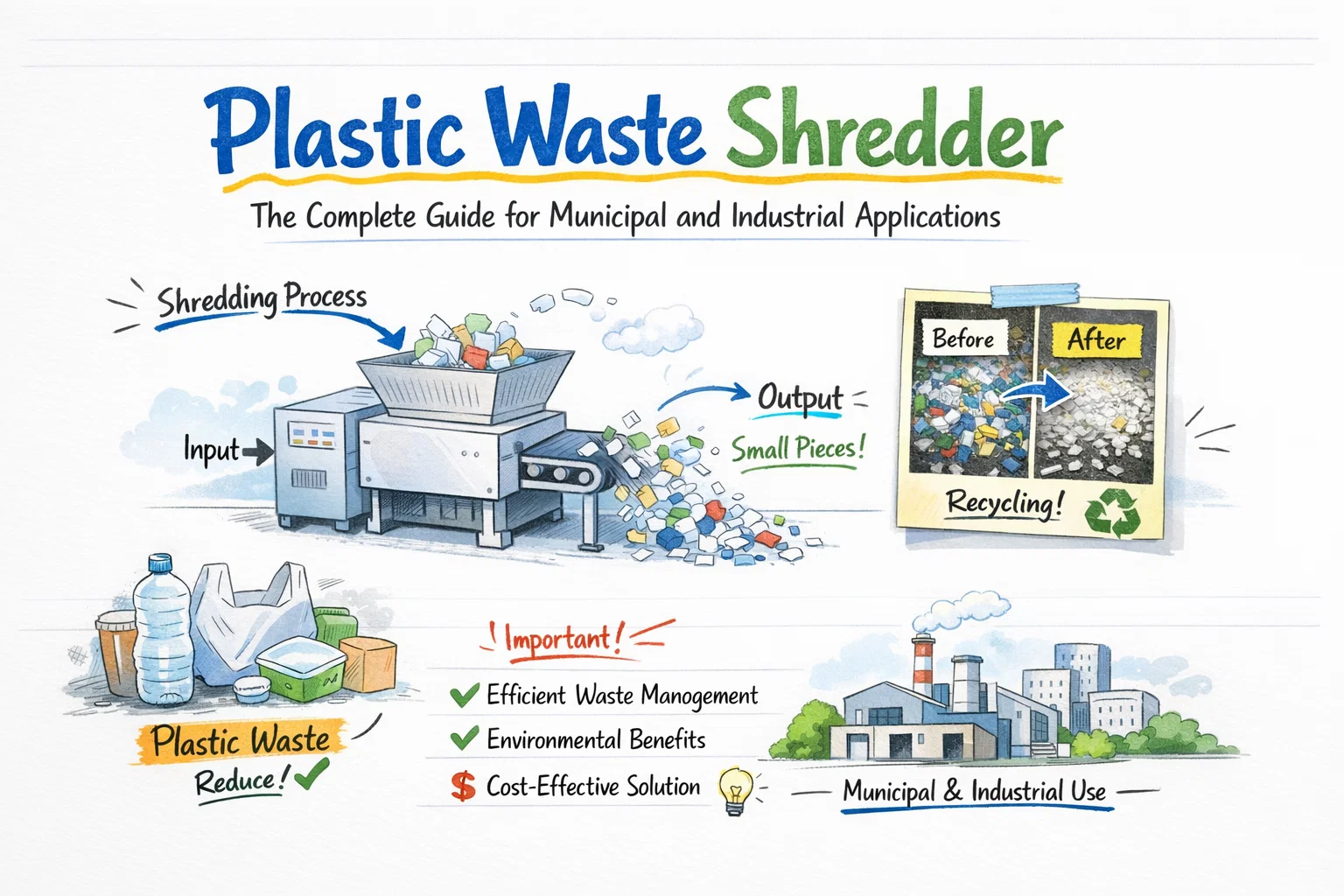
A plastic waste shredder is a heavy-duty machine that tears, cuts, or crushes plastic waste into uniform particles for downstream sorting, washing, or recycling. If you run a Material Recovery Facility (MRF), a plastic recycling plant, or an industrial waste operation, choosing the wrong shredder — or placing it incorrectly in your line — will bottleneck every process after it.
This guide covers everything procurement and operations managers need: machine types, pre-sorting requirements, throughput planning, MRF/MSW line integration, and real pricing benchmarks.
What Is a Plastic Waste Shredder?
A plastic waste shredder is industrial size-reduction equipment designed to break down plastic items — bottles, drums, pipes, film, pallets — into consistent output fragments, typically 30–150 mm in size. According to equipment specialists, shredders serve as the critical first stage in almost every plastic recycling process, making downstream washing, optical sorting, and pelletizing significantly more efficient.
Unlike granulators, which operate at high speed and require pre-shredded input, plastic waste shredders use low-speed, high-torque cutting action — typically 20–80 RPM — that handles bulky, contaminated, or mixed feed without pre-cutting. This makes them the entry point for both municipal solid waste (MSW) streams and industrial post-production scrap.
Types of Plastic Waste Shredder Machines
Not every shredder handles every plastic type equally. Choosing the wrong configuration is one of the most common and costly mistakes in recycling plant design.
Single-Shaft Shredders
A single-shaft shredder uses one rotating shaft with fixed blades against a stationary counter-knife. It excels at film, bags, lightweight rigid plastics, and post-consumer packaging because output size is controlled by a bottom screen.
- Throughput range: 200 kg/h – 2,000 kg/h
- Motor power: 15–75 kW
- Best for: PET bottle bales, LDPE film rolls, injection molding scrap
- Price range: $10,000 – $40,000
Double-Shaft Shredders
A double-shaft (twin-shaft) shredder uses two counter-rotating shafts that pull material inward and shear it. It delivers higher torque and handles rigid, thick-walled plastics — HDPE drums, PVC pipes, automotive bumpers — that would stall a single-shaft unit.
- Throughput range: 500 kg/h – 5,000 kg/h
- Motor power: 30–200 kW
- Best for: Mixed rigid plastic bales, large hollow containers, industrial plastic scrap
- Price range: $25,000 – $80,000
Four-Shaft Shredders
A four-shaft shredder adds two secondary shafts for a second shearing pass, producing tighter, more uniform particle sizes in a single machine. This design is preferred in RDF (Refuse-Derived Fuel) production and high-purity recycling lines where output consistency is critical.
- Throughput range: 1,000 kg/h – 10,000+ kg/h
- Motor power: 75–1,250 kW
- Best for: Mixed MSW plastics, large MRF pre-treatment, RDF/SRF preparation
- Price range: $60,000 – $250,000+
Choosing the Right Type: Quick Reference
| Criteria | Single-Shaft | Double-Shaft | Four-Shaft |
|---|---|---|---|
| Best plastic types | Film, light rigid | Rigid, thick-walled | Mixed/heterogeneous |
| Output size control | Screen-controlled | Moderate | Tightest uniformity |
| Handles contamination | Low | Medium | High |
| MSW/MRF integration | Secondary stage | Primary + secondary | Primary large-scale |
| Entry price | $10K | $25K | $60K+ |
The Challenge of Processing Mixed Plastic Waste
Mixed plastic waste is the hardest feed stream a shredder will face. Contamination, variable density, and incompatible polymer types all reduce effective throughput and increase blade wear. According to Reworld, mixed plastics cannot be efficiently recycled without proper sorting into individual polymer types — and shredding is the step that makes sorting possible in the first place.
Three specific challenges drive most operational headaches:
- Density variation: A single feed batch may contain lightweight LDPE film (density ~0.92 g/cm³) alongside rigid HDPE drums (density ~0.95 g/cm³) and heavy PVC pipe (density ~1.4 g/cm³). The shredder must handle all without jamming.
- Contamination load: Soil, food residue, metal fasteners, and glass shards inside plastic waste accelerate blade wear. Budget for blade replacement at 800–1,500 operating hours for heavily contaminated streams.
- Oversized or tangled materials: Long plastic pipes, strapping bands, and baled film wrap around shafts. Machines with automatic reverse rotation (standard on most twin-shaft models) prevent most jams without operator intervention.
Pre-Sorting Requirements Before Shredding
Running unsorted waste directly into a shredder without pre-conditioning is the fastest way to damage cutting blades and create dangerous jams. For both municipal and industrial operations, a pre-sorting stage protects your shredder and extends its service life.
Minimum pre-sort steps for MRF applications:
- Bag breaking: Open garbage bags with a dedicated bag-breaker machine before the shredder receives feed. Intact bags trap air and cause inconsistent shredding.
- Coarse trommel screening: A rotating drum screen (typically 80–150 mm mesh) removes fines, organics, and undersized material that don’t need shredding — reducing the load on the shredder by 15–30%.
- Ferrous metal removal: Install an overband magnetic separator above the infeed conveyor. Metal fragments left in the feed destroy cutting blades in hours.
- Manual pick station: A human inspection point (or AI-assisted vision system) removes hazardous items — gas cylinders, batteries, large glass — that could cause catastrophic machine failure.
For industrial post-production plastic scrap, pre-sorting requirements are simpler: separate by resin type (PET vs. HDPE vs. PP) if purity of the shredded output matters. If the output feeds an RDF line, mixed resins are acceptable.
Throughput Planning: How to Calculate Real Output
Manufacturer-rated capacity figures are almost always higher than real-world output. A shredder rated at 1,000 kg/h on clean HDPE flakes will deliver far less on contaminated mixed municipal plastics.
Use this two-step adjustment formula to calculate realistic throughput:
Step 1 — Material Hardness Index (MHI) adjustment: Real output = Rated capacity × MHI
Common MHI values:
- Clean PET/HDPE bottles: 0.80–0.90
- Mixed rigid plastics: 0.60–0.70
- Mixed MSW plastics (contaminated): 0.45–0.60
Step 2 — System Efficiency Coefficient (SEC) adjustment: Effective output = Step 1 result × SEC (typically 0.70–0.85 for continuous operations)
Example: A shredder rated at 2,000 kg/h on mixed rigid plastics (MHI = 0.65) operating with a SEC of 0.75:
- Step 1: 2,000 × 0.65 = 1,300 kg/h
- Step 2: 1,300 × 0.75 = 975 kg/h real output
This means a plant planning to process 15 tonnes/day (two 8-hour shifts) actually needs a machine rated at approximately 2,000 kg/h minimum — not 1,000 kg/h. Always size up, not down. An undersized shredder bottlenecks the entire line; an oversized one adds only marginal cost per tonne.
Plastic Waste Shredder in MRF and MSW Sorting Lines
A plastic waste shredder machine sits at the pre-treatment stage of a Material Recovery Facility — before optical sorters, air classifiers, and density separators. Its job is not to separate plastics; it is to reduce particle size so that separation equipment can work accurately.
Typical MRF Integration Sequence
- Receiving hopper → raw mixed waste input
- Bag breaker + trommel screen → pre-conditioning
- Plastic waste shredder → size reduction to 50–150 mm
- Overband magnet → ferrous metal removal
- Eddy current separator → non-ferrous metal removal
- Air classifier / ballistic separator → light vs. heavy fraction separation
- NIR optical sorter → PET / HDPE / PP / PVC identification and ejection
- Baler or conveyor to downstream → baled plastic fractions to recycler
The shredder’s output size directly determines the accuracy of every separation stage that follows. A NIR optical sorter, for example, performs best on particles between 40–120 mm — feed that is too large or too small reduces sort purity.
Integration with Energycle’s plastic shredders
Energycle’s plastic waste shredder line is designed for direct integration with downstream MRF sorting equipment. The shredders include PLC control and adjustable output screens, allowing operators to dial in particle size to match the requirements of their NIR sorters or washing lines. For plants processing rigid containers, the rigid plastic shredder series handles HDPE, PVC, and ABS at industrial scale.
Plastic Waste Shredder Cost: What to Budget in 2026
According to Energycle’s pricing data, plastic waste shredder machines range from $10,000 to $80,000 depending on shaft configuration, rotor width, blade material, and motor power.
| Machine Type | Capacity | Price Range (USD) | Best Application |
|---|---|---|---|
| Single-shaft shredder | 200–2,000 kg/h | $10,000 – $40,000 | Film, bottles, light rigid |
| Double-shaft shredder | 500–5,000 kg/h | $25,000 – $80,000 | Rigid, thick-walled, drums |
| Four-shaft shredder | 1,000–10,000+ kg/h | $60,000 – $250,000+ | MSW, MRF, RDF production |
| Starter system (shredder + granulator + conveyor) | 100–500 kg/h | $15,000 – $60,000 | Small recyclers, pilot lines |
Key cost drivers beyond the machine price:
- Blade material: D2 tool steel costs more upfront but lasts 2–3× longer than standard carbon steel blades on abrasive feeds.
- Motor power: Every 15 kW of added motor power adds roughly $3,000–$8,000 to machine cost.
- Hydraulic pusher: An integrated pusher adds $5,000–$15,000 but is essential for low-bulk-density materials like film bales.
- Installation and commissioning: Budget 10–15% of machine cost for on-site installation, especially for MRF integration with conveyor systems.
Key Takeaways and Next Steps
Selecting a plastic waste shredder is a capacity and integration decision, not just a machine purchase. Match your shredder type to your plastic feed stream, apply the MHI and SEC adjustments to size it correctly, and specify pre-sort equipment to protect it. When integrated correctly into a MRF or MSW sorting line, a properly specified shredder cuts downstream processing costs, improves sort purity, and extends the life of every machine after it.
Ready to specify the right machine for your operation? Explore Energycle’s plastic shredder range or contact the engineering team for a throughput assessment tailored to your waste stream.
Frequently Asked Questions
What is a plastic waste shredder?
A plastic waste shredder is an industrial machine that uses low-speed, high-torque rotating blades to tear and cut plastic waste into uniform fragments, typically 30–150 mm, for recycling or waste processing. It handles all plastic types — from thin film to rigid drums — and serves as the primary size-reduction step in MRF and recycling plant workflows.
Can a shredder handle mixed plastic waste?
Yes, a double-shaft or four-shaft plastic waste shredder machine can process mixed plastic waste streams, including contaminated and heterogeneous municipal plastic waste. However, effective pre-sorting — bag breaking, magnetic metal removal, and coarse trommel screening — is required beforehand to protect the blades and maintain consistent throughput. A contaminated mixed stream reduces effective capacity by 40–55% compared to clean single-resin input.
How much does a plastic waste shredder cost?
Plastic waste shredder prices range from $10,000 for a small single-shaft unit to over $250,000 for a high-capacity four-shaft industrial system. According to Energycle’s 2026 pricing data, the most common range for a production-ready double-shaft shredder for MRF or recycling plant use is $25,000–$80,000, with total installed system cost (including conveyors and controls) typically 25–40% higher than the machine price alone.
