

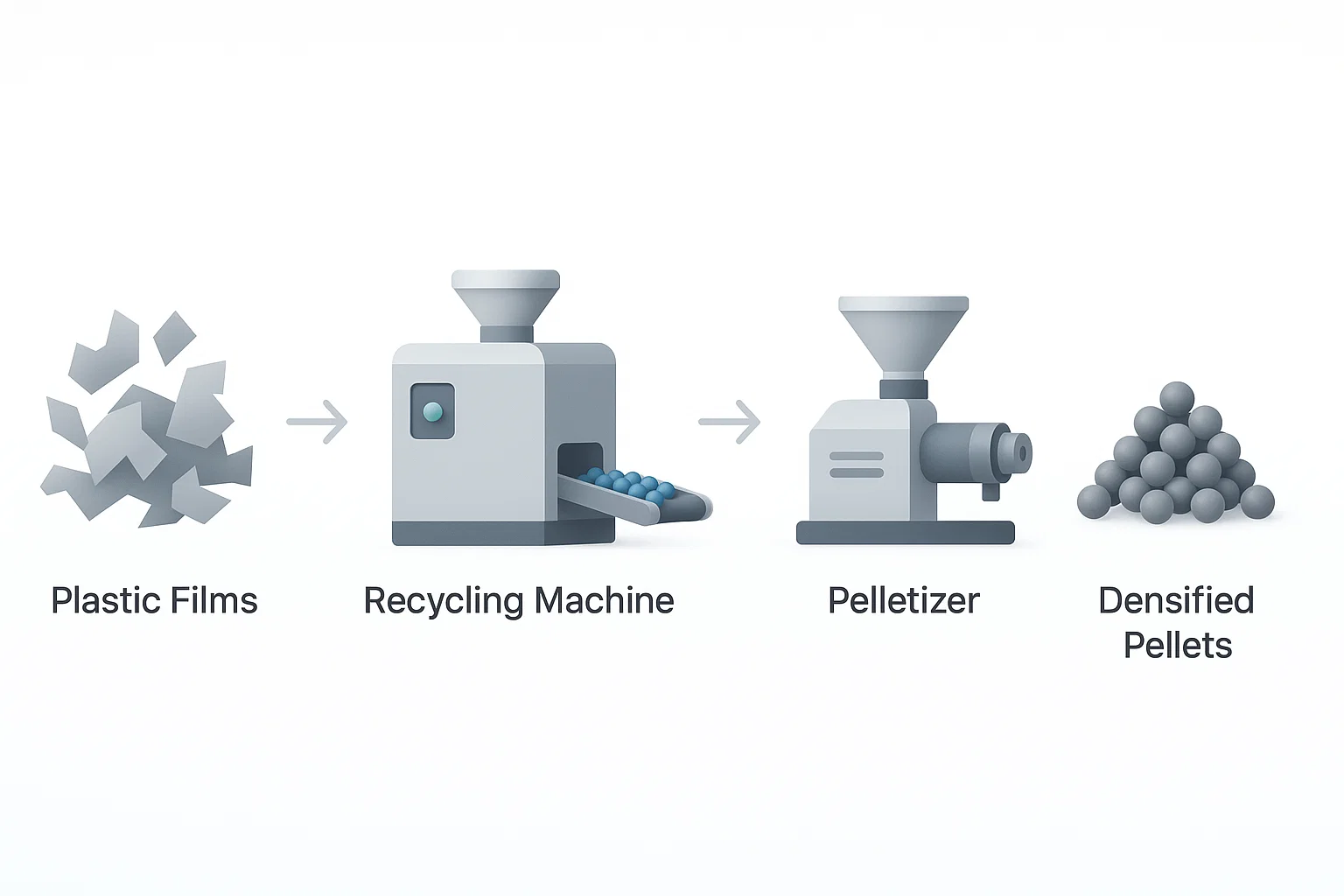
Film densification cost savings should be calculated from measured bulk density, usable vehicle volume, legal payload, storage layout, added energy and downstream value. Densification can reduce handling and transport cost when loose film is volume-limited, but it does not guarantee a fixed saving for every plant. This guide provides formulas and an illustrative example that operators can replace with their own data.
What film densification changes
Loose plastic film has a low and variable bulk density. It occupies substantial space, bridges in hoppers and can feed an extruder unevenly. A densification step changes the physical form so that the same mass occupies less volume. Depending on the process, it may also remove water or create a more stable feed form.
The equipment must match the feed condition. A screw press or stiskač plastične folije is intended for washed, wet PE or PP film where dewatering is a primary task. An agglomerator or cutter compactor is better suited to sorted, reasonably dry thermoplastic scrap that needs densification and feeding preparation. Densification does not replace upstream sorting or washing.
Measure bulk density before calculating savings
Bulk density is the mass of material divided by the volume it occupies under a defined filling method. Use the same container, filling procedure and number of samples before and after densification. Film can settle during storage or transport, so document whether the measurement represents material directly from the machine, material after cooling or material after a stated settling time.
Bulk density (kg/m³) = sample mass (kg) ÷ occupied volume (m³)
Record the range as well as the average. If density varies by feedstock, colour or moisture, calculate each major stream separately instead of applying one result to the entire year.
Transport calculation: volume-limited or weight-limited?
A load is volume-limited when the vehicle fills before reaching its legal or operational payload. It is weight-limited when payload is reached while volume remains. Densification reduces trips only when volume is the limiting factor or when it allows safer, more consistent loading.
| Calculation | Formula | Input source |
|---|---|---|
| Material volume | Mass ÷ measured bulk density | Scale and standardized density test |
| Volume-limited mass per load | Usable vehicle volume × bulk density × fill factor | Carrier specification and measured loading practice |
| Allowed mass per load | Lower of volume-limited mass and payload limit | Vehicle, container and local transport rules |
| Number of loads | Round annual or monthly mass ÷ allowed mass per load upward | Production forecast and actual dispatch records |
| Transport cost per tonne | Total freight, loading and handling cost ÷ delivered tonnes | Carrier invoices and plant labour records |
Illustrative transport example
Assume a recycler must move 20 tonnes of film each month. For illustration only, the loose material measures 50 kg/m³, the densified material measures 300 kg/m³ and the usable vehicle volume is 90 m³. Assume a fill factor of 0.85 and a payload limit above both calculated volume-limited loads.
- Loose film per load: 90 × 50 × 0.85 = 3,825 kg.
- Densified film per load: 90 × 300 × 0.85 = 22,950 kg, subject to the vehicle’s legal payload.
- Loose-film trips: 20,000 ÷ 3,825, rounded upward.
- Densified-film trips: 20,000 ÷ the lower of 22,950 kg and the legal payload, rounded upward.
This example does not describe a guaranteed Energycle result. Replace every assumption with measured material, vehicle and route data. If the legal payload is already reached with loose material, densification may improve handling without reducing the number of trips.
Calculate storage space without inventing a percentage
Storage savings depend on usable stacking height, aisle space, fire protection, container type, material stability and inventory days. First calculate the material volume, then convert it to required floor area using a realistic stacking height and layout factor.
Required material volume (m³) = stored mass (kg) ÷ measured bulk density (kg/m³)
Indicative floor area (m²) = material volume ÷ usable stacking height × layout factor
The layout factor should account for aisles, separation distances, access and non-stackable space. Site fire and safety requirements override an attractive spreadsheet result. Use actual warehouse rent, handling labour and inventory days to convert the space difference into money.
Add the cost of densification
Transport and storage are only one side of the calculation. Include electricity, wear parts, planned maintenance, labour, water or heat where applicable, reject handling and the capital recovery method used by the business. Meter energy under representative feed rather than multiplying installed motor power by operating hours.
| Cost element | How to measure it | Uobičajena izostavka |
|---|---|---|
| Struja | Metered kWh during stable production ÷ saleable tonnes | Using nameplate power as actual consumption |
| Wear and maintenance | Parts, labour and planned downtime over a defined period ÷ tonnes | Ignoring screw, screen, knife or bearing wear |
| Labour | Operator and material-handling hours attributable to the step | Counting only direct machine attendance |
| Yield impact | Saleable output before and after the process boundary | Calling water loss or removed dirt a production loss |
| Kapitalni trošak | Use the company’s approved depreciation or financing method | Claiming a payback period without utilization and margin data |
Downstream extrusion benefits must be tested
Densified film can feed more consistently than loose, tangled film, but the effect on extruder output and specific energy depends on polymer mix, moisture, contamination, densifier settings and the extruder. Measure extruder feed stability, output, pressure, filtration changes, pellet quality and kWh per saleable tonne during a controlled comparison.
A squeezer may reduce the load on downstream thermal drying by removing mechanical water, but the result must be stated with the feedstock and moisture test method. It does not remove ink, paper, metal or incompatible polymers. Our comparison of film agglomerators, compactors and screw-press densifiers explains these different functions.
When densification may not pay
- The plant already ships weight-limited loads and gains no reduction in trips.
- A nearby buyer accepts loose or baled film and pays no premium for the densified form.
- The feedstock is too contaminated or mixed for the intended downstream product.
- Proizvodnja je prekideća da bi opravdao stalno opremu i trošak održavanja.
- Izabran način zagusinjenja mijenja materijal na način koji kupac ne može procesuirati.
Kompatibilnost pakovanja i kontrola izvora ostaju važne. Udruženje za recikliranje plástova objavljuje Smjernice za dizajn fleksibilnog pakovanja PE, dok CEFLEX pruža smjernice za recikliranost fleksibilnog pakovanja.
Popis podataka za projektiranje
- Mjesečna i vrhunska masa filma po vrsti ulaznog materijala.
- Mjerena slobodna i procesirana gustoća masova.
- Ulazna i izlazna vlažnost koristeći isti testni metod.
- Upotrebljivi prostor vozila, faktor ispunjenosti, zakonita nosivost i trošak prijevoza.
- Broj dana skladištenja, pravila stajanja i trošak skladišta.
- Mjerena energija, rad, potrošni dijelovi, održavanje i prodajni izvođenje.
- Specifikacija kupca i vrijednost za svaku formu proizvoda.
Za potpun protok čišćenja i zagusinjenja pogledajte PP/PE film razdvajanje i gušenje linije.
Česta pitanja
Je gšenjenje uvijek smanjuje trošak prijevoza filma?
Ne. Smanjuje se broj putovanja kada su količine ograničene i procesirani materijal se može sigurno učvrstiti. Putovanje ograničeno težinom može pokazati nijedno smanjenje broja putovanja.
Je omjer kompresije dovoljan za usporedbu stješnjivača?
Broj. Usporedite izmjerenu ulaznu i izlaznu gustinu, vlažnost, količinu, energiju po prodajnoj tuni, iznošenje, temperaturu materijala i performansu procesa ispod.
Kako bi se trebala iskoristiti aglomerator ili stlačivač za mokru očišćenu filmu?
Sukavac je obično prvi izbor kada je glavna potreba mehanička dehidracija. Aglomeratori se obično koriste za razvrstani, prilično suhi film koji treba zagusiniti i pripremiti za daljnju isporuku.
Zatražite izračun temeljem vašeg materijala
Energycle može pregledati izmjerenu gustoću, vlažnost, mjesečni volumen, ograničenja prijevoza i zahtjeve struje donje strane kako bi definirao prilagođeni put zagusinjenja. Svaka procjena ušteda bi trebala pokazati njene ulaze, formule i isključenja tako da rezultat može biti provjeren.
