

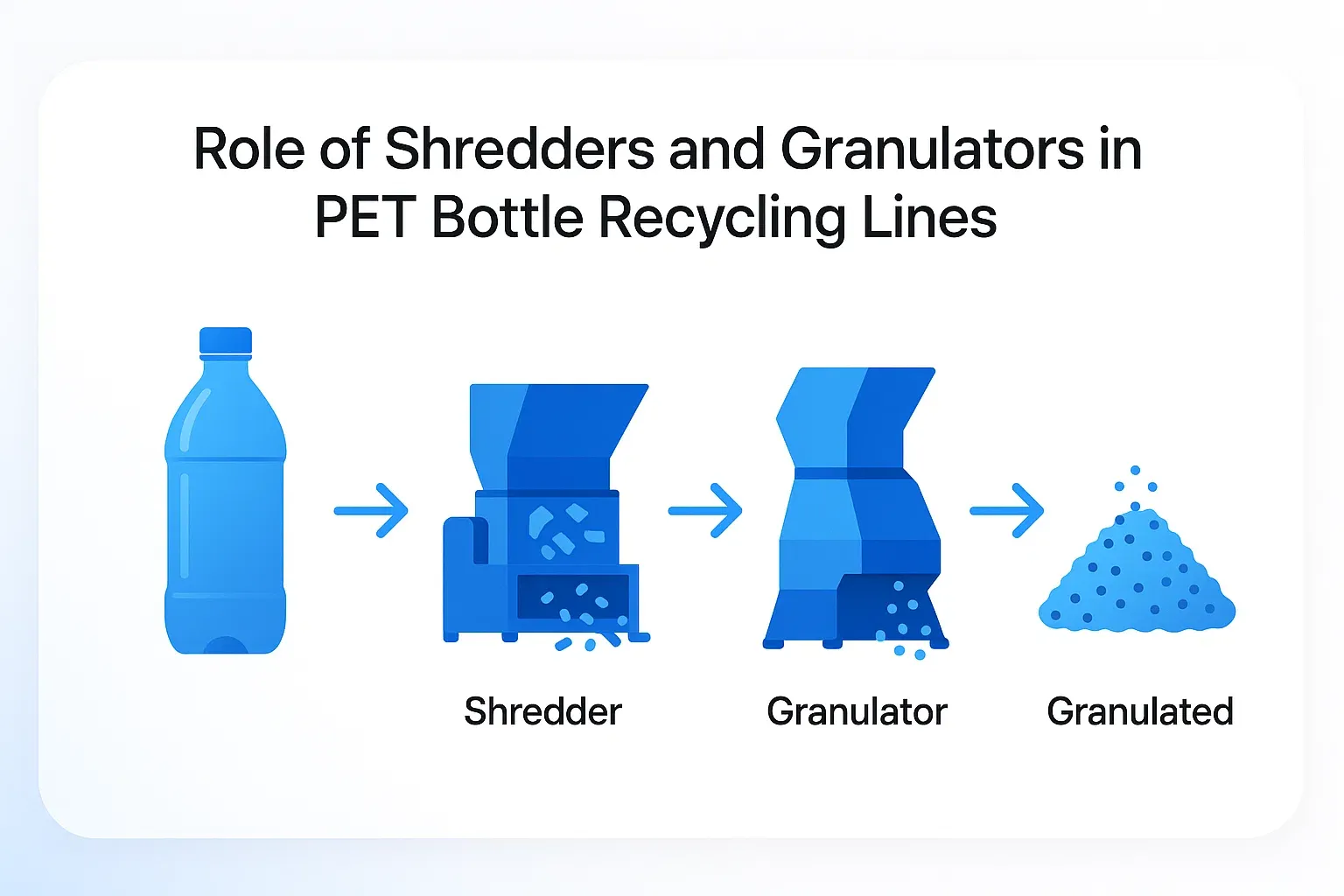
In PET Bottle-to-Bottle (B2B) recycling, yield is everything. Even small increases in fines (dust) generation can translate into meaningful annual losses depending on throughput, yield, and margin. This guide details practical protocols for minimizing yield loss in the size reduction stage.
Related equipment: integrated shredder-granulator machine.
1. The Pre-Shredding Rule: De-Label First
Never feed whole baled bottles directly into a shredder if you can avoid it. * Problem: PVC labels and PP caps get shredded into the same size as the PET flake. Mechanical separation becomes difficult. * Solution: Dry De-Labeler. * Action: A high-friction rotor can remove most labels before bottles enter the shredder. * Result: Blade life and downstream cleanliness can improve, depending on glue type, label material, and maintenance.
2. Wet Granulation: The IV Protector
PET is hygroscopic and heat-sensitive. * Problem: Dry granulators generate friction heat. If the PET temperature exceeds 70°C, it softens and creates “angel hair” (fines). This degrades the Intrinsic Viscosity (IV). * Solution: Wet Granulation. * Action: Inject water into the cutting chamber. * Benefit 1: Cooling. Keeps material <40°C. * Benefit 2: Pre-Wash. The friction acts as a high-intensity wash, removing sugar and glue. * Benefit 3: Lubrication. Can extend blade life, especially when processing abrasive or contaminated feedstock.
3. Fines Management: The Yield Killer
“Fines” are PET particles <2mm. They are lost in the wash process (float away) or burn in the extruder. * Cause: Dull knives or excessive screen gap. * Protocol: * Knife Gap: Often set in a tight range (e.g., 0.2mm – 0.3mm) depending on rotor design and knife condition. * Screen: Use screens with offsets (angled holes) to reduce long splinters passing through. * Sharpness: Rotate or sharpen knives on a defined interval (often tens to low hundreds of operating hours, depending on contamination). Running with dull knives can increase fines significantly.
4. Food Grade Compliance (FDA/EFSA)
If producing Food Grade rPET: * Grease: Many food-grade programs specify NSF H1 (or equivalent) lubricants for areas with possible incidental contact; confirm requirements with your certification and customer specs. * Material: Contact surfaces are often specified as stainless (e.g., 304) or appropriately treated/plated to reduce corrosion and contamination risk.
Conclusion
A cheap granulator often produces inconsistent flake. For B2B quality, the size reduction line is best treated as a precision manufacturing process, not a garbage disposal.
References
[1] “Optimizing PET Flake Quality,” Recycling Today. Optimizing PET Flake Quality [2] “Wet vs Dry Granulation Study,” Journal of Polymer Science. Wet vs Dry Granulation Study
Related Resources
- PET Bottle Recycling Washing System
- PET Single Screw Pelletizer
- PET Recycling Line Efficiency
- Comparing PET Recycling Machines
- What Are PET Flakes Used For?
Related: For a side-by-side comparison of capacity tiers, 3-year TCO, and regional fit, see our PET recycling machines buyer’s guide.
