

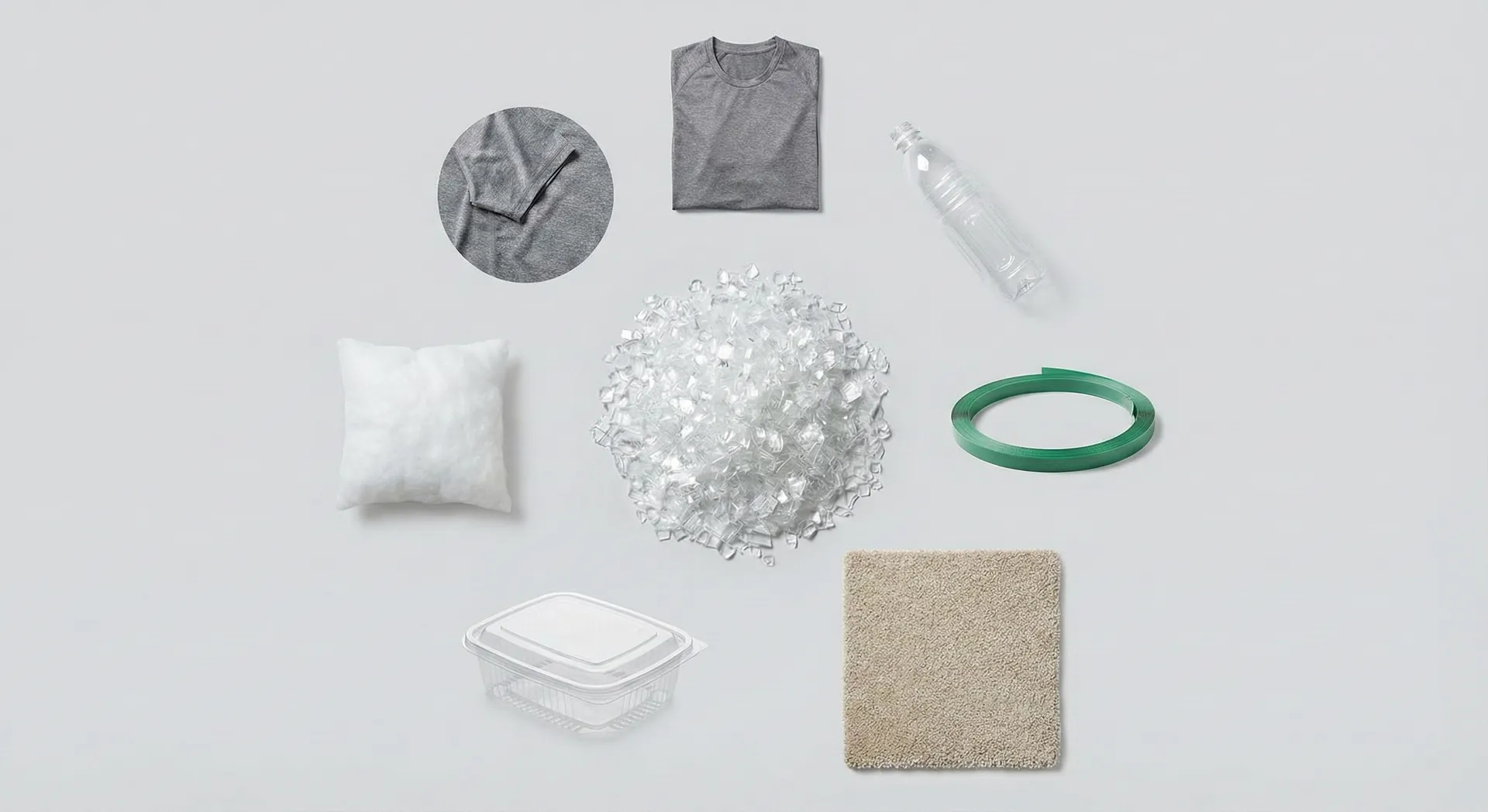
What Are PET Flakes Used For? Applications and Quality Requirements
PET flakes are an intermediate material made by sorting, granulating, washing and drying PET containers or other defined PET feed. They can become fibre, sheet, strapping, bottles and selected moulded products, but not every flake grade is suitable for every application. Colour, polymer contamination, moisture, intrinsic viscosity, fines and regulatory status determine the practical outlet.
PET flake applications at a glance
| Application | Typical form used by converter | Important quality questions |
|---|---|---|
| Polyester staple fibre and filament | Washed flake or pellets, depending on process | Colour, filterable contamination, moisture, IV and spinning performance |
| Thermoforming sheet | Flake, pellets or a blend | Colour, black specks, gels, moisture, IV and sheet appearance |
| PET strapping | Qualified flake or pellets | Molecular weight, contamination, consistency, tensile and elongation performance |
| Bottle-to-bottle | Qualified rPET flake or pellets from a compliant process | Input source, decontamination, traceability, food-contact rules and bottle performance |
| Non-food containers and moulded parts | Flake or compounded pellets | Processability, colour, mechanical properties and application limits |
The Association of Plastic Recyclers’ Applications Guidance Protocol for Recycled PET addresses bottle, sheet, strapping and fibre applications and demonstrates why end-use testing matters.
1. Polyester fibre
Recycled PET can be melt-spun into staple fibre or filament for textiles, carpets, nonwovens, insulation and filling. The converter may feed washed flake directly or use pelletised material according to its drying, extrusion and filtration system.
Fibre is not a universal outlet for contaminated PET. PVC, paper, metals, polyolefins and excessive fines can block filters, break filaments or affect colour and mechanical performance. The buyer should state the allowable contaminants and the required spinning or filtration trial.
2. Thermoforming sheet
PET flake or pellets can be extruded into sheet for trays, clamshells and other formed products. Clear applications place tight controls on colour, haze, black specks and incompatible polymer. Moisture and thermal history influence extrusion stability.
Food-contact sheet requires the applicable regulatory pathway; a visually clear washed flake is not automatically food-contact compliant. Non-food sheet also needs application testing for thickness, impact and forming.
3. PET strapping
Strapping uses PET’s strength and orientation potential for unit-load packaging. Feed consistency, molecular weight and contamination influence extrusion, drawing, tensile strength, elongation and weld behaviour.
A buyer may require solid-state polymerisation or another conditioning route before strapping production. Qualify actual output in the intended strap process rather than relying on colour or flake cleanliness alone.
4. Bottle-to-bottle rPET
Bottle-to-bottle recycling uses a controlled collection and recycling pathway to produce material suitable for new bottles. Sorting, washing and flake quality are necessary, but food-contact suitability also depends on feed-source control, decontamination, traceability and the requirements of the destination market.
The European Commission explains the EU framework on its plastic recycling for food-contact materials page. In the United States, the FDA publishes guidance and information on recycled plastics in food packaging. Requirements differ by jurisdiction and process.
5. Non-food packaging and moulded products
Qualified rPET can be used in non-food containers, industrial packaging and some moulded or compounded applications. These uses may accept different colour or regulatory status, but they still need mechanical and process requirements.
PET is not a simple drop-in substitute for every injection-moulded polymer. Drying, crystallinity, mould design, impact requirement and material history must be evaluated by the product manufacturer.
What “PET flake grade” should mean
Terms such as cold-washed, hot-washed, super-clean, fibre-grade and bottle-grade are not complete specifications. Two suppliers can use the same grade name for different material. Replace labels with measurable limits.
| Property | Why it matters | How to specify |
|---|---|---|
| PET polymer content | Controls incompatible resin entering the melt | Named test method and contaminant categories |
| PVC and other dense plastics | May remain with PET after water separation and degrade in processing | Application-specific limit and detection method |
| PE/PP, labels and paper | Can affect filters, appearance and downstream yield | Mass or particle-count limit with sampling procedure |
| Colour | Determines clear, light-blue, green or mixed-colour outlets | Colour fractions and instrumental values where needed |
| Moisture | Affects storage and melt processing | Limit, sample conditioning and test method |
| Intrinsic viscosity | Relates to molecular weight and processing/application performance | Method, conditioning and acceptable range |
| Fines and particle size | Influence conveying, drying, loss and melting | Sieve distribution, not one nominal size |
| Metal, ash and black specks | Affect appearance, wear and product performance | Defined analytical or visual inspection method |
How flake colour changes the outlet
Clear and light-blue bottle flake generally has more potential for clear applications than green or mixed-colour material, but colour alone does not determine grade. A clear stream with PVC or adhesive contamination can be less useful than a consistent coloured stream that meets a buyer’s process limits.
Sort colours before granulation where possible. Once flakes are mixed, restoring a narrow colour specification becomes more difficult and can reduce recovery.
Why PVC control matters
PET and PVC commonly sink in water, so a sink-float tank does not reliably separate them. PVC can degrade at PET processing conditions and affect colour and properties. Bottle sorting, validated sensor sorting and flake testing are therefore important.
Read the separate guide on PVC contamination in PET recycling for process-specific controls.
Typical route from bottles to flakes
- inspect, open bales and meter bottles;
- sort by polymer, colour and accepted container type;
- remove labels and metals as required;
- granulate to a controlled particle-size distribution;
- prewash, hot wash and/or friction wash for defined contamination;
- use density separation for appropriate float and sink fractions;
- rinse and control the water loop;
- mechanically dewater and thermally dry to the agreed flake specification;
- perform final sorting, laboratory testing and lot-controlled storage.
The PET bottle recycling system should be designed from the final use backward.
How the end use changes equipment selection
A fibre buyer may prioritise filterable contamination and colour. A clear sheet producer may place tighter limits on black specks and haze. Bottle-to-bottle applications add feed-source, decontamination and regulatory controls. Strapping needs consistent molecular and mechanical performance.
Therefore, equipment capacity should be measured at saleable flake quality. More washing or sorting can improve one property while reducing recovery, so track dry mass balance and all critical specifications.
Frequently asked questions
Can PET flakes be used directly to make new bottles?
Only through a qualified recycling and conversion pathway that meets the bottle and, where relevant, food-contact requirements. Washed flake alone is not automatic approval.
Are hot-washed PET flakes always better than cold-washed flakes?
No. Hot washing may remove defined adhesives or residues, but grade depends on the complete specification, process control and buyer’s application.
Which PET flake quality has the highest value?
The grade with a reliable buyer and verified compliance with that buyer’s specification has the relevant value. Public labels or spot prices cannot replace lot testing and commercial terms.
Start with a buyer specification
Send Energycle representative bottles and the intended fibre, sheet, strapping or bottle specification. The washing line, sorting stages and acceptance test can then be configured around the PET flake application.
