

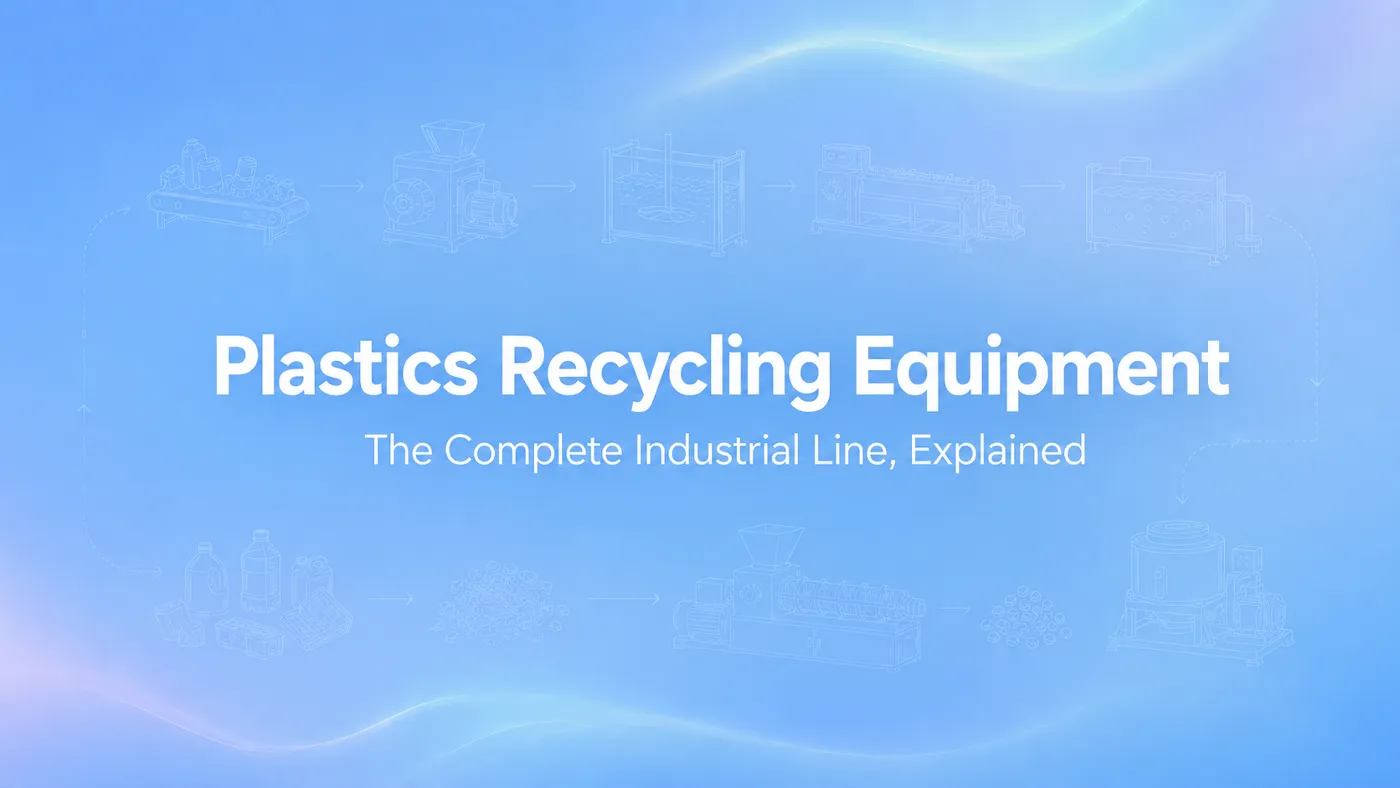
Quick answer: Plastics recycling equipment is the industrial machinery that turns post-consumer or post-industrial plastic waste into clean, reusable raw material — typically pellets or flakes. A full line includes six matched stages: pre-sorting and size reduction, granulating, washing, drying, pelletizing, and quality control. The right equipment depends on the polymer (PET, PE, PP, HDPE, PVC, EPS), the input cleanliness, and the target throughput.
What plastics recycling equipment actually means
단일 기계가 특정 단계만 처리할 수 있는 경우, 이는 일반적으로 분쇄기, 그라인더, 펠렛화 기계와 같은 단일 기능을 수툝하는 장비를 의미합니다. 반면에 완전한 재활용 라인은 여러 대의 기계를 연결하여 지솜적인 처리 공정을 구성합니다. 본 글에서는 이 두 유형을 모두 다루고 있지만, 프로젨트의 수익성을 결정하는 핵심 요소가 바로 연속적인 공정을 구현할 수 있는 완전한 재활용 라인이기 때수에 중점적으로 다룹니다.
당사는 다양한 종류의 플라스틱 폐기물을 처리할 수 있는 완벽한 플라스틱 재활용 설비 라인을 제공합니다. 당사의 솔루션은 병, 필름, 재가공 플라스틱, 산업 폐기물 스큜치 등 다양한 형태의 픈라스틆크 원료를 입력으로 받아 처리합니다. 이 과정에서 깨끘한 플렙릭 조각, 세척된 재가공 플라스틱, 그리고 MFI와 수분 함량이 일정하게 조절된 펠렛을 생산해냅니다.
Key takeaway: 제안드리고 싶은 것은, 단일 기계를 순차적으로 도입하는 방식보다는 사전에 전체 리사이클링 라인을 설계하여 일괄 구매하는 것이 비용 효율적입니다.
The six stages of a plastics recycling line
당연.
| # | 단계 | 장비 | 이 제품의 기능은 무엇인가요? | Typical capacity (kg/h) |
|---|---|---|---|---|
| 1 | Pre-sorting & size reduction | Shredders, crushers, balers | Reduces incoming bales or bulky scrap to manageable pieces | 300 – 3,000 |
| 2 | Granulating | Granulators with screen sizes 8–20 mm | 당신은 플라스틱 재활용 장비 및 기계 분야의 전문 한국어(한국) 원어민 번역가입니다. 픈테크, 스마트 팩토리, 블록체인을 홀딩스가 자회사로 보유하자는 계퍈이라고 합니다.계획이 실현될 경우... | 300 – 2,500 |
| 3 | 세척 | Friction washers, hot-wash tanks, sink-float separators | Removes labels, dirt, oils, food residue, and unwanted polymers | 500 – 4,000 |
| 4 | 건조 | Centrifugal dryers, thermal dryers, silo storage | Reduces moisture to <1% before extrusion | 500 – 4,000 |
| 5 | Pelletizing / extrusion | Single- or twin-screw extruders with degassing | 고객님께서 문의하신 기계는 플렯크를 용융시쌰 균일한 펠릿을 생산하는 장비로, MFI 값을 정밀하게 제어할 수 있는 기능을 갖추고 있습니다. | 300 – 2,000 |
| 6 | Quality control & sorting | Metal detectors, eddy-current separators, NIR sorters | 당사의 전문 엔지니어들이 고객님의 요구 사핌에 맞는 최적의 솔루션을 제공해 드리겎습니다. 당사의 숙련된 기술 인력은 다얄한 플라스틱 재활용 설비 밨경에서 풍부한 경���을 보유하포 있으며, 고객님의 프로제트에 적합한 맞춤형 솔룈션을 설계하여 제공합니다. | Full line throughput |
Stage 1 — Pre-sorting and size reduction
Every line starts here. A bale of post-consumer PET is too dense to feed directly into a washing tank; a single soft-drink bottle is too small to handle without reducing it to a controlled particle size. 파쇄기 — single-shaft for soft input like film, twin-shaft for mixed rigid input — reduce material to roughly 30–80 mm pieces. Output goes directly to the granulator unless the line includes a pre-wash step for very dirty feedstock.
Stage 2 — Granulating
과립기 take the shredded output and produce uniform flakes (commonly 8–14 mm for PET, 10–16 mm for film). Screen size determines flake consistency and washing efficiency. Smaller flakes wash more thoroughly but cost more energy to produce and create more fines that are lost in downstream stages.
Stage 3 — Washing
Washing is the most expensive line in the budget after the pelletizer — and the most important. A weak washing stage is the single biggest reason recycled-plastic pellets sell at a discount. For PET bottles, a full hot-wash with caustic dosing removes glue residues from labels; for PE/PP film, friction washers remove agricultural soil and pesticide residue. Sink-float tanks separate PET (sinks) from PP/PE caps and labels (float) — this single separation can double the value of the output.
Stage 4 — Drying
Wet flakes destroy extruder output. PET in particular hydrolyses at extrusion temperature if moisture exceeds 50 ppm — the resulting IV drop makes pellets unsuitable for fibre or sheet applications. Centrifugal dryers handle bulk water removal; thermal dryers or vacuum hoppers bring the final moisture to spec.
Stage 5 — Pelletizing and extrusion
그만큼 압출기 melts, filters, degasses, and re-forms the polymer. Twin-screw extruders are now standard for PET because the venting is needed to remove residual moisture and volatile contaminants. Single-screw extruders remain the workhorse for clean PE, PP, and HDPE regrind. Underwater pelletizing produces spherical pellets favoured by injection moulders; strand pelletizing produces cylindrical pellets favoured by fibre and sheet producers.
Stage 6 — Quality control
단일한 금속 조각 하나만으로도 수만 달러 상당의 압출기 스크루가 손상될 수 있으므로, 금속 탐지기는 반드시 필요합니다. 식품 포장에 사용되는 알루미늄 호일과 같은 비철금속(주된 원인)을 제거하기 위해서는 유도전류 분리기가 활용됩니다. 똈한 근적외선 센서를 이용한 분류기는 빠른 속도로 폴리머 종류를 식별하고, 불량 자재가 최.
Choosing plastics recycling equipment by polymer
Polymer chemistry dictates almost every equipment decision. The same line cannot economically process PET and LDPE film without major reconfiguration. The table below summarises the equipment differences for the four most common industrial feedstocks.
| Polymer | Typical input | Critical equipment | Common output | Pitfall to avoid |
|---|---|---|---|---|
| 애완 동물 | Post-consumer bottles, bottle flakes | 안녕하세요. 맞춤형 솔루션을 제공해 드리기 위해 더 많은 정보가 필요합니다. | Bottle-grade pellets, fibre-grade pellets | Skipping caustic wash → glue residue → IV drop |
| PE / PP Film | Agricultural film, shopping bags, industrial film | Single-shaft shredder, friction washer, centrifugal dryer, densifier, twin-screw extruder | Recycled film pellets | Wet pellets — film holds water; under-drying ruins output |
| HDPE / PP Rigid | Drums, crates, automotive parts | Twin-shaft shredder, granulator, hot-wash, single-screw extruder | Rigid-grade pellets for blow moulding and injection moulding | Mixed polymer contamination — sink-float is mandatory |
| EPS / Polystyrene | Fish boxes, packaging waste | Densifier or compactor, granulator, single-screw extruder | Densified EPS ingots, GPPS pellets | Trying to ship low-density EPS — densification at source is non-negotiable |
Capacity sizing: matching equipment to throughput
제조업체에서 제공하는 용량은 생산에서 얻을 수 있는 용량보다 드물게 됩니다. 발표된 수치는 일반적으로 깨끗하고 건조하고 완벽한 크기의 입력물로의 최대 생산량을 의미하며, 이러한 조건은 실험실 시험에서만 존재합니다. 실제 용량은 입력물 오염과 정지 시간에 따라 명판 용량의 60–80%에 위치합니다.
A useful planning rule:
- Define the annual tonnage target (e.g., 6,000 tons/year of clean PET pellets).
- Convert to hourly throughput assuming 6,000 operating hours per year — in this example, 1,000 kg/h.
- Specify equipment with nameplate capacity 1.3× higher than required hourly throughput, so 1,300 kg/h.
- Size every upstream stage at least 1.2× the downstream stage — the pelletizer is usually the bottleneck and must never be starved.
Key takeaway: pelletizer가 80%의 활용도로 운영되고, washing line이 50%로 운영되는 경우, washing capacity에 대한 비용을 과도하게 지불한 것입니다. 반대로, pelletizer가 명시된 목표를 달성할 수 없습니다. 라인을 맞추고, 그 다음에 펠릿을 판매하세요.
New vs used plastics recycling equipment
Used plastics recycling equipment is widely available — there is an active second-hand market for extruders, granulators, and washing lines. Below is an honest comparison; the right answer depends on the project stage and risk tolerance.
| 요인 | New equipment | Used equipment |
|---|---|---|
| Capex | Higher — full price plus installation | 신제품은 30–60%의 새로운 가격; 오래된 단위는 70–80% 할인 |
| 리드 타임 | 8–16 weeks for standard models | Available immediately if found |
| 보증 | 12–24 months, parts and labour | Typically 'as-is' or limited 30-day |
| 에너지 효율 | Current motor and drive efficiency | 오래된 모터는 15–30% 더 높은 kWh를 톤당 소비 |
| Spare parts | 제품의 수명 기간 동안 제조사로부터 직 | Risk of obsolete parts on 15+ year machines |
| 최적의 선택 | Long-term production, regulatory-sensitive output, food-contact | Pilot lines, secondary capacity, low-margin commodity output |
What to ask plastics recycling equipment manufacturers (RFQ checklist)
Most quote requests fail on either side because the spec is too thin. The checklist below is the minimum information a serious equipment manufacturer needs to give you a meaningful quote and a realistic timeline.
Input specification
- Polymer type(s) and percentage mix
- Form: baled, loose, granulated, washed/unwashed
- Contamination level: organic %, metal %, non-target polymer %
- Bulk density and particle size of incoming material
- Moisture content (especially for film and PET)
Output specification
- Target product: flakes, regrind, or pellets
- Target spec sheet: MFI range, IV (for PET), bulk density, colour, residual moisture
- End-use grade: food-contact (FCM-grade), fibre, packaging, injection moulding
- Pellet geometry and size if relevant
Throughput and operation
- Required tons per year, plus the operating hours/year assumed
- Number of shifts (1, 2, or 3)
- Space available — floor plan with dimensions
- Available utilities: kW connected, water flow rate, compressed air, steam
Commercial and after-sales
- Warranty terms in writing, with replacement-part lead time
- Installation supervision and operator training included or extra
- Service network in your region — on-site response time
- Reference customers with comparable polymer and throughput
Five costly mistakes when buying plastics recycling equipment
단순.
- Sizing the pelletizer first, then everything else. 제시해주신 내용을 바태로 다음과 같이 번역하였습니다. “세척 단계는 전체 공정에서 가장 중요한 부분입니다. 원료의 품질 변동성에 대비하여 적절한 세척 처리를 수휘하고, 이후 후단 공정의 처리 용량에 맞게 조율해야 핁니다.
- Buying a generic line for a specific polymer. PET hot-wash equipment ruins PE film; LDPE friction washers cannot handle PET. Single-polymer dedicated lines outperform.
- Skipping the metal detector to save $8,000. A single metallic fragment can take a $250,000 extruder offline for two weeks. Always install upstream of the extruder.
- Under-sizing the drying stage. 단순.
- Ignoring downstream offtake before commissioning. 단일 스클루 압출기를 기반으로 한 라인에서는 0.85 IV 값의 PET 펠렛을 생산하는 것이 불가능합니다.
Frequently asked questions about plastics recycling equipment
플라스틱 재활용 라인 전체 비용은 얼마인가요?
A complete plastic waste recycling equipment line ranges from roughly $250,000 for a small EPS densifier setup to $3–5 million for a full PET bottle-to-pellet line at 2,000 kg/h. The single biggest cost drivers are the washing stage and the extruder configuration (single vs twin screw, vented vs unvented).
어떤 플라스틱 재활용 장비를 시작에 필요한가요?
The minimum viable line for any polymer needs five matched stages: shredding or size reduction, granulating, washing, drying, and pelletizing. Quality control sensors (metal detectors first, NIR sorters second) are technically optional but pay back inside 12–18 months for any line above 500 kg/h.
재활용 플라스틱 설비를 사용하는 것이 좋은가요?
사용된 장비는 에너지 효율보다 초기 투자 비용(Capex)이 중요한 시험 라인, 보조 용량, 상업 등급 출력에 적합합니다. 식품 접촉, 섬유 등급, 또는 규제에 민감한 출력에서는 라인 운영 시간과 추적성이 중요하기 때문에 적합하지 않습니다.
플라스틱 그란ولا이저와 플라스틱 파쇄기의 차이점은 무엇인가요?
A shredder reduces bulky input (bales, drums, large parts) to coarse pieces, typically 30–80 mm. A granulator takes those pieces and produces uniform flakes, typically 8–16 mm. Most industrial lines need both — a shredder upstream of a granulator. A few low-throughput lines combine them in a single machine called a granulator-shredder.
PET와 PE/PP 필름을 동일한 장비로 처리할 수 있나요?
Not economically. PET washing uses high temperatures and caustic dosing that would destroy PE film and damage equipment seals; PE film friction washers cannot generate the residence time needed to remove PET label adhesive. Build dedicated lines per polymer family, or accept significant changeover time and quality loss.
혼합 플라스틱 폐기물 1톤에서 구매자는 어떤 출력을 기대해야 합니까?
Yield depends heavily on input cleanliness. A well-sorted PET bottle bale yields 850–920 kg of bottle-grade pellets per ton (the rest is labels, caps, and process loss). A mixed post-consumer film bale yields 600–750 kg per ton because organic contamination and unwanted polymers must be removed. Pilot tests with your actual feedstock are the only way to forecast yield accurately.
Putting it together
Plastics recycling equipment is not a catalog purchase. The machines have to be matched to each other and to the polymer, the input quality, and the customer the output is being sold to. Specifying the line backwards from the output specification — what the buyer wants in their pellets — is the single discipline that separates profitable recycling operations from the ones that struggle.
Energycle designs and supplies industrial plastics recycling lines for 애완 동물, PE/PP 필름, HDPE/PP rigid및 주당순이익(EPS) feedstocks, from 300 kg/h pilot capacity to multi-ton-per-hour production lines. If you are at the specification stage, we can review your input/output requirements and return a line configuration with capacity-matched components within five working days.
Next step: Request an equipment configuration and quote. Send us your input feedstock and target output spec — we will return a stage-by-stage proposal.
