

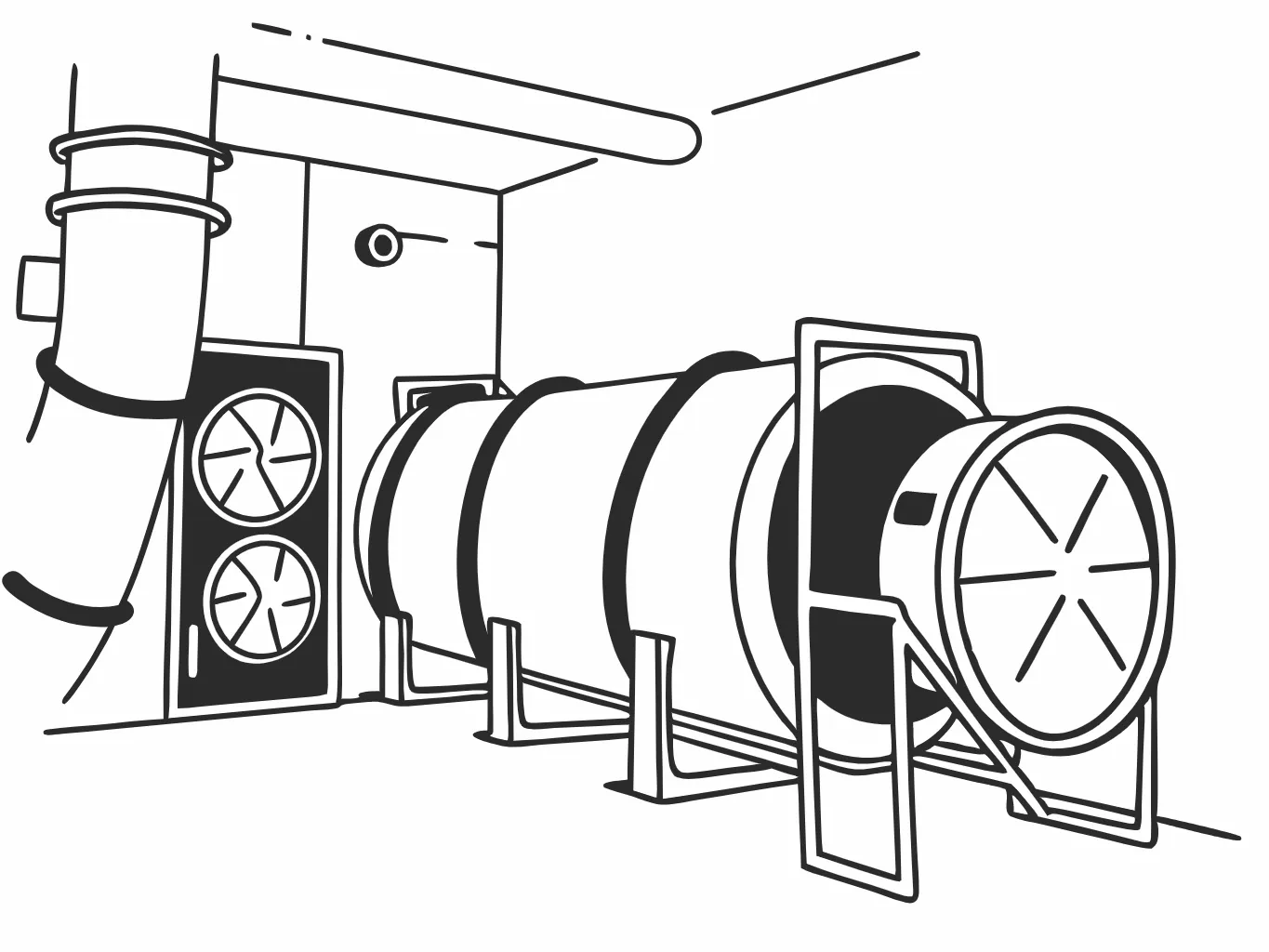
Drying is one of the biggest operating costs in a plastic recycling line. The choice is not “centrifugal dryer vs hot air” — and it does not matter whether your supplier calls the machine a centrifugal dryer, an industrial centrifugal dryer, a plastic dryer, or a centrifugal dewatering machine (they are the same equipment). What matters is how far you need to push moisture down before your next step (bagging, extrusion, pelletizing) — and the energy cost of getting there.
This guide explains how energy input differs between mechanical dewatering (spinning off bulk water) and thermal air drying (evaporating water), plus a simple way to estimate energy by the amount of water you remove.
Quick Takeaways
- Use mechanical dewatering first; thermal drying is what gets expensive because you must evaporate water.
- “Dry enough” depends on the polymer and your next process step; don’t over-dry unless the spec demands it.
- Track moisture at discharge and kWh/ton; the best dryer setup is the one that hits spec with stable throughput.
Centrifugal Dryer vs. Centrifugal Dewatering Machine vs. Plastic Dryer: Same Equipment, Different Names
If you are sourcing equipment, you will see this machine sold under several names. They all describe the same hardware — a high-speed rotor inside a perforated screen drum, driven by a 37–90 kW motor — and the selection criteria are identical regardless of the label.
| Term | Most Common Context | What It Emphasizes |
|---|---|---|
| Centrifugal dryer | Plastic recycling industry, technical literature | Outcome (moisture reduction) — the most common name in equipment specs |
| Centrifugal dewatering machine | Equipment buyers, line designers, washing-line OEMs | Mechanism (water removal by centrifugal force) |
| Industrial centrifugal dryer | Heavy-duty applications, B2B procurement | Industrial scale (vs. laboratory or compact units) |
| Plastic dryer / plastic dryer machine | General market searches, retail commerce | Application (used for plastic), broad term covering both centrifugal and thermal types |
| Plastic dewatering machine | Recycling plants emphasizing the dewatering function | Process step (bulk water removal before final drying) |
| Spin dryer | Casual / retail terminology | Action (spinning at high RPM) |
| Vertical / horizontal centrifugal dewatering machine | Specifying machine orientation for line layout | Form factor (vertical for compact lines, horizontal for higher capacity) |
The rest of this guide uses centrifugal dryer as the umbrella term, but every selection rule and energy estimate applies identically whether your project is labeled “industrial centrifugal dryer,” “plastic dryer machine,” or “centrifugal dewatering machine.”
Related Energycle references: – Centrifugal dryer for recycling applications – How centrifugal dryers work (clear guide) – Ultimate guide to thermal drying machines in plastic recycling
The Physics of Dewatering
- Mechanical Drying: Relies on kinetic energy (centrifugal force) to physically separate surface water from plastic flakes. This is highly efficient for removing bulk water but cannot remove surface moisture bound at a molecular level.
- Thermal (Hot-Air) Drying: Uses heat + airflow to evaporate water. This is necessary for final polishing but requires significantly more energy to undergo the phase change from liquid to gas.
Note on wording: “air drying” can mean ambient drying (no added heat) or hot-air drying (heated air). In recycling lines, the “final polish” stage is usually heated-air drying because ambient air rarely reaches low, stable moisture at industrial throughputs.
Mechanical Centrifugal Dryers: High Impact, Low Cost
Located immediately after the washing line, the industrial centrifugal dryer (also called a centrifugal dewatering machine or simply a plastic dryer in many recycling plants) is the “heavy lifter” of the drying stage.
Operational Principle
Wet flakes enter a calibrated rotor spinning at high RPM (typically 1200-1500 RPM). The material is accelerated against a perforated screen. Water passes through the screen, while dry flakes travel upward to the discharge.
Energy Profile
- Primary Input: AC Motor — typically 37–55 kW for a small plastic dryer machine (400–800 kg/h), 55–90 kW for a 1-ton/hr industrial centrifugal dryer.
- Efficiency: A mechanical dryer can reduce moisture from 30% down to approximately 2-3%.
- Why it saves energy: To remove water by evaporation, you must supply latent heat. Spinning removes water without paying that “phase-change” energy cost.
Benefits: * Instantaneous moisture reduction. * Small physical footprint. * Removes contaminants (fines/paper) along with water.
Thermal Hot-Air Drying: The Final Polish
Often called “hot air flash drying” or “spiral drying,” this stage typically follows mechanical drying to achieve final product specs.
Operational Principle
Pre-dried flakes are transported through a long, insulated pipe system using high-velocity hot air. The air is heated via electrical resistors, gas burners, or steam heat exchangers.
Energy Profile
- Primary Inputs: Blower Motor (transport) + Heating Elements (evaporation).
- Efficiency: Reduces moisture from ~3% down to <0.5%.
- Why it costs more: Evaporating water requires latent heat. At 100°C, water’s enthalpy of vaporization is about 2,257 kJ/kg (value varies with temperature).
Benefits: * Achieves very low final moisture levels fit for extrusion. * Gentle handling (no mechanical wear on flakes).
Where Ambient Air Drying Fits (and Where It Doesn’t)
Ambient air drying can look “cheap” on paper (no heaters), but it is usually limited by: – Long drying times and large floor area – Weather/season variation (unstable final moisture) – Dust/contamination risk while material is exposed
In practice, ambient air drying may be acceptable for temporary draining or non-critical storage, but it rarely replaces mechanical + thermal stages when you need repeatable moisture for extrusion.
Strategic Combination for Efficiency
Relying solely on thermal drying is economically disastrous; relying solely on mechanical drying is insufficient for high-quality extrusion.
The “Hybrid” Approach: The most energy-efficient recycling lines use a multi-stage approach: 1. Stage 1 – Mechanical: Two centrifugal dewatering machines (or one industrial centrifugal dryer with a larger motor) in series. The first removes 80% of water; the second gets it down to roughly 2-3%. 2. Stage 2 – Thermal: A final hot air spiral pipe system typically requires only a small temperature delta (e.g., 60-80°C) to flash off the remaining surface moisture.
What Moisture Target Do You Actually Need?
Use these as practical starting points; your buyer spec and polymer behavior are the final authority.
| Downstream step | Typical moisture target | Why it matters |
|---|---|---|
| Bagging / storage of washed flakes | ~2% to 5% | Prevents dripping and reduces clumping; usually achievable with good dewatering |
| Extrusion / pelletizing (general) | Often <1% (commonly <0.5%) | Reduces steam/bubbles, pressure instability, and surface defects |
| High-sensitivity products (case-dependent) | Lower targets may be required | Some polymers and end uses demand tighter moisture control and additional drying steps |
Energy Cost Comparison (Simple, Directional Example)
Assume you process 1,000 kg/h of dry plastic.
| System Type | What it does | Main energy driver | Directional takeaway |
|---|---|---|---|
| Mechanical Only | Removes bulk water after washing | Motor power (kW) and load | Low-cost drying, but may not hit extrusion-grade moisture |
| Thermal Only | Evaporates most water without dewatering | Latent heat of vaporization + blower power | Very high energy if you try to evaporate “bulk” water |
| Optimized Hybrid | Dewater first, then evaporate the last fraction | Small thermal load after dewatering | Best balance of spec, stability, and operating cost |
A Simple Energy Estimate (Use for Back-of-the-Envelope Planning)
If your line needs to evaporate W kg of water per hour, the theoretical minimum heat input (not including losses) is:
Energy (kWh/h) ≈ (W × 2,257 kJ/kg) ÷ 3,600
That means evaporating 1 kg of water is about 0.63 kWh at the theoretical minimum. Real systems use more (heat losses, exhaust air, imperfect heat transfer). For planning, many plants assume a multiplier (often ~1.5× to 3×) depending on dryer type and heat recovery.
Example (directional): If material after a centrifugal dryer is ~3% moisture and you need ~0.5% for extrusion, the remaining water to remove might be on the order of ~25–30 kg/h per 1,000 kg/h of dry plastic, which already implies ~16–19 kWh/h theoretical heat before losses and blower power.
Why “thermal only” gets expensive fast: If washed material enters drying at ~30% moisture and you still need ~0.5%, you may be evaporating hundreds of kg/h of water per 1,000 kg/h of dry plastic—directionally 250+ kWh/h theoretical heat before losses.
Common Reasons Plants Spend Too Much on Drying
- Skipping dewatering: Sending “dripping” flakes into hot air drying forces the heater to do work a centrifuge should do.
- No moisture measurement: Operators adjust by feel, which usually means over-drying (wasted energy) or under-drying (quality failures).
- Screen and airflow neglect: A blinded screen or restricted exhaust reduces dewatering performance and makes the thermal stage work harder.
Special Case: Film Lines (Squeezer vs Centrifugal)
If you are drying washed film, mechanical dewatering often uses a squeezer (rather than only a centrifugal dryer) to remove water and densify film before thermal polishing. For a reference point, see Energycle’s plastic dewatering drying centrifugal thermal squeezer and plastic film squeezer technology.
Conclusion
Mechanical dryers remove bulk water efficiently; thermal drying is the finishing step when the product spec requires it. If you size and operate the mechanical stage correctly, you can usually shrink the thermal load and stabilize final moisture.
Frequently Asked Questions
What is a centrifugal dryer and how does it work?
A centrifugal dryer is a mechanical dewatering machine that spins wet plastic flakes at 1,200–1,500 RPM inside a perforated drum. Centrifugal force pushes water through the screen holes while the flakes stay inside and travel to the discharge. It typically reduces moisture from 30% to 2–3% using only motor power — no heat required.
Is a centrifugal dryer better than a thermal dryer?
They serve different roles. A centrifugal dryer removes bulk water efficiently (low energy cost), but cannot reach sub-1% moisture. A thermal dryer evaporates remaining moisture to reach extrusion-grade specs (<0.5%). The most cost-effective approach combines both: centrifugal first, then thermal to finish.
How much energy does a centrifugal dryer use?
A centrifugal dryer for a 1 ton/hour recycling line typically uses a 45–90 kW motor. The energy cost per ton of plastic is much lower than thermal drying because no latent heat of evaporation is required — water is removed mechanically.
Can a centrifugal dryer handle plastic film?
Standard centrifugal dryers work well for rigid flakes (PET, HDPE, PP). For film, a squeezer-type dewatering machine is usually preferred because it simultaneously removes water and densifies the film. Some lines use a squeezer followed by a centrifugal dryer for maximum water removal.
What moisture level can a centrifugal dryer achieve?
Most centrifugal dryers reduce moisture to 2–3% in a single pass. Running two centrifugal dryers in series can push moisture closer to 1–2%. For sub-0.5% moisture required by pelletizing, a thermal drying stage is needed after centrifugal dewatering.
Is an industrial centrifugal dryer the same as a plastic dryer?
For plastic recycling, yes. “Industrial centrifugal dryer,” “plastic dryer,” “plastic dryer machine,” “centrifugal dewatering machine,” and “spin dryer” all describe the same hardware in different terminology. The mechanical principle (high-speed rotor + perforated screen) and selection rules (motor sizing, screen specification, throughput) are identical. Where the terms differ is emphasis: industrial centrifugal dryer signals heavy-duty B2B; plastic dryer is a generic market term; centrifugal dewatering machine emphasizes the water-removal mechanism. For a sourcing decision, look at motor power, rotor diameter, screen specification, and throughput — not the marketing name.
What does a centrifugal dewatering machine cost compared to thermal drying?
A 1 ton/hour centrifugal dewatering machine typically costs $12,000–$25,000 USD with a 45–55 kW motor — a one-time capital expense. Thermal dryer capital cost is similar, but operating cost is dominated by energy. Evaporating 1 kg of water requires ~0.63 kWh of theoretical heat (real systems use 1.5–3× more); a thermal-only line evaporating 250 kg of water per ton of plastic burns 250+ kWh per ton. A centrifugal dewatering machine doing the same bulk-water removal uses 45–55 kWh per ton — roughly a 5× operating-cost difference at the bulk-water stage. This is why every viable rigid plastic recycling line uses centrifugal dewatering before thermal drying.
Vertical or horizontal centrifugal dewatering machine — which should I choose?
Vertical centrifugal dewatering machines are more compact, easier to clean, and typically suit 400–800 kg/h capacities — a good fit for limited floor space and small-to-mid recycling lines. Horizontal machines have a horizontal rotor with paddles that convey material along the screen, achieving more uniform dewatering and higher capacities (1,000–3,000+ kg/h). For most rigid plastic recycling lines above 1 ton/h, horizontal designs are the standard. Below 800 kg/h, vertical units are common and cost-effective.
