

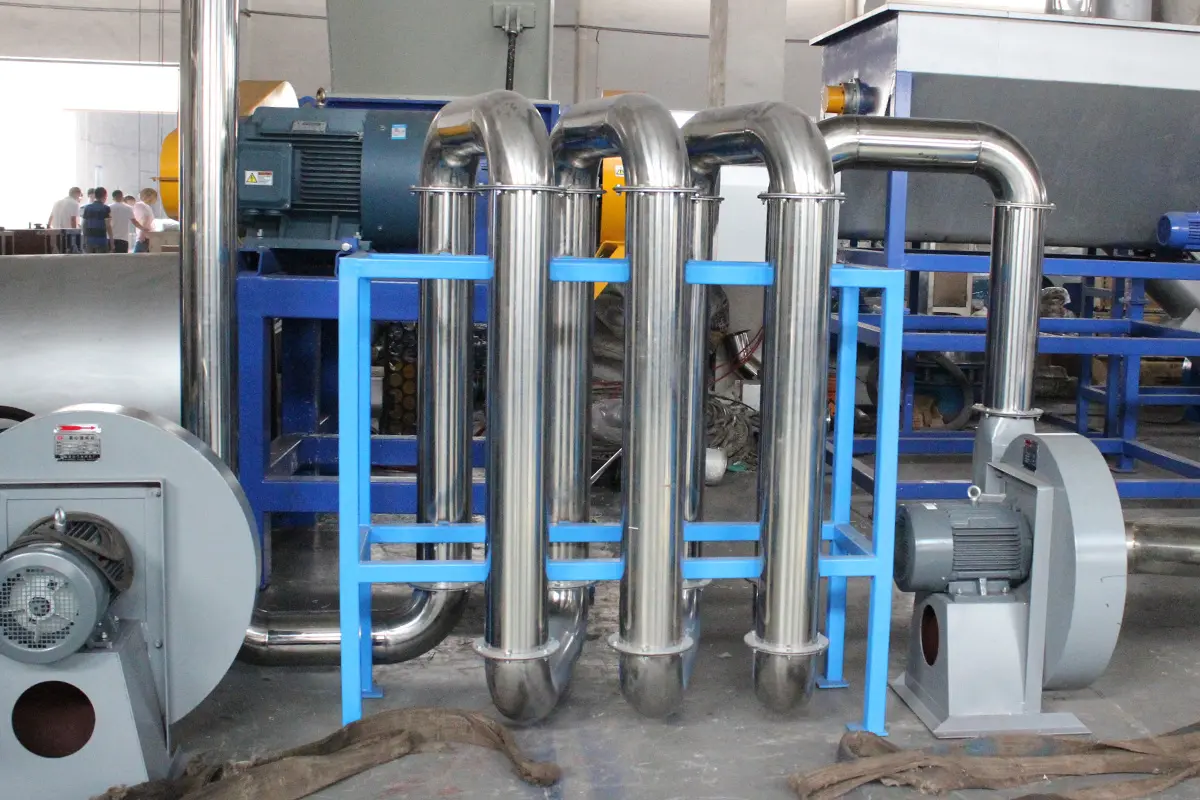
A thermal drying machine in a plastic washing line uses heated air to remove moisture that remains after mechanical dewatering. It should be selected from the polymer form, incoming moisture, required final moisture, ambient air condition and saleable throughput. A generic claim such as “below 3%” is incomplete unless the feed, sampling point and test method are defined.
Thermal drying is the second drying step
Mechanical equipment should remove free water before heat is added. A centrifugal dryer is commonly used for rigid flakes, while a screw press or film squeezer can suit flexible material. Thermal air then removes the remaining surface moisture that cannot be economically separated by mechanical force.
Sending unnecessarily wet material into a hot-air system increases evaporation load, air volume and energy use. Diagnose mechanical dewatering, drainage and carry-over before increasing heater output.
Surface drying versus resin pre-drying
A washing-line thermal dryer is not automatically a substitute for a desiccant resin dryer at an extruder. Polyolefin flakes often need surface-water removal. Hygroscopic polymers such as PET can absorb moisture into the resin and may need controlled low-dew-point drying before melt processing according to the extruder and application specification.
Define the handoff: washed flake for storage or sale, or prepared feed entering an extrusion process. The moisture limit and sampling location should come from the downstream buyer or process owner.
How a pneumatic hot-air dryer works
- Metered feed: mechanically dewatered plastic enters at a stable rate.
- Heated air contact: a blower moves heated air through a duct where flakes or film are suspended and conveyed.
- Moisture transfer: heat supplies evaporation energy while airflow carries water vapour away.
- Residence: duct length, material velocity and recirculation determine contact time.
- Separation: a cyclone or separator removes dried plastic from the air stream.
- Exhaust or return: air is discharged or partly recirculated through an engineered filtration and humidity-control system.
The thermal dryer for plastic recycling illustrates this washing-line configuration.
Five variables control drying performance
| Variable | Effect | What to measure |
|---|---|---|
| Incoming moisture | Sets the water load that must be removed | Representative wet-basis moisture after mechanical dewatering |
| Air temperature | Changes heat transfer and evaporation potential | Supply and exhaust temperature under load |
| Air humidity | Determines the air’s capacity to accept more water | Ambient or process-air humidity and dew point where relevant |
| Airflow | Transports heat, vapour and material | Flow or pressure, filter condition and leaks |
| Residence and loading | Controls contact time and heat per unit mass | Dry feed rate, recirculation and material holdup |
A higher temperature cannot compensate safely for blocked airflow or unstable feed. Excess temperature can soften, deform, oxidise or discolour material and can create a fire or fume hazard.
Calculate the actual water-removal duty
Use wet-basis moisture consistently. If the wet feed rate is W, incoming moisture fraction is Min and target moisture is Mout, the water to remove is:
Water removal = W × (Min − Mout) ÷ (1 − Mout)
For example calculations, use measured values from representative production; do not substitute catalogue assumptions. Heater, blower, duct and separation capacity must all support the water load at the site’s ambient condition.
Choose equipment by material form
Rigid PET, HDPE or PP flakes convey differently from light LDPE film. Particle size, bulk density, fines, labels and temperature sensitivity influence pickup velocity, cyclone performance and residence.
- Rigid flakes: confirm cyclone separation, impact wear, fines and flake temperature.
- Film: prevent wrapping and duct accumulation; mechanical squeezing may reduce both moisture and bulk-volume problems.
- Mixed or filled plastic: test settling, abrasion and different heat response before specifying one condition.
Our plastic film squeezing machine is a mechanical alternative or preparation stage for washed flexible material.
Set a measurable final-moisture specification
Agree whether moisture is measured immediately after the dryer, after cooling, at silo discharge or at the extruder. Hot material can change during transport and storage, and exposed dry flake may regain moisture.
Define sample size, frequency, test instrument, conditioning and acceptance limit. Compare instruments against a reference laboratory method. A line should not be accepted from a single hand-held reading taken from the driest visible material.
Energy-efficiency priorities
- Maximise safe mechanical water removal first.
- Stabilise feed rate and avoid heating during long idle periods.
- Repair air leaks and keep filters, screens and cyclone discharge clear.
- Insulate appropriate hot surfaces and ductwork while preserving inspection access.
- Control temperature and airflow from measured moisture load.
- Evaluate heat or air recirculation only after considering humidity, contamination, filtration and fire safety.
Report total system electricity or fuel per accepted dry tonne. Heater efficiency alone can hide blower power, rejected product and upstream dewatering problems.
Common thermal dryer problems
| Symptom | Possible cause | Checks |
|---|---|---|
| Final moisture rises | Wetter feed, overloading, low heat, high humidity or air leak | Incoming moisture, dry rate, temperatures, airflow and seals |
| Material collects in duct | Insufficient velocity, wrapping, poor geometry or feed surge | Pressure trend, bends, feed form and metering |
| Excess fines in exhaust | Poor cyclone separation, damaged filter or unsuitable air velocity | Particle distribution, cyclone and collection equipment |
| Discoloured or deformed flake | High temperature, long residence or hot spots | Sensor accuracy, heater control and material holdup |
| High unit energy | Wet feed, leaks, idle operation, blocked filter or rejected output | Water duty, system energy and accepted output |
Safety and maintenance
Hot surfaces, heaters, rotating feeders, blowers and airlocks require guarding and energy isolation. Plastic fines and dust can be combustible. OSHA’s combustible-dust resources provide background, but the site needs a material- and process-specific hazard assessment.
Inspect filters, cyclone, rotary valve, duct joints, temperature sensors, heater controls, bearings, fan, insulation and collection points. Do not open a hot or pressurised path, clear a blockage or enter equipment until hazardous energy has been isolated and the system is safe.
Acceptance-test checklist
- representative polymer, particle form and incoming moisture;
- stable dry feed rate and agreed run duration;
- final moisture at the specified sampling point;
- product temperature, fines and visible degradation;
- complete-system energy and ambient condition;
- stoppages, material loss and accepted dry output;
- safety-function and alarm verification.
Frequently asked questions
Can a thermal dryer replace a centrifugal dryer?
Usually it should not replace economical mechanical removal of free water. Thermal drying is most effective after a centrifugal dryer, press or squeezer has reduced the evaporation load.
What final moisture should a plastic thermal dryer achieve?
The downstream process or buyer must define it for the polymer and test method. There is no universal moisture percentage for every flake and film application.
Why does final moisture change during the day?
Incoming moisture, feed rate, ambient humidity, airflow, filter condition, leaks and heater control can all change. Trend them with moisture results to identify the cause.
Specify water load, not only throughput
Send Energycle the polymer, particle-size range, wet feed rate, measured incoming and target moisture, ambient design condition and downstream process. Review the complete mechanical and thermal drying sequence before selecting heater and blower capacity.
